HTML Coding
Basic Tags
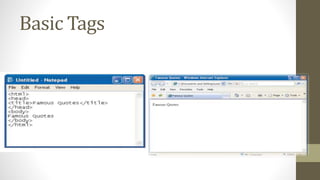
• You can create HTML files using the Notepad program.
• Start the Notepad program
• Type the given text
• Create a new folder and type a name, quotes
• Save the file in the quotes folder giving a name with the
extension .html, default.html
• Open this file in your Web browser by selecting File>Open and
specifying its location
Basic Tags
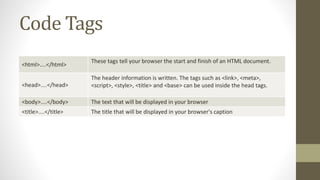
Code Tags
<html>....</html>
These tags tell your browser the start and finish of an HTML document.
<head>....</head>
The header information is written. The tags such as <link>, <meta>,
<script>, <style>, <title> and <base> can be used inside the head tags.
<body>....</body> The text that will be displayed in your browser
<title>....</title> The title that will be displayed in your browser's caption
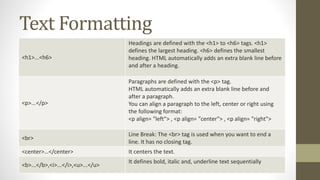
Text Formatting
<h1>...<h6>
Headings are defined with the <h1> to <h6> tags. <h1>
defines the largest heading. <h6> defines the smallest
heading. HTML automatically adds an extra blank line before
and after a heading.
<p>...</p>
Paragraphs are defined with the <p> tag.
HTML automatically adds an extra blank line before and
after a paragraph.
You can align a paragraph to the left, center or right using
the following format:
<p align= "left"> , <p align= "center"> , <p align= "right">
<br>
Line Break: The <br> tag is used when you want to end a
line. It has no closing tag.
<center>…</center> It centers the text.
<b>...</b>,<i>...</i>,<u>...</u>
It defines bold, italic and, underline text sequentially
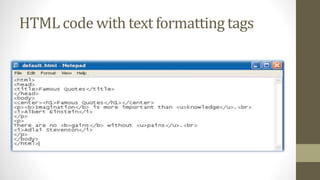
HTML code with text formatting tags
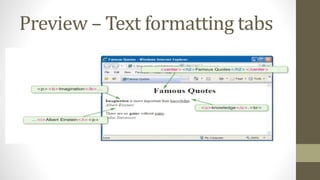
Preview – Text formatting tabs
Text formatting
• If you want to change font, font size, and font color, you can use
<Font> tag:
<font face="…" size="…" color="…">text</font>
• The size attribute can be set as an absolute value from 1 to 7 or as a
relative value using the "+" or "-" sign. Normal text is size 3.
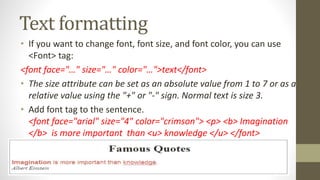
• Add font tag to the sentence.
<font face="arial" size="4" color="crimson"> <p> <b> Imagination
</b> is more important than <u> knowledge </u> </font>
Horizontal Line
• A horizontal line is a great way to separate your Web page into
different sections and add visual borders.
• The basic syntax for a horizontal line:
<hr>
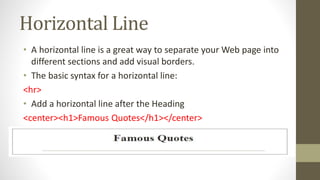
• Add a horizontal line after the Heading
<center><h1>Famous Quotes</h1></center>
<hr>
Background
• The <body> tag has two attributes bgcolor and background that
modify the background. The background can be a color or an image.
• The bgcolor attribute specifies a background color for an HTML
page.
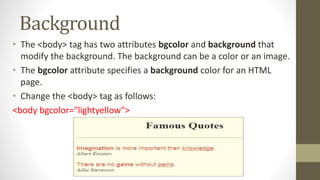
• Change the <body> tag as follows:
<body bgcolor="lightyellow">
Background
• You may want to choose a background picture instead of plain color.
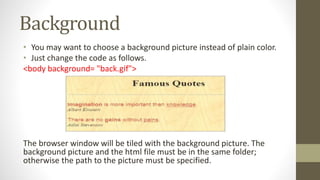
• Just change the code as follows.
<body background= "back.gif">
The browser window will be tiled with the background picture. The
background picture and the html file must be in the same folder;
otherwise the path to the picture must be specified.
Images
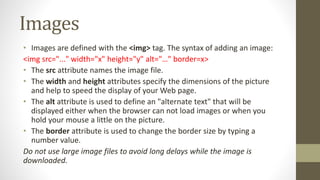
• Images are defined with the <img> tag. The syntax of adding an image:
<img src="..." width="x" height="y" alt="…" border=x>
• The src attribute names the image file.
• The width and height attributes specify the dimensions of the picture
and help to speed the display of your Web page.
• The alt attribute is used to define an "alternate text" that will be
displayed either when the browser can not load images or when you
hold your mouse a little on the picture.
• The border attribute is used to change the border size by typing a
number value.
Do not use large image files to avoid long delays while the image is
downloaded.
Images
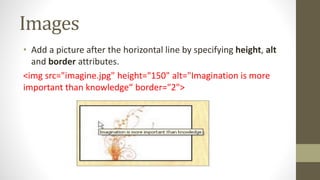
• Add a picture after the horizontal line by specifying height, alt
and border attributes.
<img src="imagine.jpg" height="150" alt="Imagination is more
important than knowledge“ border="2">
Links
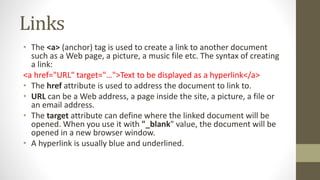
• The <a> (anchor) tag is used to create a link to another document
such as a Web page, a picture, a music file etc. The syntax of creating
a link:
<a href="URL" target="…">Text to be displayed as a hyperlink</a>
• The href attribute is used to address the document to link to.
• URL can be a Web address, a page inside the site, a picture, a file or
an email address.
• The target attribute can define where the linked document will be
opened. When you use it with "_blank" value, the document will be
opened in a new browser window.
• A hyperlink is usually blue and underlined.
Links
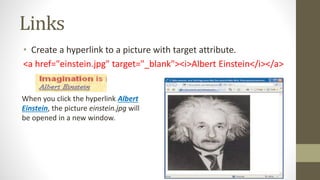
• Create a hyperlink to a picture with target attribute.
<a href="einstein.jpg" target="_blank"><i>Albert Einstein</i></a>
When you click the hyperlink Albert
Einstein, the picture einstein.jpg will
be opened in a new window.

HTML Coding

  • 1.
  • 2.
    Basic Tags • Youcan create HTML files using the Notepad program. • Start the Notepad program • Type the given text • Create a new folder and type a name, quotes • Save the file in the quotes folder giving a name with the extension .html, default.html • Open this file in your Web browser by selecting File>Open and specifying its location
  • 3.
  • 4.
    Code Tags <html>....</html> These tagstell your browser the start and finish of an HTML document. <head>....</head> The header information is written. The tags such as <link>, <meta>, <script>, <style>, <title> and <base> can be used inside the head tags. <body>....</body> The text that will be displayed in your browser <title>....</title> The title that will be displayed in your browser's caption
  • 5.
    Text Formatting <h1>...<h6> Headings aredefined with the <h1> to <h6> tags. <h1> defines the largest heading. <h6> defines the smallest heading. HTML automatically adds an extra blank line before and after a heading. <p>...</p> Paragraphs are defined with the <p> tag. HTML automatically adds an extra blank line before and after a paragraph. You can align a paragraph to the left, center or right using the following format: <p align= "left"> , <p align= "center"> , <p align= "right"> <br> Line Break: The <br> tag is used when you want to end a line. It has no closing tag. <center>…</center> It centers the text. <b>...</b>,<i>...</i>,<u>...</u> It defines bold, italic and, underline text sequentially
  • 6.
    HTML code withtext formatting tags
  • 7.
    Preview – Textformatting tabs
  • 8.
    Text formatting • Ifyou want to change font, font size, and font color, you can use <Font> tag: <font face="…" size="…" color="…">text</font> • The size attribute can be set as an absolute value from 1 to 7 or as a relative value using the "+" or "-" sign. Normal text is size 3. • Add font tag to the sentence. <font face="arial" size="4" color="crimson"> <p> <b> Imagination </b> is more important than <u> knowledge </u> </font>
  • 9.
    Horizontal Line • Ahorizontal line is a great way to separate your Web page into different sections and add visual borders. • The basic syntax for a horizontal line: <hr> • Add a horizontal line after the Heading <center><h1>Famous Quotes</h1></center> <hr>
  • 10.
    Background • The <body>tag has two attributes bgcolor and background that modify the background. The background can be a color or an image. • The bgcolor attribute specifies a background color for an HTML page. • Change the <body> tag as follows: <body bgcolor="lightyellow">
  • 11.
    Background • You maywant to choose a background picture instead of plain color. • Just change the code as follows. <body background= "back.gif"> The browser window will be tiled with the background picture. The background picture and the html file must be in the same folder; otherwise the path to the picture must be specified.
  • 12.
    Images • Images aredefined with the <img> tag. The syntax of adding an image: <img src="..." width="x" height="y" alt="…" border=x> • The src attribute names the image file. • The width and height attributes specify the dimensions of the picture and help to speed the display of your Web page. • The alt attribute is used to define an "alternate text" that will be displayed either when the browser can not load images or when you hold your mouse a little on the picture. • The border attribute is used to change the border size by typing a number value. Do not use large image files to avoid long delays while the image is downloaded.
  • 13.
    Images • Add apicture after the horizontal line by specifying height, alt and border attributes. <img src="imagine.jpg" height="150" alt="Imagination is more important than knowledge“ border="2">
  • 14.
    Links • The <a>(anchor) tag is used to create a link to another document such as a Web page, a picture, a music file etc. The syntax of creating a link: <a href="URL" target="…">Text to be displayed as a hyperlink</a> • The href attribute is used to address the document to link to. • URL can be a Web address, a page inside the site, a picture, a file or an email address. • The target attribute can define where the linked document will be opened. When you use it with "_blank" value, the document will be opened in a new browser window. • A hyperlink is usually blue and underlined.
  • 15.
    Links • Create ahyperlink to a picture with target attribute. <a href="einstein.jpg" target="_blank"><i>Albert Einstein</i></a> When you click the hyperlink Albert Einstein, the picture einstein.jpg will be opened in a new window.