Intermediate Algebra 098A
Review of
Exponents &
Factoring
1.1 – Integer Exponents
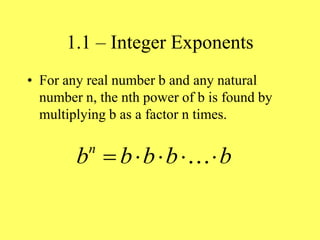
• For any real number b and any natural
number n, the nth power of b is found by
multiplying b as a factor n times.
n
b b b b b
    
Exponential Expression – an
expression that involves
exponents
• Base – the number being multiplied
• Exponent – the number of factors of the
base.
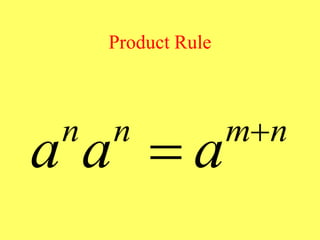
Product Rule
n n m n
a a a 

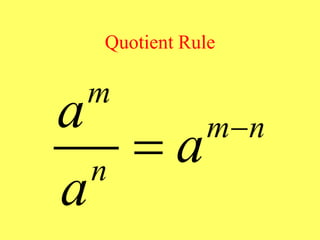
Quotient Rule
m
m n
n
a
a
a


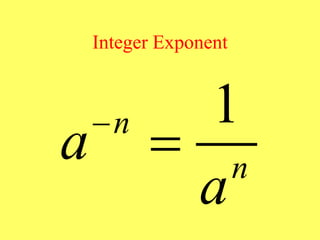
Integer Exponent
1
n
n
a
a


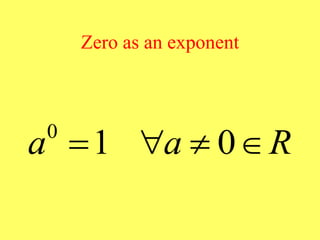
Zero as an exponent
0
1 0
a a R
   
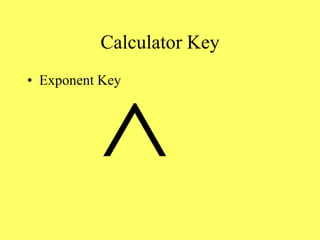
Calculator Key
• Exponent Key
^
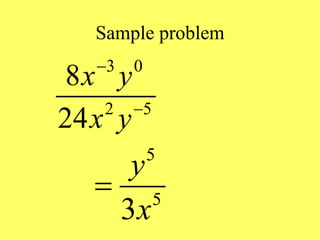
Sample problem
3 0
2 5
8
24
x y
x y


5
5
3
y
x

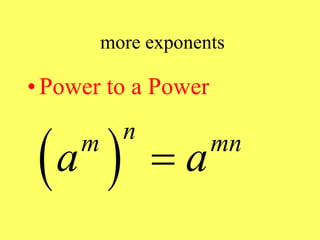
more exponents
• Power to a Power
 
n
m mn
a a

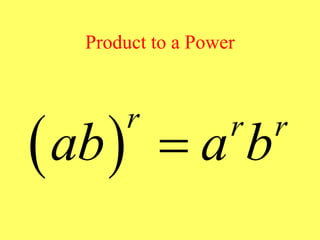
Product to a Power
 
r r r
ab a b

Polynomials - Review
•Addition
•and
•Subtraction
Objective:
•Determine the
coefficient and degree
of a monomial
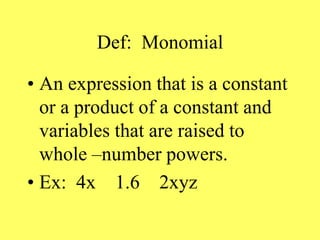
Def: Monomial
• An expression that is a constant
or a product of a constant and
variables that are raised to
whole –number powers.
• Ex: 4x 1.6 2xyz
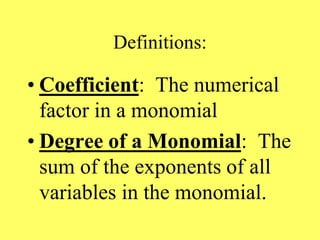
Definitions:
• Coefficient: The numerical
factor in a monomial
• Degree of a Monomial: The
sum of the exponents of all
variables in the monomial.
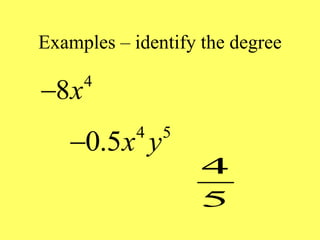
Examples – identify the degree
4
8x

4 5
0.5x y

4
5
Def: Polynomial:
•A monomial or an
expression that can be
written as a sum or
monomials.
Def: Polynomial in one variable:
•A polynomial in which
every variable term has
the same variable.
Definitions:
• Binomial: A polynomial
containing two terms.
• Trinomial: A
polynomial containing
three terms.
Degree of a Polynomial
•The greatest degree of
any of the terms in the
polynomial.
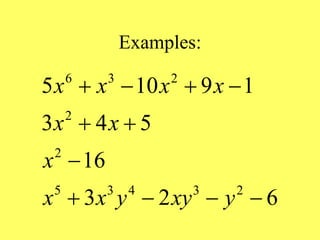
Examples:
6 3 2
2
2
5 3 4 3 2
5 10 9 1
3 4 5
16
3 2 6
x x x x
x x
x
x x y xy y
   
 

   
Objective
•Add
•and
•Subtract
•Polynomials
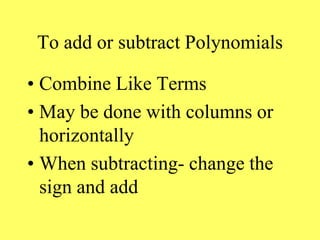
To add or subtract Polynomials
• Combine Like Terms
• May be done with columns or
horizontally
• When subtracting- change the
sign and add
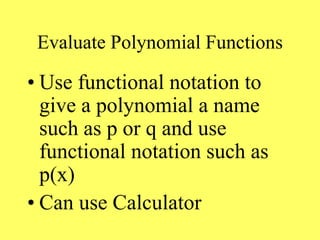
Evaluate Polynomial Functions
• Use functional notation to
give a polynomial a name
such as p or q and use
functional notation such as
p(x)

• Can use Calculator
Calculator Methods
• 1. Plug In
• 2. Use [Table]
• 3. Use program EVALUATE
• 4. Use [STO->]
• 5. Use [VARS] [Y=]
• 6. Use graph- [CAL][Value]
Objective:
•Apply evaluation of
polynomials to real-life
applications.
Intermediate Algebra 5.4
•Multiplication
•and
•Special Products
Objective
•Multiply
•a
• polynomial
•by a
•monomial
Procedure: Multiply a
polynomial by a monomial
• Use the distributive property to
multiply each term in the
polynomial by the monomial.
• Helpful to multiply the
coefficients first, then the
variables in alphabetical order.
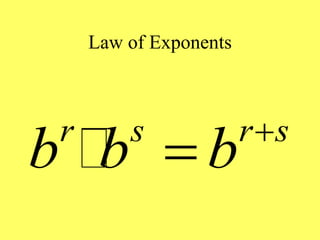
Law of Exponents
r s r s
b b b 

Objectives:
•Multiply Polynomials
•Multiply Binomials.
•Multiply Special
Products.
Procedure: Multiplying
Polynomials
• 1. Multiply every term in the
first polynomial by every term
in the second polynomial.
• 2. Combine like terms.
• 3. Can be done horizontally or
vertically.
Multiplying Binomials
•FOIL
• First
• Outer
• Inner
• Last
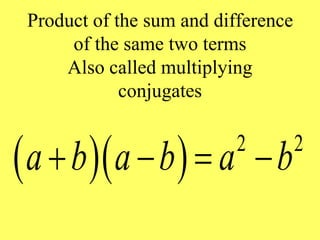
Product of the sum and difference
of the same two terms
Also called multiplying
conjugates
   2 2
a b a b a b
   
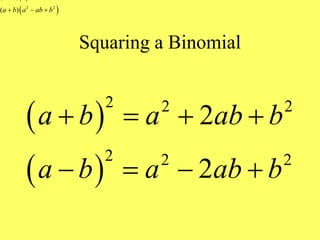
Squaring a Binomial
 
 
2 2 2
2 2 2
2
2
a b a ab b
a b a ab b
   
   
 
2 2
( )
a b a ab b
  
Objective:
• Simplify Expressions
• Use techniques as part of a
larger simplification
problem.
Albert Einstein-
Physicist
•“In the middle of
difficulty lies
opportunity.”
Intermediate Algebra –098A
•Common Factors
•and
•Grouping
Def: Factored Form
•A number or
expression written as a
product of factors.
Greatest Common Factor (GCF)
• Of two numbers a and b is the
largest integer that is a factor of
both a and b.
Calculator and gcd
• [MATH][NUM]gcd(
• Can do two numbers – input
with commas and ).
• Example: gcd(36,48)=12
Greatest Common Factor (GCF)
of a set of terms
•Always do this
FIRST!
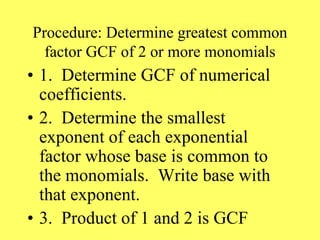
Procedure: Determine greatest common
factor GCF of 2 or more monomials
• 1. Determine GCF of numerical
coefficients.
• 2. Determine the smallest
exponent of each exponential
factor whose base is common to
the monomials. Write base with
that exponent.
• 3. Product of 1 and 2 is GCF
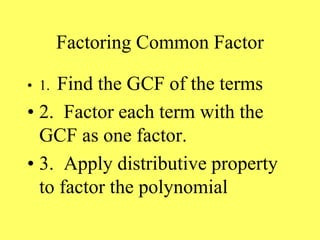
Factoring Common Factor
• 1. Find the GCF of the terms
• 2. Factor each term with the
GCF as one factor.
• 3. Apply distributive property
to factor the polynomial
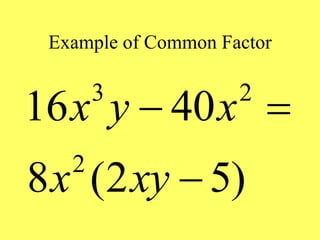
Example of Common Factor
3 2
2
16 40
8 (2 5)
x y x
x xy
 

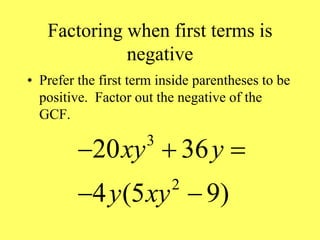
Factoring when first terms is
negative
• Prefer the first term inside parentheses to be
positive. Factor out the negative of the
GCF.
3
2
20 36
4 (5 9)
xy y
y xy
  
 
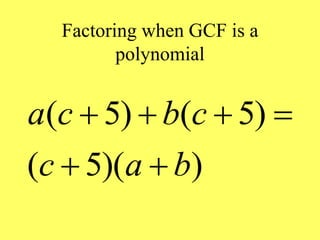
Factoring when GCF is a
polynomial
( 5) ( 5)
( 5)( )
a c b c
c a b
   
 
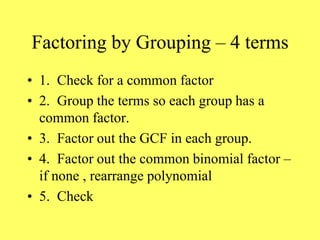
Factoring by Grouping – 4 terms
• 1. Check for a common factor
• 2. Group the terms so each group has a
common factor.
• 3. Factor out the GCF in each group.
• 4. Factor out the common binomial factor –
if none , rearrange polynomial
• 5. Check
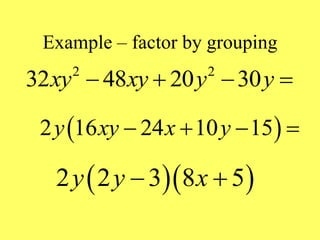
Example – factor by grouping
2 2
32 48 20 30
xy xy y y
   
 
2 16 24 10 15
y xy x y
   
  
2 2 3 8 5
y y x
 
Ralph Waldo Emerson – U.S.
essayist, poet, philosopher
•“We live in
succession , in
division, in parts, in
particles.”
Intermediate Algebra 098A
•Special Factoring
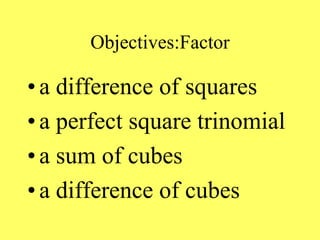
Objectives:Factor
• a difference of squares
• a perfect square trinomial
• a sum of cubes
• a difference of cubes
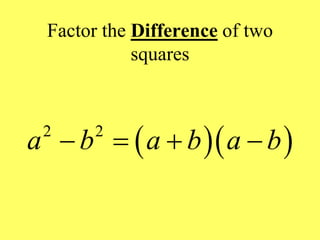
Factor the Difference of two
squares
  
2 2
a b a b a b
   
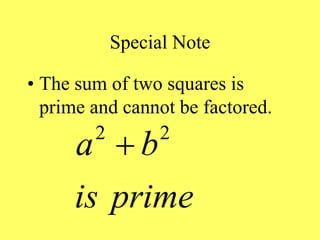
Special Note
• The sum of two squares is
prime and cannot be factored.
2 2
a b
is prime

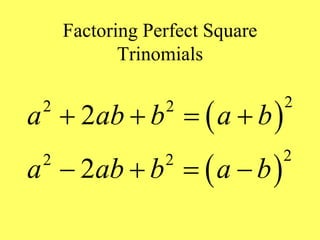
Factoring Perfect Square
Trinomials
 
 
2
2 2
2
2 2
2
2
a ab b a b
a ab b a b
   
   
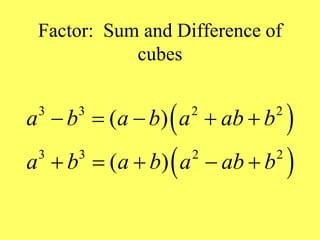
Factor: Sum and Difference of
cubes
 
 
3 3 2 2
3 3 2 2
( )
( )
a b a b a ab b
a b a b a ab b
    
    
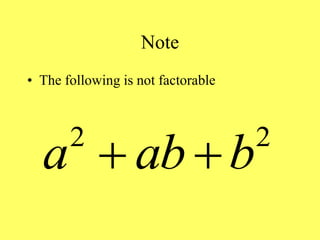
Note
• The following is not factorable
2 2
a ab b
 
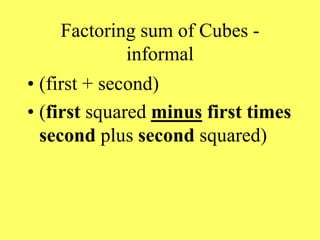
Factoring sum of Cubes -
informal
• (first + second)
• (first squared minus first times
second plus second squared)
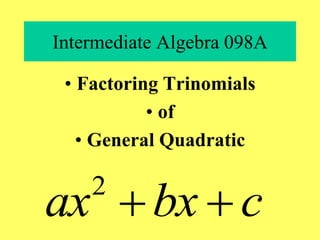
Intermediate Algebra 098A
• Factoring Trinomials
• of
• General Quadratic
2
ax bx c
 
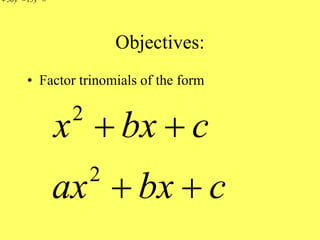
Objectives:
• Factor trinomials of the form
50 15
y y
  
2
2
x bx c
ax bx c
 
 
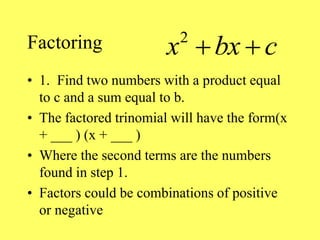
Factoring
• 1. Find two numbers with a product equal
to c and a sum equal to b.
• The factored trinomial will have the form(x
+ ___ ) (x + ___ )
• Where the second terms are the numbers
found in step 1.
• Factors could be combinations of positive
or negative
2
x bx c
 
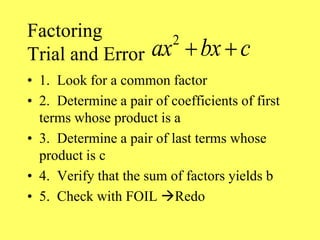
Factoring
Trial and Error
• 1. Look for a common factor
• 2. Determine a pair of coefficients of first
terms whose product is a
• 3. Determine a pair of last terms whose
product is c
• 4. Verify that the sum of factors yields b
• 5. Check with FOIL Redo
2
ax bx c
 
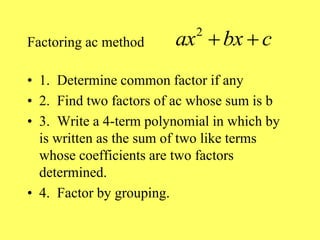
Factoring ac method
• 1. Determine common factor if any
• 2. Find two factors of ac whose sum is b
• 3. Write a 4-term polynomial in which by
is written as the sum of two like terms
whose coefficients are two factors
determined.
• 4. Factor by grouping.
2
ax bx c
 
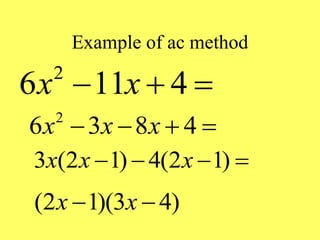
Example of ac method
2
6 11 4
x x
  
2
6 3 8 4
x x x
   
3 (2 1) 4(2 1)
x x x
   
(2 1)(3 4)
x x
 
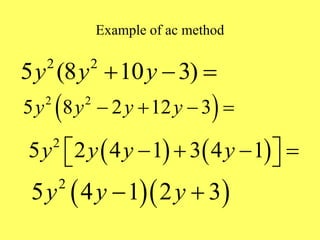
Example of ac method
2 2
5 (8 10 3)
y y y
  
 
2 2
5 8 2 12 3
y y y y
   
   
2
5 2 4 1 3 4 1
y y y y
   
 
 
  
2
5 4 1 2 3
y y y
 
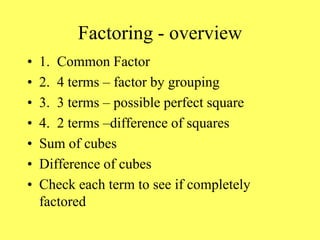
Factoring - overview
• 1. Common Factor
• 2. 4 terms – factor by grouping
• 3. 3 terms – possible perfect square
• 4. 2 terms –difference of squares
• Sum of cubes
• Difference of cubes
• Check each term to see if completely
factored
Isiah Thomas:
• “I’ve always believed no
matter how many shots I
miss, I’m going to make
the next one.”
Intermediate Algebra 098A
•Solving Equations
•by
•Factoring
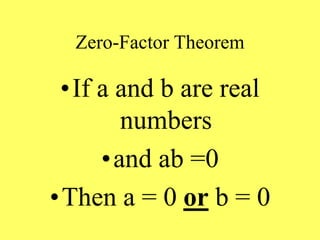
Zero-Factor Theorem
•If a and b are real
numbers
•and ab =0
•Then a = 0 or b = 0
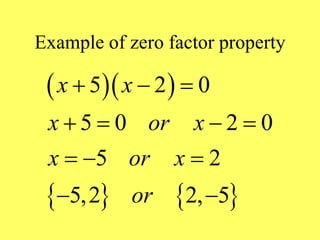
Example of zero factor property
  
   
5 2 0
5 0 2 0
5 2
5,2 2, 5
x x
x or x
x or x
or
  
   
  
 
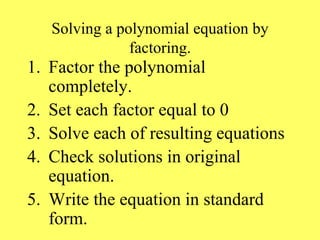
Solving a polynomial equation by
factoring.
1. Factor the polynomial
completely.
2. Set each factor equal to 0
3. Solve each of resulting equations
4. Check solutions in original
equation.
5. Write the equation in standard
form.
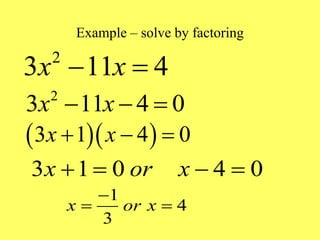
Example – solve by factoring
2
3 11 4
x x
 
2
3 11 4 0
x x
  
  
3 1 4 0
x x
  
3 1 0 4 0
x or x
   
1
4
3
x or x

 
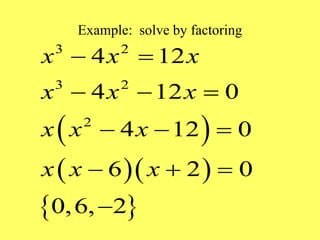
Example: solve by factoring
 
  
 
3 2
3 2
2
4 12
4 12 0
4 12 0
6 2 0
0,6, 2
x x x
x x x
x x x
x x x
 
  
  
  

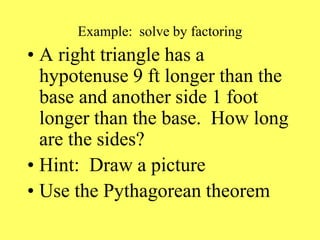
Example: solve by factoring
• A right triangle has a
hypotenuse 9 ft longer than the
base and another side 1 foot
longer than the base. How long
are the sides?
• Hint: Draw a picture
• Use the Pythagorean theorem
Solution
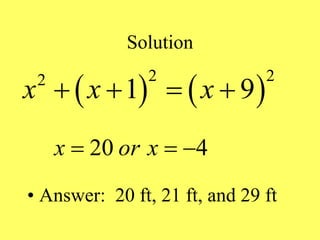
• Answer: 20 ft, 21 ft, and 29 ft
   
2 2
2
1 9
x x x
   
20 4
x or x
  
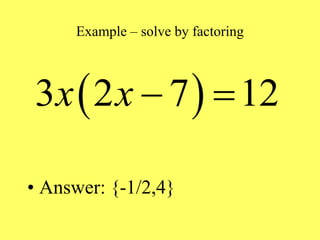
Example – solve by factoring
• Answer: {-1/2,4}
 
3 2 7 12
x x  
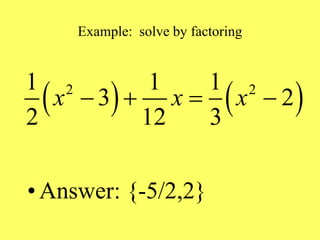
Example: solve by factoring
• Answer: {-5/2,2}
   
2 2
1 1 1
3 2
2 12 3
x x x
   
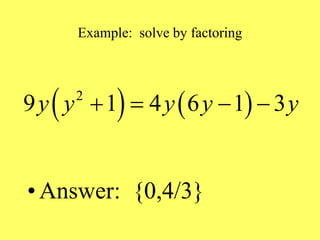
Example: solve by factoring
• Answer: {0,4/3}
   
2
9 1 4 6 1 3
y y y y y
   
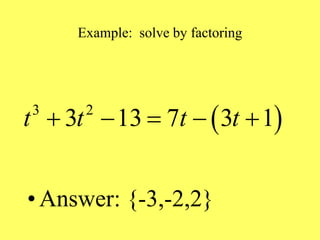
Example: solve by factoring
• Answer: {-3,-2,2}
 
3 2
3 13 7 3 1
t t t t
    
Sugar Ray Robinson
• “I’ve always believed that
you can think positive just
as well as you can think
negative.”
Maya Angelou - poet
• “Since time is the one
immaterial object which we
cannot influence – neither
speed up nor slow down, add
to nor diminish – it is an
imponderably valuable gift.”

098A_exponents_factoring.ppt