Andrea Paraboschi
Is this a business plan?
“What are we going to
do tonight, Brain?”	

!
“The same thing we do
every night, Pinky...	

Tonight
we will take
over the world”
Pinky and The Brain
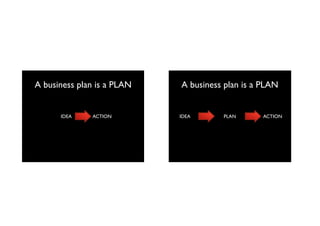
A business plan is a PLAN
IDEA ACTION
A business plan is a PLAN
IDEA PLAN ACTION
Without a business plan,
you have great chances to fail What a business plan is?
What a business plan is?
• A document about your business future
What a business plan is?
• A document about your business future
• Something inherently strategic
What a business plan is?
• A document about your business future
• Something inherently strategic
• An itinery description on how to get from A
to B, where A is now and B is a point in the
future (usually 3 to 5 years)
What a business plan is?
• A document about your business future
• Something inherently strategic
• An itinery description on how to get from A
to B, where A is now and B is a point in the
future (usually 3 to 5 years)
• The only way you have to understand what
you’re doing and to commit other people
(investors, employees, customers...)
What a business plan is NOT? What a business plan is NOT?
• A 3 minutes long pitch of your business idea
What a business plan is NOT?
• A 3 minutes long pitch of your business idea
• Bureaucracy stuff in order to get money from
investors
What a business plan is NOT?
• A 3 minutes long pitch of your business idea
• Bureaucracy stuff in order to get money from
investors
• Something optional, requested but not so important
in order to be founded
What a business plan is NOT?
• A 3 minutes long pitch of your business idea
• Bureaucracy stuff in order to get money from
investors
• Something optional, requested but not so important
in order to be founded
• A business model
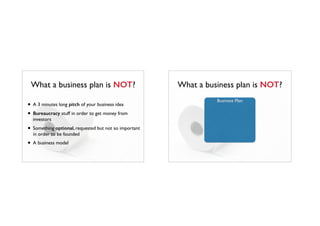
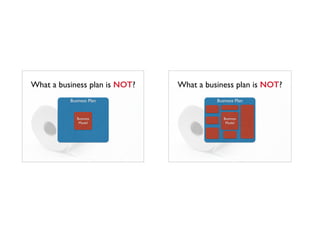
What a business plan is NOT?
Business Plan
What a business plan is NOT?
Business Plan
Business
Model
What a business plan is NOT?
Business Plan
Business
Model
A possible definition
Pinson, Linda. (2004). Anatomy of a Business Plan: A Step-by-Step Guide to Building a Business and Securing Your Company’s
Future (6th Edition). Page 20. Dearborn Trade: Chicago, USA.
A possible definition
Pinson, Linda. (2004). Anatomy of a Business Plan: A Step-by-Step Guide to Building a Business and Securing Your Company’s
Future (6th Edition). Page 20. Dearborn Trade: Chicago, USA.
A business plan is a formal statement of a set of business goals,
the reasons they are believed attainable, and the plan for
reaching those goals.
A possible definition
Pinson, Linda. (2004). Anatomy of a Business Plan: A Step-by-Step Guide to Building a Business and Securing Your Company’s
Future (6th Edition). Page 20. Dearborn Trade: Chicago, USA.
A business plan is a formal statement of a set of business goals,
the reasons they are believed attainable, and the plan for
reaching those goals.
It may also contain background information about the organisation
or team attempting to reach those goals.
A possible definition
Pinson, Linda. (2004). Anatomy of a Business Plan: A Step-by-Step Guide to Building a Business and Securing Your Company’s
Future (6th Edition). Page 20. Dearborn Trade: Chicago, USA.
A business plan is a formal statement of a set of business goals,
the reasons they are believed attainable, and the plan for
reaching those goals.
It may also contain background information about the organisation
or team attempting to reach those goals.
Business plans may also target changes in perception and branding
by the customer, client, taxpayer, or larger community.
A possible definition
Pinson, Linda. (2004). Anatomy of a Business Plan: A Step-by-Step Guide to Building a Business and Securing Your Company’s
Future (6th Edition). Page 20. Dearborn Trade: Chicago, USA.
A business plan is a formal statement of a set of business goals,
the reasons they are believed attainable, and the plan for
reaching those goals.
It may also contain background information about the organisation
or team attempting to reach those goals.
Business plans may also target changes in perception and branding
by the customer, client, taxpayer, or larger community.
When the existing business is to assume a major change or when
planning a new venture, a 3 to 5 year business plan is required,
since investors will look for their annual return in that timeframe.
Why do you need a
Business Plan?
Why do you need a
Business Plan?
• It’s a tool designed mainly for YOU, in order to let
you understand how your business is put together
Why do you need a
Business Plan?
• It’s a tool designed mainly for YOU, in order to let
you understand how your business is put together
• It’s an exercise you NEED in order to find mistakes
and to better tune your business
Why do you need a
Business Plan?
• It’s a tool designed mainly for YOU, in order to let
you understand how your business is put together
• It’s an exercise you NEED in order to find mistakes
and to better tune your business
• It’s the only way you can MONITOR your
progresses
Why do you need a
Business Plan?
• It’s a tool designed mainly for YOU, in order to let
you understand how your business is put together
• It’s an exercise you NEED in order to find mistakes
and to better tune your business
• It’s the only way you can MONITOR your
progresses
• It’s a good way to attract smart people to work for
you!
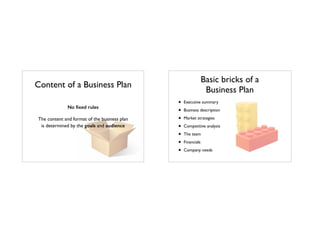
Content of a Business Plan
No fixed rules
!
The content and format of the business plan 	

is determined by the goals and audience
Basic bricks of a
Business Plan
• Executive summary	

• Business description	

• Market strategies	

• Competitive analysis	

• The team	

• Financials	

• Company needs
1- Executive summary 1- Executive summary
• Explains to the reader what you want to build
1- Executive summary
• Explains to the reader what you want to build
• It has to be concise: max 1 page
1- Executive summary
• Explains to the reader what you want to build
• It has to be concise: max 1 page
• It’s the LAST thing you have to write in the BP
1- Executive summary
• Explains to the reader what you want to build
• It has to be concise: max 1 page
• It’s the LAST thing you have to write in the BP
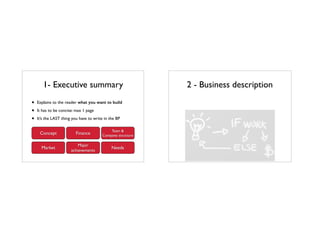
Concept Finance
Team & 	

Company structure
Market Needs
Major
achievements
2 - Business description
• Tell the reader about the industry your company will
operate in
2 - Business description
• Tell the reader about the industry your company will
operate in
• Describe the current scenario and how it could evolve
in the future (including regulations)
2 - Business description
• Tell the reader about the industry your company will
operate in
• Describe the current scenario and how it could evolve
in the future (including regulations)
• What problem is your product/service trying to solve?
2 - Business description
• Tell the reader about the industry your company will
operate in
• Describe the current scenario and how it could evolve
in the future (including regulations)
• What problem is your product/service trying to solve?
• Describe your business (what are you offering, value
proposition, marketing strategy, support, product
technologies) and how you’re going to make money
2 - Business description
• Tell the reader about the industry your company will
operate in
• Describe the current scenario and how it could evolve
in the future (including regulations)
• What problem is your product/service trying to solve?
• Describe your business (what are you offering, value
proposition, marketing strategy, support, product
technologies) and how you’re going to make money
• Focus on differentiation
3 - Market strategies
• Define the total market. How much is it worth?
3 - Market strategies
• Define the total market. How much is it worth?
• Identify your segment and your feasible target
3 - Market strategies
• Define the total market. How much is it worth?
• Identify your segment and your feasible target
• Try to project your market share along time axis
3 - Market strategies
• Define the total market. How much is it worth?
• Identify your segment and your feasible target
• Try to project your market share along time axis
• Explain your pricing strategy
3 - Market strategies
• Define the total market. How much is it worth?
• Identify your segment and your feasible target
• Try to project your market share along time axis
• Explain your pricing strategy
• Focus on the supply and distribution chain and identify
key suppliers and strategic partners
3 - Market strategies
• Define the total market. How much is it worth?
• Identify your segment and your feasible target
• Try to project your market share along time axis
• Explain your pricing strategy
• Focus on the supply and distribution chain and identify
key suppliers and strategic partners
• Show your distribution, advertising and sales plans
4 - Competitive analysis 4 - Competitive analysis
• Identify your competitors and how they are positioned in
the market
4 - Competitive analysis
• Identify your competitors and how they are positioned in
the market
• Look for your competitors success factors and weaknesses
4 - Competitive analysis
• Identify your competitors and how they are positioned in
the market
• Look for your competitors success factors and weaknesses
• Define your distinctive competitive advantages (and
barriers you can build in order to tackle competition)
5 - The team 5 - The team
• Focus on strengths, team member’s competences and
needs
5 - The team
• Focus on strengths, team member’s competences and
needs
• Explain how each person in the team can fit into the
company
5 - The team
• Focus on strengths, team member’s competences and
needs
• Explain how each person in the team can fit into the
company
• Write together the business plan! It’s impossible to
cover all the topics in depth (need of multi-disciplinar
competences)
6 - Financials 6 - Financials
• Create a 3-5 years financial summary (Cash flow,
EBITDA, Profits/Loss)
6 - Financials
• Create a 3-5 years financial summary (Cash flow,
EBITDA, Profits/Loss)
• Drill down and show your business case in detail (how
many units you will sell, profitability, cost structure,
break-even point...)
6 - Financials
• Create a 3-5 years financial summary (Cash flow,
EBITDA, Profits/Loss)
• Drill down and show your business case in detail (how
many units you will sell, profitability, cost structure,
break-even point...)
• Use charts and tables!
7 - Needs 7 - Needs
• Tell the reader how much money you need to start the
business and why
7 - Needs
• Tell the reader how much money you need to start the
business and why
• Needs aren’t just finance-related ! What competences
do you need in your company? Who you need to hire
to start? Are you ok with the distribution or do you
need to access some premium channels? What about
your image and product design? Start from your core
assets and fill the gaps
7 - Needs
• Tell the reader how much money you need to start the
business and why
• Needs aren’t just finance-related ! What competences
do you need in your company? Who you need to hire
to start? Are you ok with the distribution or do you
need to access some premium channels? What about
your image and product design? Start from your core
assets and fill the gaps
• Be honest!
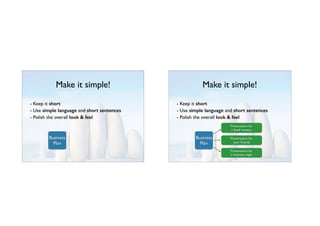
Make it simple!
!
- Keep it short	

- Use simple language and short sentences
- Polish the overall look & feel
Business
Plan
Make it simple!
!
- Keep it short	

- Use simple language and short sentences
- Polish the overall look & feel
Business
Plan
Presentation for 	

a Seed investor
Presentation for 	

your friends
Presentation for 	

a business angel
How to present a
Business Plan?
!
- You can present your BP using a 10-15 slides
deck	

- It has to be something simple to be
understood, clear, concise, direct
Presenting a BP to investors	

1) What does your company do?
Presenting a BP to investors	

1) What does your company do?
Presenting a BP to investors	

1) What does your company do?
- ONE SENTENCE. If you need 5 slides to
introduce your business to the audience, you have a
problem
Presenting a BP to investors	

1) What does your company do?
- ONE SENTENCE. If you need 5 slides to
introduce your business to the audience, you have a
problem
- Examples:
Presenting a BP to investors	

1) What does your company do?
- ONE SENTENCE. If you need 5 slides to
introduce your business to the audience, you have a
problem
- Examples:
Twitter:“We instantly connect people everywhere to what’s most
important to them”
Presenting a BP to investors	

1) What does your company do?
- ONE SENTENCE. If you need 5 slides to
introduce your business to the audience, you have a
problem
- Examples:
Twitter:“We instantly connect people everywhere to what’s most
important to them”
Napcabs:“We provide comfort and privacy for passengers inside airport
terminals”
Presenting a BP to investors	

1) What does your company do?
- ONE SENTENCE. If you need 5 slides to
introduce your business to the audience, you have a
problem
- Examples:
Twitter:“We instantly connect people everywhere to what’s most
important to them”
Napcabs:“We provide comfort and privacy for passengers inside airport
terminals”
- If you already have traction (customers or
revenues), tell theVCs now! The rest will be
storytelling…
Presenting a BP to investors	

2) What problem are you solving?
Presenting a BP to investors	

2) What problem are you solving?
Presenting a BP to investors	

2) What problem are you solving?
- Tell the audience what is the customer’s pain, how
you’re addressing it and how BIG it is
Presenting a BP to investors	

2) What problem are you solving?
- Tell the audience what is the customer’s pain, how
you’re addressing it and how BIG it is
- What are people doing today to work around this
issue, trying to solve the pain?
Presenting a BP to investors	

2) What problem are you solving?
- Tell the audience what is the customer’s pain, how
you’re addressing it and how BIG it is
- What are people doing today to work around this
issue, trying to solve the pain?
- How much better is your solution?
Presenting a BP to investors	

2) What problem are you solving?
- Tell the audience what is the customer’s pain, how
you’re addressing it and how BIG it is
- What are people doing today to work around this
issue, trying to solve the pain?
- How much better is your solution?
Presenting a BP to investors	

2) What problem are you solving?
- Tell the audience what is the customer’s pain, how
you’re addressing it and how BIG it is
- What are people doing today to work around this
issue, trying to solve the pain?
- How much better is your solution?
- SELL the pain to the audience! Look at their faces!
If they don’t feel the same problem, you are losing
your time.Take a step back and explain. Let them
get the point! (do you remember Steve Jobs’
keynotes?)
Presenting a BP to investors	

3) What is your solution?
Presenting a BP to investors	

3) What is your solution?
Presenting a BP to investors	

3) What is your solution?
- If possible, show a DEMO. Investors want to
touch your solution. Make it feel as much real as
possible
Presenting a BP to investors	

3) What is your solution?
- If possible, show a DEMO. Investors want to
touch your solution. Make it feel as much real as
possible
- How does it solve the problem? Does it address
the customer’s pain without causing another one?
Presenting a BP to investors	

3) What is your solution?
- If possible, show a DEMO. Investors want to
touch your solution. Make it feel as much real as
possible
- How does it solve the problem? Does it address
the customer’s pain without causing another one?
- Is there a product-market fit or it’s just an
“Engineer-gone-wild” solution?
Presenting a BP to investors	

3) What is your solution?
- If possible, show a DEMO. Investors want to
touch your solution. Make it feel as much real as
possible
- How does it solve the problem? Does it address
the customer’s pain without causing another one?
- Is there a product-market fit or it’s just an
“Engineer-gone-wild” solution?
- What are the first customers saying about it?
Surveys may help.
Presenting a BP to investors	

4) How big is the market 	

for your idea?
Presenting a BP to investors	

4) How big is the market 	

for your idea?
Presenting a BP to investors	

4) How big is the market 	

for your idea?
- The market is often too small for a venture idea
Presenting a BP to investors	

4) How big is the market 	

for your idea?
- The market is often too small for a venture idea
- Size the market, be honest
Presenting a BP to investors	

4) How big is the market 	

for your idea?
- The market is often too small for a venture idea
- Size the market, be honest
- What is the profile of your target customer?
Presenting a BP to investors	

4) How big is the market 	

for your idea?
- The market is often too small for a venture idea
- Size the market, be honest
- What is the profile of your target customer?
- How much will customers pay for your product?
Test that!
Presenting a BP to investors	

4) How big is the market 	

for your idea?
- The market is often too small for a venture idea
- Size the market, be honest
- What is the profile of your target customer?
- How much will customers pay for your product?
Test that!
- Use theVC words, their ideas. Do some preliminary
research about the markets your audience is
interested in
Presenting a BP to investors	

5) Why now?
Presenting a BP to investors	

5) Why now?
Presenting a BP to investors	

5) Why now?
- Being too early or too late == being wrong
Presenting a BP to investors	

5) Why now?
- Being too early or too late == being wrong
- What driving forces are at work to make the right
timing for your company?
Presenting a BP to investors	

5) Why now?
- Being too early or too late == being wrong
- What driving forces are at work to make the right
timing for your company?
- What is changing, what are the key external
trends?
Presenting a BP to investors	

6) Competition
Presenting a BP to investors	

6) Competition
- Look for your competitors.There are always
competitors, in every market. No competitors?You
may have a problem.
- List the competitors and point out your
competitive advantages
- Why will you win? (better patented technology,
disruptive business model, better access to
channels,…)
- Don’t put some logos on a white slide! Knowing
your competitors is extremely important: it shows
your market knowledge to the investors
Presenting a BP to investors	

7) Technology
TTadvisor
venture	
  partners
contents by
Presenting a BP to investors	

7) Technology
TTadvisor
venture	
  partners
contents by
Presenting a BP to investors	

7) Technology
- Competing Technologies: How many competing technologies exist?
Do they belong to leading competitors? Are they already in the market?
Are they going to reach the market before the proposed technology?
TTadvisor
venture	
  partners
contents by
Presenting a BP to investors	

7) Technology
- Competing Technologies: How many competing technologies exist?
Do they belong to leading competitors? Are they already in the market?
Are they going to reach the market before the proposed technology?
- Patenting: Is the proposed techology patented? Is the patenting process
going smoothly? Is the IP strategy covering all key technology assets Are
there any risk of infringing someone else patents?
TTadvisor
venture	
  partners
contents by
Presenting a BP to investors	

7) Technology
- Competing Technologies: How many competing technologies exist?
Do they belong to leading competitors? Are they already in the market?
Are they going to reach the market before the proposed technology?
- Patenting: Is the proposed techology patented? Is the patenting process
going smoothly? Is the IP strategy covering all key technology assets Are
there any risk of infringing someone else patents?
- Suppliers: Is this technology critically linked to specific suppliers? Are
there partnership agreements with critical suppliers? Are partnership
agreements exclusive? What is the % of technology in suppliers' hands?
TTadvisor
venture	
  partners
contents by
Presenting a BP to investors	

7) Technology
- Competing Technologies: How many competing technologies exist?
Do they belong to leading competitors? Are they already in the market?
Are they going to reach the market before the proposed technology?
- Patenting: Is the proposed techology patented? Is the patenting process
going smoothly? Is the IP strategy covering all key technology assets Are
there any risk of infringing someone else patents?
- Suppliers: Is this technology critically linked to specific suppliers? Are
there partnership agreements with critical suppliers? Are partnership
agreements exclusive? What is the % of technology in suppliers' hands?
- Legal & Norms: Does this technology comply current norms? Do we
foreseen changes in norms effecting our technology? Will our technology
benefit for changes in norms? Does the entrepreneur have link with
norm setting bodies?
TTadvisor
venture	
  partners
contents by
Presenting a BP to investors	

7) Technology
TTadvisor
venture	
  partners
contents by
Presenting a BP to investors	

7) Technology
TTadvisor
venture	
  partners
contents by
- Lab & Equipments: Is the company fully equipped with required labs? What %
of test and development has to be performed with external labs? Are critical
suppliers equipped with appropriate labs? Are development partners equipped
with appropriate labs? Is the company linked with properly equipped institutions?
Are needed (and not available) equipments easy to be sourced? Does the
company have appropriate legal protection while using external labs? Is there a
risk of poor IP protection while performing external tests?
- Proof of Concept: Do we have scientific, peer-reviewed evidence of findings?
Are there lab results, with clearly indicated testing methodology? Is there a
working prototype? Is there a pilot manufacturing unit? Has the product passed
all reliability test? Has the entrepreneur provided a consistent FMEA document?
Presenting a BP to investors	

7) Technology
TTadvisor
venture	
  partners
contents by
- Lab & Equipments: Is the company fully equipped with required labs? What %
of test and development has to be performed with external labs? Are critical
suppliers equipped with appropriate labs? Are development partners equipped
with appropriate labs? Is the company linked with properly equipped institutions?
Are needed (and not available) equipments easy to be sourced? Does the
company have appropriate legal protection while using external labs? Is there a
risk of poor IP protection while performing external tests?
- Proof of Concept: Do we have scientific, peer-reviewed evidence of findings?
Are there lab results, with clearly indicated testing methodology? Is there a
working prototype? Is there a pilot manufacturing unit? Has the product passed
all reliability test? Has the entrepreneur provided a consistent FMEA document?
- R&D Timeframe: Are we in base research, applied research, prototyping,
industrialisation or launch phase? How long will we take before reaching the
market launch phase? Do we expect competing technologies/product to enter
the market before us? Do we expect changes in the market before launch?
Presenting a BP to investors	

7) Technology
TTadvisor
venture	
  partners
contents by
- Lab & Equipments: Is the company fully equipped with required labs? What %
of test and development has to be performed with external labs? Are critical
suppliers equipped with appropriate labs? Are development partners equipped
with appropriate labs? Is the company linked with properly equipped institutions?
Are needed (and not available) equipments easy to be sourced? Does the
company have appropriate legal protection while using external labs? Is there a
risk of poor IP protection while performing external tests?
- Proof of Concept: Do we have scientific, peer-reviewed evidence of findings?
Are there lab results, with clearly indicated testing methodology? Is there a
working prototype? Is there a pilot manufacturing unit? Has the product passed
all reliability test? Has the entrepreneur provided a consistent FMEA document?
- R&D Timeframe: Are we in base research, applied research, prototyping,
industrialisation or launch phase? How long will we take before reaching the
market launch phase? Do we expect competing technologies/product to enter
the market before us? Do we expect changes in the market before launch?
Presenting a BP to investors	

8) Business Model
Presenting a BP to investors	

8) Business Model
Presenting a BP to investors	

8) Business Model
- Spend time here.This is like the problem statement.
You have to sell your BM to the investors.
Presenting a BP to investors	

8) Business Model
- Spend time here.This is like the problem statement.
You have to sell your BM to the investors.
- Make use of simple schemes, the canvass can help!
Presenting a BP to investors	

8) Business Model
- Spend time here.This is like the problem statement.
You have to sell your BM to the investors.
- Make use of simple schemes, the canvass can help!
How will you acquire your customers?
Presenting a BP to investors	

8) Business Model
- Spend time here.This is like the problem statement.
You have to sell your BM to the investors.
- Make use of simple schemes, the canvass can help!
How will you acquire your customers?
What are the acquisition costs?
Presenting a BP to investors	

8) Business Model
- Spend time here.This is like the problem statement.
You have to sell your BM to the investors.
- Make use of simple schemes, the canvass can help!
How will you acquire your customers?
What are the acquisition costs?
What is the pricing strategy?
Presenting a BP to investors	

8) Business Model
- Spend time here.This is like the problem statement.
You have to sell your BM to the investors.
- Make use of simple schemes, the canvass can help!
How will you acquire your customers?
What are the acquisition costs?
What is the pricing strategy?
What is the average customer value?
Presenting a BP to investors	

8) Business Model
- Spend time here.This is like the problem statement.
You have to sell your BM to the investors.
- Make use of simple schemes, the canvass can help!
How will you acquire your customers?
What are the acquisition costs?
What is the pricing strategy?
What is the average customer value?
What is the revenue model?
Presenting a BP to investors	

8) Business Model
- Spend time here.This is like the problem statement.
You have to sell your BM to the investors.
- Make use of simple schemes, the canvass can help!
How will you acquire your customers?
What are the acquisition costs?
What is the pricing strategy?
What is the average customer value?
What is the revenue model?
How do you get big?
Presenting a BP to investors	

9) Show your team
Presenting a BP to investors	

9) Show your team
Presenting a BP to investors	

9) Show your team
- In some cases, a company is bought for the team,
not for the BM (Glancee…)
Presenting a BP to investors	

9) Show your team
- In some cases, a company is bought for the team,
not for the BM (Glancee…)
- A company is NOT a person
Presenting a BP to investors	

9) Show your team
- In some cases, a company is bought for the team,
not for the BM (Glancee…)
- A company is NOT a person
- Include the background of founders and senior
management (advisors and board members)
Presenting a BP to investors	

9) Show your team
- In some cases, a company is bought for the team,
not for the BM (Glancee…)
- A company is NOT a person
- Include the background of founders and senior
management (advisors and board members)
- Why are they relevant to the team?
Presenting a BP to investors	

9) Show your team
- In some cases, a company is bought for the team,
not for the BM (Glancee…)
- A company is NOT a person
- Include the background of founders and senior
management (advisors and board members)
- Why are they relevant to the team?
- Who do you need to hire? When?
Presenting a BP to investors	

9) Show your team
- In some cases, a company is bought for the team,
not for the BM (Glancee…)
- A company is NOT a person
- Include the background of founders and senior
management (advisors and board members)
- Why are they relevant to the team?
- Who do you need to hire? When?
- Recruit a board of directors before the investor
does!
Presenting a BP to investors	

10) Financial Model
Presenting a BP to investors	

10) Financial Model
Presenting a BP to investors	

10) Financial Model
- Include simplified financial statements (P&L, balance
sheet, cash flow)
Presenting a BP to investors	

10) Financial Model
- Include simplified financial statements (P&L, balance
sheet, cash flow)
- Forecast up to 3-5 years (max 5 years). Show your
assumptions and how they may change
Presenting a BP to investors	

10) Financial Model
- Include simplified financial statements (P&L, balance
sheet, cash flow)
- Forecast up to 3-5 years (max 5 years). Show your
assumptions and how they may change
- What you can really control are the expenses. Be
precise here.
Presenting a BP to investors	

10) Financial Model
- Include simplified financial statements (P&L, balance
sheet, cash flow)
- Forecast up to 3-5 years (max 5 years). Show your
assumptions and how they may change
- What you can really control are the expenses. Be
precise here.
- VCs want to be sure that the money they may give
to you are enough to let the company grow from A
to B, before another round of funding.
Presenting a BP to investors	

10) Financial Model
- Include simplified financial statements (P&L, balance
sheet, cash flow)
- Forecast up to 3-5 years (max 5 years). Show your
assumptions and how they may change
- What you can really control are the expenses. Be
precise here.
- VCs want to be sure that the money they may give
to you are enough to let the company grow from A
to B, before another round of funding.
- Be sure that numbers fit and are simple, otherwise
you will be challenged by the audience
Presenting a BP to investors	

Tips & Tricks
TTadvisor
venture	
  partners
contents by
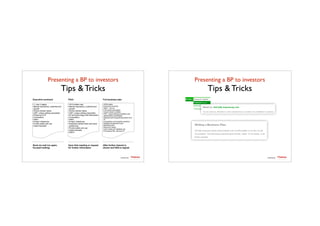
•1, max 2 pages
•Market description, potential and
growth
•Unmet market needs
•USP: unique selling proposition
•Presence of IP
•Competitors
•Team
•Project milestones
•Funds needs and use
•Cash forecasts
•10/15 slides max
•Market description, potential and
growth
•Unmet market needs
•USP: unique selling proposition
•IP and technology brief description
•Competitors
•Team
•Project milestones
•Expected market share and price
positioning
•Funds needs and use
•Cash forecasts
•SWOT
•30/60 pages
•Executive summary
•Team – full cvs
•Full market description
•Unmet needs in details
•USP: unique selling proposition and
stakeholders advantages
•Detailed technological description and
IP
•Competitors and possible reactions
•Detailed development plan
•Marketing plan
•Resource needs
•Cash needs and detailed use
•Provisional P&L, BS and CF
Executive summary Pitch Full business plan
Send via mail (no spam,
focused mailing)
Upon first meeting or request
for further information
After further interest is
shown and NDA is signed
Presenting a BP to investors	

Tips & Tricks
TTadvisor
venture	
  partners
contents by
Presenting a BP to investors	

Tips & Tricks
TTadvisor
venture	
  partners
contents by
Presenting a BP to investors	

Tips & Tricks
TTadvisor
venture	
  partners
contents by
Presenting a BP to investors	

Be ready to do an elevator pitch
TTadvisor
venture	
  partners
contents by
Presenting a BP to investors	

Be ready to do an elevator pitch
TTadvisor
venture	
  partners
contents by
APPENDIX	

Funding your start-up
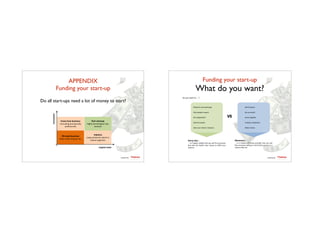
Do all start-ups need a lot of money to start?
life-­‐style	
  business	
  
shop,	
  small	
  company,	
  etc.
Capital	
  need
Innovation
know-­‐how	
  business	
  
Consulting	
  and	
  specialty	
  
professionals
Tech	
  startups	
  
Highly	
  technological	
  new	
  
ventures
Industry	
  
Large	
  production	
  plants	
  in	
  
mature	
  segments
TTadvisor
venture	
  partners
contents by
Funding your start-up	

What do you want?
Do	
  you	
  want	
  to….	
  ?
VS
Own	
  your	
  dream	
  company	
   	
   	
   Make	
  money	


Research	
  and	
  prototype	
   	
   	
   Sell	
  Products	


Gain	
  people	
  respect	


   Be	
  successful	


Be	
  independent	
   	
   	
   Grow	
  together	


Exercise	
  power	
   	
   	
   Embrace	
  mediation	


Sorry,	
  but…
…	
  it	
  is	
  highly	
  unlikely	
  that	
  you	
  will	
  find	
  someone	
  
that	
  will	
  risk	
  his/her	
  own	
  money	
  to	
  fulfill	
  your	
  
dreams!
Mmmmm…
…	
   it	
   is	
   indeed	
   somehow	
   possible	
   that	
   you	
   will	
  
find	
  someone	
  willing	
  to	
  risk	
  his/her	
  money	
  in	
  a	
  
venture	
  like	
  this
TTadvisor
venture	
  partners
contents by
Funding your start-up	

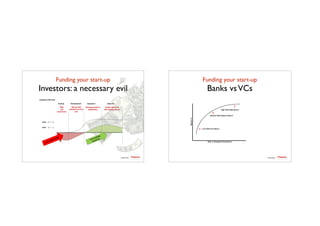
Investors: a necessary evil
Development Expansion MaturityStartup
Cash	


  (	


  )
Sales	


  (	


  )
Enterprise	
  life-­‐cycle
R&D
and	
  
investments
High	
  growth	
  
starting	
  from	
  first	
  
sale
Slowing	
  growth	
  to	
  
stabilization
Steady	
  sales	
  with	
  
diminishing	
  returns
Cash	
  needed	
  today
Cash	
  available	
  
tomorrow
TTadvisor
venture	
  partners
contents by
Funding your start-up	

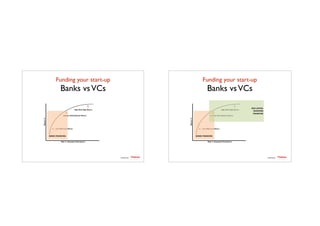
Banks vsVCs
TTadvisor
venture	
  partners
contents by
Funding your start-up	

Banks vsVCs
TTadvisor
venture	
  partners
contents by
!
!
!
!
!
!
!
!
!
!
!
!
!
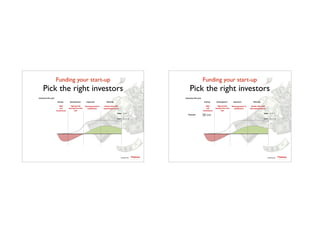
BANKS	
  FINANCING
Funding your start-up	

Banks vsVCs
TTadvisor
venture	
  partners
contents by
!
!
!
!
!
!
!
!
!
!
!
!
!
BANKS	
  FINANCING
RISK	
  CAPITAL	
  
INVESTORS	
  
FINANCING
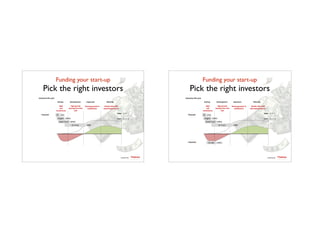
Funding your start-up	

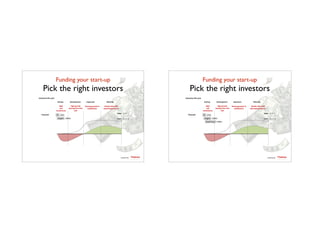
Pick the right investors
TTadvisor
venture	
  partners
contents by
Development Expansion MaturityStartup
Cash	


  (	


  )
Sales	


  (	


  )
Enterprise	
  life-­‐cycle
R&D
and	
  
investments
High	
  growth	
  
starting	
  from	
  first	
  
sale
Slowing	
  growth	
  to	
  
stabilization
Steady	
  sales	
  with	
  
diminishing	
  returns
Funding your start-up	

Pick the right investors
TTadvisor
venture	
  partners
contents by
Development Expansion MaturityStartup
Cash	


  (	


  )
Sales	


  (	


  )
Enterprise	
  life-­‐cycle
R&D
and	
  
investments
High	
  growth	
  
starting	
  from	
  first	
  
sale
Slowing	
  growth	
  to	
  
stabilization
Steady	
  sales	
  with	
  
diminishing	
  returns
3F 20k$Financial:
Funding your start-up	

Pick the right investors
TTadvisor
venture	
  partners
contents by
Development Expansion MaturityStartup
Cash	


  (	


  )
Sales	


  (	


  )
Enterprise	
  life-­‐cycle
R&D
and	
  
investments
High	
  growth	
  
starting	
  from	
  first	
  
sale
Slowing	
  growth	
  to	
  
stabilization
Steady	
  sales	
  with	
  
diminishing	
  returns
3F
Angels
20k$
200k$
Financial:
Funding your start-up	

Pick the right investors
TTadvisor
venture	
  partners
contents by
Development Expansion MaturityStartup
Cash	


  (	


  )
Sales	


  (	


  )
Enterprise	
  life-­‐cycle
R&D
and	
  
investments
High	
  growth	
  
starting	
  from	
  first	
  
sale
Slowing	
  growth	
  to	
  
stabilization
Steady	
  sales	
  with	
  
diminishing	
  returns
3F
Angels
Seed	
  Fund
20k$
200k$
500k$
Financial:
Funding your start-up	

Pick the right investors
TTadvisor
venture	
  partners
contents by
Development Expansion MaturityStartup
Cash	


  (	


  )
Sales	


  (	


  )
Enterprise	
  life-­‐cycle
R&D
and	
  
investments
High	
  growth	
  
starting	
  from	
  first	
  
sale
Slowing	
  growth	
  to	
  
stabilization
Steady	
  sales	
  with	
  
diminishing	
  returns
3F
Angels
Seed	
  Fund
20k$
200k$
500k$
VC	
  Fund 10M$
Financial:
Funding your start-up	

Pick the right investors
TTadvisor
venture	
  partners
contents by
Development Expansion MaturityStartup
Cash	


  (	


  )
Sales	


  (	


  )
Enterprise	
  life-­‐cycle
R&D
and	
  
investments
High	
  growth	
  
starting	
  from	
  first	
  
sale
Slowing	
  growth	
  to	
  
stabilization
Steady	
  sales	
  with	
  
diminishing	
  returns
3F
Angels
Seed	
  Fund
20k$
200k$
500k$
VC	
  Fund 10M$
Co-­‐dev 200k$
Financial:
Industrial:
Funding your start-up	

Pick the right investors
TTadvisor
venture	
  partners
contents by
Development Expansion MaturityStartup
Cash	


  (	


  )
Sales	


  (	


  )
Enterprise	
  life-­‐cycle
R&D
and	
  
investments
High	
  growth	
  
starting	
  from	
  first	
  
sale
Slowing	
  growth	
  to	
  
stabilization
Steady	
  sales	
  with	
  
diminishing	
  returns
3F
Angels
Seed	
  Fund
20k$
200k$
500k$
VC	
  Fund 10M$
Co-­‐dev 200k$
Licensing variable
Financial:
Industrial:
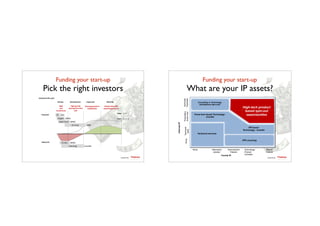
Funding your start-up	

What are your IP assets?
TTadvisor
venture	
  partners
contents by
None Alternative
solution
Improvement
Patents
Technology/
Product
concepts
Master
Patents
NoneTechnical
skills
Technical
Expertise
InformalIP
Formal IP
High-tech product
based spin-out
opportunities
Consulting or Technology
development spin-outs
IPR Licensing
Technical services
IPR based
Technology - transfer
‘Proprietary
Know-how’
Know-how based Technology -
transfer
References and useful
examples on:
• http://www.bplans.com/	

• http://www.entrepreneur.com	

• Harvard Business School Press-Pocket Mentor,
"Creating a Business Plan”!
• How to write a business plan by UCBerkeley
HAAS Business School - https://www.youtube.com/
watch?v=QwlClWaR7DI!
• Khan Academy videos - https://www.youtube.com/
channel/UC4a-Gbdw7vOaccHmFo40b9g

how to write a business plan

  • 1.
    Andrea Paraboschi Is thisa business plan? “What are we going to do tonight, Brain?” ! “The same thing we do every night, Pinky... Tonight we will take over the world” Pinky and The Brain
  • 2.
    A business planis a PLAN IDEA ACTION A business plan is a PLAN IDEA PLAN ACTION
  • 3.
    Without a businessplan, you have great chances to fail What a business plan is?
  • 4.
    What a businessplan is? • A document about your business future What a business plan is? • A document about your business future • Something inherently strategic
  • 5.
    What a businessplan is? • A document about your business future • Something inherently strategic • An itinery description on how to get from A to B, where A is now and B is a point in the future (usually 3 to 5 years) What a business plan is? • A document about your business future • Something inherently strategic • An itinery description on how to get from A to B, where A is now and B is a point in the future (usually 3 to 5 years) • The only way you have to understand what you’re doing and to commit other people (investors, employees, customers...)
  • 6.
    What a businessplan is NOT? What a business plan is NOT? • A 3 minutes long pitch of your business idea
  • 7.
    What a businessplan is NOT? • A 3 minutes long pitch of your business idea • Bureaucracy stuff in order to get money from investors What a business plan is NOT? • A 3 minutes long pitch of your business idea • Bureaucracy stuff in order to get money from investors • Something optional, requested but not so important in order to be founded
  • 8.
    What a businessplan is NOT? • A 3 minutes long pitch of your business idea • Bureaucracy stuff in order to get money from investors • Something optional, requested but not so important in order to be founded • A business model What a business plan is NOT? Business Plan
  • 9.
    What a businessplan is NOT? Business Plan Business Model What a business plan is NOT? Business Plan Business Model
  • 10.
    A possible definition Pinson,Linda. (2004). Anatomy of a Business Plan: A Step-by-Step Guide to Building a Business and Securing Your Company’s Future (6th Edition). Page 20. Dearborn Trade: Chicago, USA. A possible definition Pinson, Linda. (2004). Anatomy of a Business Plan: A Step-by-Step Guide to Building a Business and Securing Your Company’s Future (6th Edition). Page 20. Dearborn Trade: Chicago, USA. A business plan is a formal statement of a set of business goals, the reasons they are believed attainable, and the plan for reaching those goals.
  • 11.
    A possible definition Pinson,Linda. (2004). Anatomy of a Business Plan: A Step-by-Step Guide to Building a Business and Securing Your Company’s Future (6th Edition). Page 20. Dearborn Trade: Chicago, USA. A business plan is a formal statement of a set of business goals, the reasons they are believed attainable, and the plan for reaching those goals. It may also contain background information about the organisation or team attempting to reach those goals. A possible definition Pinson, Linda. (2004). Anatomy of a Business Plan: A Step-by-Step Guide to Building a Business and Securing Your Company’s Future (6th Edition). Page 20. Dearborn Trade: Chicago, USA. A business plan is a formal statement of a set of business goals, the reasons they are believed attainable, and the plan for reaching those goals. It may also contain background information about the organisation or team attempting to reach those goals. Business plans may also target changes in perception and branding by the customer, client, taxpayer, or larger community.
  • 12.
    A possible definition Pinson,Linda. (2004). Anatomy of a Business Plan: A Step-by-Step Guide to Building a Business and Securing Your Company’s Future (6th Edition). Page 20. Dearborn Trade: Chicago, USA. A business plan is a formal statement of a set of business goals, the reasons they are believed attainable, and the plan for reaching those goals. It may also contain background information about the organisation or team attempting to reach those goals. Business plans may also target changes in perception and branding by the customer, client, taxpayer, or larger community. When the existing business is to assume a major change or when planning a new venture, a 3 to 5 year business plan is required, since investors will look for their annual return in that timeframe. Why do you need a Business Plan?
  • 13.
    Why do youneed a Business Plan? • It’s a tool designed mainly for YOU, in order to let you understand how your business is put together Why do you need a Business Plan? • It’s a tool designed mainly for YOU, in order to let you understand how your business is put together • It’s an exercise you NEED in order to find mistakes and to better tune your business
  • 14.
    Why do youneed a Business Plan? • It’s a tool designed mainly for YOU, in order to let you understand how your business is put together • It’s an exercise you NEED in order to find mistakes and to better tune your business • It’s the only way you can MONITOR your progresses Why do you need a Business Plan? • It’s a tool designed mainly for YOU, in order to let you understand how your business is put together • It’s an exercise you NEED in order to find mistakes and to better tune your business • It’s the only way you can MONITOR your progresses • It’s a good way to attract smart people to work for you!
  • 15.
    Content of aBusiness Plan No fixed rules ! The content and format of the business plan is determined by the goals and audience Basic bricks of a Business Plan • Executive summary • Business description • Market strategies • Competitive analysis • The team • Financials • Company needs
  • 16.
    1- Executive summary1- Executive summary • Explains to the reader what you want to build
  • 17.
    1- Executive summary •Explains to the reader what you want to build • It has to be concise: max 1 page 1- Executive summary • Explains to the reader what you want to build • It has to be concise: max 1 page • It’s the LAST thing you have to write in the BP
  • 18.
    1- Executive summary •Explains to the reader what you want to build • It has to be concise: max 1 page • It’s the LAST thing you have to write in the BP Concept Finance Team & Company structure Market Needs Major achievements 2 - Business description
  • 19.
    2 - Businessdescription • Tell the reader about the industry your company will operate in 2 - Business description • Tell the reader about the industry your company will operate in • Describe the current scenario and how it could evolve in the future (including regulations)
  • 20.
    2 - Businessdescription • Tell the reader about the industry your company will operate in • Describe the current scenario and how it could evolve in the future (including regulations) • What problem is your product/service trying to solve? 2 - Business description • Tell the reader about the industry your company will operate in • Describe the current scenario and how it could evolve in the future (including regulations) • What problem is your product/service trying to solve? • Describe your business (what are you offering, value proposition, marketing strategy, support, product technologies) and how you’re going to make money
  • 21.
    2 - Businessdescription • Tell the reader about the industry your company will operate in • Describe the current scenario and how it could evolve in the future (including regulations) • What problem is your product/service trying to solve? • Describe your business (what are you offering, value proposition, marketing strategy, support, product technologies) and how you’re going to make money • Focus on differentiation 3 - Market strategies
  • 22.
    3 - Marketstrategies • Define the total market. How much is it worth? 3 - Market strategies • Define the total market. How much is it worth? • Identify your segment and your feasible target
  • 23.
    3 - Marketstrategies • Define the total market. How much is it worth? • Identify your segment and your feasible target • Try to project your market share along time axis 3 - Market strategies • Define the total market. How much is it worth? • Identify your segment and your feasible target • Try to project your market share along time axis • Explain your pricing strategy
  • 24.
    3 - Marketstrategies • Define the total market. How much is it worth? • Identify your segment and your feasible target • Try to project your market share along time axis • Explain your pricing strategy • Focus on the supply and distribution chain and identify key suppliers and strategic partners 3 - Market strategies • Define the total market. How much is it worth? • Identify your segment and your feasible target • Try to project your market share along time axis • Explain your pricing strategy • Focus on the supply and distribution chain and identify key suppliers and strategic partners • Show your distribution, advertising and sales plans
  • 25.
    4 - Competitiveanalysis 4 - Competitive analysis • Identify your competitors and how they are positioned in the market
  • 26.
    4 - Competitiveanalysis • Identify your competitors and how they are positioned in the market • Look for your competitors success factors and weaknesses 4 - Competitive analysis • Identify your competitors and how they are positioned in the market • Look for your competitors success factors and weaknesses • Define your distinctive competitive advantages (and barriers you can build in order to tackle competition)
  • 27.
    5 - Theteam 5 - The team • Focus on strengths, team member’s competences and needs
  • 28.
    5 - Theteam • Focus on strengths, team member’s competences and needs • Explain how each person in the team can fit into the company 5 - The team • Focus on strengths, team member’s competences and needs • Explain how each person in the team can fit into the company • Write together the business plan! It’s impossible to cover all the topics in depth (need of multi-disciplinar competences)
  • 29.
    6 - Financials6 - Financials • Create a 3-5 years financial summary (Cash flow, EBITDA, Profits/Loss)
  • 30.
    6 - Financials •Create a 3-5 years financial summary (Cash flow, EBITDA, Profits/Loss) • Drill down and show your business case in detail (how many units you will sell, profitability, cost structure, break-even point...) 6 - Financials • Create a 3-5 years financial summary (Cash flow, EBITDA, Profits/Loss) • Drill down and show your business case in detail (how many units you will sell, profitability, cost structure, break-even point...) • Use charts and tables!
  • 31.
    7 - Needs7 - Needs • Tell the reader how much money you need to start the business and why
  • 32.
    7 - Needs •Tell the reader how much money you need to start the business and why • Needs aren’t just finance-related ! What competences do you need in your company? Who you need to hire to start? Are you ok with the distribution or do you need to access some premium channels? What about your image and product design? Start from your core assets and fill the gaps 7 - Needs • Tell the reader how much money you need to start the business and why • Needs aren’t just finance-related ! What competences do you need in your company? Who you need to hire to start? Are you ok with the distribution or do you need to access some premium channels? What about your image and product design? Start from your core assets and fill the gaps • Be honest!
  • 33.
    Make it simple! ! -Keep it short - Use simple language and short sentences - Polish the overall look & feel Business Plan Make it simple! ! - Keep it short - Use simple language and short sentences - Polish the overall look & feel Business Plan Presentation for a Seed investor Presentation for your friends Presentation for a business angel
  • 34.
    How to presenta Business Plan? ! - You can present your BP using a 10-15 slides deck - It has to be something simple to be understood, clear, concise, direct Presenting a BP to investors 1) What does your company do?
  • 35.
    Presenting a BPto investors 1) What does your company do? Presenting a BP to investors 1) What does your company do? - ONE SENTENCE. If you need 5 slides to introduce your business to the audience, you have a problem
  • 36.
    Presenting a BPto investors 1) What does your company do? - ONE SENTENCE. If you need 5 slides to introduce your business to the audience, you have a problem - Examples: Presenting a BP to investors 1) What does your company do? - ONE SENTENCE. If you need 5 slides to introduce your business to the audience, you have a problem - Examples: Twitter:“We instantly connect people everywhere to what’s most important to them”
  • 37.
    Presenting a BPto investors 1) What does your company do? - ONE SENTENCE. If you need 5 slides to introduce your business to the audience, you have a problem - Examples: Twitter:“We instantly connect people everywhere to what’s most important to them” Napcabs:“We provide comfort and privacy for passengers inside airport terminals” Presenting a BP to investors 1) What does your company do? - ONE SENTENCE. If you need 5 slides to introduce your business to the audience, you have a problem - Examples: Twitter:“We instantly connect people everywhere to what’s most important to them” Napcabs:“We provide comfort and privacy for passengers inside airport terminals” - If you already have traction (customers or revenues), tell theVCs now! The rest will be storytelling…
  • 38.
    Presenting a BPto investors 2) What problem are you solving? Presenting a BP to investors 2) What problem are you solving?
  • 39.
    Presenting a BPto investors 2) What problem are you solving? - Tell the audience what is the customer’s pain, how you’re addressing it and how BIG it is Presenting a BP to investors 2) What problem are you solving? - Tell the audience what is the customer’s pain, how you’re addressing it and how BIG it is - What are people doing today to work around this issue, trying to solve the pain?
  • 40.
    Presenting a BPto investors 2) What problem are you solving? - Tell the audience what is the customer’s pain, how you’re addressing it and how BIG it is - What are people doing today to work around this issue, trying to solve the pain? - How much better is your solution? Presenting a BP to investors 2) What problem are you solving? - Tell the audience what is the customer’s pain, how you’re addressing it and how BIG it is - What are people doing today to work around this issue, trying to solve the pain? - How much better is your solution?
  • 41.
    Presenting a BPto investors 2) What problem are you solving? - Tell the audience what is the customer’s pain, how you’re addressing it and how BIG it is - What are people doing today to work around this issue, trying to solve the pain? - How much better is your solution? - SELL the pain to the audience! Look at their faces! If they don’t feel the same problem, you are losing your time.Take a step back and explain. Let them get the point! (do you remember Steve Jobs’ keynotes?) Presenting a BP to investors 3) What is your solution?
  • 42.
    Presenting a BPto investors 3) What is your solution? Presenting a BP to investors 3) What is your solution? - If possible, show a DEMO. Investors want to touch your solution. Make it feel as much real as possible
  • 43.
    Presenting a BPto investors 3) What is your solution? - If possible, show a DEMO. Investors want to touch your solution. Make it feel as much real as possible - How does it solve the problem? Does it address the customer’s pain without causing another one? Presenting a BP to investors 3) What is your solution? - If possible, show a DEMO. Investors want to touch your solution. Make it feel as much real as possible - How does it solve the problem? Does it address the customer’s pain without causing another one? - Is there a product-market fit or it’s just an “Engineer-gone-wild” solution?
  • 44.
    Presenting a BPto investors 3) What is your solution? - If possible, show a DEMO. Investors want to touch your solution. Make it feel as much real as possible - How does it solve the problem? Does it address the customer’s pain without causing another one? - Is there a product-market fit or it’s just an “Engineer-gone-wild” solution? - What are the first customers saying about it? Surveys may help. Presenting a BP to investors 4) How big is the market for your idea?
  • 45.
    Presenting a BPto investors 4) How big is the market for your idea? Presenting a BP to investors 4) How big is the market for your idea? - The market is often too small for a venture idea
  • 46.
    Presenting a BPto investors 4) How big is the market for your idea? - The market is often too small for a venture idea - Size the market, be honest Presenting a BP to investors 4) How big is the market for your idea? - The market is often too small for a venture idea - Size the market, be honest - What is the profile of your target customer?
  • 47.
    Presenting a BPto investors 4) How big is the market for your idea? - The market is often too small for a venture idea - Size the market, be honest - What is the profile of your target customer? - How much will customers pay for your product? Test that! Presenting a BP to investors 4) How big is the market for your idea? - The market is often too small for a venture idea - Size the market, be honest - What is the profile of your target customer? - How much will customers pay for your product? Test that! - Use theVC words, their ideas. Do some preliminary research about the markets your audience is interested in
  • 48.
    Presenting a BPto investors 5) Why now? Presenting a BP to investors 5) Why now?
  • 49.
    Presenting a BPto investors 5) Why now? - Being too early or too late == being wrong Presenting a BP to investors 5) Why now? - Being too early or too late == being wrong - What driving forces are at work to make the right timing for your company?
  • 50.
    Presenting a BPto investors 5) Why now? - Being too early or too late == being wrong - What driving forces are at work to make the right timing for your company? - What is changing, what are the key external trends? Presenting a BP to investors 6) Competition
  • 51.
    Presenting a BPto investors 6) Competition - Look for your competitors.There are always competitors, in every market. No competitors?You may have a problem. - List the competitors and point out your competitive advantages - Why will you win? (better patented technology, disruptive business model, better access to channels,…) - Don’t put some logos on a white slide! Knowing your competitors is extremely important: it shows your market knowledge to the investors Presenting a BP to investors 7) Technology TTadvisor venture  partners contents by
  • 52.
    Presenting a BPto investors 7) Technology TTadvisor venture  partners contents by Presenting a BP to investors 7) Technology - Competing Technologies: How many competing technologies exist? Do they belong to leading competitors? Are they already in the market? Are they going to reach the market before the proposed technology? TTadvisor venture  partners contents by
  • 53.
    Presenting a BPto investors 7) Technology - Competing Technologies: How many competing technologies exist? Do they belong to leading competitors? Are they already in the market? Are they going to reach the market before the proposed technology? - Patenting: Is the proposed techology patented? Is the patenting process going smoothly? Is the IP strategy covering all key technology assets Are there any risk of infringing someone else patents? TTadvisor venture  partners contents by Presenting a BP to investors 7) Technology - Competing Technologies: How many competing technologies exist? Do they belong to leading competitors? Are they already in the market? Are they going to reach the market before the proposed technology? - Patenting: Is the proposed techology patented? Is the patenting process going smoothly? Is the IP strategy covering all key technology assets Are there any risk of infringing someone else patents? - Suppliers: Is this technology critically linked to specific suppliers? Are there partnership agreements with critical suppliers? Are partnership agreements exclusive? What is the % of technology in suppliers' hands? TTadvisor venture  partners contents by
  • 54.
    Presenting a BPto investors 7) Technology - Competing Technologies: How many competing technologies exist? Do they belong to leading competitors? Are they already in the market? Are they going to reach the market before the proposed technology? - Patenting: Is the proposed techology patented? Is the patenting process going smoothly? Is the IP strategy covering all key technology assets Are there any risk of infringing someone else patents? - Suppliers: Is this technology critically linked to specific suppliers? Are there partnership agreements with critical suppliers? Are partnership agreements exclusive? What is the % of technology in suppliers' hands? - Legal & Norms: Does this technology comply current norms? Do we foreseen changes in norms effecting our technology? Will our technology benefit for changes in norms? Does the entrepreneur have link with norm setting bodies? TTadvisor venture  partners contents by Presenting a BP to investors 7) Technology TTadvisor venture  partners contents by
  • 55.
    Presenting a BPto investors 7) Technology TTadvisor venture  partners contents by - Lab & Equipments: Is the company fully equipped with required labs? What % of test and development has to be performed with external labs? Are critical suppliers equipped with appropriate labs? Are development partners equipped with appropriate labs? Is the company linked with properly equipped institutions? Are needed (and not available) equipments easy to be sourced? Does the company have appropriate legal protection while using external labs? Is there a risk of poor IP protection while performing external tests? - Proof of Concept: Do we have scientific, peer-reviewed evidence of findings? Are there lab results, with clearly indicated testing methodology? Is there a working prototype? Is there a pilot manufacturing unit? Has the product passed all reliability test? Has the entrepreneur provided a consistent FMEA document? Presenting a BP to investors 7) Technology TTadvisor venture  partners contents by - Lab & Equipments: Is the company fully equipped with required labs? What % of test and development has to be performed with external labs? Are critical suppliers equipped with appropriate labs? Are development partners equipped with appropriate labs? Is the company linked with properly equipped institutions? Are needed (and not available) equipments easy to be sourced? Does the company have appropriate legal protection while using external labs? Is there a risk of poor IP protection while performing external tests? - Proof of Concept: Do we have scientific, peer-reviewed evidence of findings? Are there lab results, with clearly indicated testing methodology? Is there a working prototype? Is there a pilot manufacturing unit? Has the product passed all reliability test? Has the entrepreneur provided a consistent FMEA document? - R&D Timeframe: Are we in base research, applied research, prototyping, industrialisation or launch phase? How long will we take before reaching the market launch phase? Do we expect competing technologies/product to enter the market before us? Do we expect changes in the market before launch?
  • 56.
    Presenting a BPto investors 7) Technology TTadvisor venture  partners contents by - Lab & Equipments: Is the company fully equipped with required labs? What % of test and development has to be performed with external labs? Are critical suppliers equipped with appropriate labs? Are development partners equipped with appropriate labs? Is the company linked with properly equipped institutions? Are needed (and not available) equipments easy to be sourced? Does the company have appropriate legal protection while using external labs? Is there a risk of poor IP protection while performing external tests? - Proof of Concept: Do we have scientific, peer-reviewed evidence of findings? Are there lab results, with clearly indicated testing methodology? Is there a working prototype? Is there a pilot manufacturing unit? Has the product passed all reliability test? Has the entrepreneur provided a consistent FMEA document? - R&D Timeframe: Are we in base research, applied research, prototyping, industrialisation or launch phase? How long will we take before reaching the market launch phase? Do we expect competing technologies/product to enter the market before us? Do we expect changes in the market before launch? Presenting a BP to investors 8) Business Model
  • 57.
    Presenting a BPto investors 8) Business Model Presenting a BP to investors 8) Business Model - Spend time here.This is like the problem statement. You have to sell your BM to the investors.
  • 58.
    Presenting a BPto investors 8) Business Model - Spend time here.This is like the problem statement. You have to sell your BM to the investors. - Make use of simple schemes, the canvass can help! Presenting a BP to investors 8) Business Model - Spend time here.This is like the problem statement. You have to sell your BM to the investors. - Make use of simple schemes, the canvass can help! How will you acquire your customers?
  • 59.
    Presenting a BPto investors 8) Business Model - Spend time here.This is like the problem statement. You have to sell your BM to the investors. - Make use of simple schemes, the canvass can help! How will you acquire your customers? What are the acquisition costs? Presenting a BP to investors 8) Business Model - Spend time here.This is like the problem statement. You have to sell your BM to the investors. - Make use of simple schemes, the canvass can help! How will you acquire your customers? What are the acquisition costs? What is the pricing strategy?
  • 60.
    Presenting a BPto investors 8) Business Model - Spend time here.This is like the problem statement. You have to sell your BM to the investors. - Make use of simple schemes, the canvass can help! How will you acquire your customers? What are the acquisition costs? What is the pricing strategy? What is the average customer value? Presenting a BP to investors 8) Business Model - Spend time here.This is like the problem statement. You have to sell your BM to the investors. - Make use of simple schemes, the canvass can help! How will you acquire your customers? What are the acquisition costs? What is the pricing strategy? What is the average customer value? What is the revenue model?
  • 61.
    Presenting a BPto investors 8) Business Model - Spend time here.This is like the problem statement. You have to sell your BM to the investors. - Make use of simple schemes, the canvass can help! How will you acquire your customers? What are the acquisition costs? What is the pricing strategy? What is the average customer value? What is the revenue model? How do you get big? Presenting a BP to investors 9) Show your team
  • 62.
    Presenting a BPto investors 9) Show your team Presenting a BP to investors 9) Show your team - In some cases, a company is bought for the team, not for the BM (Glancee…)
  • 63.
    Presenting a BPto investors 9) Show your team - In some cases, a company is bought for the team, not for the BM (Glancee…) - A company is NOT a person Presenting a BP to investors 9) Show your team - In some cases, a company is bought for the team, not for the BM (Glancee…) - A company is NOT a person - Include the background of founders and senior management (advisors and board members)
  • 64.
    Presenting a BPto investors 9) Show your team - In some cases, a company is bought for the team, not for the BM (Glancee…) - A company is NOT a person - Include the background of founders and senior management (advisors and board members) - Why are they relevant to the team? Presenting a BP to investors 9) Show your team - In some cases, a company is bought for the team, not for the BM (Glancee…) - A company is NOT a person - Include the background of founders and senior management (advisors and board members) - Why are they relevant to the team? - Who do you need to hire? When?
  • 65.
    Presenting a BPto investors 9) Show your team - In some cases, a company is bought for the team, not for the BM (Glancee…) - A company is NOT a person - Include the background of founders and senior management (advisors and board members) - Why are they relevant to the team? - Who do you need to hire? When? - Recruit a board of directors before the investor does! Presenting a BP to investors 10) Financial Model
  • 66.
    Presenting a BPto investors 10) Financial Model Presenting a BP to investors 10) Financial Model - Include simplified financial statements (P&L, balance sheet, cash flow)
  • 67.
    Presenting a BPto investors 10) Financial Model - Include simplified financial statements (P&L, balance sheet, cash flow) - Forecast up to 3-5 years (max 5 years). Show your assumptions and how they may change Presenting a BP to investors 10) Financial Model - Include simplified financial statements (P&L, balance sheet, cash flow) - Forecast up to 3-5 years (max 5 years). Show your assumptions and how they may change - What you can really control are the expenses. Be precise here.
  • 68.
    Presenting a BPto investors 10) Financial Model - Include simplified financial statements (P&L, balance sheet, cash flow) - Forecast up to 3-5 years (max 5 years). Show your assumptions and how they may change - What you can really control are the expenses. Be precise here. - VCs want to be sure that the money they may give to you are enough to let the company grow from A to B, before another round of funding. Presenting a BP to investors 10) Financial Model - Include simplified financial statements (P&L, balance sheet, cash flow) - Forecast up to 3-5 years (max 5 years). Show your assumptions and how they may change - What you can really control are the expenses. Be precise here. - VCs want to be sure that the money they may give to you are enough to let the company grow from A to B, before another round of funding. - Be sure that numbers fit and are simple, otherwise you will be challenged by the audience
  • 69.
    Presenting a BPto investors Tips & Tricks TTadvisor venture  partners contents by •1, max 2 pages •Market description, potential and growth •Unmet market needs •USP: unique selling proposition •Presence of IP •Competitors •Team •Project milestones •Funds needs and use •Cash forecasts •10/15 slides max •Market description, potential and growth •Unmet market needs •USP: unique selling proposition •IP and technology brief description •Competitors •Team •Project milestones •Expected market share and price positioning •Funds needs and use •Cash forecasts •SWOT •30/60 pages •Executive summary •Team – full cvs •Full market description •Unmet needs in details •USP: unique selling proposition and stakeholders advantages •Detailed technological description and IP •Competitors and possible reactions •Detailed development plan •Marketing plan •Resource needs •Cash needs and detailed use •Provisional P&L, BS and CF Executive summary Pitch Full business plan Send via mail (no spam, focused mailing) Upon first meeting or request for further information After further interest is shown and NDA is signed Presenting a BP to investors Tips & Tricks TTadvisor venture  partners contents by
  • 70.
    Presenting a BPto investors Tips & Tricks TTadvisor venture  partners contents by Presenting a BP to investors Tips & Tricks TTadvisor venture  partners contents by
  • 71.
    Presenting a BPto investors Be ready to do an elevator pitch TTadvisor venture  partners contents by Presenting a BP to investors Be ready to do an elevator pitch TTadvisor venture  partners contents by
  • 72.
    APPENDIX Funding your start-up Doall start-ups need a lot of money to start? life-­‐style  business   shop,  small  company,  etc. Capital  need Innovation know-­‐how  business   Consulting  and  specialty   professionals Tech  startups   Highly  technological  new   ventures Industry   Large  production  plants  in   mature  segments TTadvisor venture  partners contents by Funding your start-up What do you want? Do  you  want  to….  ? VS Own  your  dream  company       Make  money                                                                                                   Research  and  prototype       Sell  Products                                                                                                         Gain  people  respect         Be  successful                                                                                                                     Be  independent       Grow  together                                                                                                                                       Exercise  power       Embrace  mediation                                                                                                                                         Sorry,  but… …  it  is  highly  unlikely  that  you  will  find  someone   that  will  risk  his/her  own  money  to  fulfill  your   dreams! Mmmmm… …   it   is   indeed   somehow   possible   that   you   will   find  someone  willing  to  risk  his/her  money  in  a   venture  like  this TTadvisor venture  partners contents by
  • 73.
    Funding your start-up Investors:a necessary evil Development Expansion MaturityStartup Cash          (                    ) Sales        (                    ) Enterprise  life-­‐cycle R&D and   investments High  growth   starting  from  first   sale Slowing  growth  to   stabilization Steady  sales  with   diminishing  returns Cash  needed  today Cash  available   tomorrow TTadvisor venture  partners contents by Funding your start-up Banks vsVCs TTadvisor venture  partners contents by
  • 74.
    Funding your start-up BanksvsVCs TTadvisor venture  partners contents by ! ! ! ! ! ! ! ! ! ! ! ! ! BANKS  FINANCING Funding your start-up Banks vsVCs TTadvisor venture  partners contents by ! ! ! ! ! ! ! ! ! ! ! ! ! BANKS  FINANCING RISK  CAPITAL   INVESTORS   FINANCING
  • 75.
    Funding your start-up Pickthe right investors TTadvisor venture  partners contents by Development Expansion MaturityStartup Cash          (                    ) Sales        (                    ) Enterprise  life-­‐cycle R&D and   investments High  growth   starting  from  first   sale Slowing  growth  to   stabilization Steady  sales  with   diminishing  returns Funding your start-up Pick the right investors TTadvisor venture  partners contents by Development Expansion MaturityStartup Cash          (                    ) Sales        (                    ) Enterprise  life-­‐cycle R&D and   investments High  growth   starting  from  first   sale Slowing  growth  to   stabilization Steady  sales  with   diminishing  returns 3F 20k$Financial:
  • 76.
    Funding your start-up Pickthe right investors TTadvisor venture  partners contents by Development Expansion MaturityStartup Cash          (                    ) Sales        (                    ) Enterprise  life-­‐cycle R&D and   investments High  growth   starting  from  first   sale Slowing  growth  to   stabilization Steady  sales  with   diminishing  returns 3F Angels 20k$ 200k$ Financial: Funding your start-up Pick the right investors TTadvisor venture  partners contents by Development Expansion MaturityStartup Cash          (                    ) Sales        (                    ) Enterprise  life-­‐cycle R&D and   investments High  growth   starting  from  first   sale Slowing  growth  to   stabilization Steady  sales  with   diminishing  returns 3F Angels Seed  Fund 20k$ 200k$ 500k$ Financial:
  • 77.
    Funding your start-up Pickthe right investors TTadvisor venture  partners contents by Development Expansion MaturityStartup Cash          (                    ) Sales        (                    ) Enterprise  life-­‐cycle R&D and   investments High  growth   starting  from  first   sale Slowing  growth  to   stabilization Steady  sales  with   diminishing  returns 3F Angels Seed  Fund 20k$ 200k$ 500k$ VC  Fund 10M$ Financial: Funding your start-up Pick the right investors TTadvisor venture  partners contents by Development Expansion MaturityStartup Cash          (                    ) Sales        (                    ) Enterprise  life-­‐cycle R&D and   investments High  growth   starting  from  first   sale Slowing  growth  to   stabilization Steady  sales  with   diminishing  returns 3F Angels Seed  Fund 20k$ 200k$ 500k$ VC  Fund 10M$ Co-­‐dev 200k$ Financial: Industrial:
  • 78.
    Funding your start-up Pickthe right investors TTadvisor venture  partners contents by Development Expansion MaturityStartup Cash          (                    ) Sales        (                    ) Enterprise  life-­‐cycle R&D and   investments High  growth   starting  from  first   sale Slowing  growth  to   stabilization Steady  sales  with   diminishing  returns 3F Angels Seed  Fund 20k$ 200k$ 500k$ VC  Fund 10M$ Co-­‐dev 200k$ Licensing variable Financial: Industrial: Funding your start-up What are your IP assets? TTadvisor venture  partners contents by None Alternative solution Improvement Patents Technology/ Product concepts Master Patents NoneTechnical skills Technical Expertise InformalIP Formal IP High-tech product based spin-out opportunities Consulting or Technology development spin-outs IPR Licensing Technical services IPR based Technology - transfer ‘Proprietary Know-how’ Know-how based Technology - transfer
  • 79.
    References and useful exampleson: • http://www.bplans.com/ • http://www.entrepreneur.com • Harvard Business School Press-Pocket Mentor, "Creating a Business Plan”! • How to write a business plan by UCBerkeley HAAS Business School - https://www.youtube.com/ watch?v=QwlClWaR7DI! • Khan Academy videos - https://www.youtube.com/ channel/UC4a-Gbdw7vOaccHmFo40b9g