

business planning
agenda introduction to tandem and the team what is a business plan? why write a business plan? structuring your business plan q & a session with entrepreneur  upcoming GoSolo workshops
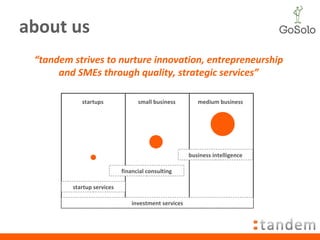
“ tandem strives to nurture innovation, entrepreneurship and SMEs through quality, strategic services” about us startups small business medium business financial consulting startup services business intelligence investment services
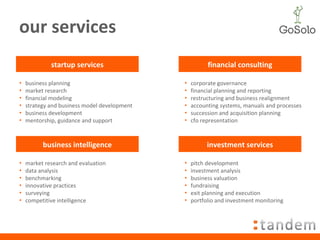
our services startup services business planning market research financial modeling strategy and business model development business development mentorship, guidance and support financial consulting corporate governance financial planning and reporting restructuring and business realignment accounting systems, manuals and processes succession and acquisition planning cfo representation business intelligence market research and evaluation data analysis benchmarking innovative practices surveying competitive intelligence investment services pitch development investment analysis business valuation fundraising exit planning and execution portfolio and investment monitoring
agenda introduction to tandem and the team what is a business plan? why write a business plan? structuring your business plan q & a session with entrepreneur  upcoming GoSolo workshops
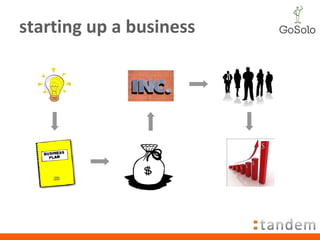
starting up a business
what is a business plan? A business plan is… a written description of the future of your business. It’s a document that describes what you plan to do, why and how you plan to do it. It is NOT… a financial forecast for the business A business plan should be… concise compelling complete
agenda introduction to tandem and the team what is a business plan? why write a business plan? structuring your business plan q & a session with entrepreneur  upcoming GoSolo workshops
why write a business plan? Allows you to  solidify your idea  and become more  focused Helps identify any  critical success factors ,  challenges  and  risks  that need to be mitigated Helps identify any  growth opportunities  for your business Serves as an  operational  and  communicational  tool Helps you  manage  your business and understand what needs to be done to get it off the ground Provides you with a basis for  financing  your business Allows all partners to be  aligned  to one vision and goal Serves as a great  benchmark  as you grow and develop your business Provides you with a clear  roadmap Allows you to set key  targets ,  goals  and  milestones
agenda introduction to tandem and the team what is a business plan? why write a business plan? structuring your business plan q & a session with entrepreneur  upcoming GoSolo workshops
structuring your business plan overview The business plan should convey: The concept The opportunity and goals of the business The strategies you’ll use to capitalize on the opportunity Potential problems that may confront your business and ways to solve them How and who will run the business How you will make money How much money you will need to break even The length of the business plan entirely depends on the nature of the business and the degree of detail you would like to go into.
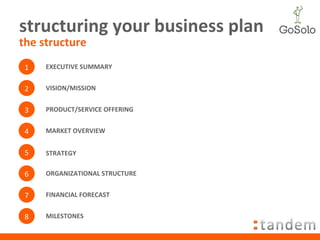
structuring your business plan the structure 1 3 4 5 6 7 8 EXECUTIVE SUMMARY PRODUCT/SERVICE OFFERING MARKET OVERVIEW STRATEGY ORGANIZATIONAL STRUCTURE FINANCIAL FORECAST MILESTONES 2 VISION/MISSION
structuring your business plan executive summary The size of the opportunity/target market The problem you are trying to solve How you are trying to solve it How your offering differs from competition Why do you believe your business will succeed If you’re looking for an investment, then it should include: The business model The investment requirements The executive summary should be written last and is a condensed version of the business plan, no longer than two pages. It should highlight the main points: The executive summary should be enticing the reader to continue. Good executive summaries are compelling and written in a story-like, non-technical format.
structuring your business plan vision/mission Examples of vision and mission statements: Bayt.com  – To be an admired and respected indispensable online extension of peoples lives GM  – To be the world leader in transportation products and related services EBay  – To provide a global trading platform where practically anyone can trade practically anything DELL  – Committed to being a good neighbour in the communities we call home. A  vision statement  outlines what the organization wants to be, or how it wants the world in which it operates to be. It is a source of inspiration. A  mission statement  tells you the fundamental purpose of the organization. It describes what it will do to achieve its vision. These statements serve as a point of direction of where the organization wishes to go It keeps all stakeholders aligned to one goal It provides a good starting point and guidance for developing the rest of the business plan
structuring your business plan product/service offering Depending on the complexity of the product/service, this should be no longer than two pages. It should highlight: The problem you are trying to solve How are you trying to solve it? What is the offering? How do customers benefit? The offering should be clear and simple. You must focus on the core product/service and what really will make your offering different and valuable to the customer.
structuring your business plan market overview The information in this section affects the strategy and the financial outlook of the business. This is the research section of the business plan. The outcome can validate or destroy your idea. External Trends What are the external factors that impact your business (and market/industry) in a positive or negative way? Political, Economical, Societal, Technological, Environmental and Legal.  Market Outlook How big is the overall market? How much of that market do you intend to serve and why? How many customers are there? What are the growth p rojections of your target market? What are the buyers behavior/habits? Include supporting documentation. Industry Analysis How many players operate in this market? How many of them are competitors? On what basis do they compete? If you are looking for an investment then you should include a section on successful transactions in the industry (globally).
structuring your business plan strategy This section highlights how you plan on reaching the market, distributing your product/service and competing. A good starting point is to analyze how your competitors operate. Marketing Plan How will you create awareness? How will you reach your target market? What forms of marketing will you pursue and why? How will people purchase your product/service? How will your product/service be packaged? Where will it be placed? How will it be distributed? How will it be priced relative to competition? Competitive Strategy How will you compete in the industry? How will you create a sustainable competitive advantage?  Operating Plan What key internal and external processes need to be developed and how?  Try and be as innovative as possible here. A SWOT analysis is often useful here to highlight a summary of the strengths, weaknesses, opportunities and threats of your business.
structuring your business plan organizational structure Deriving an appropriate organization structure depends a lot on the business in question. The key components that will be highlighted here is: Management Team Who are they? What is there experience? Why are they the right person for the job? What are their roles and responsibilities? Board of Directors Will you have a Board of Directors? If so, who are they? Any Non-Executive member? What is their experience? How are they useful to your business? Organization Chart What is the hierarchy and how is the company structured? Who reports to who? If you outsource any part of the business, it should be highlighted here as well as in the operating plan. Shareholder Structure Who owns what in the company?
structuring your business plan financial forecast Developing an appropriate financial forecast is hugely important in determining how much capital is required to invest. Typically, financial forecasts are done over 5 years. 1. Gather data from the market as assumptions for your forecast How big is the market in # of customers? How many customers are you targeting each year? How much are you charging for your products? How many staff do you require at how much per year? What are your startup costs? How much is rent? How much will be spent on marketing? 2. Develop a Profit & Loss Statement, Balance Sheet and Cash Flow Statement Based on the assumptions, develop financial statements over a 5 year period. Look at the cash flow statement to see how much money is required to fund your business through to cash flow break-even.  3. Provide 3 cases – worst case, base case and best case Analyze the numbers to see if it is worth pursuing. If you’re looking for investment, then a valuation would need to be done through a discounted-cash flow/multiples-based approach.
structuring your business plan milestones This is not present in every business plan, but serves as a good roadmap for the first 12 to 18 months. It can serve as a benchmark post business plan. This should highlight what key targets need to be implemented over a period. Come up with critical targets for your business in line with your strategy When do you plan on incorporating? When do you plan on marketing? How many customers would you like to secure after each quarter? When do you plan on recruiting key personnel? 2. If possible, assign as realistic a timeline as possible for each milestone The result should be a high-level plan with key milestones over the period. It should be used as a strategic document for them management team (and Board of Directors) to ensure that the company is on the right track.
structuring your business plan summary Make sure the business plan is concise and clear Try and support your market section with primary research – surveys etc. Review the numbers to see if it is worth pursuing or if there are changes to your strategy, organizational structure Let a third party review the plan and give you their feedback. Make sure it’s someone who will provide you with an unbiased opinion. It doesn’t have to be perfect right now, as it will change in the future Identify any risks while developing your plan and see how large they are and if you can mitigate If everything looks good, then get on your way!
agenda introduction to tandem and the team what is a business plan? why write a business plan? structuring your business plan q & a session with entrepreneur  upcoming GoSolo workshops
upcoming GoSolo workshops wednesday september 8 th  2010 fundraising wednesday october 13 th  2010 incorporation wednesday november 10 th  2010 marketing on a budget register at  [email_address]

GoSolo Workshop 3: Business Planning

  • 1.
  • 2.
    agenda introduction totandem and the team what is a business plan? why write a business plan? structuring your business plan q & a session with entrepreneur upcoming GoSolo workshops
  • 3.
    “ tandem strivesto nurture innovation, entrepreneurship and SMEs through quality, strategic services” about us startups small business medium business financial consulting startup services business intelligence investment services
  • 4.
    our services startupservices business planning market research financial modeling strategy and business model development business development mentorship, guidance and support financial consulting corporate governance financial planning and reporting restructuring and business realignment accounting systems, manuals and processes succession and acquisition planning cfo representation business intelligence market research and evaluation data analysis benchmarking innovative practices surveying competitive intelligence investment services pitch development investment analysis business valuation fundraising exit planning and execution portfolio and investment monitoring
  • 5.
    agenda introduction totandem and the team what is a business plan? why write a business plan? structuring your business plan q & a session with entrepreneur upcoming GoSolo workshops
  • 6.
    starting up abusiness
  • 7.
    what is abusiness plan? A business plan is… a written description of the future of your business. It’s a document that describes what you plan to do, why and how you plan to do it. It is NOT… a financial forecast for the business A business plan should be… concise compelling complete
  • 8.
    agenda introduction totandem and the team what is a business plan? why write a business plan? structuring your business plan q & a session with entrepreneur upcoming GoSolo workshops
  • 9.
    why write abusiness plan? Allows you to solidify your idea and become more focused Helps identify any critical success factors , challenges and risks that need to be mitigated Helps identify any growth opportunities for your business Serves as an operational and communicational tool Helps you manage your business and understand what needs to be done to get it off the ground Provides you with a basis for financing your business Allows all partners to be aligned to one vision and goal Serves as a great benchmark as you grow and develop your business Provides you with a clear roadmap Allows you to set key targets , goals and milestones
  • 10.
    agenda introduction totandem and the team what is a business plan? why write a business plan? structuring your business plan q & a session with entrepreneur upcoming GoSolo workshops
  • 11.
    structuring your businessplan overview The business plan should convey: The concept The opportunity and goals of the business The strategies you’ll use to capitalize on the opportunity Potential problems that may confront your business and ways to solve them How and who will run the business How you will make money How much money you will need to break even The length of the business plan entirely depends on the nature of the business and the degree of detail you would like to go into.
  • 12.
    structuring your businessplan the structure 1 3 4 5 6 7 8 EXECUTIVE SUMMARY PRODUCT/SERVICE OFFERING MARKET OVERVIEW STRATEGY ORGANIZATIONAL STRUCTURE FINANCIAL FORECAST MILESTONES 2 VISION/MISSION
  • 13.
    structuring your businessplan executive summary The size of the opportunity/target market The problem you are trying to solve How you are trying to solve it How your offering differs from competition Why do you believe your business will succeed If you’re looking for an investment, then it should include: The business model The investment requirements The executive summary should be written last and is a condensed version of the business plan, no longer than two pages. It should highlight the main points: The executive summary should be enticing the reader to continue. Good executive summaries are compelling and written in a story-like, non-technical format.
  • 14.
    structuring your businessplan vision/mission Examples of vision and mission statements: Bayt.com – To be an admired and respected indispensable online extension of peoples lives GM – To be the world leader in transportation products and related services EBay – To provide a global trading platform where practically anyone can trade practically anything DELL – Committed to being a good neighbour in the communities we call home. A vision statement outlines what the organization wants to be, or how it wants the world in which it operates to be. It is a source of inspiration. A mission statement tells you the fundamental purpose of the organization. It describes what it will do to achieve its vision. These statements serve as a point of direction of where the organization wishes to go It keeps all stakeholders aligned to one goal It provides a good starting point and guidance for developing the rest of the business plan
  • 15.
    structuring your businessplan product/service offering Depending on the complexity of the product/service, this should be no longer than two pages. It should highlight: The problem you are trying to solve How are you trying to solve it? What is the offering? How do customers benefit? The offering should be clear and simple. You must focus on the core product/service and what really will make your offering different and valuable to the customer.
  • 16.
    structuring your businessplan market overview The information in this section affects the strategy and the financial outlook of the business. This is the research section of the business plan. The outcome can validate or destroy your idea. External Trends What are the external factors that impact your business (and market/industry) in a positive or negative way? Political, Economical, Societal, Technological, Environmental and Legal. Market Outlook How big is the overall market? How much of that market do you intend to serve and why? How many customers are there? What are the growth p rojections of your target market? What are the buyers behavior/habits? Include supporting documentation. Industry Analysis How many players operate in this market? How many of them are competitors? On what basis do they compete? If you are looking for an investment then you should include a section on successful transactions in the industry (globally).
  • 17.
    structuring your businessplan strategy This section highlights how you plan on reaching the market, distributing your product/service and competing. A good starting point is to analyze how your competitors operate. Marketing Plan How will you create awareness? How will you reach your target market? What forms of marketing will you pursue and why? How will people purchase your product/service? How will your product/service be packaged? Where will it be placed? How will it be distributed? How will it be priced relative to competition? Competitive Strategy How will you compete in the industry? How will you create a sustainable competitive advantage? Operating Plan What key internal and external processes need to be developed and how? Try and be as innovative as possible here. A SWOT analysis is often useful here to highlight a summary of the strengths, weaknesses, opportunities and threats of your business.
  • 18.
    structuring your businessplan organizational structure Deriving an appropriate organization structure depends a lot on the business in question. The key components that will be highlighted here is: Management Team Who are they? What is there experience? Why are they the right person for the job? What are their roles and responsibilities? Board of Directors Will you have a Board of Directors? If so, who are they? Any Non-Executive member? What is their experience? How are they useful to your business? Organization Chart What is the hierarchy and how is the company structured? Who reports to who? If you outsource any part of the business, it should be highlighted here as well as in the operating plan. Shareholder Structure Who owns what in the company?
  • 19.
    structuring your businessplan financial forecast Developing an appropriate financial forecast is hugely important in determining how much capital is required to invest. Typically, financial forecasts are done over 5 years. 1. Gather data from the market as assumptions for your forecast How big is the market in # of customers? How many customers are you targeting each year? How much are you charging for your products? How many staff do you require at how much per year? What are your startup costs? How much is rent? How much will be spent on marketing? 2. Develop a Profit & Loss Statement, Balance Sheet and Cash Flow Statement Based on the assumptions, develop financial statements over a 5 year period. Look at the cash flow statement to see how much money is required to fund your business through to cash flow break-even. 3. Provide 3 cases – worst case, base case and best case Analyze the numbers to see if it is worth pursuing. If you’re looking for investment, then a valuation would need to be done through a discounted-cash flow/multiples-based approach.
  • 20.
    structuring your businessplan milestones This is not present in every business plan, but serves as a good roadmap for the first 12 to 18 months. It can serve as a benchmark post business plan. This should highlight what key targets need to be implemented over a period. Come up with critical targets for your business in line with your strategy When do you plan on incorporating? When do you plan on marketing? How many customers would you like to secure after each quarter? When do you plan on recruiting key personnel? 2. If possible, assign as realistic a timeline as possible for each milestone The result should be a high-level plan with key milestones over the period. It should be used as a strategic document for them management team (and Board of Directors) to ensure that the company is on the right track.
  • 21.
    structuring your businessplan summary Make sure the business plan is concise and clear Try and support your market section with primary research – surveys etc. Review the numbers to see if it is worth pursuing or if there are changes to your strategy, organizational structure Let a third party review the plan and give you their feedback. Make sure it’s someone who will provide you with an unbiased opinion. It doesn’t have to be perfect right now, as it will change in the future Identify any risks while developing your plan and see how large they are and if you can mitigate If everything looks good, then get on your way!
  • 22.
    agenda introduction totandem and the team what is a business plan? why write a business plan? structuring your business plan q & a session with entrepreneur upcoming GoSolo workshops
  • 23.
    agenda introduction totandem and the team what is a business plan? why write a business plan? structuring your business plan q & a session with entrepreneur upcoming GoSolo workshops
  • 24.
    upcoming GoSolo workshopswednesday september 8 th 2010 fundraising wednesday october 13 th 2010 incorporation wednesday november 10 th 2010 marketing on a budget register at [email_address]