BUSINESS PLAN
 A typical business plan comprises of the following things
       Formal statement of a set of business goals.
       Reasons why they are believed attainable.
       Plan for reaching those goals.
DEFINITION
      A business plan is a formal statement of a set of business goals, the
   reasons why they are believed attainable, and the plan for reaching those
   goals. It also contain background information about the organization or team
   attempting to reach those goals.

    The business goals being attempted may be for- profit or non-profit. For-
      profit business plans typically focus on financial goals. Non-profit and
      government agency business plans tend to focus on service goals, although
      non-profits may also focus on maximizing profit. Business plans may also
      target changes in perception and branding by the customer, client, tax-
      payer, or larger community.
    If you do decide to seek a business loan for your small business, the first
      thing you will need is a business plan. You will not get outside funding
      without a good business plan. It will give the people who loan you money
      the assurance that you have considered your venture thoroughly and will be
      able to pay back the loan.
    Your business plan should include a brief introduction, including a description
      of the service or product you intend to provide. Also tell what experience
      you have in the world of commerce and in this particular type of business.
A business Plan performs three functions
   1. Action Plan
      A business plan can help to move you to action. A business plan will help
      you to pull apart the pieces of starting a business and examine each piece
      by itself. Writing a business plan can help to move you to action by
      breaking down a seemingly insurmountable task (starting a business) into
      many smaller, less intimidating tasks.
   2. Road Map
      A business plan can also serve to help others to understand your vision, including suppliers,
      customers, employees, friends, and family. A business plan can also serve to help others to
      understand your vision, including suppliers, customers, employees, friends, and family.
3. Sales Tool
   A business plan can serve as a sales tool. A well-written business plan can serve to sell people close
   to you on the benefits of proceeding with your concept.
Elements of a Successful Business Plan
Executive Summary (1 page)
Company Overview (~1 page)
• Introduction
• Mission Statement
• History and Current Status
• Objectives

Product and Service (~1 page)
• Features
• Benefits
• Proprietary Rights
• Stage of Development

Market and Industry Analysis (~3pages)
• Market Size and Growth
• Trends
• Target Market
• Industry Structure
• Competitive Environment
• Competition
• Opportunity

Marketing Plan (~4 pages)
• Target Market Strategy
• Channel
• Positioning
• Product/Service Strategy
• Pricing Strategy
• E-commerce
• Communication Strategy
• Sales Strategy
• Revenue Model

Operations Plan (~2 pages)
• Operations Strategy
• Scope of Operations
• Ongoing Operations

Development Plan (~1 page)
• Development Strategy

Management (~1 page)
• Company Organization
• Management Team

Competitive Advantage (1 page)
Financial Plan (~3 pages)
• Financial Projections
• Key Assumptions
• Sources and Uses of Funds
• Business Risks

Funding (1 page)
• Funding Requirements
• Funding Strategies
• Sources and Uses of Funds Statement
• Offering

Appendices (15 pages max)
Required
• Key financial assumptions
• 5 year Income Statement
• 5 year Balance Sheet
• 5 year Cash Flow
• Monthly & Quarterly Cash Flow Statements
• Financial Comps
• Resumes of founders and principals

Optional
• Customer surveys and results
• Operations layout
• Sample menus, web pages, adverts, etc.
• Anything else that will help to illuminate and/or sell your plan


These elements of a good business plan will take you a long way
toward establishing a successful business. Whether or not you
plan to seek outside financial assistance, having thought through
and planned these aspects of your business will help you succeed
in your new business venture. I hope this helps you in preparing
your own unique business plan.

So, you know you need a business plan, but what about business
plan software? For business planning, there are really three
alternatives:

   1. crafting your own business plan from scratch
   2. hiring a business plan writer or business planning
      consultant; or
3. using business plan software to write your own
       business plan. Each of these alternatives are their own
       advantages and disadvantages


Executive Summary
The Executive Summary of a Business Plan is a one-page distillation of your entire plan, and often is
the last section to be written. Despite the title, it is not written for executives, nor is it a summary of
the plan. Its objective is to capture the reader’s interest, so that they want to read the entire plan;
even better to call you to arrange a meeting. It should be considered a chance to “sell” the reader
on the business opportunity.
Business Plan
What does it mean?
    A business plan is a formal statement of a set of business goals, the
     reasons why they are believed attainable, and the plan for reaching
     those goals.
    The primary value of a business plan will be to create a written outline
     that evaluates all aspects of the economic viability of a business
     venture including a description and analysis of a business prospects.
Business Plan Format
    A Vision Statement
    The People
    Your Business Profile
    Economic Assessment
    Cash flow assessment
6 steps to a great business plan!
    Basic business concept
    Feasibility and specifics
    Focus and refine concept
    Outline the specifics of your business
    Put your plan into a compelling form
    Review sample plans
How to formulate your business plan
    Be flexible early in the process and keep it fluid. Don't commit too
     early. Expect your first plan to be provisional and subject to revision.
    Ask yourself if your experience or expertise gives you the right to an
     opinion on your specific opportunity.
    Identify your potential deal killers: variables that are likely to prove
     fatal to the venture.
    Clearly identify what you see as the key drivers of success. What are
     you betting on here?
    Raise money only in sufficient amount to finance the experiment or
     evaluation you next envision, with a cushion for contingencies.
    Delay hiring key managers until initial rounds of experimentation have
     produced a stable business model.
    At some point, take the plunge and test your product or service on a
     small scale.
    Test and refine your business model before expanding your
     operations.
Innovation And Business plan

Innovations and entrepreneurship
   Innovation and entrepreneurship are considered in European Union as
     increasing economics vector, competitiveness and rural development.
   The successful entrepreneurial is usually based on a significant
     innovation.
   Innovation activities are one of the important reactions to the
     challenges.

Innovation behavior of the firm
   External factors
     - market environment characteristics
     - regional institutional characteristics
      - policy institutions
   Internal factors
      - organizational
      - personal

Entrepreneurship development
   Entrepreneurship can be defined as the process of using private
     initiative to transform a business concept into a new venture or to
     grow and diversify an existing venture or enterprise with high growth
     potential.
   Entrepreneurs identify an innovation to seize an opportunity,
     mobilize money and management skills, and take calculated risks to
     open markets for new products, processes and services.
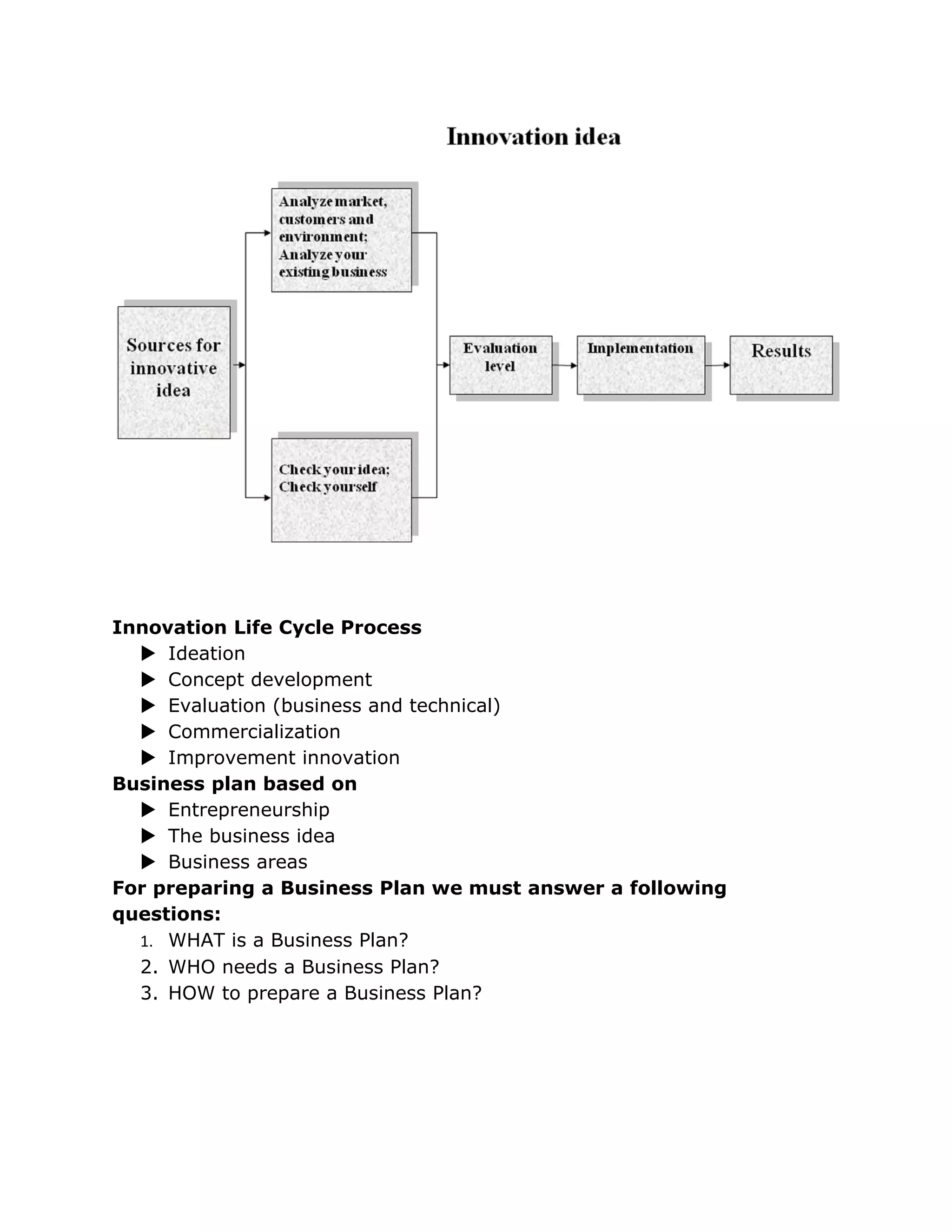
Innovation Life Cycle Process
   Ideation
   Concept development
   Evaluation (business and technical)
   Commercialization
   Improvement innovation
Business plan based on
   Entrepreneurship
   The business idea
   Business areas
For preparing a Business Plan we must answer a following
questions:
  1. WHAT is a Business Plan?
  2. WHO needs a Business Plan?
  3. HOW to prepare a Business Plan?
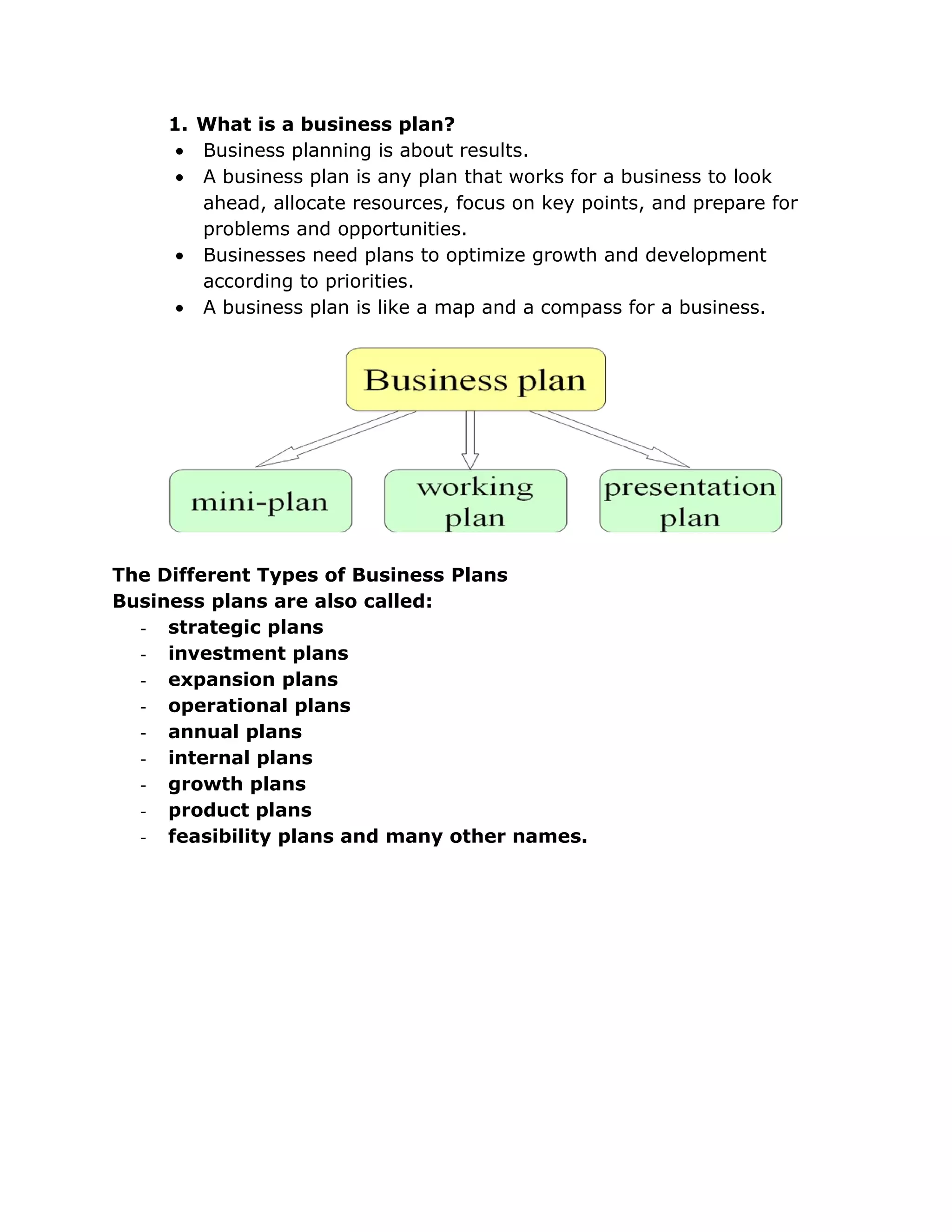
1. What is a business plan?
      • Business planning is about results.
      • A business plan is any plan that works for a business to look
        ahead, allocate resources, focus on key points, and prepare for
        problems and opportunities.
      • Businesses need plans to optimize growth and development
        according to priorities.
      • A business plan is like a map and a compass for a business.


The Different Types of Business Plans
Business plans are also called:
  - strategic plans
  - investment plans
  - expansion plans
  - operational plans
  - annual plans
  - internal plans
  - growth plans
  - product plans
  - feasibility plans and many other names.
1. Who needs a business plan?
You need a business plan if you’re running a business;
You need a business plan if you’re applying for a business loan;
You need a business plan if you’re looking for business investment, new
products or new services;
You need a business plan to communicate with a management team.
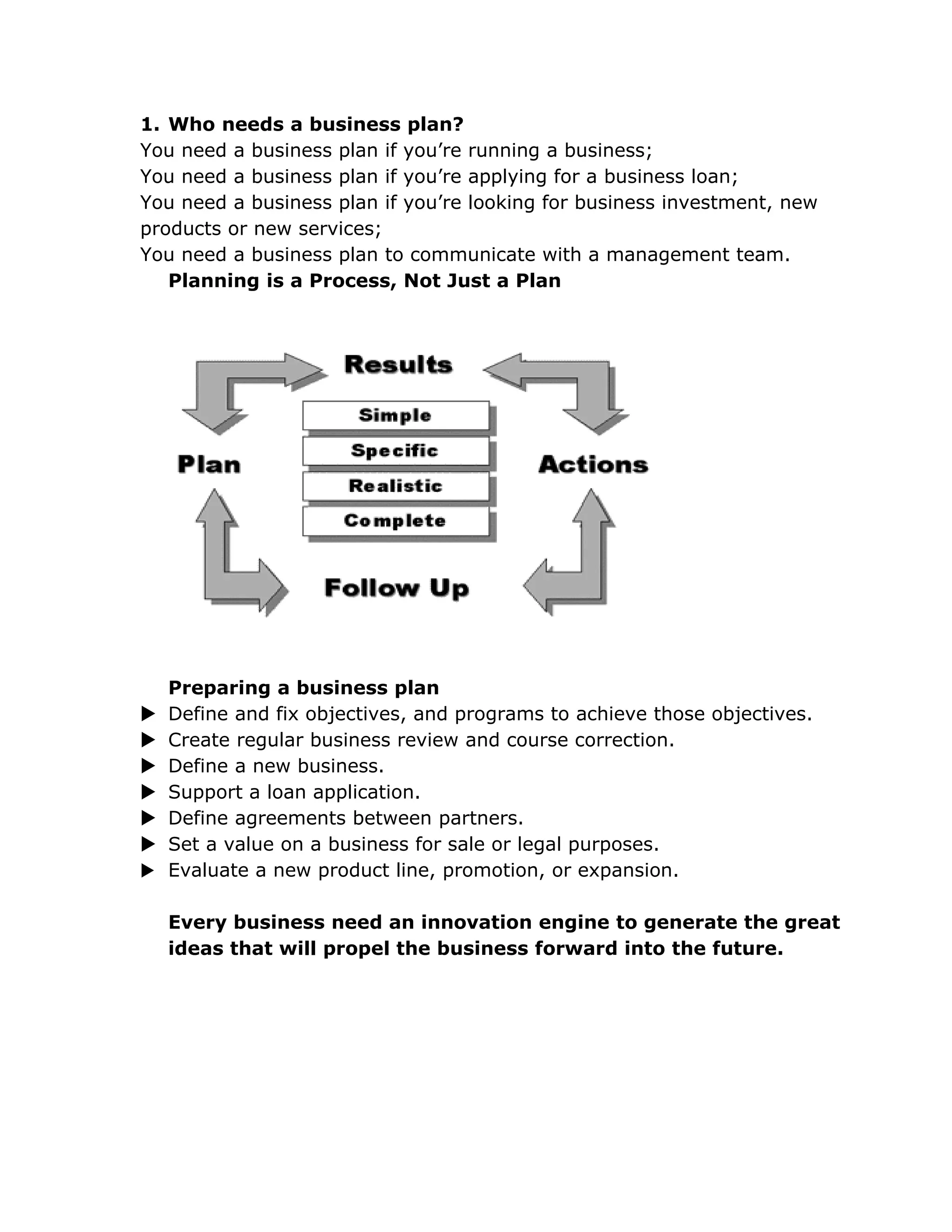
   Planning is a Process, Not Just a Plan


    Preparing a business plan
   Define and fix objectives, and programs to achieve those objectives.
   Create regular business review and course correction.
   Define a new business.
   Support a loan application.
   Define agreements between partners.
   Set a value on a business for sale or legal purposes.
   Evaluate a new product line, promotion, or expansion.

    Every business need an innovation engine to generate the great
    ideas that will propel the business forward into the future.

Innovation And Business Plan

  • 1.
    BUSINESS PLAN Atypical business plan comprises of the following things  Formal statement of a set of business goals.  Reasons why they are believed attainable.  Plan for reaching those goals. DEFINITION  A business plan is a formal statement of a set of business goals, the reasons why they are believed attainable, and the plan for reaching those goals. It also contain background information about the organization or team attempting to reach those goals.  The business goals being attempted may be for- profit or non-profit. For- profit business plans typically focus on financial goals. Non-profit and government agency business plans tend to focus on service goals, although non-profits may also focus on maximizing profit. Business plans may also target changes in perception and branding by the customer, client, tax- payer, or larger community.  If you do decide to seek a business loan for your small business, the first thing you will need is a business plan. You will not get outside funding without a good business plan. It will give the people who loan you money the assurance that you have considered your venture thoroughly and will be able to pay back the loan.  Your business plan should include a brief introduction, including a description of the service or product you intend to provide. Also tell what experience you have in the world of commerce and in this particular type of business. A business Plan performs three functions 1. Action Plan A business plan can help to move you to action. A business plan will help you to pull apart the pieces of starting a business and examine each piece by itself. Writing a business plan can help to move you to action by breaking down a seemingly insurmountable task (starting a business) into many smaller, less intimidating tasks. 2. Road Map A business plan can also serve to help others to understand your vision, including suppliers, customers, employees, friends, and family. A business plan can also serve to help others to understand your vision, including suppliers, customers, employees, friends, and family.
  • 2.
    3. Sales Tool A business plan can serve as a sales tool. A well-written business plan can serve to sell people close to you on the benefits of proceeding with your concept.
  • 3.
    Elements of aSuccessful Business Plan Executive Summary (1 page) Company Overview (~1 page) • Introduction • Mission Statement • History and Current Status • Objectives Product and Service (~1 page) • Features • Benefits • Proprietary Rights • Stage of Development Market and Industry Analysis (~3pages) • Market Size and Growth • Trends • Target Market • Industry Structure • Competitive Environment • Competition • Opportunity Marketing Plan (~4 pages) • Target Market Strategy • Channel • Positioning • Product/Service Strategy • Pricing Strategy • E-commerce • Communication Strategy • Sales Strategy • Revenue Model Operations Plan (~2 pages) • Operations Strategy • Scope of Operations • Ongoing Operations Development Plan (~1 page) • Development Strategy Management (~1 page) • Company Organization • Management Team Competitive Advantage (1 page)
  • 4.
    Financial Plan (~3pages) • Financial Projections • Key Assumptions • Sources and Uses of Funds • Business Risks Funding (1 page) • Funding Requirements • Funding Strategies • Sources and Uses of Funds Statement • Offering Appendices (15 pages max) Required • Key financial assumptions • 5 year Income Statement • 5 year Balance Sheet • 5 year Cash Flow • Monthly & Quarterly Cash Flow Statements • Financial Comps • Resumes of founders and principals Optional • Customer surveys and results • Operations layout • Sample menus, web pages, adverts, etc. • Anything else that will help to illuminate and/or sell your plan These elements of a good business plan will take you a long way toward establishing a successful business. Whether or not you plan to seek outside financial assistance, having thought through and planned these aspects of your business will help you succeed in your new business venture. I hope this helps you in preparing your own unique business plan. So, you know you need a business plan, but what about business plan software? For business planning, there are really three alternatives: 1. crafting your own business plan from scratch 2. hiring a business plan writer or business planning consultant; or
  • 5.
    3. using businessplan software to write your own business plan. Each of these alternatives are their own advantages and disadvantages Executive Summary The Executive Summary of a Business Plan is a one-page distillation of your entire plan, and often is the last section to be written. Despite the title, it is not written for executives, nor is it a summary of the plan. Its objective is to capture the reader’s interest, so that they want to read the entire plan; even better to call you to arrange a meeting. It should be considered a chance to “sell” the reader on the business opportunity.
  • 6.
    Business Plan What doesit mean?  A business plan is a formal statement of a set of business goals, the reasons why they are believed attainable, and the plan for reaching those goals.  The primary value of a business plan will be to create a written outline that evaluates all aspects of the economic viability of a business venture including a description and analysis of a business prospects. Business Plan Format  A Vision Statement  The People  Your Business Profile  Economic Assessment  Cash flow assessment 6 steps to a great business plan!  Basic business concept  Feasibility and specifics  Focus and refine concept  Outline the specifics of your business  Put your plan into a compelling form  Review sample plans How to formulate your business plan  Be flexible early in the process and keep it fluid. Don't commit too early. Expect your first plan to be provisional and subject to revision.  Ask yourself if your experience or expertise gives you the right to an opinion on your specific opportunity.  Identify your potential deal killers: variables that are likely to prove fatal to the venture.  Clearly identify what you see as the key drivers of success. What are you betting on here?  Raise money only in sufficient amount to finance the experiment or evaluation you next envision, with a cushion for contingencies.  Delay hiring key managers until initial rounds of experimentation have produced a stable business model.  At some point, take the plunge and test your product or service on a small scale.  Test and refine your business model before expanding your operations.
  • 7.
    Innovation And Businessplan Innovations and entrepreneurship  Innovation and entrepreneurship are considered in European Union as increasing economics vector, competitiveness and rural development.  The successful entrepreneurial is usually based on a significant innovation.  Innovation activities are one of the important reactions to the challenges. Innovation behavior of the firm  External factors - market environment characteristics - regional institutional characteristics - policy institutions  Internal factors - organizational - personal Entrepreneurship development  Entrepreneurship can be defined as the process of using private initiative to transform a business concept into a new venture or to grow and diversify an existing venture or enterprise with high growth potential.  Entrepreneurs identify an innovation to seize an opportunity, mobilize money and management skills, and take calculated risks to open markets for new products, processes and services.
  • 8.
    Innovation Life CycleProcess  Ideation  Concept development  Evaluation (business and technical)  Commercialization  Improvement innovation Business plan based on  Entrepreneurship  The business idea  Business areas For preparing a Business Plan we must answer a following questions: 1. WHAT is a Business Plan? 2. WHO needs a Business Plan? 3. HOW to prepare a Business Plan?
  • 9.
    1. What isa business plan? • Business planning is about results. • A business plan is any plan that works for a business to look ahead, allocate resources, focus on key points, and prepare for problems and opportunities. • Businesses need plans to optimize growth and development according to priorities. • A business plan is like a map and a compass for a business. The Different Types of Business Plans Business plans are also called: - strategic plans - investment plans - expansion plans - operational plans - annual plans - internal plans - growth plans - product plans - feasibility plans and many other names.
  • 10.
    1. Who needsa business plan? You need a business plan if you’re running a business; You need a business plan if you’re applying for a business loan; You need a business plan if you’re looking for business investment, new products or new services; You need a business plan to communicate with a management team. Planning is a Process, Not Just a Plan Preparing a business plan  Define and fix objectives, and programs to achieve those objectives.  Create regular business review and course correction.  Define a new business.  Support a loan application.  Define agreements between partners.  Set a value on a business for sale or legal purposes.  Evaluate a new product line, promotion, or expansion. Every business need an innovation engine to generate the great ideas that will propel the business forward into the future.