



Module 4: PLANNING A BUSINESS
LESSON 2
TYPES OF
BUSINESS PLAN
Mr. CARLO JUSTINO J. LUNA
Angeles City National Trade School
WHAT IS THE LESSON ABOUT?
This lesson deals with the
different types of business plan.
At the end of the lesson, you should be
able to:
a. enumerate the components of a
business plan; and
b. determine and describe the different
types of business plan
WHAT WILL YOU LEARN?
 A business plan is a formal
statement of business goals, reasons
they are attainable, and plans for
reaching them.
 It may also contain background
information about the organization
or team attempting to reach those
goals.
BUSINESS PLAN
C
WORDS TO STUDY
O M P O N E N T
is a constituent part of the business plan
F
WORDS TO STUDY
E A S I B I L I T Y
S T U D Y
is an analysis and evaluation of a
proposed project to determine its
profitability
M
WORDS TO STUDY
A R K E T I N G
deals with the selling and buying
activities of the business
P
WORDS TO STUDY
R O J E C T
deals with the introduction statement of
the problem
S U M M A R Y
After having learned about
the IMPORTANCE of
business planning, you
must KNOW THE
DIFFERENT TYPES of
business plan.
1. Feasibility Study
2. Concept Paper
3. Business Plan
4. Project Proposal
TYPES
FEASIBILITY
STUDY
 It is created in order to minimize risk
and to ascertain the viability of a
project.
 It is not merely an investigation but a
frame work on how the operation of a
business project shall be accomplished.
 It is used to determine the potential
success of a proposed business venture
FEASIBILITY STUDY
FEASIBILITY STUDY
Will it work? When?
Why?
Where?
How long?
How much?
A feasibility study has a PROJECT
SUMMARY which deals with the:
1. Introductory statement of the
problem
2. Business name
3. Business logo
4. Business location
5. Descriptive definition of the problem
A feasibility study contains five major
components, namely:
a) Marketing study
b) Technical study
c) Management study
d) Financial study
e) Social desirability
COMPONENTS OF FEASIBILITY STUDY
a. MARKETING STUDY
The sufficient demands for the product
as well as the competitive position of
the firm in the industry must be
determined.
COMPONENTS OF FEASIBILITY STUDY
b. TECHNICAL STUDY
In this study, you must consider the
manufacturing process, plant size,
production schedule, machinery, plant
location and layout structure,
raw materials, utilities and
waste disposal.
COMPONENTS OF FEASIBILITY STUDY
c. MANAGEMENT STUDY
This involves on how the project shall
be managed such as the business
organization including the organization
chart and function of each unit
management personnel,
skills and numbers of
labor required.
COMPONENTS OF FEASIBILITY STUDY
d. FINANCIAL STUDY
You should include the assessment of
total capital requirements break-even
outputs, sales and prices, amount of
sales required to earn a
certain amount of profit and
the cash payback period.
COMPONENTS OF FEASIBILITY STUDY
e. SOCIAL DESIRABILITY
This is measured by economic benefits
to the people living in the community
and its vicinities.
COMPONENTS OF FEASIBILITY STUDY
CONCEPT
PAPER
 It is a written plan for a business on
how it will be managed.
 It is a tool to represent a certain
venture anticipating its future.
CONCEPT PAPER
The different parts of the concept paper
are the following:
a) Introduction
b) Objectives
c) Rationale
d) Terms and conditions
e) Recommendations
PARTS OF CONCEPT PAPER
a. INTRODUCTION
This is the part that discusses the
significant details of the product/service
and why the product/service is needed
by the community.
PARTS OF CONCEPT PAPER
b. OBJECTIVES
This part gives the details of the
business both specific and general.
PARTS OF CONCEPT PAPER
c. RATIONALE
This part focuses on the advantages of
putting a certain business.
PARTS OF CONCEPT PAPER
d. TERMS & CONDITIONS
In this part, specific agreement from
particular to general things are
clarified.
PARTS OF CONCEPT PAPER
e. RECOMMENDATIONS
This part is very important because it
helps to improve the project in the
future.
PARTS OF CONCEPT PAPER
 A concept paper is a document written
to convince potential funders to sponsor
a product, program or service.
 Concept papers vary in format and
specifics depending on the organization,
but are generally concise documents
containing information, statistics and
persuasive arguments.
HOW TO WRITE A CONCEPT PAPER
STEPS:
1. Acknowledge the role of the sponsoring
organization.
Demonstrate your knowledge of the
private or public organization by
summarizing the nature of its involvement
in the project.
For example, if the funders are dedicated to
advancing literacy in developing nations,
acknowledge their successful history in this area.
1. Acknowledge the role of the sponsoring
organization.
STEPS:
2. Describe your team or organization.
Explain the core objective of your project.
For example, you may be an instructional software
company that uses software programs to teach
reading skills to disenfranchised populations.
Clearly convey your position as it relates to the
goals of the funding organization.
2. Describe your team or organization.
STEPS:
3. Identify the problem.
Funders read your concept paper because
they have a shared interest in the
problem. Describe the core issue. Explain
the problem in enough detail to convey
your background and expertise with the
issue. If necessary, include data to
demonstrate the extent of the problem.
3. Identify the problem.
STEPS:
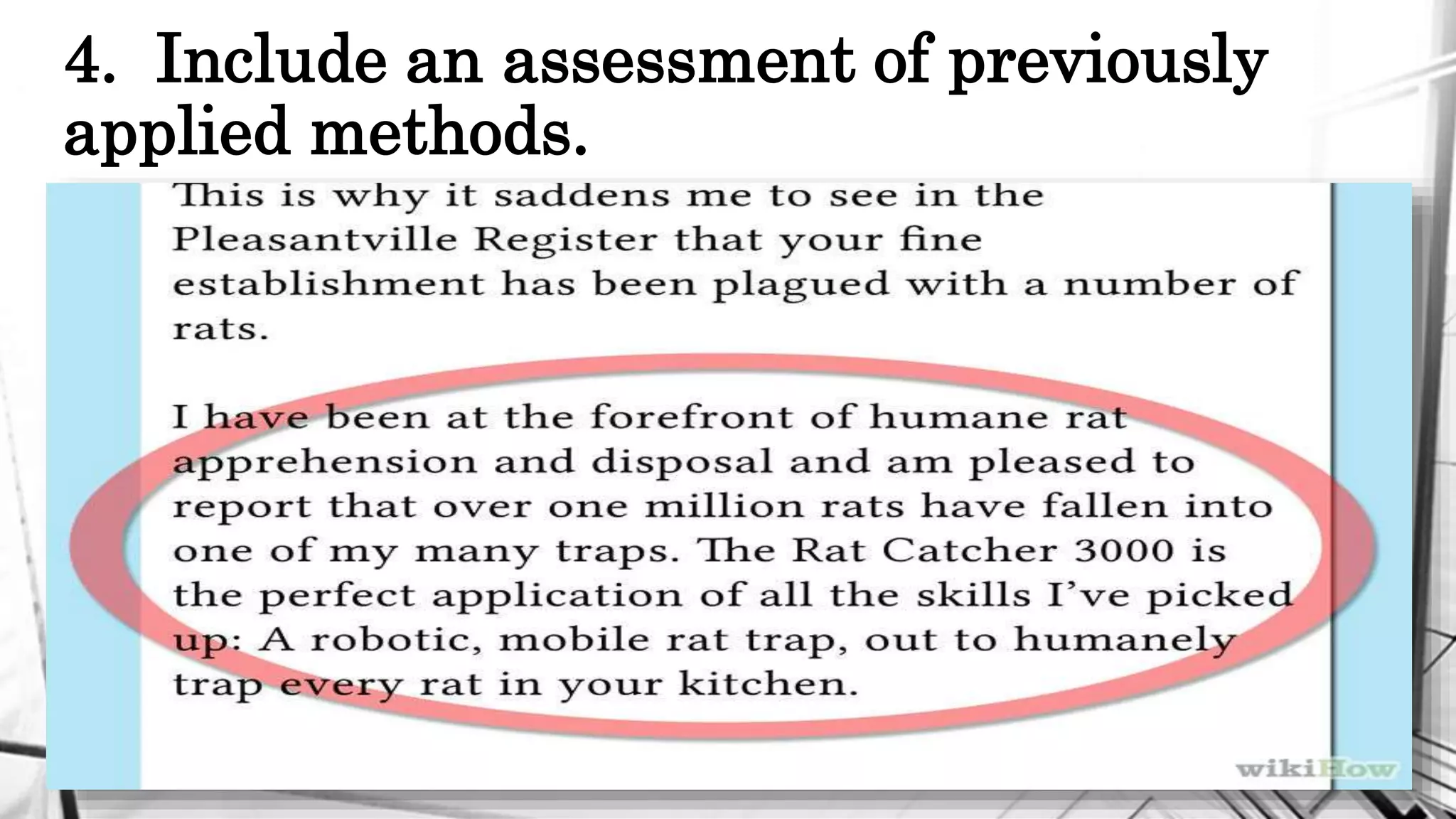
4. Include an assessment of previously
applied methods.
This may be a report of your past
successes with a similar project. Or it may
be a reference to a history of successes
experienced by various organizations who
have applied your specific solution to the
problem.
4. Include an assessment of previously
applied methods.
STEPS:
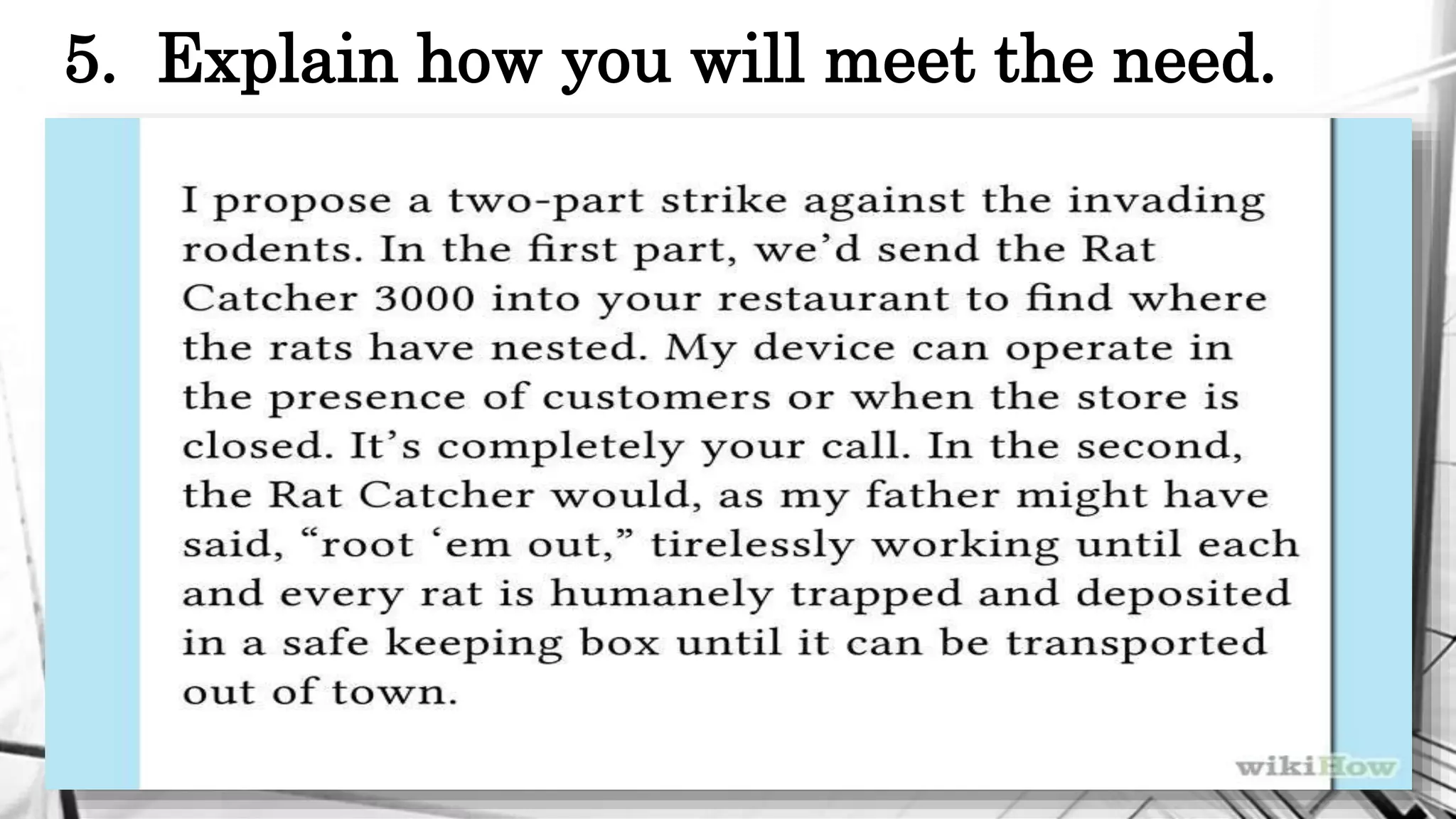
5. Explain how you will meet the need.
Describe the product, service or program.
Be clear and concise. Use language that
the reader will easily understand. Avoid
using technical language for a non-
technical audience.
5. Explain how you will meet the need.
STEPS:
6. Outline your intended objective.
Your solution to the problem may save
money, advance learning or prevent health
issues. Include quantitative details, such
as the number of people who will benefit,
how much time will be saved or the
amount of profit that will be generated.
6. Outline your intended objective.
STEPS:
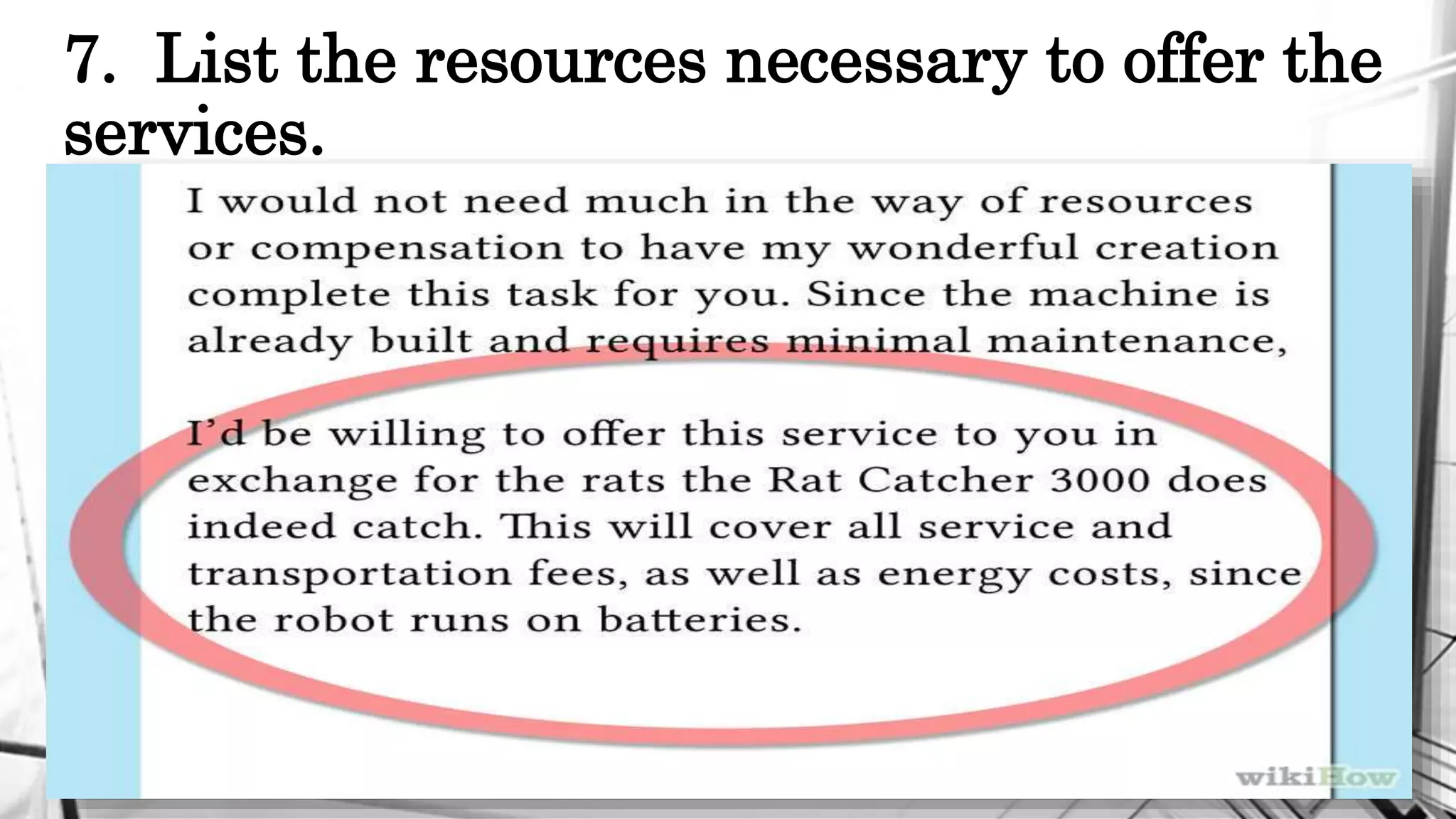
7. List the resources necessary to offer
the services.
This may include a list of materials to
build a product or the type of personnel
required to provide the services. A detailed
list will demonstrate your grasp of the
project's needs and your readiness to
provide the product or service.
7. List the resources necessary to offer the
services.
STEPS:
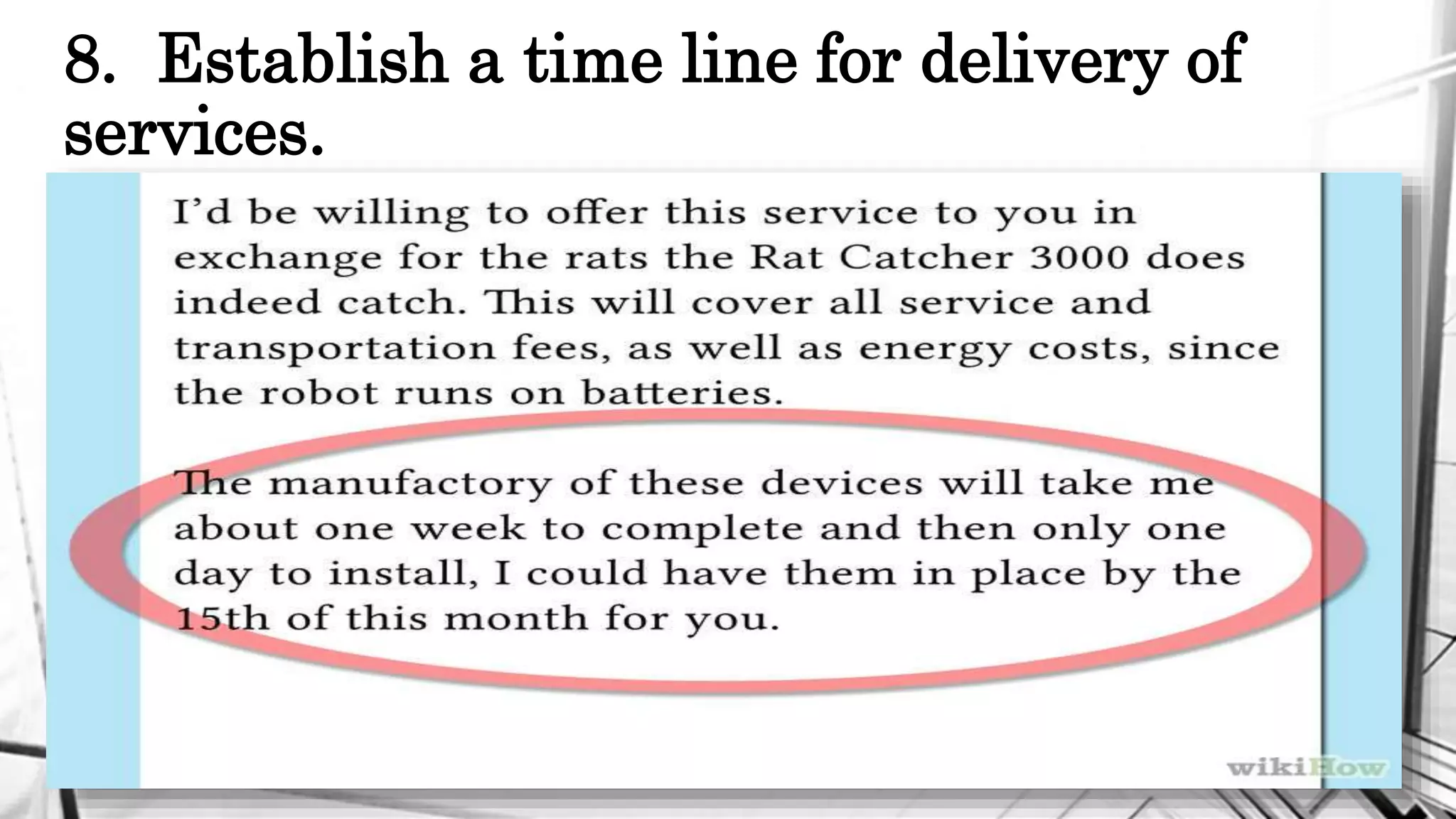
8. Establish a time line for delivery of
services.
Explain how long it will take to build the
product, deliver the service or manage the
project. The time line should be both
realistic and efficient.
8. Establish a time line for delivery of
services.
STEPS:
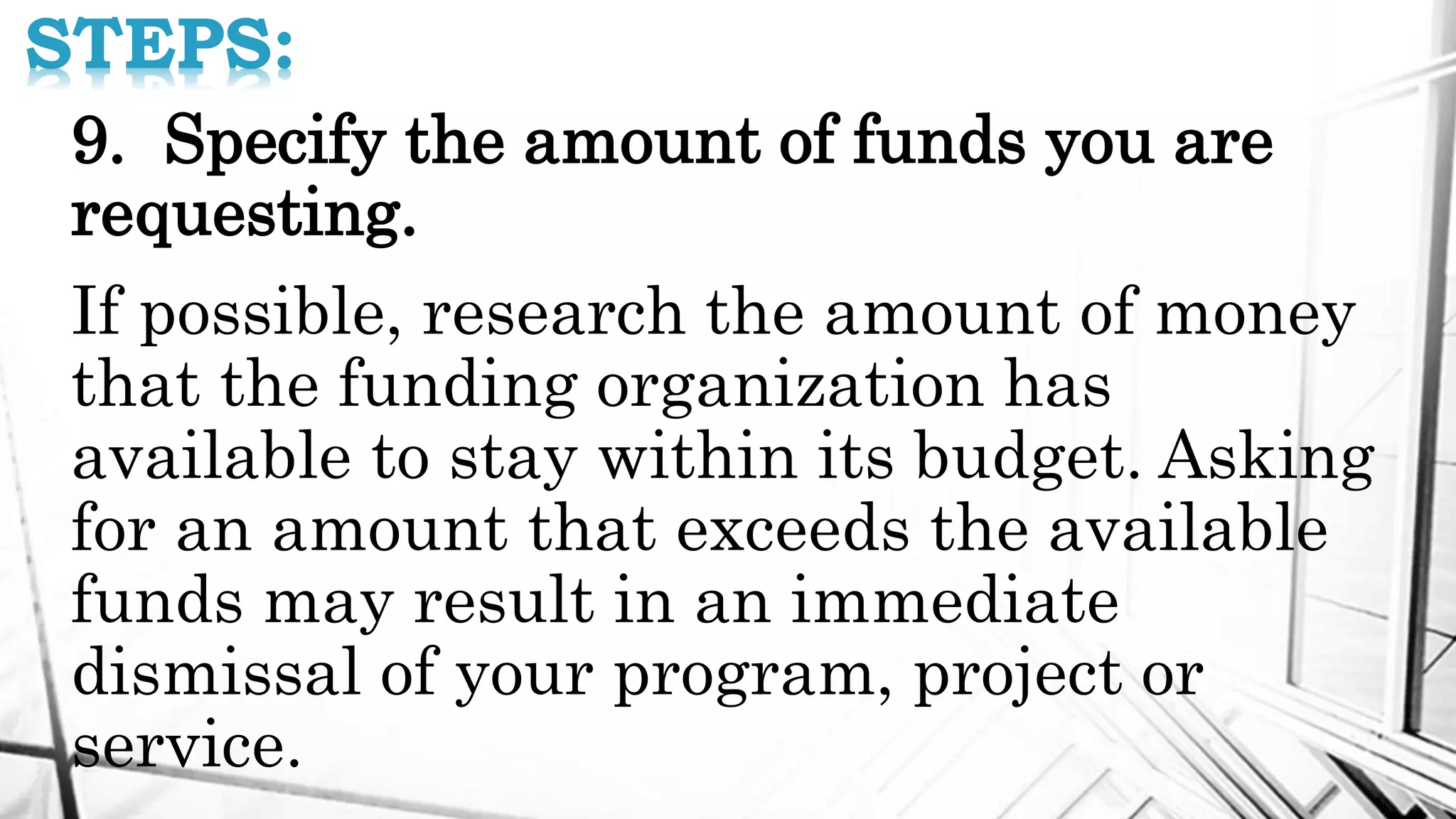
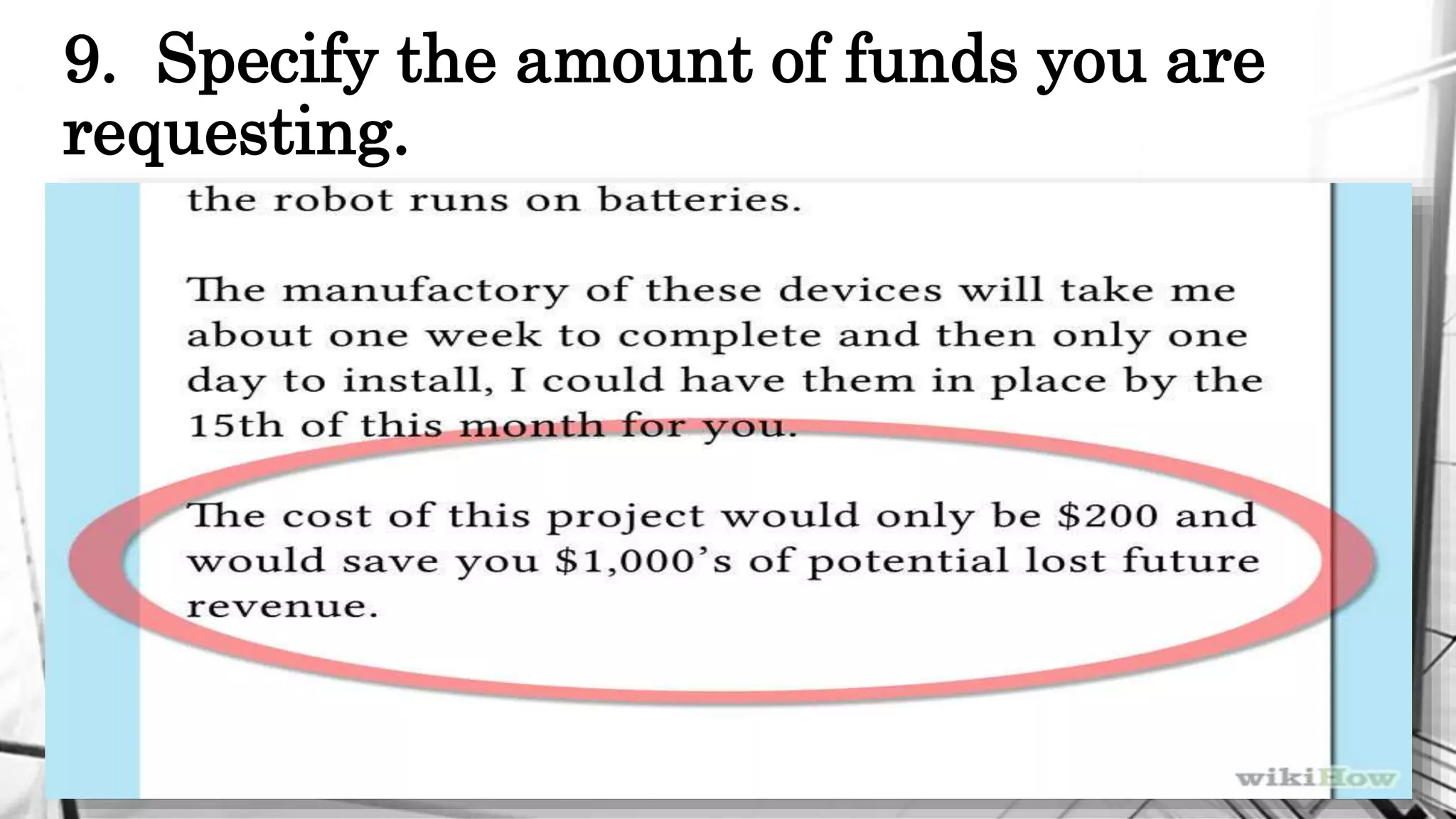
9. Specify the amount of funds you are
requesting.
If possible, research the amount of money
that the funding organization has
available to stay within its budget. Asking
for an amount that exceeds the available
funds may result in an immediate
dismissal of your program, project or
service.
9. Specify the amount of funds you are
requesting.
STEPS:
10. Summarize the concept paper by
describing the outcome.
Close with a few sentences to ensure the
sponsoring organization that an
investment in your team or organization
will meet objectives and solve the specific
problem.
10. Summarize the concept paper by
describing the outcome.
STEPS:
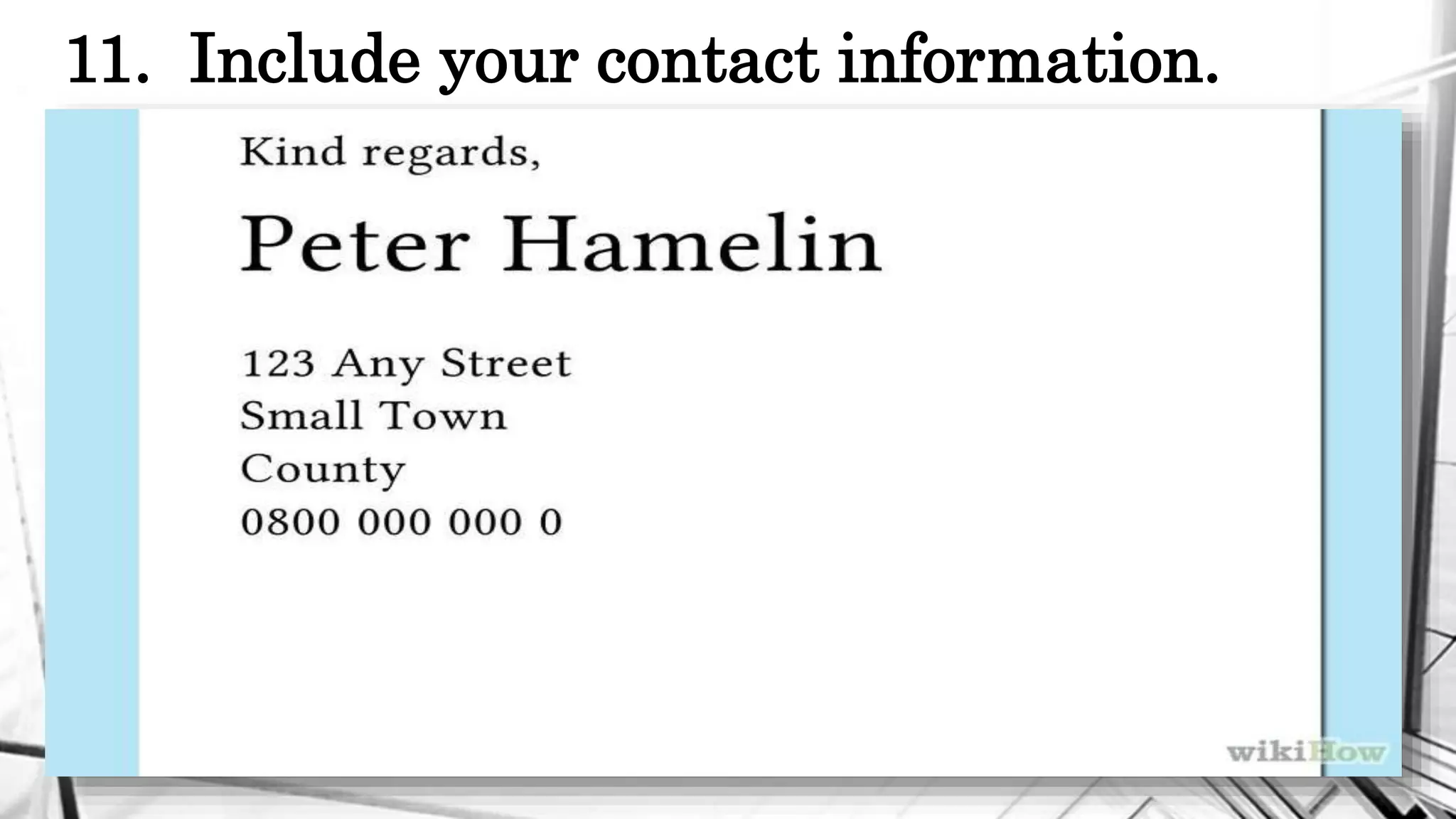
11. Include your contact information.
List your name, address, website, phone
number and email address.
11. Include your contact information.
BUSINESS
PLAN
A business plan describes the nature of
the business, the sales and marketing
strategy, the financial background,
containing a projected profit and loss
statement
BUSINESS PLAN
a) The environment
b) Behavior of the product
c) Location of the business
d) Organizational plan
e) Production plan
f) Financial plan
COMPONENTS OF BUSINESS PLAN
a. THE ENVIRONMENT
The needs of the people in the
community should be identified.
COMPONENTS OF BUSINESS PLAN
b. BEHAVIOR OF THE PRODUCT
You should know the market trends,
product demand in the community, the
resources, quantity and quality goods in
buying.
COMPONENTS OF BUSINESS PLAN
c. LOCATION OF THE BUSINESS
You should consider the place where
customers prefer to buy.
COMPONENTS OF BUSINESS PLAN
d. ORGANIZATIONAL PLAN
The needed workers in the business
must be listed in organizational chart.
COMPONENTS OF BUSINESS PLAN
e. PRODUCTION PLAN
This involves the manpower, money,
machinery, materials and methods to be
able to produce the desired output based
on anticipated profit.
COMPONENTS OF BUSINESS PLAN
f. FINANCIAL PLAN
You, as an entrepreneur, need to
determine the fiscal needs of the
business and the sources of needed
funds.
COMPONENTS OF BUSINESS PLAN
PROJECT
PROPOSAL
This is the initial
document that converts an
idea or policy into the
details of a potential
project.
PROJECT PROPOSAL
a) Executive Summary
b) Justification
c) Procedure
d) Objectives
e) Project Organization &
Management
f) Budget
PARTS OF A BUSINESS PROPOSAL
a. EXECUTIVE SUMMARY
The overview of the proposal from
beginning to end should be stated in the
project proposal.
PARTS OF A BUSINESS PROPOSAL
b. JUSTIFICATION
This emphasizes the need of the
proposal.
PARTS OF A BUSINESS PROPOSAL
c. PROCEDURE
The steps are being explained where to
start and to end.
PARTS OF A BUSINESS PROPOSAL
d. OBJECTIVES
The goals or targets of the business are
defined.
PARTS OF A BUSINESS PROPOSAL
e. PROJECT ORGANIZATION and
MANAGEMENT
The manpower and function of each are
clearly stated.
PARTS OF A BUSINESS PROPOSAL
f. BUDGET
You should determine the source for the
input and output, the profits and the
loss of the business.
PARTS OF A BUSINESS PROPOSAL
LET’S APPLY
WHAT YOU
HAVE LEARNED
Directions: Think of a service
type of business which you feel
is a good venture to invest on.
APPLICATION
PART 1: Make your own concept paper to
support your business ideas and plans.
Title of your concept paper:
Introduction:
Objectives:
Rationale:
Terms and conditions:
Recommendations:
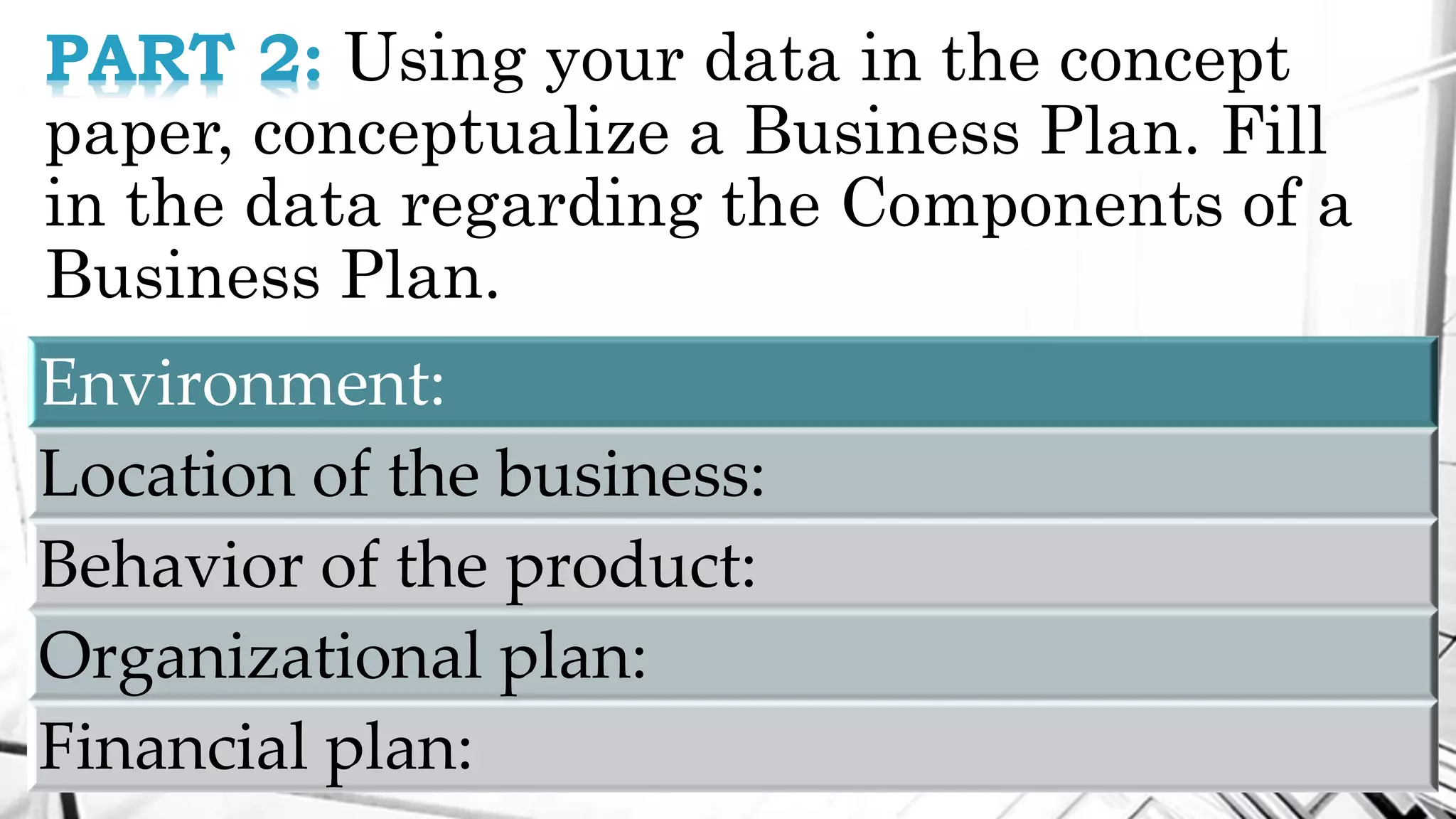
PART 2: Using your data in the concept
paper, conceptualize a Business Plan. Fill
in the data regarding the Components of a
Business Plan.
Environment:
Location of the business:
Behavior of the product:
Organizational plan:
Financial plan:

Types of Business Plan

  • 1.
    Module 4: PLANNINGA BUSINESS LESSON 2 TYPES OF BUSINESS PLAN Mr. CARLO JUSTINO J. LUNA Angeles City National Trade School
  • 2.
    WHAT IS THELESSON ABOUT? This lesson deals with the different types of business plan.
  • 3.
    At the endof the lesson, you should be able to: a. enumerate the components of a business plan; and b. determine and describe the different types of business plan WHAT WILL YOU LEARN?
  • 4.
     A businessplan is a formal statement of business goals, reasons they are attainable, and plans for reaching them.  It may also contain background information about the organization or team attempting to reach those goals. BUSINESS PLAN
  • 5.
    C WORDS TO STUDY OM P O N E N T is a constituent part of the business plan
  • 6.
    F WORDS TO STUDY EA S I B I L I T Y S T U D Y is an analysis and evaluation of a proposed project to determine its profitability
  • 7.
    M WORDS TO STUDY AR K E T I N G deals with the selling and buying activities of the business
  • 8.
    P WORDS TO STUDY RO J E C T deals with the introduction statement of the problem S U M M A R Y
  • 9.
    After having learnedabout the IMPORTANCE of business planning, you must KNOW THE DIFFERENT TYPES of business plan.
  • 10.
    1. Feasibility Study 2.Concept Paper 3. Business Plan 4. Project Proposal TYPES
  • 11.
  • 12.
     It iscreated in order to minimize risk and to ascertain the viability of a project.  It is not merely an investigation but a frame work on how the operation of a business project shall be accomplished.  It is used to determine the potential success of a proposed business venture FEASIBILITY STUDY
  • 13.
    FEASIBILITY STUDY Will itwork? When? Why? Where? How long? How much?
  • 14.
    A feasibility studyhas a PROJECT SUMMARY which deals with the: 1. Introductory statement of the problem 2. Business name 3. Business logo 4. Business location 5. Descriptive definition of the problem
  • 15.
    A feasibility studycontains five major components, namely: a) Marketing study b) Technical study c) Management study d) Financial study e) Social desirability COMPONENTS OF FEASIBILITY STUDY
  • 16.
    a. MARKETING STUDY Thesufficient demands for the product as well as the competitive position of the firm in the industry must be determined. COMPONENTS OF FEASIBILITY STUDY
  • 17.
    b. TECHNICAL STUDY Inthis study, you must consider the manufacturing process, plant size, production schedule, machinery, plant location and layout structure, raw materials, utilities and waste disposal. COMPONENTS OF FEASIBILITY STUDY
  • 18.
    c. MANAGEMENT STUDY Thisinvolves on how the project shall be managed such as the business organization including the organization chart and function of each unit management personnel, skills and numbers of labor required. COMPONENTS OF FEASIBILITY STUDY
  • 19.
    d. FINANCIAL STUDY Youshould include the assessment of total capital requirements break-even outputs, sales and prices, amount of sales required to earn a certain amount of profit and the cash payback period. COMPONENTS OF FEASIBILITY STUDY
  • 20.
    e. SOCIAL DESIRABILITY Thisis measured by economic benefits to the people living in the community and its vicinities. COMPONENTS OF FEASIBILITY STUDY
  • 21.
  • 22.
     It isa written plan for a business on how it will be managed.  It is a tool to represent a certain venture anticipating its future. CONCEPT PAPER
  • 23.
    The different partsof the concept paper are the following: a) Introduction b) Objectives c) Rationale d) Terms and conditions e) Recommendations PARTS OF CONCEPT PAPER
  • 24.
    a. INTRODUCTION This isthe part that discusses the significant details of the product/service and why the product/service is needed by the community. PARTS OF CONCEPT PAPER
  • 25.
    b. OBJECTIVES This partgives the details of the business both specific and general. PARTS OF CONCEPT PAPER
  • 26.
    c. RATIONALE This partfocuses on the advantages of putting a certain business. PARTS OF CONCEPT PAPER
  • 27.
    d. TERMS &CONDITIONS In this part, specific agreement from particular to general things are clarified. PARTS OF CONCEPT PAPER
  • 28.
    e. RECOMMENDATIONS This partis very important because it helps to improve the project in the future. PARTS OF CONCEPT PAPER
  • 29.
     A conceptpaper is a document written to convince potential funders to sponsor a product, program or service.  Concept papers vary in format and specifics depending on the organization, but are generally concise documents containing information, statistics and persuasive arguments. HOW TO WRITE A CONCEPT PAPER
  • 30.
    STEPS: 1. Acknowledge therole of the sponsoring organization. Demonstrate your knowledge of the private or public organization by summarizing the nature of its involvement in the project. For example, if the funders are dedicated to advancing literacy in developing nations, acknowledge their successful history in this area.
  • 31.
    1. Acknowledge therole of the sponsoring organization.
  • 32.
    STEPS: 2. Describe yourteam or organization. Explain the core objective of your project. For example, you may be an instructional software company that uses software programs to teach reading skills to disenfranchised populations. Clearly convey your position as it relates to the goals of the funding organization.
  • 33.
    2. Describe yourteam or organization.
  • 34.
    STEPS: 3. Identify theproblem. Funders read your concept paper because they have a shared interest in the problem. Describe the core issue. Explain the problem in enough detail to convey your background and expertise with the issue. If necessary, include data to demonstrate the extent of the problem.
  • 35.
  • 36.
    STEPS: 4. Include anassessment of previously applied methods. This may be a report of your past successes with a similar project. Or it may be a reference to a history of successes experienced by various organizations who have applied your specific solution to the problem.
  • 37.
    4. Include anassessment of previously applied methods.
  • 38.
    STEPS: 5. Explain howyou will meet the need. Describe the product, service or program. Be clear and concise. Use language that the reader will easily understand. Avoid using technical language for a non- technical audience.
  • 39.
    5. Explain howyou will meet the need.
  • 40.
    STEPS: 6. Outline yourintended objective. Your solution to the problem may save money, advance learning or prevent health issues. Include quantitative details, such as the number of people who will benefit, how much time will be saved or the amount of profit that will be generated.
  • 41.
    6. Outline yourintended objective.
  • 42.
    STEPS: 7. List theresources necessary to offer the services. This may include a list of materials to build a product or the type of personnel required to provide the services. A detailed list will demonstrate your grasp of the project's needs and your readiness to provide the product or service.
  • 43.
    7. List theresources necessary to offer the services.
  • 44.
    STEPS: 8. Establish atime line for delivery of services. Explain how long it will take to build the product, deliver the service or manage the project. The time line should be both realistic and efficient.
  • 45.
    8. Establish atime line for delivery of services.
  • 46.
    STEPS: 9. Specify theamount of funds you are requesting. If possible, research the amount of money that the funding organization has available to stay within its budget. Asking for an amount that exceeds the available funds may result in an immediate dismissal of your program, project or service.
  • 47.
    9. Specify theamount of funds you are requesting.
  • 48.
    STEPS: 10. Summarize theconcept paper by describing the outcome. Close with a few sentences to ensure the sponsoring organization that an investment in your team or organization will meet objectives and solve the specific problem.
  • 49.
    10. Summarize theconcept paper by describing the outcome.
  • 50.
    STEPS: 11. Include yourcontact information. List your name, address, website, phone number and email address.
  • 51.
    11. Include yourcontact information.
  • 52.
  • 53.
    A business plandescribes the nature of the business, the sales and marketing strategy, the financial background, containing a projected profit and loss statement BUSINESS PLAN
  • 54.
    a) The environment b)Behavior of the product c) Location of the business d) Organizational plan e) Production plan f) Financial plan COMPONENTS OF BUSINESS PLAN
  • 55.
    a. THE ENVIRONMENT Theneeds of the people in the community should be identified. COMPONENTS OF BUSINESS PLAN
  • 56.
    b. BEHAVIOR OFTHE PRODUCT You should know the market trends, product demand in the community, the resources, quantity and quality goods in buying. COMPONENTS OF BUSINESS PLAN
  • 57.
    c. LOCATION OFTHE BUSINESS You should consider the place where customers prefer to buy. COMPONENTS OF BUSINESS PLAN
  • 58.
    d. ORGANIZATIONAL PLAN Theneeded workers in the business must be listed in organizational chart. COMPONENTS OF BUSINESS PLAN
  • 59.
    e. PRODUCTION PLAN Thisinvolves the manpower, money, machinery, materials and methods to be able to produce the desired output based on anticipated profit. COMPONENTS OF BUSINESS PLAN
  • 60.
    f. FINANCIAL PLAN You,as an entrepreneur, need to determine the fiscal needs of the business and the sources of needed funds. COMPONENTS OF BUSINESS PLAN
  • 61.
  • 62.
    This is theinitial document that converts an idea or policy into the details of a potential project. PROJECT PROPOSAL
  • 63.
    a) Executive Summary b)Justification c) Procedure d) Objectives e) Project Organization & Management f) Budget PARTS OF A BUSINESS PROPOSAL
  • 64.
    a. EXECUTIVE SUMMARY Theoverview of the proposal from beginning to end should be stated in the project proposal. PARTS OF A BUSINESS PROPOSAL
  • 65.
    b. JUSTIFICATION This emphasizesthe need of the proposal. PARTS OF A BUSINESS PROPOSAL
  • 66.
    c. PROCEDURE The stepsare being explained where to start and to end. PARTS OF A BUSINESS PROPOSAL
  • 67.
    d. OBJECTIVES The goalsor targets of the business are defined. PARTS OF A BUSINESS PROPOSAL
  • 68.
    e. PROJECT ORGANIZATIONand MANAGEMENT The manpower and function of each are clearly stated. PARTS OF A BUSINESS PROPOSAL
  • 69.
    f. BUDGET You shoulddetermine the source for the input and output, the profits and the loss of the business. PARTS OF A BUSINESS PROPOSAL
  • 70.
  • 71.
    Directions: Think ofa service type of business which you feel is a good venture to invest on. APPLICATION
  • 72.
    PART 1: Makeyour own concept paper to support your business ideas and plans. Title of your concept paper: Introduction: Objectives: Rationale: Terms and conditions: Recommendations:
  • 73.
    PART 2: Usingyour data in the concept paper, conceptualize a Business Plan. Fill in the data regarding the Components of a Business Plan. Environment: Location of the business: Behavior of the product: Organizational plan: Financial plan: