Business Plans
  Introduction
Why a Business Plan?

 Strategic   Guide

 Lenders


 Investors
Strategic Guide
 Where  Do You Want To Go?
 How Are You Going to Get There?
 What Market Niches?
 How Much is it Going to Cost?
 Greatest Profit Opportunity?
Lender Expectations
 Good  Business Track Record
 Ability to Repay
 Staying Power
 Collateral
Investor Expectations
 Competitive  Advantage
 Huge Market
 Strong Management Team
 Strong Marketing and Sales Plan
 Exit Strategy
Entrepreneurs Start Businesses:
 To Capitalize on an Invention
 To Be Their Own Boss
 To Get Rich


---All Need an Exit Strategy
Funding Sources:
 Savings
 Friends and Family
 Financial Institutions / Banks
 Angel Investors
 Venture Capital
Business Planning
A  business plan is a formal statement of a
 set of business goals, the reasons they are
 believed attainable, and the plan for
 reaching those goals. It may also contain
 background information about the
 organization or team attempting to reach
 those goals.
STRATEGIC PLANNNING
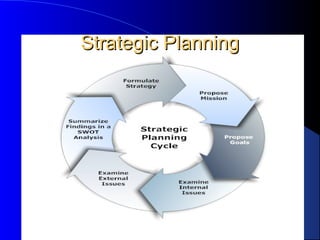
   Strategic planning is an organization's process of
    defining its strategy, or direction, and making decisions
     on allocating its resources to pursue this strategy. In
    order to determine the direction of the organization, it is
    necessary to understand its current position and the
    possible avenues through which it can pursue a particular
    course of action. Generally, strategic planning deals with
    at least one of three key questions:
   "What do we do?"
   "For whom do we do it?"
   "How do we excel?"
Strategic Planning
Business planning VS Strategic
               Planning
   A strategic plan is primarily used for implementing and
    managing the strategic direction of an existing
    organization. A business plan is used to initially start a
    business, obtain funding, or direct operations.
   A strategic plan is for established businesses, organizations
    and business owners that are serious about growing their
    organization. Whereas a business plan could be for new
    businesses and entrepreneurs who are startups.
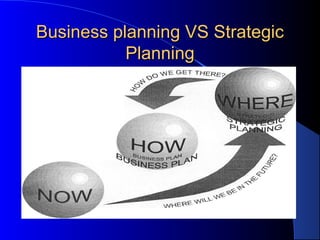
   A strategic plan is used to provide focus, direction and
    action in order to move the organization from where they
    are now to where they want to go. Whereas a business
    plan is used to provide a structure for ideas in order to
    initially define the business.
Cont….
A   strategic plan is used to communicate the
  direction of the organization to the staff and
  stakeholders. However, a business plan is
  used to present the entrepreneur’s ideas to a
  bank.
 A strategic plan is critical to prioritizing
  resources (time, money and people) to grow
  the revenue and increase the return on
  investment. Whereas a business plan is
  critical if the business is seeking funding. s
Business planning VS Strategic
           Planning
Business Plan Content
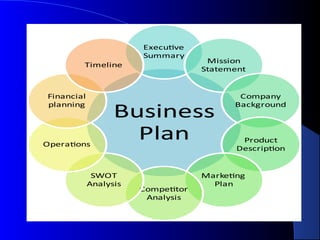
 Executive Summary
 Company Description
 Product/Services Description
 Industry Overview
 Market Analysis
 Competitors
Business Plan Content
 Customers
 Marketing  and Sales Plans
 Development
 Operations
 Management
Business Plan Content
 Personnel
 Financial Summary
 Financials
 Offering
 Appendices
Executive Summary

A   mini-business plan in one or two pages
 Highlights the most important points of your
  business plan
 It is NOT an introduction to the plan
Executive Summary
 Identify  the company, its background, structure
  and location
 Describe what the company does, and the market
  it serves
 Describe the market potential for the company’s
  products and services, market trends, etc.
Executive Summary

 Outline
        the backgrounds and experience of the top
  management team

 Describe  the funding required, the purposes for
  which it will be used, the collateral available (if
  for a lender), and the expected outcomes
Company Overview

 Brief   Company Introduction
  – Mission statement
  – Location, size, history
  – Market and products
  – Overview of company capabilities
  – Objectives
Products/Services
 Products   / Services
  – What does it do?
  – Uniqueness
  – Competitive Advantage
 Technology
  – Brief description
  – Applications
 Commercialization       Status
  – Brief overview
Industry Overview
 SetThe Stage
 Industry Definition and Description
   – Major players within the industry
   – Factors driving dynamics
   – New products and developments
 Legislation and Policies Driving the Industry
 Historical and Future Trends
Market Analysis
 Market   Definition
  – Primary Market
  – Secondary Markets


 Market   Size and Trends
  – Current total revenues
  – Predicted annual growth rate
Competitors
 Direct   Competitors
   – Who are they?
   – Size and product breadth
   – Revenues and profitability
   – Strengths and weaknesses
   – Market shares
 Indirect   Competitors
Indirect competitors in the business world are
  those businesses that don't necessarily sell
  the same products but offer different
  alternatives to satisfying the same customer
  need.
Customers
 Customer   Characteristics
  – Who are they?
  – Why do they buy?
  – Need satisfied by the product/service
  – How is the need currently filled?
  – What are the alternatives?
  – Who makes the decision to buy?
  – How frequently do they purchase?
Marketing and Sales Plans
 Statement  of Opportunity
 Marketing and Sales Objectives
 Existing Customers
 Potential Customers
   – Prospects targeted
   – How prospects will be targeted and qualified
Marketing Strategies
 Product/Service   Strategy
 Pricing Strategy
 Distribution Strategy
 Advertising and Promotion Strategy
 Sales Strategy
 Marketing and Sales Forecasts
Marketing and Sales Plans
 Marketing     Programs
   –   Direct Mail
   –   Trade Shows
   –   Advertising
   –   Internet
   –   Publicity/Public Relations
   –   Marketing Budget
 Pricing
   – Basis for targeted price point
   – Margins and profitability by volume levels
Marketing and Sales Plans
 Sales   Plan
  – Sales force structure – (direct or reps)
  – Sales expectations/quotas
  – Margins given to intermediaries
  – Service and warranties
  – Sales Budget
  – Organizational chart indicating planned growth
Development
R   & D Plan
 – Objectives
 – Milestones and current status
 – Difficulties and risks
 – Staffing
 – R & D Budget and assumptions
Operations
 Manufacturing/Production   Plan
  – Objectives
  – Facilities
  – Staffing
  – Subcontractors
  – Quality Control
  – Budget / Operating Expenses
Management

 Company  Organization
 Management Team
 Administrative Expenses
Management Team
 President
 VP Finance
 VP Sales
 VP Marketing
 VP Manufacturing
 Board of Advisors
Personnel
 Human   Resource Plan
  – Staffing Objectives
  – Organizational Structure
  – 3-5 year growth plan
  – Budget
Summary of Financials
 Financial   Objectives
   – Time to Cash Flow Positive
   – Time to profitability
 FinancialAssumptions
 Capital Requirements
 Exit Scenario
Financials

 Pro-forma Cash Flow Projections
 Pro-forma Profit & Loss Statements
 Pro-forma Balance Sheet
Offering

 InvestmentRequirements
 Pro-forma Valuation of Business
 Offer
Appendices
 Resumes   of Key Management
 Patent Information
 Customer List
 Testimonials
 Supplemental Financial Spreadsheets
 References
Questions?

Ch 01 -Introduction to bpp by A.A Mugheri

  • 1.
    Business Plans Introduction
  • 2.
    Why a BusinessPlan?  Strategic Guide  Lenders  Investors
  • 3.
    Strategic Guide  Where Do You Want To Go?  How Are You Going to Get There?  What Market Niches?  How Much is it Going to Cost?  Greatest Profit Opportunity?
  • 4.
    Lender Expectations  Good Business Track Record  Ability to Repay  Staying Power  Collateral
  • 5.
    Investor Expectations  Competitive Advantage  Huge Market  Strong Management Team  Strong Marketing and Sales Plan  Exit Strategy
  • 6.
    Entrepreneurs Start Businesses: To Capitalize on an Invention  To Be Their Own Boss  To Get Rich ---All Need an Exit Strategy
  • 7.
    Funding Sources:  Savings Friends and Family  Financial Institutions / Banks  Angel Investors  Venture Capital
  • 8.
    Business Planning A business plan is a formal statement of a set of business goals, the reasons they are believed attainable, and the plan for reaching those goals. It may also contain background information about the organization or team attempting to reach those goals.
  • 10.
    STRATEGIC PLANNNING  Strategic planning is an organization's process of defining its strategy, or direction, and making decisions on allocating its resources to pursue this strategy. In order to determine the direction of the organization, it is necessary to understand its current position and the possible avenues through which it can pursue a particular course of action. Generally, strategic planning deals with at least one of three key questions:  "What do we do?"  "For whom do we do it?"  "How do we excel?"
  • 11.
  • 12.
    Business planning VSStrategic Planning  A strategic plan is primarily used for implementing and managing the strategic direction of an existing organization. A business plan is used to initially start a business, obtain funding, or direct operations.  A strategic plan is for established businesses, organizations and business owners that are serious about growing their organization. Whereas a business plan could be for new businesses and entrepreneurs who are startups.  A strategic plan is used to provide focus, direction and action in order to move the organization from where they are now to where they want to go. Whereas a business plan is used to provide a structure for ideas in order to initially define the business.
  • 13.
    Cont…. A strategic plan is used to communicate the direction of the organization to the staff and stakeholders. However, a business plan is used to present the entrepreneur’s ideas to a bank.  A strategic plan is critical to prioritizing resources (time, money and people) to grow the revenue and increase the return on investment. Whereas a business plan is critical if the business is seeking funding. s
  • 14.
    Business planning VSStrategic Planning
  • 15.
    Business Plan Content Executive Summary  Company Description  Product/Services Description  Industry Overview  Market Analysis  Competitors
  • 16.
    Business Plan Content Customers  Marketing and Sales Plans  Development  Operations  Management
  • 17.
    Business Plan Content Personnel  Financial Summary  Financials  Offering  Appendices
  • 18.
    Executive Summary A mini-business plan in one or two pages  Highlights the most important points of your business plan  It is NOT an introduction to the plan
  • 19.
    Executive Summary  Identify the company, its background, structure and location  Describe what the company does, and the market it serves  Describe the market potential for the company’s products and services, market trends, etc.
  • 20.
    Executive Summary  Outline the backgrounds and experience of the top management team  Describe the funding required, the purposes for which it will be used, the collateral available (if for a lender), and the expected outcomes
  • 21.
    Company Overview  Brief Company Introduction – Mission statement – Location, size, history – Market and products – Overview of company capabilities – Objectives
  • 22.
    Products/Services  Products / Services – What does it do? – Uniqueness – Competitive Advantage  Technology – Brief description – Applications  Commercialization Status – Brief overview
  • 23.
    Industry Overview  SetTheStage  Industry Definition and Description – Major players within the industry – Factors driving dynamics – New products and developments  Legislation and Policies Driving the Industry  Historical and Future Trends
  • 24.
    Market Analysis  Market Definition – Primary Market – Secondary Markets  Market Size and Trends – Current total revenues – Predicted annual growth rate
  • 25.
    Competitors  Direct Competitors – Who are they? – Size and product breadth – Revenues and profitability – Strengths and weaknesses – Market shares  Indirect Competitors Indirect competitors in the business world are those businesses that don't necessarily sell the same products but offer different alternatives to satisfying the same customer need.
  • 26.
    Customers  Customer Characteristics – Who are they? – Why do they buy? – Need satisfied by the product/service – How is the need currently filled? – What are the alternatives? – Who makes the decision to buy? – How frequently do they purchase?
  • 27.
    Marketing and SalesPlans  Statement of Opportunity  Marketing and Sales Objectives  Existing Customers  Potential Customers – Prospects targeted – How prospects will be targeted and qualified
  • 28.
    Marketing Strategies  Product/Service Strategy  Pricing Strategy  Distribution Strategy  Advertising and Promotion Strategy  Sales Strategy  Marketing and Sales Forecasts
  • 29.
    Marketing and SalesPlans  Marketing Programs – Direct Mail – Trade Shows – Advertising – Internet – Publicity/Public Relations – Marketing Budget  Pricing – Basis for targeted price point – Margins and profitability by volume levels
  • 30.
    Marketing and SalesPlans  Sales Plan – Sales force structure – (direct or reps) – Sales expectations/quotas – Margins given to intermediaries – Service and warranties – Sales Budget – Organizational chart indicating planned growth
  • 31.
    Development R & D Plan – Objectives – Milestones and current status – Difficulties and risks – Staffing – R & D Budget and assumptions
  • 32.
    Operations  Manufacturing/Production Plan – Objectives – Facilities – Staffing – Subcontractors – Quality Control – Budget / Operating Expenses
  • 33.
    Management  Company Organization  Management Team  Administrative Expenses
  • 34.
    Management Team  President VP Finance  VP Sales  VP Marketing  VP Manufacturing  Board of Advisors
  • 35.
    Personnel  Human Resource Plan – Staffing Objectives – Organizational Structure – 3-5 year growth plan – Budget
  • 36.
    Summary of Financials Financial Objectives – Time to Cash Flow Positive – Time to profitability  FinancialAssumptions  Capital Requirements  Exit Scenario
  • 37.
    Financials  Pro-forma CashFlow Projections  Pro-forma Profit & Loss Statements  Pro-forma Balance Sheet
  • 38.
  • 39.
    Appendices  Resumes of Key Management  Patent Information  Customer List  Testimonials  Supplemental Financial Spreadsheets  References
  • 40.