Starting, Growing
      & Sustaining Your Business


Bashir Abolore Muse   08033623996
Starting Your
  Business
How Do I Come up with A Winning
             Business Idea
    Create a vision
     Close your eyes for a few minutes and
      conjure up a detailed image of what you
      want your life to look like in 5 years. Be as
      specific as possible.
     Where do you live?
     How do you spend your days?
     What kind of work do you do?
     Do you work alone or with other people?
     Who are you surrounded by?
     What do you do when you aren't working?
3
How Do I Come up with A Winning Business Idea
     Don't limit yourself to these questions; create a
      vivid vision of yourself, touching on things that are
      important to you. These are all personal issues
      that will impact the type of business you pursue -
      being a city or country person; wanting to travel
      or sit at your computer; liking to meet people or
      work on the phone. This activity will help you
      create a foundation for choosing from small
      business ideas, making business decisions, and
      setting clear goals.
     It is best to do this exercise with someone else
      and share your vision. If you can't, write it down to
4
      make your vision more concrete.
(How Do I Come up with A Winning Business
                      Idea)
    Determine what you're good at and
      what you like to do
     It's often useful to look inside yourself to
      figure out what you like and dislike, and
      where your talents lie. It's one thing to
      come up with a winning business idea.
      It's another to come up with one that fits
      your skill set and interests you. Your
      business has to keep you excited so you
      can thrive over the long haul.
5
     One of the best ways to do this is to
(How Do I Come up with A Winning Business Idea)
                Inward Search


    List 1: What you're good at
     Everyone is good at something and
     many skills can be the foundation for a
     business. You might be naturally
     organized or have a knack for fixing
     things. You may be so used to your skills
     that they don't immediately come to
     mind, so assemble this list by observing
     yourself for a few weeks with an eye out
     for your aptitudes and by asking people
6
     who know you well for their impressions
(How Do I Come up with A Winning Business Idea)
                    Inward Search

    List 2: Skills you've acquired over the
     years
     Whether or not you've worked in a
     conventional environment, you no doubt
     have accumulated many. Write down all
     the work responsibilities you've had;
     think about the varied tasks you know
     how to complete. Make sure this list is
     complete -- there should be at least 10
     distinct items
7
(How Do I Come up with A Winning Business Idea)
                Inward Search

    List 3: Things you like to do
     List the things you enjoy doing. This
     may not be as easy as it sounds. This
     list should be at least 10 items long.
     Stretch beyond your hobbies and
     interests that spring to mind
     immediately. If you're stymied, ask
     people who have known you for a long
     time -- particularly people who knew you
     as a kid -- what they have seen you
8
     doing when you're happiest.
(How Do I Come up with A Winning Business Idea)
                    Inward Search

    Keep these three lists in an accessible
     place (for instance on your desk) for
     several weeks, and when small
     business ideas come to you, jot them
     down in the proper category. Ask people
     who know you well for their input or to
     help you jog your memory.


9
(How Do I Come up with A Winning Business Idea)
                Outward Search
     Figure out what the market needs
      So far, you've been looking inward to come up
       with your business idea. Now its time to look
       outward to discover an unfilled need that you
       can meet with your product or service.
      There are plenty of "Top 10" or "Hot New"
       business lists out there. These may stimulate
       some ideas, but the best business ideas will
       come from you and will be based on who you
       are and what the market is looking for. So
       while you're doing your soul searching and list
10     making, put up your antenna and look out for
(How Do I Come up with A Winning Business Idea)
                Outward Search
     Figure out what the market needs
      When you are contemplating business
      possibilities, keep in mind that you don't have to
      stay in the business you start forever. You can run
      a business for a few years until you come up with
      an off-shoot idea or are in a position to start a
      more capital-intensive business.

      Keep your business antenna up, with an eye
      out for unfilled opportunities Research the
      market by:
        Reading the newspaper and magazines
11      Watching television
        Talking to people
(How Do I Come up with A Winning Business Idea)
                Outward Search
      What products or services would you want that you
         haven't been able to find?
        Is there something that everybody hates to do that you
         can do for them?
        Is there a product or service that would make life
         easier for people you know?
        What business trends are happening that you want to
         participate in...that really light your fire?
        Are there gaps in the market that you can fill with your
         talents? What are they? (For example, corporate
         downsizing has opened up the market for services like
         consulting, desktop publishing, graphic
         design, staffing services, and computer
         maintenance).Now...
         Write down some potential business ideas. Be
12
         specific.... don't list something like 'import/export';
Growing Your
  Business
Strategic Planning for Small Business
                Growth
     This session will help you:
       Keep your business on the right track
        (Focus)

       Allocate your resources appropriately


       Evaluate and re-align business
        objectives with outcomes

14
Getting started!
 Provide answers to the following questions:

      What is your vision?

      What is your Mission?

      What are your values?

      What does your product/service promise?

15    What segment of the market is your target?
Self Assessment?
      Do you have a vision statement?

      Do you have a mission statement?

      Do you have the values written down?

      Do you have a product/service promise?

      Do you know the segment of the market you
      want to play?


16
Vision, Mission and Values

      Vision:         Who we want to be!

      Mission:   what we want to do!

      Values:         what we stand for!


17
The Mission Statement
     The Mission statement should answer the following
     questions:

      What do we stand for?


      Who are our target customers?


      What are our products/services that will satisfy their needs?


      Why should they do business with us?


      What is our competitive advantage?


18
Define your core competencies
      What is unique about our product/services

      What added value service can we provide?

      How skillful are our staff/workers?

      How would we respond to changes in the economic
       environment?

      What is our management capabilities?

      What affiliations/alliances can we leverage on?


19
Segment the Market

      Define basis for segmentation


      Ensure segments are large enough and with enough
      purchasing power to generate profits

      Ensure the segment is accessible


      Use your natural competitive advantage for
      positioning

20
Evaluate your SWOT

      Prepare a “Balance Sheet” of strengths and
      weaknesses

      Include all key performance areas: human
      resources, financial control, systems
      control, marketing, legal etc.

      Narrow your option initially to your areas of
      strengths.

21
Opportunities and Threats
      Opportunities:

        Look for new potential market


        Look for niches that competitors are overlooking


      Threats:

        Look for new competitors, Government policy
         changes, economic recession, technological
         improvements/advancements

        Look for substitute products/services


22
Examine key success factors
      These are critical factors influencing a company’s
       ability to compete in the market, such as:

        Cost factors


        Services offered


        Location


        Availability of Capital


        Access to Technical support


23
Set Goals & Objectives
        Goals:    the Broad long range attributes we
                   seek to accomplish


        Objectives:      Specific Targets of
                          performance


          They should be SMART
          (specific, measurable, attainable, realizable, time
          bound)
24
Strategic Options
      Strategy is the means to the end.


      It must focus on achieving the key success
      factors and generally revolves around
         Cost Leadership


         Differentiation


         Focus


25
Strategy to Action
      Strategy must be turned into projects by defining

        Purpose


        Scope


        Contribution


        Resource requirements


        Timing


        Deploy committed people to the project


26
Summary
      The following should be considered:


       The consumer perception


       Evaluation of the important attributes for the product
        class

       Judgment of the existing brands


       Rating of the Ideal brand


27
Sustaining Your
   Business
Succession Planning
     This session will help you:

        Understand the dynamics of

         Business continuity (management and leadership)

         Vision preservation

         Mission enhancement

         Value protection

         Product/service improvement/diversification


29
Getting started!

      Why do want your business to continue?


      Why do you want to preserve your vision?


      Why do want to enhance your mission?


      Why do want to protect your value/s?


      Why do want to continue to improve and/or diversify
       your product/service base?

30
Self assessment?
      Are you aware that you must plan and
      prepare for transition?

      Are you preparing anyone to take over from
      you

      Are you deliberately developing internal
      competence (showing your workforce how it is
      done, should be done and done very well)

      Do you trust your workforce?
31
What is succession?
      It is the process of
      identifying and preparing
      suitable employees through
      mentoring, training, and
      job rotation to replace key
      players
      (such as the CEO/MD)
      within an organisation
      as their term expire.

32
Succession planning = Practice
              continuity
     It safeguards:
        Management style/orientation


        Leadership frameworks/competence


        Vision (who we are)


        Mission (what we want to be)


        Products/service delivery


33
Benefits of succession planning

      Helps to develop a diverse workforce

      Promotes and improves internal competence

      Promotes workforce/brand Loyalty

      Helps retain skillful and qualified staff

      Institutionalize management and leadership
       frameworks

      Ensures openness and empathy
34
Summary


     Succession planning helps internalize a
     process of systematic review of the
     potential successors prior to the CEO/MD’s
     (or other key management staff) retirement


35
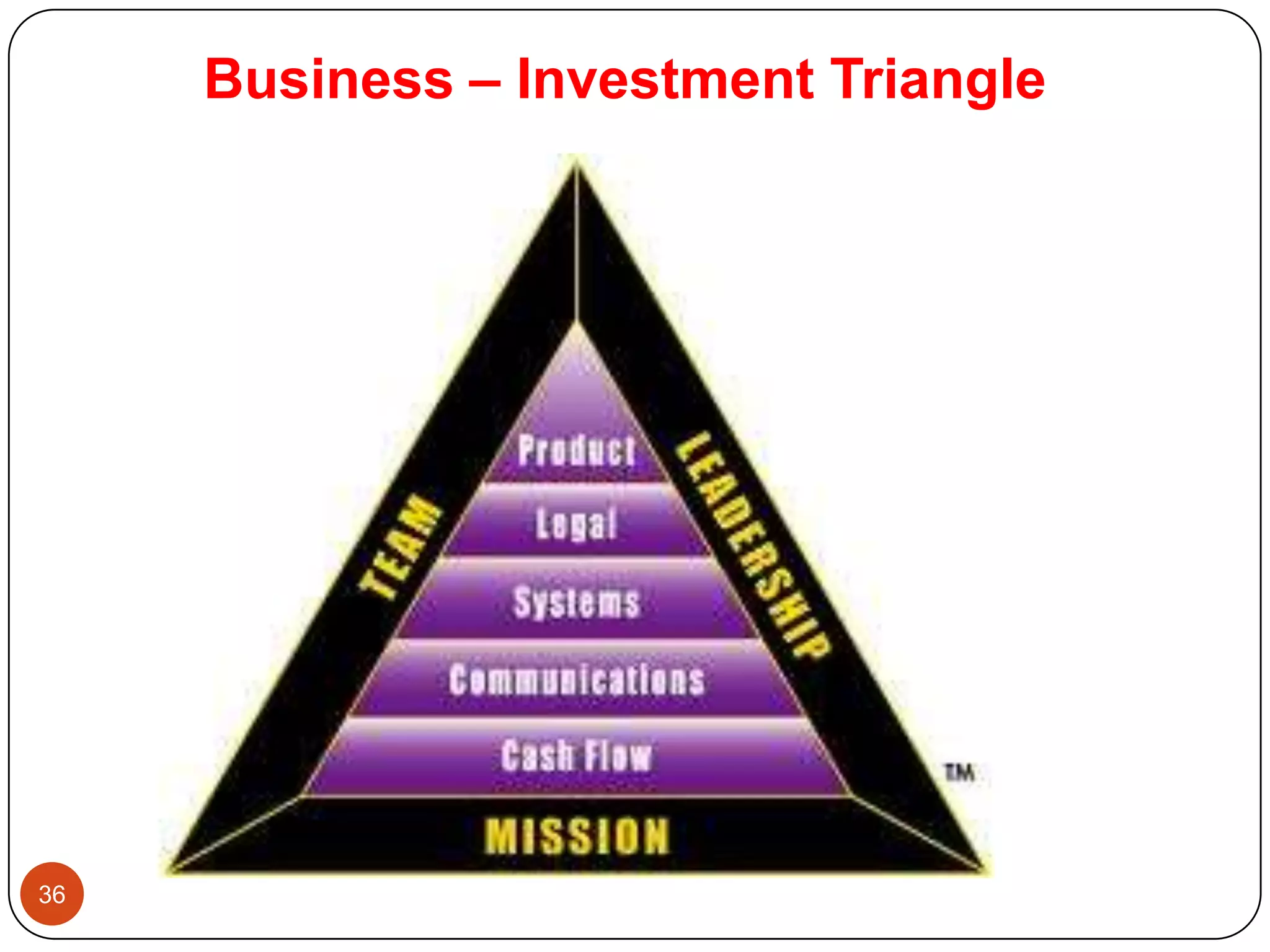
Business – Investment Triangle


36

Idan

  • 1.
    Starting, Growing & Sustaining Your Business Bashir Abolore Muse 08033623996
  • 2.
  • 3.
    How Do ICome up with A Winning Business Idea Create a vision  Close your eyes for a few minutes and conjure up a detailed image of what you want your life to look like in 5 years. Be as specific as possible.  Where do you live?  How do you spend your days?  What kind of work do you do?  Do you work alone or with other people?  Who are you surrounded by?  What do you do when you aren't working? 3
  • 4.
    How Do ICome up with A Winning Business Idea  Don't limit yourself to these questions; create a vivid vision of yourself, touching on things that are important to you. These are all personal issues that will impact the type of business you pursue - being a city or country person; wanting to travel or sit at your computer; liking to meet people or work on the phone. This activity will help you create a foundation for choosing from small business ideas, making business decisions, and setting clear goals.  It is best to do this exercise with someone else and share your vision. If you can't, write it down to 4 make your vision more concrete.
  • 5.
    (How Do ICome up with A Winning Business Idea) Determine what you're good at and what you like to do  It's often useful to look inside yourself to figure out what you like and dislike, and where your talents lie. It's one thing to come up with a winning business idea. It's another to come up with one that fits your skill set and interests you. Your business has to keep you excited so you can thrive over the long haul. 5  One of the best ways to do this is to
  • 6.
    (How Do ICome up with A Winning Business Idea) Inward Search List 1: What you're good at Everyone is good at something and many skills can be the foundation for a business. You might be naturally organized or have a knack for fixing things. You may be so used to your skills that they don't immediately come to mind, so assemble this list by observing yourself for a few weeks with an eye out for your aptitudes and by asking people 6 who know you well for their impressions
  • 7.
    (How Do ICome up with A Winning Business Idea) Inward Search List 2: Skills you've acquired over the years Whether or not you've worked in a conventional environment, you no doubt have accumulated many. Write down all the work responsibilities you've had; think about the varied tasks you know how to complete. Make sure this list is complete -- there should be at least 10 distinct items 7
  • 8.
    (How Do ICome up with A Winning Business Idea) Inward Search List 3: Things you like to do List the things you enjoy doing. This may not be as easy as it sounds. This list should be at least 10 items long. Stretch beyond your hobbies and interests that spring to mind immediately. If you're stymied, ask people who have known you for a long time -- particularly people who knew you as a kid -- what they have seen you 8 doing when you're happiest.
  • 9.
    (How Do ICome up with A Winning Business Idea) Inward Search Keep these three lists in an accessible place (for instance on your desk) for several weeks, and when small business ideas come to you, jot them down in the proper category. Ask people who know you well for their input or to help you jog your memory. 9
  • 10.
    (How Do ICome up with A Winning Business Idea) Outward Search Figure out what the market needs  So far, you've been looking inward to come up with your business idea. Now its time to look outward to discover an unfilled need that you can meet with your product or service.  There are plenty of "Top 10" or "Hot New" business lists out there. These may stimulate some ideas, but the best business ideas will come from you and will be based on who you are and what the market is looking for. So while you're doing your soul searching and list 10 making, put up your antenna and look out for
  • 11.
    (How Do ICome up with A Winning Business Idea) Outward Search Figure out what the market needs  When you are contemplating business possibilities, keep in mind that you don't have to stay in the business you start forever. You can run a business for a few years until you come up with an off-shoot idea or are in a position to start a more capital-intensive business.  Keep your business antenna up, with an eye out for unfilled opportunities Research the market by:  Reading the newspaper and magazines 11  Watching television  Talking to people
  • 12.
    (How Do ICome up with A Winning Business Idea) Outward Search  What products or services would you want that you haven't been able to find?  Is there something that everybody hates to do that you can do for them?  Is there a product or service that would make life easier for people you know?  What business trends are happening that you want to participate in...that really light your fire?  Are there gaps in the market that you can fill with your talents? What are they? (For example, corporate downsizing has opened up the market for services like consulting, desktop publishing, graphic design, staffing services, and computer maintenance).Now... Write down some potential business ideas. Be 12 specific.... don't list something like 'import/export';
  • 13.
    Growing Your Business
  • 14.
    Strategic Planning forSmall Business Growth This session will help you:  Keep your business on the right track (Focus)  Allocate your resources appropriately  Evaluate and re-align business objectives with outcomes 14
  • 15.
    Getting started! Provideanswers to the following questions:  What is your vision?  What is your Mission?  What are your values?  What does your product/service promise? 15  What segment of the market is your target?
  • 16.
    Self Assessment?  Do you have a vision statement?  Do you have a mission statement?  Do you have the values written down?  Do you have a product/service promise?  Do you know the segment of the market you want to play? 16
  • 17.
    Vision, Mission andValues  Vision: Who we want to be!  Mission: what we want to do!  Values: what we stand for! 17
  • 18.
    The Mission Statement The Mission statement should answer the following questions:  What do we stand for?  Who are our target customers?  What are our products/services that will satisfy their needs?  Why should they do business with us?  What is our competitive advantage? 18
  • 19.
    Define your corecompetencies  What is unique about our product/services  What added value service can we provide?  How skillful are our staff/workers?  How would we respond to changes in the economic environment?  What is our management capabilities?  What affiliations/alliances can we leverage on? 19
  • 20.
    Segment the Market  Define basis for segmentation  Ensure segments are large enough and with enough purchasing power to generate profits  Ensure the segment is accessible  Use your natural competitive advantage for positioning 20
  • 21.
    Evaluate your SWOT  Prepare a “Balance Sheet” of strengths and weaknesses  Include all key performance areas: human resources, financial control, systems control, marketing, legal etc.  Narrow your option initially to your areas of strengths. 21
  • 22.
    Opportunities and Threats  Opportunities:  Look for new potential market  Look for niches that competitors are overlooking  Threats:  Look for new competitors, Government policy changes, economic recession, technological improvements/advancements  Look for substitute products/services 22
  • 23.
    Examine key successfactors  These are critical factors influencing a company’s ability to compete in the market, such as:  Cost factors  Services offered  Location  Availability of Capital  Access to Technical support 23
  • 24.
    Set Goals &Objectives  Goals: the Broad long range attributes we seek to accomplish  Objectives: Specific Targets of performance  They should be SMART (specific, measurable, attainable, realizable, time bound) 24
  • 25.
    Strategic Options  Strategy is the means to the end.  It must focus on achieving the key success factors and generally revolves around  Cost Leadership  Differentiation  Focus 25
  • 26.
    Strategy to Action  Strategy must be turned into projects by defining  Purpose  Scope  Contribution  Resource requirements  Timing  Deploy committed people to the project 26
  • 27.
    Summary  The following should be considered:  The consumer perception  Evaluation of the important attributes for the product class  Judgment of the existing brands  Rating of the Ideal brand 27
  • 28.
  • 29.
    Succession Planning This session will help you:  Understand the dynamics of  Business continuity (management and leadership)  Vision preservation  Mission enhancement  Value protection  Product/service improvement/diversification 29
  • 30.
    Getting started!  Why do want your business to continue?  Why do you want to preserve your vision?  Why do want to enhance your mission?  Why do want to protect your value/s?  Why do want to continue to improve and/or diversify your product/service base? 30
  • 31.
    Self assessment?  Are you aware that you must plan and prepare for transition?  Are you preparing anyone to take over from you  Are you deliberately developing internal competence (showing your workforce how it is done, should be done and done very well)  Do you trust your workforce? 31
  • 32.
    What is succession?  It is the process of identifying and preparing suitable employees through mentoring, training, and job rotation to replace key players (such as the CEO/MD) within an organisation as their term expire. 32
  • 33.
    Succession planning =Practice continuity It safeguards:  Management style/orientation  Leadership frameworks/competence  Vision (who we are)  Mission (what we want to be)  Products/service delivery 33
  • 34.
    Benefits of successionplanning  Helps to develop a diverse workforce  Promotes and improves internal competence  Promotes workforce/brand Loyalty  Helps retain skillful and qualified staff  Institutionalize management and leadership frameworks  Ensures openness and empathy 34
  • 35.
    Summary Succession planning helps internalize a process of systematic review of the potential successors prior to the CEO/MD’s (or other key management staff) retirement 35
  • 36.