Defining a business plan
•A business plan is a formal statement of a set
business goals, the reasons why they are believed to
be attainable, and the plans for reaching these
goals.
•It defines the entrepreneur's vision and serves
as the firm's resume (summary or Curriculum
vitae of a Firm).
1
•A good business plan should emphasize on
the
•strengths and
•recognize the weaknesses of the venture.
•It should convey sincerity of purpose and
analysis which lends credibility to the plan
and the one who/which is making it.
2
A good business plan has to address two issues,
namely:
•A business opportunity exists which has the
potential to earn the investor the return he/she
demands.
•It must also show that the one proposing to exploit
this opportunity can do so effectively.
A business plan can be used at different times, with potential
benefits for several audiences.
3
• To convince oneself that the new venture is worthwhile
before making a significant financial and personal
commitment.
• To assist management in goal-setting and long-range
planning (Medium Term Strategic Plan)
• To attract investors and get financing.
• To explain the business to other companies with which
it would be useful to create an alliance or contract.
• To attract employees.
Important note:
•The plan will depend on your specific
situation e.g.
•description of the management team is very
important for investors while
•financial history is most important for banks
•Make your plan that matches its purpose.
5
• Should be concise (20-40) pages.
• It should use good visual formatting, such as
bulleted lists and short paragraphs.
• Should convey large and profitable market
opportunities
• Should cover all aspects of business
• Should convey strength and depth of
management team
• The language should be free of jargon and
easy to understand.
• The tone should be business-like and
enthusiastic.
• It should be strong on facts in order to
The basic elements of a standard business plan
include:
1. Title Page
2. Table of Contents
3. Executive Summary
4. Company Description
5. Product/Service
6. Market and Competition
7. Marketing and Selling Strategy
8. Operating Plan
9. Management/Organization
10. Financing
11. Supporting Documents
Tittle/Cover Page
• Name of the Company
• Address and Contact Details
• Time Period Covered by Plan
• Date of Preparation
•The executive summary is the cornerstone of a
good plan.
•This is the section that people read in order to
decide whether to read the rest.
•It should concisely summarize the technical,
marketing, financial, and managerial details.
•More importantly, it needs to convince the
reader that the new venture is a worthy
investment.
Executive summary cont….
In summary
• Firm and its environment
• Firm's current status and outlook
• Product and services
• Benefits to Customers
• Objectives – financial and Non financial
• Financial Forecast Brief
• Amount of Required finances
• Benefits to Investors
Table of Contents
•Headings and Sub-headings
Business Description
•General Description ofVenture
•Industry Background
•Company History
•Products/ Services Description, USPs
•Market Potential / Goals
Marketing and Sales
• Sales and Revenue Objectives
• Marketing Details:
Target Market, Market Size, Trends, Competition,
Estimated Market Share, Distribution and Sales,
Pricing, Advertisement and promotion.
• Marketing and Sales Organization
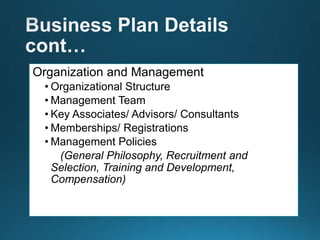
Organization and Management
• Organizational Structure
• Management Team
• Key Associates/ Advisors/ Consultants
• Memberships/ Registrations
• Management Policies
(General Philosophy, Recruitment and
Selection, Training and Development,
Compensation)
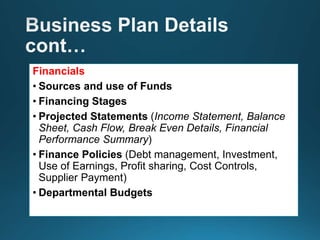
Financials
• Sources and use of Funds
• Financing Stages
• Projected Statements (Income Statement, Balance
Sheet, Cash Flow, Break Even Details, Financial
Performance Summary)
• Finance Policies (Debt management, Investment,
Use of Earnings, Profit sharing, Cost Controls,
Supplier Payment)
• Departmental Budgets
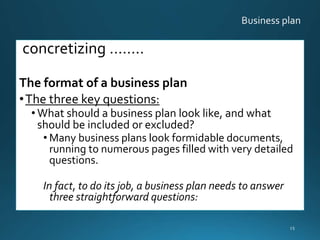
concretizing ……..
The format of a business plan
•The three key questions:
• What should a business plan look like, and what
should be included or excluded?
• Many business plans look formidable documents,
running to numerous pages filled with very detailed
questions.
In fact, to do its job, a business plan needs to answer
three straightforward questions:
15
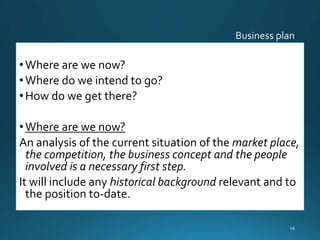
•Where are we now?
•Where do we intend to go?
•How do we get there?
•Where are we now?
An analysis of the current situation of the market place,
the competition, the business concept and the people
involved is a necessary first step.
It will include any historical background relevant and to
the position to-date.
16
Where do we intend to go?
•The direction that is intended for the business needs to
be clear and precise, if others are to share its vision for
the future.
•As well as qualitative expression of the objectives,
quantifiable targets will clarify and measure progress
towards the intended goals.
•Identification of likely changes to the business
environment will build on the opportunities outlined,
and assess possible threats.
17
•How do we get there?
•Implementation of accepted aims is what
all the parties to a plan are interested in as a
final result.
•Plans for marketing and managing the
business, with detailed financial analysis, are
the advisable preliminaries before putting it
all into practice.
18
•Details of the components in a plan
a. Where are we now
(i) Identity of the business
•Introduction; Relevant history and background, date
or proposed date for commencement of trading
/beginning of a plan
•Names: Name of business and trading names
Names of managers/owners
•Legal identity: Company/sole trader
/partnership, co-operative,
Details of share or capital structure
19
•Location: Address, registered and operational
Brief details of premises
•Professional advisor: Accountants, solicitors,
bank.
(ii)The key people
•Existing management: Names of the management,
outline of background experience, skills and
knowledge, why they are suited to the business
•Future requirements: Gaps in skills and experience and
how they will be filled, Future recruitment intentions
20
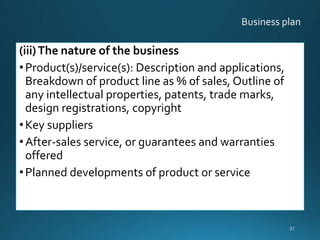
(iii)The nature of the business
•Product(s)/service(s): Description and applications,
Breakdown of product line as % of sales, Outline of
any intellectual properties, patents, trade marks,
design registrations, copyright
•Key suppliers
•After-sales service, or guarantees and warranties
offered
•Planned developments of product or service
21
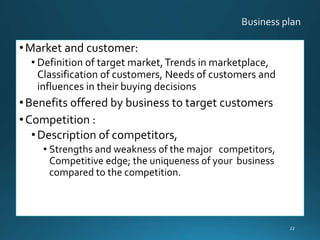
•Market and customer:
• Definition of target market,Trends in marketplace,
Classification of customers, Needs of customers and
influences in their buying decisions
•Benefits offered by business to target customers
•Competition :
•Description of competitors,
• Strengths and weakness of the major competitors,
Competitive edge; the uniqueness of your business
compared to the competition.
22
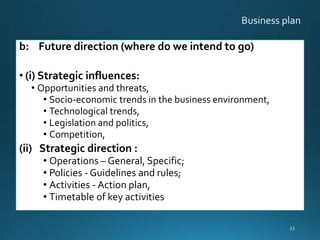
b: Future direction (where do we intend to go)
• (i) Strategic influences:
• Opportunities and threats,
• Socio-economic trends in the business environment,
• Technological trends,
• Legislation and politics,
• Competition,
(ii) Strategic direction :
• Operations – General, Specific;
• Policies - Guidelines and rules;
• Activities - Action plan,
• Timetable of key activities
23
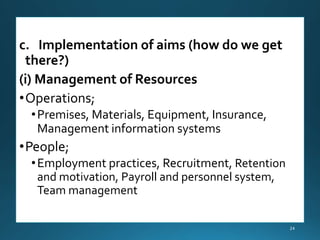
c. Implementation of aims (how do we get
there?)
(i) Management of Resources
•Operations;
•Premises, Materials, Equipment, Insurance,
Management information systems
•People;
•Employment practices, Recruitment, Retention
and motivation, Payroll and personnel system,
Team management
24
• (ii) Marketing plan
• Competitive edge;
• Unique selling point of business, Marketing objectives -
Specific aims for product or services in the Marketplace
• Marketing methods;
• Innovation, Features and benefits, Product mix, Product
development
• Incentive;
• Basis of pricing, Margins, Discount policy, Promotion -
methods to be used, Consistency of image.
• Distribution -channels used, Direct or intermediaries
• Research;Confirmation of demand, Future research
planned
25
(iii) Money: financial analysis
•Funding requirements;
•Start-up capital,Working capital, Asset capital,
Timing of funds required, Security offered.
•Profit and loss;
•3-year forecast – Sales,Variable costs, Gross
profit, Overheads, Net profit.
•Cash flow;
•3-year forecast – Receipts, Payments, Monthly
and cumulative cash flow.
26
•Balance sheet;
• Use of funds, Source of funds
•Sensitivity analysis;
• break-even point,What-ifs.
•Summary;
• main assumptions.
27
Key Points
•It is important to have an idea to innovate before
developing a business plan
•Innovation should be geared towards solving a
problem or improving services in your organization
•Before starting the implementation the analysis is
very important using strengths you have and
identifying your weak areas to overcome but also
understand the challenges in your new venture.
•Based on adequate information then the Business plan
document preparation can follow.
28
Vision and Mission
TheVision
Definition:
•A vision shows what you want your business to
accomplish.
•It shows a way to success.
•It provides the inspiration for both your daily
operations and your strategic decisions.
•Effective business planning needs a vision.
•It’s the vision statement that provides the
destination for the journey without which there is no
destination.
29
•How to write a vision statement:
(i). Examine your mission statement
It should tell
•who your organization is
•what you do
•what you stand for
•why you do it.
(ii). Use the following formula to shape your vision
statement:
•To be/achieve/reach …..the best/leading ------------in
offering/teaching/selling -----------in country/region--
30
•Using this formula to write a vision statement
will force you to choose what you consider to
be the most important accomplishment of
your business and give you a time frame to
accomplish it.
(iii)Commit to your vision statement
•Take action to make your vision statement
come true: Use it as the basis of your business
planning
31
• Because the vision statement provides your
destination, therefore your goals and strategies will
focus and struggle to make it real.
• It is the natural basis for all of your business
planning
• If you want to keep your vision statement alive
then you have to share it with potential partners,
staff and employees if you have.
• Print it out and post it on your desk, in your staff
room, wherever you, your colleagues and your
staff will see it and remind them regularly.
32
•Example:
3.1 Vision
•To provide an excellent training opportunity for
trainees and graduates aspirations to higher levels of
professional qualifications.
•Note: this vision has no time frame
33
Mission
•Mission statement is an opportunity to define
your business at the most basic level.
It tells:
•who your organization is
•what you do and why you do it
•what you stand for (It describes the purpose for
which your organization exists).
34
Issues that may be addressed in a mission:
•Do you want to make a profit, or is it enough to
just make a living?
•What markets are you serving, and what benefits
do you offer them?
•Do you solve a problem for your customers?
•What kind of internal work environment do you
want for your employees?
35
Basic guidelines in writing a mission statement
•Start by reading other organization’s mission
statements, but write a statement about you and
not some other organization.
•Make sure you actually believe in what you’re
writing; otherwise your customers and your
employees will know if you were not serious with it.
•Get lots of input from the community you plan to
serve, as well as from your board, staff, and other
stakeholders.
•Allow enough time, be open to new ideas
•Keep it short at most three to four sentences long.
36
Example:
3.2 Mission
• To establish high quality training environment that will
sustain and allow trainees to acquire professional
competences relevant to their levels and aspire for
attainment of higher knowledge, skills, understanding and
appropriate behaviour in Pharmaceutical Sciences and
health sciences.
•
37
The benefits of a well-defined mission
statement
•It focuses your energy and clarifies your
purpose
•It motivates stakeholders including the staff,
volunteers, and donors as well as helps to
attract people and resources.
•Vision and Mission are the bases of planning
for your organization
38
•A sound business plan can mean difference
between a company that prospers and one
that flounders.
•A good business plan communicates accuracy
and credibility, and generates enthusiasm for
business.
•An effective business plan should be
thorough, professional and realistic.
10. business plan

10. business plan

  • 1.
    Defining a businessplan •A business plan is a formal statement of a set business goals, the reasons why they are believed to be attainable, and the plans for reaching these goals. •It defines the entrepreneur's vision and serves as the firm's resume (summary or Curriculum vitae of a Firm). 1
  • 2.
    •A good businessplan should emphasize on the •strengths and •recognize the weaknesses of the venture. •It should convey sincerity of purpose and analysis which lends credibility to the plan and the one who/which is making it. 2
  • 3.
    A good businessplan has to address two issues, namely: •A business opportunity exists which has the potential to earn the investor the return he/she demands. •It must also show that the one proposing to exploit this opportunity can do so effectively. A business plan can be used at different times, with potential benefits for several audiences. 3
  • 4.
    • To convinceoneself that the new venture is worthwhile before making a significant financial and personal commitment. • To assist management in goal-setting and long-range planning (Medium Term Strategic Plan) • To attract investors and get financing. • To explain the business to other companies with which it would be useful to create an alliance or contract. • To attract employees.
  • 5.
    Important note: •The planwill depend on your specific situation e.g. •description of the management team is very important for investors while •financial history is most important for banks •Make your plan that matches its purpose. 5
  • 6.
    • Should beconcise (20-40) pages. • It should use good visual formatting, such as bulleted lists and short paragraphs. • Should convey large and profitable market opportunities • Should cover all aspects of business • Should convey strength and depth of management team • The language should be free of jargon and easy to understand. • The tone should be business-like and enthusiastic. • It should be strong on facts in order to
  • 7.
    The basic elementsof a standard business plan include: 1. Title Page 2. Table of Contents 3. Executive Summary 4. Company Description 5. Product/Service 6. Market and Competition 7. Marketing and Selling Strategy 8. Operating Plan 9. Management/Organization 10. Financing 11. Supporting Documents
  • 8.
    Tittle/Cover Page • Nameof the Company • Address and Contact Details • Time Period Covered by Plan • Date of Preparation
  • 9.
    •The executive summaryis the cornerstone of a good plan. •This is the section that people read in order to decide whether to read the rest. •It should concisely summarize the technical, marketing, financial, and managerial details. •More importantly, it needs to convince the reader that the new venture is a worthy investment.
  • 10.
    Executive summary cont…. Insummary • Firm and its environment • Firm's current status and outlook • Product and services • Benefits to Customers • Objectives – financial and Non financial • Financial Forecast Brief • Amount of Required finances • Benefits to Investors
  • 11.
    Table of Contents •Headingsand Sub-headings Business Description •General Description ofVenture •Industry Background •Company History •Products/ Services Description, USPs •Market Potential / Goals
  • 12.
    Marketing and Sales •Sales and Revenue Objectives • Marketing Details: Target Market, Market Size, Trends, Competition, Estimated Market Share, Distribution and Sales, Pricing, Advertisement and promotion. • Marketing and Sales Organization
  • 13.
    Organization and Management •Organizational Structure • Management Team • Key Associates/ Advisors/ Consultants • Memberships/ Registrations • Management Policies (General Philosophy, Recruitment and Selection, Training and Development, Compensation)
  • 14.
    Financials • Sources anduse of Funds • Financing Stages • Projected Statements (Income Statement, Balance Sheet, Cash Flow, Break Even Details, Financial Performance Summary) • Finance Policies (Debt management, Investment, Use of Earnings, Profit sharing, Cost Controls, Supplier Payment) • Departmental Budgets
  • 15.
    concretizing …….. The formatof a business plan •The three key questions: • What should a business plan look like, and what should be included or excluded? • Many business plans look formidable documents, running to numerous pages filled with very detailed questions. In fact, to do its job, a business plan needs to answer three straightforward questions: 15
  • 16.
    •Where are wenow? •Where do we intend to go? •How do we get there? •Where are we now? An analysis of the current situation of the market place, the competition, the business concept and the people involved is a necessary first step. It will include any historical background relevant and to the position to-date. 16
  • 17.
    Where do weintend to go? •The direction that is intended for the business needs to be clear and precise, if others are to share its vision for the future. •As well as qualitative expression of the objectives, quantifiable targets will clarify and measure progress towards the intended goals. •Identification of likely changes to the business environment will build on the opportunities outlined, and assess possible threats. 17
  • 18.
    •How do weget there? •Implementation of accepted aims is what all the parties to a plan are interested in as a final result. •Plans for marketing and managing the business, with detailed financial analysis, are the advisable preliminaries before putting it all into practice. 18
  • 19.
    •Details of thecomponents in a plan a. Where are we now (i) Identity of the business •Introduction; Relevant history and background, date or proposed date for commencement of trading /beginning of a plan •Names: Name of business and trading names Names of managers/owners •Legal identity: Company/sole trader /partnership, co-operative, Details of share or capital structure 19
  • 20.
    •Location: Address, registeredand operational Brief details of premises •Professional advisor: Accountants, solicitors, bank. (ii)The key people •Existing management: Names of the management, outline of background experience, skills and knowledge, why they are suited to the business •Future requirements: Gaps in skills and experience and how they will be filled, Future recruitment intentions 20
  • 21.
    (iii)The nature ofthe business •Product(s)/service(s): Description and applications, Breakdown of product line as % of sales, Outline of any intellectual properties, patents, trade marks, design registrations, copyright •Key suppliers •After-sales service, or guarantees and warranties offered •Planned developments of product or service 21
  • 22.
    •Market and customer: •Definition of target market,Trends in marketplace, Classification of customers, Needs of customers and influences in their buying decisions •Benefits offered by business to target customers •Competition : •Description of competitors, • Strengths and weakness of the major competitors, Competitive edge; the uniqueness of your business compared to the competition. 22
  • 23.
    b: Future direction(where do we intend to go) • (i) Strategic influences: • Opportunities and threats, • Socio-economic trends in the business environment, • Technological trends, • Legislation and politics, • Competition, (ii) Strategic direction : • Operations – General, Specific; • Policies - Guidelines and rules; • Activities - Action plan, • Timetable of key activities 23
  • 24.
    c. Implementation ofaims (how do we get there?) (i) Management of Resources •Operations; •Premises, Materials, Equipment, Insurance, Management information systems •People; •Employment practices, Recruitment, Retention and motivation, Payroll and personnel system, Team management 24
  • 25.
    • (ii) Marketingplan • Competitive edge; • Unique selling point of business, Marketing objectives - Specific aims for product or services in the Marketplace • Marketing methods; • Innovation, Features and benefits, Product mix, Product development • Incentive; • Basis of pricing, Margins, Discount policy, Promotion - methods to be used, Consistency of image. • Distribution -channels used, Direct or intermediaries • Research;Confirmation of demand, Future research planned 25
  • 26.
    (iii) Money: financialanalysis •Funding requirements; •Start-up capital,Working capital, Asset capital, Timing of funds required, Security offered. •Profit and loss; •3-year forecast – Sales,Variable costs, Gross profit, Overheads, Net profit. •Cash flow; •3-year forecast – Receipts, Payments, Monthly and cumulative cash flow. 26
  • 27.
    •Balance sheet; • Useof funds, Source of funds •Sensitivity analysis; • break-even point,What-ifs. •Summary; • main assumptions. 27
  • 28.
    Key Points •It isimportant to have an idea to innovate before developing a business plan •Innovation should be geared towards solving a problem or improving services in your organization •Before starting the implementation the analysis is very important using strengths you have and identifying your weak areas to overcome but also understand the challenges in your new venture. •Based on adequate information then the Business plan document preparation can follow. 28
  • 29.
    Vision and Mission TheVision Definition: •Avision shows what you want your business to accomplish. •It shows a way to success. •It provides the inspiration for both your daily operations and your strategic decisions. •Effective business planning needs a vision. •It’s the vision statement that provides the destination for the journey without which there is no destination. 29
  • 30.
    •How to writea vision statement: (i). Examine your mission statement It should tell •who your organization is •what you do •what you stand for •why you do it. (ii). Use the following formula to shape your vision statement: •To be/achieve/reach …..the best/leading ------------in offering/teaching/selling -----------in country/region-- 30
  • 31.
    •Using this formulato write a vision statement will force you to choose what you consider to be the most important accomplishment of your business and give you a time frame to accomplish it. (iii)Commit to your vision statement •Take action to make your vision statement come true: Use it as the basis of your business planning 31
  • 32.
    • Because thevision statement provides your destination, therefore your goals and strategies will focus and struggle to make it real. • It is the natural basis for all of your business planning • If you want to keep your vision statement alive then you have to share it with potential partners, staff and employees if you have. • Print it out and post it on your desk, in your staff room, wherever you, your colleagues and your staff will see it and remind them regularly. 32
  • 33.
    •Example: 3.1 Vision •To providean excellent training opportunity for trainees and graduates aspirations to higher levels of professional qualifications. •Note: this vision has no time frame 33
  • 34.
    Mission •Mission statement isan opportunity to define your business at the most basic level. It tells: •who your organization is •what you do and why you do it •what you stand for (It describes the purpose for which your organization exists). 34
  • 35.
    Issues that maybe addressed in a mission: •Do you want to make a profit, or is it enough to just make a living? •What markets are you serving, and what benefits do you offer them? •Do you solve a problem for your customers? •What kind of internal work environment do you want for your employees? 35
  • 36.
    Basic guidelines inwriting a mission statement •Start by reading other organization’s mission statements, but write a statement about you and not some other organization. •Make sure you actually believe in what you’re writing; otherwise your customers and your employees will know if you were not serious with it. •Get lots of input from the community you plan to serve, as well as from your board, staff, and other stakeholders. •Allow enough time, be open to new ideas •Keep it short at most three to four sentences long. 36
  • 37.
    Example: 3.2 Mission • Toestablish high quality training environment that will sustain and allow trainees to acquire professional competences relevant to their levels and aspire for attainment of higher knowledge, skills, understanding and appropriate behaviour in Pharmaceutical Sciences and health sciences. • 37
  • 38.
    The benefits ofa well-defined mission statement •It focuses your energy and clarifies your purpose •It motivates stakeholders including the staff, volunteers, and donors as well as helps to attract people and resources. •Vision and Mission are the bases of planning for your organization 38
  • 39.
    •A sound businessplan can mean difference between a company that prospers and one that flounders. •A good business plan communicates accuracy and credibility, and generates enthusiasm for business. •An effective business plan should be thorough, professional and realistic.