MODERATOR:DR.RAVINARAYAN
BY:DR.PUNEET MAHAJAN
PGDCC 1ST YEAR
History
 Roentgen disocvered first example of ionizing

radiation called X rays while experimenting with
cathode rays in CROOKES tube.
 Crookes tube created free electrons by ionization of
residual air in the tube by high DC voltage
 This voltage accelrated the electrons coming from the
hot cathode to high enough velocity that they created
X Rays when they struck with anode.
PRODUCTION OF X RAYS
 X rays are invisible, highly

penetrating,electromagnetic radiations with very high
frequency and very short wavelength of 0.1 to 1 A.
 When electrons released by hot cathode are accelrated
by high voltage are suddenly decelrated upon collision
with metal target ,the anode.
 Tungsten is maily used as target anode its high atomic
no and melting point of 3300 F.
 Molybdenum is used foe mammography
.
Different tissues in body absorb Xrays at different extents:
• Bone- high absorption (white)

• Tissue- somewhere in the middle absorption (grey)

• Air- low absorption (black)
 THE PLAIN FILM
• The PA (postero-anterior) view:

It is the most frequently required radiological
examination. Comparison of current film with old
films is valuable.
Position: Patient facing the
film, chin up with the shoulders
rotated forwards to displaced
the scapulae from the lungs.
Exposure is made on full
inspiration, centering at T5.
 Lateral view:

Comparison with PA view:
Advantages : Anterior mediastinal
masses
Encysted pleural fluids
Posterior basal consolidation
Disadvantages : Lung collapse
Large pleural effusion.
 Lateral decubitus position:

It is helpful to assess the volume of pleural effusion
and demonstrate whether a pleural effusion is mobile
or loculated.

Lateral decubitus position film showing mobile pleural effusion (arrows)
AP VS PA VIEW

This is a PA film on the left compared with a AP supine film on the
right.
The AP shows magnification of the heart and widening of the
mediastinum.
AP film is taken mostly in very ill patients who cannot stand erect.
• Poor inspiratory effort
will compress and
overcrowd the lung
markings
CENTERING
MEDIAL ENDS OF CLAVICLES SHOULD BE AT
EQUIDISTANT FROM SPINOUS PROCESS AT
T4/5 LEVEL.
ROTATION CAN DISTORT MEDIASTINAL
BORDERS.
LUNGS NEAREST TO FILM APPEARS LESS
TRANSLUCENT.
RT Sternal end is away from central line of spine.
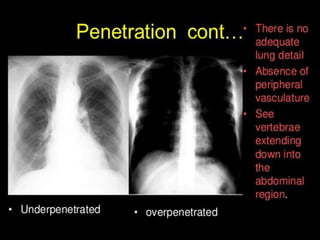
Penetration is degree to which x
rays absorbed through body.
 Normally the vertebral bodies should be just
visible through the heart.



DEPENDS UPON THE KVP
 kVp = Energy of x-rays = higher penetrability, it moves through

tissue.

 The energy determines the QUALITY of x-ray produced.

1. increase in kVp = electrons gain high energy
2. higher the energy of electrons = greater quality of x-rays
3. greater quality = greater penetrability
TRACHEA
 NARROWING: Normal
coronal diameter is 25mm
for males nd 21 mm for
females.
 DISPLACEMENT
 INTRALUMINAL
LESIONS
 MIDLINE IN UPPER PART
THEN DEVIATES TO
RIGHT AROUND AORTIC
KNUCKLE
PARATRACHEAL STRIPE
 RIGHT PARATRACHEAL

STRIPE:RT border of trachea
meeting with rt lung
SEEN IN 60 % .
<5MM
 LEFT PARATRACHEAL
STRIPE
NOT VISUALISED
BECAUSE OF GREAT
VESSELS ON LEFT
BORDER OF TRACHEA
MEDIASTINUM AND HEART
P-A view

 Right border:
 Superior vena cava
 Right atrium
 The inferior vena cava.

rarely
 The right atrium& the
superior vena cava shares
more than 50%.
Left border
 Aortic knucle
 Pulmonary bay
 LA appendage
 Left ventricle
CARDIAC MALPOSITIONS
 SITUS SOLITUS
 DEXTROCARDIA WITH

SITUS INVERSUS
 DEXTROCARDIA WITH
SITUS SOLITUS
 LEVOCARDIA WITH
SITUS INVERSUS
 SITUS AMBIGIUOS
visceroatrial situs solitus
(gastric bubble arrowed) and
isolated dextrocardia.

Chest radiograph of a patient with total
situs inversus (gastric
bubble arrowed).
Cardiac calcification
 Valvular
 Pericardial
 Myocardial
 Endocardial

 Intraluminal
 vascular
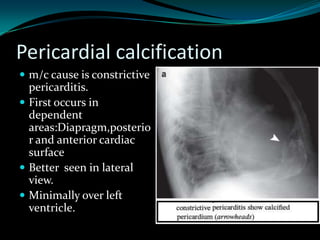
Pericardial calcification
 m/c cause is constrictive

pericarditis.
 First occurs in
dependent
areas:Diapragm,posterio
r and anterior cardiac
surface
 Better seen in lateral
view.
 Minimally over left
ventricle.
Aortic valve calcification
JUNCTION LINES
 ANTERIOR JUNCTION

LINE

 POSTERIOR JUNCTION

LINE
 FORMED BY LUNGS
MEETING POSTERIORLY
BEHIND ESOPHAGUS

 FORMED BY LUNGS
MEETING ANTERIOR TO
THE ASCENDING
AORTA.
 2 MM THICK
 1 MM THICK
 STRAIGHT OR CURVED
 RUNS DOWNWARD
LINE,CONVEX TO LEFT
BELOW THE
EXTENDS FROM LUNG
SUPRASTERNAL NOTCH
APICES TO AORTIC
CURVING FROM LEFT
KNUCKLE OR BELOW
TO RIGHT
LUNGS
apices to
lower border of 2nd rib
anteriorly.
 2. Middle zone :lower
border of 2nd rib
anteriorly to lower
border of 4th rib
anteriorly.
 • 3. Lower zone :lower
border of 4th rib
anteriorly to lung
 bases.
 1. Upper zone:
The right upper lobe (RUL) occupies the upper 1/3 of the
right lung.
Posteriorly, the RUL is adjacent to the first three to five ribs.
Anteriorly, the RUL extends inferiorly as far as the 4th right
anterior rib
The right middle lobe is typically the smallest of
the three, and appears triangular in shape,
being narrowest near the hilum
RIGHT LOWER LOBE
 The right lower lobe is the largest of all three lobes, separated

from the others by the major fissure.
 Posteriorly, the RLL extend as far superiorly as the 6th thoracic
vertebral body, and extends inferiorly to the diaphragm.
Lung Anatomy on Chest X-ray
 These lobes can be separated

from one another by two
fissures.
 The minor fissure separates
the RUL from the RML, and
thus represents the visceral
pleural surfaces of both of
these lobes.
 Oriented obliquely, the major
fissure extends posteriorly and
superiorly approximately to
the level of the fourth
vertebral body.
No defined left minor fissure, there are only two lobes on the left;
the left upper lobe and left lower lobe.
LEFT LOWER LOBES
 Left lower lobes
Lung Anatomy on Chest X-ray
 These two lobes are

separated by a major
fissure, identical to that
seen on the right side,
although often slightly
more inferior in location.
 The portion of the left
lung that corresponds
anatomically to the right
middle lobe is
incorporated into the left
upper lobe.
Pulmonary artery
• MPA Forms convexity on left mediastinal border b/w

arch of aorta and straight left heart border.
• RPA runs horizontally to the right and is not seen on
frontal view divides in mediastinum forming
descending br.of RPA wich is visible on x ray
• LPA continues as branch of MPA and gives upper lobe
branch as it passes left main bronchus forming upper
part of left hilum.
0 mm

15 mm

Ao
Ao

Main
Pulmonary
Artery

Main
Pulmonary
Artery

LV
LV

Main pulmonary
artery ranges from
0 mm–15mm
from tangent line
Pulmonary veins
 Right and left upper lobe neins
 In the outer two thirds of the lungs, arteries cannot be

distinguished from veins on chest radiography
 VEINS CAN BE DISTINGUISHED FROM ARTERIES
AS VEINS FOLLOW HORIZONTAL COURSE TO
LEFT ATRIUM
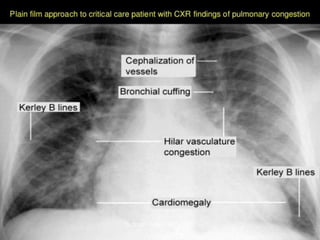
ous Hypertension
RDPA usually
> 17 mm

Upper lobe
vessels equal
to or larger
than size of
lower lobe
vessels =
Cephalization
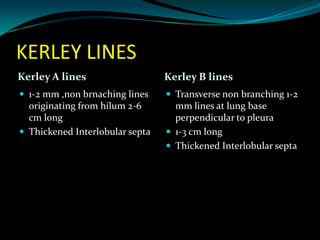
KERLEY LINES
Kerley A lines

Kerley B lines

 1-2 mm ,non brnaching lines

 Transverse non branching 1-2

originating from hilum 2-6
cm long
 Thickened Interlobular septa

mm lines at lung base
perpendicular to pleura
 1-3 cm long
 Thickened Interlobular septa
The Silhouette Sign
 An intra-thoracic radio-

opacity, if in anatomic
contact with a border of
heart or aorta, will
obscure that border. An
intra-thoracic lesion not
anatomically contiguous
with a border or a normal
structure will not
obliterate that border.
Diaphragm
•Right is normally higher than left by 1.5-3cm
•On inspiration the domes of the diaphragms are at
the level of the 6th rib anteriorly and 10th rib
posteriorly.

????CHECK ?????
Costophrenic angles crisp?
Air under diaphragms?
Flattened diaphrags
Loss of diaphragm definition
Elevated hemidiaphragm
Tenting
Pleural effusion
 Soft Tissues

Breast shadows
Supraclavicular areas
Axillae
Tissues along side of breasts
 Abdomen

Gastric bubble
Air under diaphragm
 Neck
Soft tissue mass
Bones:
Check the bones for any
fracture , lesions, density
or mineralization.
 Bony Fragments

Ribs
Sternum
Spine
Shoulder girdle
Clavicles
Superior rib notching
Polio
Restrictive lung disease
Neurofibromatosis
Connective tissue disease
Osteogenesis imperfecta
Hyperparathyroidism
Causes of inferior rib notching
Unitateral
Blalock-Taussig operation
Subclavian artery occlusion
Aortic coarctation involving left subclavian artery or anomalous
right subclavian artery

Bitateral
Aorta-coarcation, occlusion, aortitis
Subclavian-Takayasu's disease, atheroma
Pulmonary oligaemia-FaIlot's tetralogy; pulmonary atresia,
stenosis;
Venous-SVC, IVC obstruction
Shunts-intercostal-pulmonary fistula; pulmonary-intercostal
arteriovenous fistula
Others-hyperparathyroidism; neurogenic; idiopathic
.
Cardiac anomaly with hypoplastic
clavicle ?????

HOLT ORAM

SYNDROME
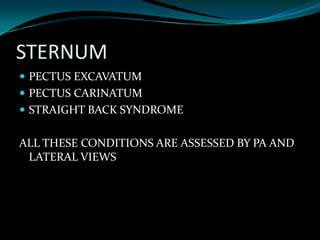
STERNUM
 PECTUS EXCAVATUM
 PECTUS CARINATUM
 STRAIGHT BACK SYNDROME

ALL THESE CONDITIONS ARE ASSESSED BY PA AND
LATERAL VIEWS
PECTUS EXCARINATUM
Best viewed in lateral film
Increased anterioposterio diameter.
Increased pulmonary vascular resistance due to
L>R shunt
Turner syndrome
Marfan syndrome
Ehlers Danlos Syndrome
Noonan syndrome
Trisomy 18
Trisomy 21
Homocystinuria
Osteogenesis imperfecta
Pectus excavatum
 Congenital or acquired
 Rickets
 Pseudocardiomegaly
 False prominence of pulmonary artery
Viewing lateral film
 Clear spaces:Retrosternal

AND retrocardiac
Obliteraion of retrosternal
space:thymoma,aneurysms of
aorta and nodal masses.
Vertebral
translucency:posterior basal
consolidation
Diaphragm outline:Both
diaphragms are visible
throughout their length
except left anteriorly
Acute posterior costophrenic
angles
 Trachea

Right pulmoanry artery
anterior to caring.
LPA is posterior and
superior and veins are
inferior.
CARDIAC CONTOURS

ANTERIOR BORDER
Ascending aorta
Pulmonary artery
Right ventricle
POSTERIOR BORDER
Pulmonary artery
Left atrium
Left ventricle from above
downwards
The Normal Chest X-ray


Lateral View:
Oblique fissure
2. Horizontal fissure
3. Thoracic spine and
retrocardiac space
4. Retrosternal space
1.

How to read normal x ray

  • 1.
  • 2.
    History  Roentgen disocveredfirst example of ionizing radiation called X rays while experimenting with cathode rays in CROOKES tube.  Crookes tube created free electrons by ionization of residual air in the tube by high DC voltage  This voltage accelrated the electrons coming from the hot cathode to high enough velocity that they created X Rays when they struck with anode.
  • 3.
    PRODUCTION OF XRAYS  X rays are invisible, highly penetrating,electromagnetic radiations with very high frequency and very short wavelength of 0.1 to 1 A.  When electrons released by hot cathode are accelrated by high voltage are suddenly decelrated upon collision with metal target ,the anode.  Tungsten is maily used as target anode its high atomic no and melting point of 3300 F.  Molybdenum is used foe mammography
  • 4.
  • 5.
    Different tissues inbody absorb Xrays at different extents: • Bone- high absorption (white) • Tissue- somewhere in the middle absorption (grey) • Air- low absorption (black)
  • 6.
     THE PLAINFILM • The PA (postero-anterior) view: It is the most frequently required radiological examination. Comparison of current film with old films is valuable. Position: Patient facing the film, chin up with the shoulders rotated forwards to displaced the scapulae from the lungs. Exposure is made on full inspiration, centering at T5.
  • 7.
     Lateral view: Comparisonwith PA view: Advantages : Anterior mediastinal masses Encysted pleural fluids Posterior basal consolidation Disadvantages : Lung collapse Large pleural effusion.
  • 8.
     Lateral decubitusposition: It is helpful to assess the volume of pleural effusion and demonstrate whether a pleural effusion is mobile or loculated. Lateral decubitus position film showing mobile pleural effusion (arrows)
  • 10.
    AP VS PAVIEW This is a PA film on the left compared with a AP supine film on the right. The AP shows magnification of the heart and widening of the mediastinum. AP film is taken mostly in very ill patients who cannot stand erect.
  • 12.
    • Poor inspiratoryeffort will compress and overcrowd the lung markings
  • 13.
    CENTERING MEDIAL ENDS OFCLAVICLES SHOULD BE AT EQUIDISTANT FROM SPINOUS PROCESS AT T4/5 LEVEL. ROTATION CAN DISTORT MEDIASTINAL BORDERS. LUNGS NEAREST TO FILM APPEARS LESS TRANSLUCENT.
  • 14.
    RT Sternal endis away from central line of spine.
  • 19.
    Penetration is degreeto which x rays absorbed through body.  Normally the vertebral bodies should be just visible through the heart.  DEPENDS UPON THE KVP  kVp = Energy of x-rays = higher penetrability, it moves through tissue.  The energy determines the QUALITY of x-ray produced. 1. increase in kVp = electrons gain high energy 2. higher the energy of electrons = greater quality of x-rays 3. greater quality = greater penetrability
  • 25.
    TRACHEA  NARROWING: Normal coronaldiameter is 25mm for males nd 21 mm for females.  DISPLACEMENT  INTRALUMINAL LESIONS  MIDLINE IN UPPER PART THEN DEVIATES TO RIGHT AROUND AORTIC KNUCKLE
  • 26.
    PARATRACHEAL STRIPE  RIGHTPARATRACHEAL STRIPE:RT border of trachea meeting with rt lung SEEN IN 60 % . <5MM  LEFT PARATRACHEAL STRIPE NOT VISUALISED BECAUSE OF GREAT VESSELS ON LEFT BORDER OF TRACHEA
  • 29.
    MEDIASTINUM AND HEART P-Aview  Right border:  Superior vena cava  Right atrium  The inferior vena cava. rarely  The right atrium& the superior vena cava shares more than 50%. Left border  Aortic knucle  Pulmonary bay  LA appendage  Left ventricle
  • 31.
    CARDIAC MALPOSITIONS  SITUSSOLITUS  DEXTROCARDIA WITH SITUS INVERSUS  DEXTROCARDIA WITH SITUS SOLITUS  LEVOCARDIA WITH SITUS INVERSUS  SITUS AMBIGIUOS
  • 32.
    visceroatrial situs solitus (gastricbubble arrowed) and isolated dextrocardia. Chest radiograph of a patient with total situs inversus (gastric bubble arrowed).
  • 33.
    Cardiac calcification  Valvular Pericardial  Myocardial  Endocardial  Intraluminal  vascular
  • 34.
    Pericardial calcification  m/ccause is constrictive pericarditis.  First occurs in dependent areas:Diapragm,posterio r and anterior cardiac surface  Better seen in lateral view.  Minimally over left ventricle.
  • 35.
  • 37.
    JUNCTION LINES  ANTERIORJUNCTION LINE  POSTERIOR JUNCTION LINE  FORMED BY LUNGS MEETING POSTERIORLY BEHIND ESOPHAGUS  FORMED BY LUNGS MEETING ANTERIOR TO THE ASCENDING AORTA.  2 MM THICK  1 MM THICK  STRAIGHT OR CURVED  RUNS DOWNWARD LINE,CONVEX TO LEFT BELOW THE EXTENDS FROM LUNG SUPRASTERNAL NOTCH APICES TO AORTIC CURVING FROM LEFT KNUCKLE OR BELOW TO RIGHT
  • 39.
    LUNGS apices to lower borderof 2nd rib anteriorly.  2. Middle zone :lower border of 2nd rib anteriorly to lower border of 4th rib anteriorly.  • 3. Lower zone :lower border of 4th rib anteriorly to lung  bases.  1. Upper zone:
  • 42.
    The right upperlobe (RUL) occupies the upper 1/3 of the right lung. Posteriorly, the RUL is adjacent to the first three to five ribs. Anteriorly, the RUL extends inferiorly as far as the 4th right anterior rib
  • 43.
    The right middlelobe is typically the smallest of the three, and appears triangular in shape, being narrowest near the hilum
  • 44.
    RIGHT LOWER LOBE The right lower lobe is the largest of all three lobes, separated from the others by the major fissure.  Posteriorly, the RLL extend as far superiorly as the 6th thoracic vertebral body, and extends inferiorly to the diaphragm.
  • 45.
    Lung Anatomy onChest X-ray  These lobes can be separated from one another by two fissures.  The minor fissure separates the RUL from the RML, and thus represents the visceral pleural surfaces of both of these lobes.  Oriented obliquely, the major fissure extends posteriorly and superiorly approximately to the level of the fourth vertebral body.
  • 46.
    No defined leftminor fissure, there are only two lobes on the left; the left upper lobe and left lower lobe.
  • 47.
    LEFT LOWER LOBES Left lower lobes
  • 48.
    Lung Anatomy onChest X-ray  These two lobes are separated by a major fissure, identical to that seen on the right side, although often slightly more inferior in location.  The portion of the left lung that corresponds anatomically to the right middle lobe is incorporated into the left upper lobe.
  • 51.
    Pulmonary artery • MPAForms convexity on left mediastinal border b/w arch of aorta and straight left heart border. • RPA runs horizontally to the right and is not seen on frontal view divides in mediastinum forming descending br.of RPA wich is visible on x ray • LPA continues as branch of MPA and gives upper lobe branch as it passes left main bronchus forming upper part of left hilum.
  • 54.
    0 mm 15 mm Ao Ao Main Pulmonary Artery Main Pulmonary Artery LV LV Mainpulmonary artery ranges from 0 mm–15mm from tangent line
  • 56.
    Pulmonary veins  Rightand left upper lobe neins  In the outer two thirds of the lungs, arteries cannot be distinguished from veins on chest radiography  VEINS CAN BE DISTINGUISHED FROM ARTERIES AS VEINS FOLLOW HORIZONTAL COURSE TO LEFT ATRIUM
  • 58.
    ous Hypertension RDPA usually >17 mm Upper lobe vessels equal to or larger than size of lower lobe vessels = Cephalization
  • 59.
    KERLEY LINES Kerley Alines Kerley B lines  1-2 mm ,non brnaching lines  Transverse non branching 1-2 originating from hilum 2-6 cm long  Thickened Interlobular septa mm lines at lung base perpendicular to pleura  1-3 cm long  Thickened Interlobular septa
  • 60.
    The Silhouette Sign An intra-thoracic radio- opacity, if in anatomic contact with a border of heart or aorta, will obscure that border. An intra-thoracic lesion not anatomically contiguous with a border or a normal structure will not obliterate that border.
  • 64.
    Diaphragm •Right is normallyhigher than left by 1.5-3cm •On inspiration the domes of the diaphragms are at the level of the 6th rib anteriorly and 10th rib posteriorly. ????CHECK ????? Costophrenic angles crisp? Air under diaphragms? Flattened diaphrags Loss of diaphragm definition Elevated hemidiaphragm Tenting
  • 66.
  • 69.
     Soft Tissues Breastshadows Supraclavicular areas Axillae Tissues along side of breasts  Abdomen Gastric bubble Air under diaphragm  Neck Soft tissue mass
  • 70.
    Bones: Check the bonesfor any fracture , lesions, density or mineralization.  Bony Fragments Ribs Sternum Spine Shoulder girdle Clavicles
  • 72.
    Superior rib notching Polio Restrictivelung disease Neurofibromatosis Connective tissue disease Osteogenesis imperfecta Hyperparathyroidism
  • 73.
    Causes of inferiorrib notching Unitateral Blalock-Taussig operation Subclavian artery occlusion Aortic coarctation involving left subclavian artery or anomalous right subclavian artery Bitateral Aorta-coarcation, occlusion, aortitis Subclavian-Takayasu's disease, atheroma Pulmonary oligaemia-FaIlot's tetralogy; pulmonary atresia, stenosis; Venous-SVC, IVC obstruction Shunts-intercostal-pulmonary fistula; pulmonary-intercostal arteriovenous fistula Others-hyperparathyroidism; neurogenic; idiopathic
  • 75.
    . Cardiac anomaly withhypoplastic clavicle ????? HOLT ORAM SYNDROME
  • 77.
    STERNUM  PECTUS EXCAVATUM PECTUS CARINATUM  STRAIGHT BACK SYNDROME ALL THESE CONDITIONS ARE ASSESSED BY PA AND LATERAL VIEWS
  • 78.
    PECTUS EXCARINATUM Best viewedin lateral film Increased anterioposterio diameter. Increased pulmonary vascular resistance due to L>R shunt Turner syndrome Marfan syndrome Ehlers Danlos Syndrome Noonan syndrome Trisomy 18 Trisomy 21 Homocystinuria Osteogenesis imperfecta
  • 79.
    Pectus excavatum  Congenitalor acquired  Rickets  Pseudocardiomegaly  False prominence of pulmonary artery
  • 80.
    Viewing lateral film Clear spaces:Retrosternal AND retrocardiac Obliteraion of retrosternal space:thymoma,aneurysms of aorta and nodal masses. Vertebral translucency:posterior basal consolidation Diaphragm outline:Both diaphragms are visible throughout their length except left anteriorly Acute posterior costophrenic angles
  • 81.
     Trachea Right pulmoanryartery anterior to caring. LPA is posterior and superior and veins are inferior. CARDIAC CONTOURS ANTERIOR BORDER Ascending aorta Pulmonary artery Right ventricle POSTERIOR BORDER Pulmonary artery Left atrium Left ventricle from above downwards
  • 82.
    The Normal ChestX-ray  Lateral View: Oblique fissure 2. Horizontal fissure 3. Thoracic spine and retrocardiac space 4. Retrosternal space 1.