

How CRT works
GROUP 4
8/7/2016 1:53 AM 1
We are going to discuss,
What exactly the CRT means
Main Components in CRT
The Electronic Gun
The Electronic Beam Deflector
The screen
How CRT works
Advantages and Disadvantages of CRT display
Our Conclusion
8/7/2016 1:53 AM 2
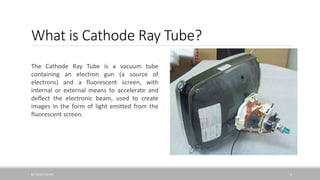
What is Cathode Ray Tube?
The Cathode Ray Tube is a vacuum tube
containing an electron gun (a source of
electrons) and a fluorescent screen, with
internal or external means to accelerate and
deflect the electronic beam, used to create
images in the form of light emitted from the
fluorescent screen.
8/7/2016 1:53 AM 3
The main components
The Cathode Ray Tube is a display device that uses electrons fired at phosphors to create
images. CRT takes input from an external source and displays it, making other devices, such as
computers useful.
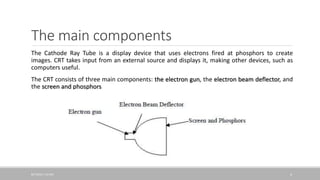
The CRT consists of three main components: the electron gun, the electron beam deflector, and
the screen and phosphors
8/7/2016 1:53 AM 4
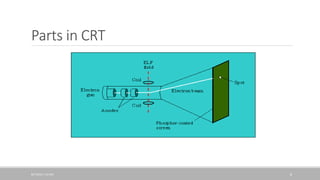
Electronic Gun
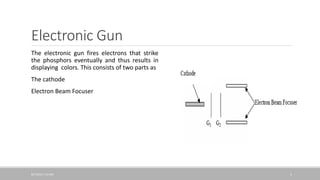
The electronic gun fires electrons that strike
the phosphors eventually and thus results in
displaying colors. This consists of two parts as
The cathode
Electron Beam Focuser
8/7/2016 1:53 AM 5
The Electron Beam Deflector
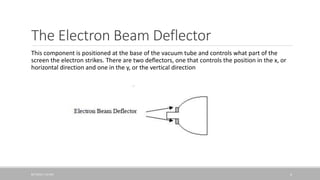
This component is positioned at the base of the vacuum tube and controls what part of the
screen the electron strikes. There are two deflectors, one that controls the position in the x, or
horizontal direction and one in the y, or the vertical direction
8/7/2016 1:53 AM 6
The Screen
Located in the front of CRT , this is what actually displays the images. In color CRTs, the screen
contains inorganic light-emitting phosphor with 3 different colors (RGB). When they are struck
they give off energy in the form of photons.
When an electron fired from the gun strikes the screen and hits an atom in the phosphor, it
transfers its energy to an electron in the phosphor. The excited electron then rises to a higher
energy level. As the electron falls, it emits energy as heat and visible light.
Directly behind the screen is a device, such as a shadow mask or aperture grille. The purpose of
these devices is to stop stray electrons from hitting the screen, so only the electron beam hits
the intended phosphors.
8/7/2016 1:53 AM 7
Parts in CRT
8/7/2016 1:53 AM 8
How it OPERATES
8/7/2016 1:53 AM 9
Dig Deep
The CRT operates by firing an electron beam at phosphors, which give off light. The electron
beam is generated at the cathode in the electronic gun. A potential (voltage) is applied, which
strips off and accelerates the electrons. The electrons then travel to the to the electron beam
focuser. An electrostatic mechanism is used to focus the beam.
After the beam exits from the electron gun, it travels to the electron beam deflector. The
deflector has two mechanisms, one to change the vertical direction and one to change the
horizontal direction of the beam. This allows the electron beam to sweep over the entire
screen.
When an electron in the beam strikes a phosphor, it excites an electron in the phosphor. After
being excited, the electron then releases the energy it got in a form of visible light, which is
always the same for that phosphor. Phosphors emitting red, blue, and green light form a color
image.
8/7/2016 1:53 AM 10
Advantages of CRT
They operate at any resolution, geometry and aspect ratio without the need for rescaling the image.
CRTs run at the highest pixel resolutions generally available.
Produce a very dark black and the highest contrast levels normally available. Suitable for use even in dimly lit or
dark environments.
CRTs produce the very best color and gray-scale and are the reference standard for all professional calibrations.
They have a perfectly smooth gray-scale with an infinite number of intensity levels. Other display technologies are
expected to reproduce the natural power-law Gamma curve of a CRT, but can only do so approximately.
CRTs have fast response times and no motion artifacts. Best for rapidly moving or changing images.
CRTs are less expensive than comparable displays using other display technologies.
8/7/2016 1:53 AM 11
The CRT's Gaussian beam profile produces images with softer edges that are not as sharp as an LCD at its native
resolution. Imperfect focus and color registration also reduce sharpness. Generally sharper than LCDs at other than
native resolutions.
Subject to geometric distortion and screen regulation problems. Also affected by magnetic fields from other
equipment including other CRTs.
Relatively bright but not as bright as LCDs. Not suitable for very brightly lit environments.
Some CRTs have a rounded spherical or cylindrical shape screen. Newer CRTs are flat.
CRTs give off electric, magnetic and electromagnetic fields. There is considerable controversy as to whether any of
these pose a health hazard, particularly magnetic fields. The most authoritative scientific studies conclude that
they are not harmful but some people remain unconvinced.
They are large, heavy, and bulky. They consume a lot of electricity and produce a lot of heat.
8/7/2016 1:53 AM 12
Disadvantages of CRT
Conclusively,
CRTs are still popular in the printing and broadcasting industries as well as in the professional
video, photography, and graphics fields due to their greater color fidelity, contrast and better
viewing from off-axis (wider viewing angle). CRTs also still find adherents in video
gaming because of their higher resolution per initial cost, fast response time, and multiple native
resolutions.
8/7/2016 1:53 AM 13
8/7/2016 1:53 AM 14
Thank You!
8/7/2016 1:53 AM 15

How crt works

  • 1.
    How CRT works GROUP4 8/7/2016 1:53 AM 1
  • 2.
    We are goingto discuss, What exactly the CRT means Main Components in CRT The Electronic Gun The Electronic Beam Deflector The screen How CRT works Advantages and Disadvantages of CRT display Our Conclusion 8/7/2016 1:53 AM 2
  • 3.
    What is CathodeRay Tube? The Cathode Ray Tube is a vacuum tube containing an electron gun (a source of electrons) and a fluorescent screen, with internal or external means to accelerate and deflect the electronic beam, used to create images in the form of light emitted from the fluorescent screen. 8/7/2016 1:53 AM 3
  • 4.
    The main components TheCathode Ray Tube is a display device that uses electrons fired at phosphors to create images. CRT takes input from an external source and displays it, making other devices, such as computers useful. The CRT consists of three main components: the electron gun, the electron beam deflector, and the screen and phosphors 8/7/2016 1:53 AM 4
  • 5.
    Electronic Gun The electronicgun fires electrons that strike the phosphors eventually and thus results in displaying colors. This consists of two parts as The cathode Electron Beam Focuser 8/7/2016 1:53 AM 5
  • 6.
    The Electron BeamDeflector This component is positioned at the base of the vacuum tube and controls what part of the screen the electron strikes. There are two deflectors, one that controls the position in the x, or horizontal direction and one in the y, or the vertical direction 8/7/2016 1:53 AM 6
  • 7.
    The Screen Located inthe front of CRT , this is what actually displays the images. In color CRTs, the screen contains inorganic light-emitting phosphor with 3 different colors (RGB). When they are struck they give off energy in the form of photons. When an electron fired from the gun strikes the screen and hits an atom in the phosphor, it transfers its energy to an electron in the phosphor. The excited electron then rises to a higher energy level. As the electron falls, it emits energy as heat and visible light. Directly behind the screen is a device, such as a shadow mask or aperture grille. The purpose of these devices is to stop stray electrons from hitting the screen, so only the electron beam hits the intended phosphors. 8/7/2016 1:53 AM 7
  • 8.
  • 9.
  • 10.
    Dig Deep The CRToperates by firing an electron beam at phosphors, which give off light. The electron beam is generated at the cathode in the electronic gun. A potential (voltage) is applied, which strips off and accelerates the electrons. The electrons then travel to the to the electron beam focuser. An electrostatic mechanism is used to focus the beam. After the beam exits from the electron gun, it travels to the electron beam deflector. The deflector has two mechanisms, one to change the vertical direction and one to change the horizontal direction of the beam. This allows the electron beam to sweep over the entire screen. When an electron in the beam strikes a phosphor, it excites an electron in the phosphor. After being excited, the electron then releases the energy it got in a form of visible light, which is always the same for that phosphor. Phosphors emitting red, blue, and green light form a color image. 8/7/2016 1:53 AM 10
  • 11.
    Advantages of CRT Theyoperate at any resolution, geometry and aspect ratio without the need for rescaling the image. CRTs run at the highest pixel resolutions generally available. Produce a very dark black and the highest contrast levels normally available. Suitable for use even in dimly lit or dark environments. CRTs produce the very best color and gray-scale and are the reference standard for all professional calibrations. They have a perfectly smooth gray-scale with an infinite number of intensity levels. Other display technologies are expected to reproduce the natural power-law Gamma curve of a CRT, but can only do so approximately. CRTs have fast response times and no motion artifacts. Best for rapidly moving or changing images. CRTs are less expensive than comparable displays using other display technologies. 8/7/2016 1:53 AM 11
  • 12.
    The CRT's Gaussianbeam profile produces images with softer edges that are not as sharp as an LCD at its native resolution. Imperfect focus and color registration also reduce sharpness. Generally sharper than LCDs at other than native resolutions. Subject to geometric distortion and screen regulation problems. Also affected by magnetic fields from other equipment including other CRTs. Relatively bright but not as bright as LCDs. Not suitable for very brightly lit environments. Some CRTs have a rounded spherical or cylindrical shape screen. Newer CRTs are flat. CRTs give off electric, magnetic and electromagnetic fields. There is considerable controversy as to whether any of these pose a health hazard, particularly magnetic fields. The most authoritative scientific studies conclude that they are not harmful but some people remain unconvinced. They are large, heavy, and bulky. They consume a lot of electricity and produce a lot of heat. 8/7/2016 1:53 AM 12 Disadvantages of CRT
  • 13.
    Conclusively, CRTs are stillpopular in the printing and broadcasting industries as well as in the professional video, photography, and graphics fields due to their greater color fidelity, contrast and better viewing from off-axis (wider viewing angle). CRTs also still find adherents in video gaming because of their higher resolution per initial cost, fast response time, and multiple native resolutions. 8/7/2016 1:53 AM 13
  • 14.
  • 15.