“ ELECTRONIC SHOP “ PRESENTATION
MIDTERM, SUMMER 2014
FACULTY: A.H.M SHATIL
MEMBERS OF GROUP
Jishan,Mahmudul Haque 12-21348-2
Nadim,Fazllul Karim 12-21662-2
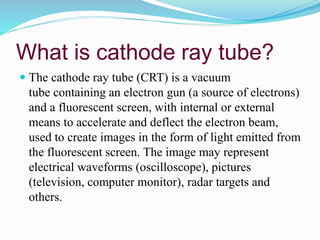
What is cathode ray tube?
 The cathode ray tube (CRT) is a vacuum
tube containing an electron gun (a source of electrons)
and a fluorescent screen, with internal or external
means to accelerate and deflect the electron beam,
used to create images in the form of light emitted from
the fluorescent screen. The image may represent
electrical waveforms (oscilloscope), pictures
(television, computer monitor), radar targets and
others.
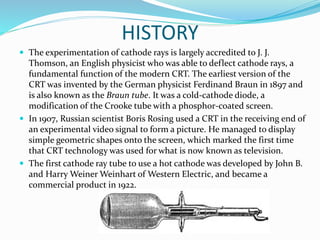
HISTORY
 The experimentation of cathode rays is largely accredited to J. J.
Thomson, an English physicist who was able to deflect cathode rays, a
fundamental function of the modern CRT. The earliest version of the
CRT was invented by the German physicist Ferdinand Braun in 1897 and
is also known as the Braun tube. It was a cold-cathode diode, a
modification of the Crooke tube with a phosphor-coated screen.
 In 1907, Russian scientist Boris Rosing used a CRT in the receiving end of
an experimental video signal to form a picture. He managed to display
simple geometric shapes onto the screen, which marked the first time
that CRT technology was used for what is now known as television.
 The first cathode ray tube to use a hot cathode was developed by John B.
and Harry Weiner Weinhart of Western Electric, and became a
commercial product in 1922.
Parts of a CRT
Electron Gun
 The role of this section is to produce electrons at a high,
fixed, velocity.
 This is done through a process known as thermionic
emission.
 A filament in the cathode is heated to the point where its electrons
become loose.
 An anode with a high voltage applied to it accelerates the electrons
towards the screen due to electrostatic attraction.
 On the way, the electrons pass through a series of control grids
which control the brightness of the image produced.
 The more negative the grid, the darker the image and vice versa.
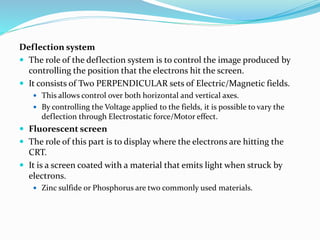
Deflection system
 The role of the deflection system is to control the image produced by
controlling the position that the electrons hit the screen.
 It consists of Two PERPENDICULAR sets of Electric/Magnetic fields.
 This allows control over both horizontal and vertical axes.
 By controlling the Voltage applied to the fields, it is possible to vary the
deflection through Electrostatic force/Motor effect.
 Fluorescent screen
 The role of this part is to display where the electrons are hitting the
CRT.
 It is a screen coated with a material that emits light when struck by
electrons.
 Zinc sulfide or Phosphorus are two commonly used materials.
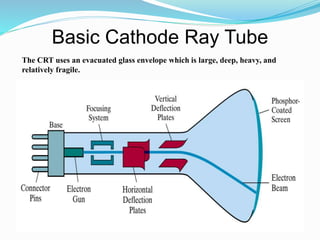
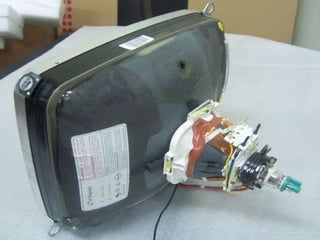
Basic Cathode Ray Tube
The CRT uses an evacuated glass envelope which is large, deep, heavy, and
relatively fragile.
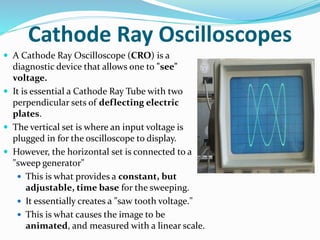
Cathode Ray Oscilloscopes
 A Cathode Ray Oscilloscope (CRO) is a
diagnostic device that allows one to "see"
voltage.
 It is essential a Cathode Ray Tube with two
perpendicular sets of deflecting electric
plates.
 The vertical set is where an input voltage is
plugged in for the oscilloscope to display.
 However, the horizontal set is connected to a
"sweep generator"
 This is what provides a constant, but
adjustable, time base for the sweeping.
 It essentially creates a "saw tooth voltage."
 This is what causes the image to be
animated, and measured with a linear scale.
Use of CRTs in display and how
it works?
 A CRT TV works by having the electron beam "scan"
the screen at an rate faster than our eyes can perceive.
 This means that it shoots across the screen like a machine
gun, and the images we see are actually made from many
fluorescent dots.
 The fluorescence caused by the beam striking the screen
lasts a bit longer so that the next scan can be made without
the previous image disappearing.
 It scans twice each time, first filling in the odd "holes" then
the even ones.
 Each scan is about 1/50 of a second.
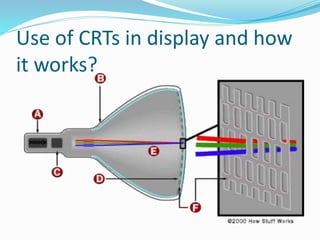
 Color CRT TVs had 3 electron guns rather than a single
one, a shadow mask, and a modified fluorescent screen.
 The 3 electron guns were needed as there were three
primary colors (Red, Green and Blue) that could be
adjusted in different amounts to create any color.
 The colors are formed as a result of the shadow mask,
which is a layer with holes in it that controls the angle of
the incoming electron beams.
 This is because the fluorescent screen is separated into multi-
colored phosphors that are placed adjacent to each other at small
intervals.
 Thus it isn't actually a single colored pixel, but rather 3 very small
pixels that join together to form a larger dot.
Color CRTs
 Color tubes use three different phosphors which emit red,
green, and blue light respectively. Color CRTs have three
electron guns, one for each primary color, arranged either
in a straight line or in a triangular configuration (the guns
are usually constructed as a single unit). A grille or mask
absorbs the electrons that would otherwise hit the wrong
phosphor. A shadow mask tube uses a metal plate with tiny
holes, placed so that the electron beam only illuminates the
correct phosphors on the face of the tube.
 The three beams in color CRTs would not strike the screen
at the same point without convergence calibration. Instead,
the set would need to be manually adjusted to converge the
three color beams together to maintain color accuracy.
Advantages of CRT
 The cathode rayed tube can easily increase the monitor’s
brightness by reflecting the light.
 They produce more colours
 The Cathode Ray Tube monitors have lower price rate
than the LCD display or Plasma display.
 The quality of the image displayed on a Cathode Ray
Tube is superior to the LCD and Plasma monitors.
 The contrast features of the cathode ray tube monitor
are considered highly excellent.
Disadvantages of CRT
 They have a big back and take up space on desk.
 The electromagnetic fields emitted by CRT monitors constitute
a health hazard to the functioning of living cells.
 CRTs emit a small amount of X-ray band radiation which can
result in a health hazard.
 Constant refreshing of CRT monitors can result in headache.
 CRTs operate at very high voltage which can overheat system
or result in an implosion
 Within a CRT a strong vacuum exists in it and can also result in
a implosion
 They are heavy to pick up and carry around
CONCLUSION
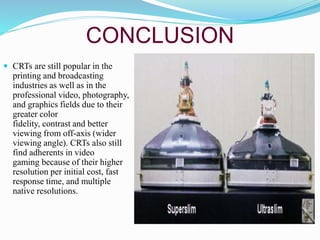
 CRTs are still popular in the
printing and broadcasting
industries as well as in the
professional video, photography,
and graphics fields due to their
greater color
fidelity, contrast and better
viewing from off-axis (wider
viewing angle). CRTs also still
find adherents in video
gaming because of their higher
resolution per initial cost, fast
response time, and multiple
native resolutions.
REFERENCE
 http://nsb.wikidot.com/pl-9-4-1-9
 http://electronics.howstuffworks.com/tv3.htm
THANK YOU
THE END

Cathoderaytube final

  • 1.
    “ ELECTRONIC SHOP“ PRESENTATION MIDTERM, SUMMER 2014 FACULTY: A.H.M SHATIL
  • 2.
    MEMBERS OF GROUP Jishan,MahmudulHaque 12-21348-2 Nadim,Fazllul Karim 12-21662-2
  • 3.
    What is cathoderay tube?  The cathode ray tube (CRT) is a vacuum tube containing an electron gun (a source of electrons) and a fluorescent screen, with internal or external means to accelerate and deflect the electron beam, used to create images in the form of light emitted from the fluorescent screen. The image may represent electrical waveforms (oscilloscope), pictures (television, computer monitor), radar targets and others.
  • 4.
    HISTORY  The experimentationof cathode rays is largely accredited to J. J. Thomson, an English physicist who was able to deflect cathode rays, a fundamental function of the modern CRT. The earliest version of the CRT was invented by the German physicist Ferdinand Braun in 1897 and is also known as the Braun tube. It was a cold-cathode diode, a modification of the Crooke tube with a phosphor-coated screen.  In 1907, Russian scientist Boris Rosing used a CRT in the receiving end of an experimental video signal to form a picture. He managed to display simple geometric shapes onto the screen, which marked the first time that CRT technology was used for what is now known as television.  The first cathode ray tube to use a hot cathode was developed by John B. and Harry Weiner Weinhart of Western Electric, and became a commercial product in 1922.
  • 5.
    Parts of aCRT Electron Gun  The role of this section is to produce electrons at a high, fixed, velocity.  This is done through a process known as thermionic emission.  A filament in the cathode is heated to the point where its electrons become loose.  An anode with a high voltage applied to it accelerates the electrons towards the screen due to electrostatic attraction.  On the way, the electrons pass through a series of control grids which control the brightness of the image produced.  The more negative the grid, the darker the image and vice versa.
  • 6.
    Deflection system  Therole of the deflection system is to control the image produced by controlling the position that the electrons hit the screen.  It consists of Two PERPENDICULAR sets of Electric/Magnetic fields.  This allows control over both horizontal and vertical axes.  By controlling the Voltage applied to the fields, it is possible to vary the deflection through Electrostatic force/Motor effect.  Fluorescent screen  The role of this part is to display where the electrons are hitting the CRT.  It is a screen coated with a material that emits light when struck by electrons.  Zinc sulfide or Phosphorus are two commonly used materials.
  • 7.
    Basic Cathode RayTube The CRT uses an evacuated glass envelope which is large, deep, heavy, and relatively fragile.
  • 8.
    Cathode Ray Oscilloscopes A Cathode Ray Oscilloscope (CRO) is a diagnostic device that allows one to "see" voltage.  It is essential a Cathode Ray Tube with two perpendicular sets of deflecting electric plates.  The vertical set is where an input voltage is plugged in for the oscilloscope to display.  However, the horizontal set is connected to a "sweep generator"  This is what provides a constant, but adjustable, time base for the sweeping.  It essentially creates a "saw tooth voltage."  This is what causes the image to be animated, and measured with a linear scale.
  • 9.
    Use of CRTsin display and how it works?
  • 10.
     A CRTTV works by having the electron beam "scan" the screen at an rate faster than our eyes can perceive.  This means that it shoots across the screen like a machine gun, and the images we see are actually made from many fluorescent dots.  The fluorescence caused by the beam striking the screen lasts a bit longer so that the next scan can be made without the previous image disappearing.  It scans twice each time, first filling in the odd "holes" then the even ones.  Each scan is about 1/50 of a second.
  • 11.
     Color CRTTVs had 3 electron guns rather than a single one, a shadow mask, and a modified fluorescent screen.  The 3 electron guns were needed as there were three primary colors (Red, Green and Blue) that could be adjusted in different amounts to create any color.  The colors are formed as a result of the shadow mask, which is a layer with holes in it that controls the angle of the incoming electron beams.  This is because the fluorescent screen is separated into multi- colored phosphors that are placed adjacent to each other at small intervals.  Thus it isn't actually a single colored pixel, but rather 3 very small pixels that join together to form a larger dot.
  • 12.
    Color CRTs  Colortubes use three different phosphors which emit red, green, and blue light respectively. Color CRTs have three electron guns, one for each primary color, arranged either in a straight line or in a triangular configuration (the guns are usually constructed as a single unit). A grille or mask absorbs the electrons that would otherwise hit the wrong phosphor. A shadow mask tube uses a metal plate with tiny holes, placed so that the electron beam only illuminates the correct phosphors on the face of the tube.  The three beams in color CRTs would not strike the screen at the same point without convergence calibration. Instead, the set would need to be manually adjusted to converge the three color beams together to maintain color accuracy.
  • 14.
    Advantages of CRT The cathode rayed tube can easily increase the monitor’s brightness by reflecting the light.  They produce more colours  The Cathode Ray Tube monitors have lower price rate than the LCD display or Plasma display.  The quality of the image displayed on a Cathode Ray Tube is superior to the LCD and Plasma monitors.  The contrast features of the cathode ray tube monitor are considered highly excellent.
  • 15.
    Disadvantages of CRT They have a big back and take up space on desk.  The electromagnetic fields emitted by CRT monitors constitute a health hazard to the functioning of living cells.  CRTs emit a small amount of X-ray band radiation which can result in a health hazard.  Constant refreshing of CRT monitors can result in headache.  CRTs operate at very high voltage which can overheat system or result in an implosion  Within a CRT a strong vacuum exists in it and can also result in a implosion  They are heavy to pick up and carry around
  • 16.
    CONCLUSION  CRTs arestill popular in the printing and broadcasting industries as well as in the professional video, photography, and graphics fields due to their greater color fidelity, contrast and better viewing from off-axis (wider viewing angle). CRTs also still find adherents in video gaming because of their higher resolution per initial cost, fast response time, and multiple native resolutions.
  • 17.
  • 18.