CATHODE RAY TUBE
WHAT IS CRT?
• CRT is the technology which is used in display devices.
• Basically display devices are the devices for showing the
information in visual form, Such as computer monitor, TV etc.
• These CTR displays are used mostly by graphic professionals,
because it offers good variant and good accurate colour.
HISTORY
• Cathode ray tube was discovered by Johann Hittorf in 1869 in
primitive Crookes tubes.
• He observe that some unknown rays were emitted from the
cathode which could cast shadows on a glowing wall of tube.
• In 1890 , Arthur Schuster and William Crookes demonstrated
cathode ray could be deflected by electric field and magnetic
field respectively.
• In 1907 Boris Rosing used CRT in the receiving end of an
experimental video signal to form a picture.
• He managed to display simple geometric shapes on to the screen, which
marked that CRT was used for what is now known as TV, monitor etc.
• The first cathode ray tube to use a hot cathode was developed by John
B. Johnson and Harry Weiner Weinhart of Western Electric, and became
a commercial product in 1922.
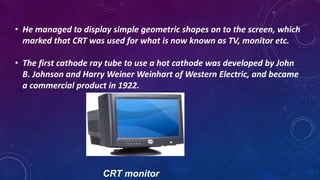
CRT monitor
OVERALL WORKING OF CRT
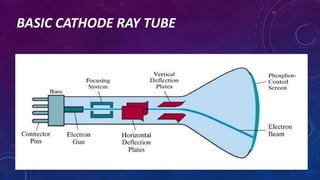
• The cathode ray tube (CRT) is a vacuum tube containing an
electron gun (a source of electrons) and a fluorescent screen,
with internal or external means to accelerate and deflect
electron beam, used to create image in the form of light
emitted from the fluorescent screen. The image may represent
pictures, which is used in television, computer monitor.
QUESTIONS
BASIC CATHODE RAY TUBE
HOW IT WORKS AND DISPLAY?
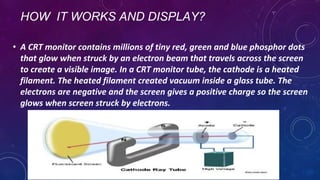
• A CRT monitor contains millions of tiny red, green and blue phosphor dots
that glow when struck by an electron beam that travels across the screen
to create a visible image. In a CRT monitor tube, the cathode is a heated
filament. The heated filament created vacuum inside a glass tube. The
electrons are negative and the screen gives a positive charge so the screen
glows when screen struck by electrons.
OVERVIEW
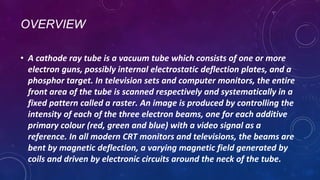
• A cathode ray tube is a vacuum tube which consists of one or more
electron guns, possibly internal electrostatic deflection plates, and a
phosphor target. In television sets and computer monitors, the entire
front area of the tube is scanned respectively and systematically in a
fixed pattern called a raster. An image is produced by controlling the
intensity of each of the three electron beams, one for each additive
primary colour (red, green and blue) with a video signal as a
reference. In all modern CRT monitors and televisions, the beams are
bent by magnetic deflection, a varying magnetic field generated by
coils and driven by electronic circuits around the neck of the tube.
QUESTIONS
PHOSPHOR PERSISTENCE
• Various phosphors are available depending upon the needs of the
measurement or display application. The brightness, colour and
persistence of the illuminating depends upon the type of phosphor
used on the CRT screen. Phosphors are available with persistence’s
ranging from less than one microsecond to several seconds. For
visual observation of brief transient events, a long persistence
phosphor may be desirable. For events which are fast and repetitive,
or high frequency, a short-persistence phosphor is generally
preferable.
MICRO CHANNEL PLATE
• When displaying fast one-shot events the electron beam must
deflect very quickly, with few electrons impinging on the screen;
leading to a faint or invisible display. Oscilloscope CRTs designed
for very fast signals can give a brighter display by passing the
electron beam through a micro-channel plate just before it
reaches the screen. Through the phenomenon of secondary
emission this plate multiplies the electrons reaching the
phosphor screen, giving a significant improvement in writing rate
(brightness), and improved sensitivity and spot size as well.
COLOR CRTS
• Colour tubes use three different phosphors which emits red, green and
blue light respectively. Colour CRTs have three electron guns, one for
each primary colour, arranged either in straight line or in a triangular
configuration (three guns are usually constructed as a single unit). A
mask absorbs the electrons that would otherwise hit the wrong
phosphor. A shadow mask tube uses a metal plate with tiny holes,
placed so that the electron beam only illuminates the correct phosphors
on the face of the tube.
• The three beams in colour CRTs would not strike the screen at the same
point without convergence calibration. Instead, the set would need to
be manually adjusted to converge the three colour beams together to
maintain colour accuracy.
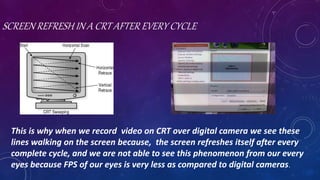
SCREEN REFRESH IN A CRT AFTER EVERY CYCLE
This is why when we record video on CRT over digital camera we see these
lines walking on the screen because, the screen refreshes itself after every
complete cycle, and we are not able to see this phenomenon from our every
eyes because FPS of our eyes is very less as compared to digital cameras.
QUESTIONS
ADVANTAGE OF CRT
• The cathode rayed tube ca easily increase the monitors brightness by
reflecting the light.
• They produced more colour.
• The CRT monitors are affordable and cheaper than LCDs and Plasma
displays due to its declining popularity.
• It gives wide viewing angles than other displays.
• There is no Dead/Stuck Pixel problem in CRTs as images are painted
on the screen
• The quality of image displayed on a Cathode ray tube monitor is
superior to the LCDs and Plasma monitors.
• The contrast features of CRT monitor are considered highly
excellent.
• Ideal for any video format including HD.
QUESTIONS
DISADVANTAGE
• CRT monitors are bulky, the back size is proportionate to the size of
monitor.
• The electromagnetic fields emitted by CRT monitors constitute a
health hazard to the functioning of living cells.
• CRTs emit a small amount of X-ray band radiation which can result in
health hazard.
• Constant refreshing of CRT monitors can result in headache.
• Sensitive to ambient magnetic fields, which can adversely effect
convergence and colour purity.
• CRTs operate at very high voltage which can overheat system or
result in an implosion.
• Slightly less sharp image compared to LCDs and Plasma.
• Within a CRT a strong vacuum exists in it and can also result in a
implosion.
• They are heavy to pick up and carry around.
CONCLUSION
• CRTs can be useful for displaying images with high pixels per unit
area and correct colour balance. LCDs, as currently the most
common flat screen technology, have generally inferior colour
rendition (despite having greater overall brightness) due to the
fluorescent lights commonly used as backlight.
• CRTs are still popular in the printing and broadcasting industries
as well as in the professional video, photography and graphics
fields due to their greater colour fidelity, contrast and better
viewing from off-axis. CRTs also still find adherents in video
gaming because of their higher resolution per initial cost, fast
response time and multiple native resolutions.
QUESTIONS
THANK YOU

Cathod ray tube ppt

  • 1.
  • 2.
    WHAT IS CRT? •CRT is the technology which is used in display devices. • Basically display devices are the devices for showing the information in visual form, Such as computer monitor, TV etc. • These CTR displays are used mostly by graphic professionals, because it offers good variant and good accurate colour.
  • 3.
    HISTORY • Cathode raytube was discovered by Johann Hittorf in 1869 in primitive Crookes tubes. • He observe that some unknown rays were emitted from the cathode which could cast shadows on a glowing wall of tube. • In 1890 , Arthur Schuster and William Crookes demonstrated cathode ray could be deflected by electric field and magnetic field respectively. • In 1907 Boris Rosing used CRT in the receiving end of an experimental video signal to form a picture.
  • 4.
    • He managedto display simple geometric shapes on to the screen, which marked that CRT was used for what is now known as TV, monitor etc. • The first cathode ray tube to use a hot cathode was developed by John B. Johnson and Harry Weiner Weinhart of Western Electric, and became a commercial product in 1922. CRT monitor
  • 5.
    OVERALL WORKING OFCRT • The cathode ray tube (CRT) is a vacuum tube containing an electron gun (a source of electrons) and a fluorescent screen, with internal or external means to accelerate and deflect electron beam, used to create image in the form of light emitted from the fluorescent screen. The image may represent pictures, which is used in television, computer monitor.
  • 6.
  • 7.
  • 8.
    HOW IT WORKSAND DISPLAY? • A CRT monitor contains millions of tiny red, green and blue phosphor dots that glow when struck by an electron beam that travels across the screen to create a visible image. In a CRT monitor tube, the cathode is a heated filament. The heated filament created vacuum inside a glass tube. The electrons are negative and the screen gives a positive charge so the screen glows when screen struck by electrons.
  • 9.
    OVERVIEW • A cathoderay tube is a vacuum tube which consists of one or more electron guns, possibly internal electrostatic deflection plates, and a phosphor target. In television sets and computer monitors, the entire front area of the tube is scanned respectively and systematically in a fixed pattern called a raster. An image is produced by controlling the intensity of each of the three electron beams, one for each additive primary colour (red, green and blue) with a video signal as a reference. In all modern CRT monitors and televisions, the beams are bent by magnetic deflection, a varying magnetic field generated by coils and driven by electronic circuits around the neck of the tube.
  • 10.
  • 11.
    PHOSPHOR PERSISTENCE • Variousphosphors are available depending upon the needs of the measurement or display application. The brightness, colour and persistence of the illuminating depends upon the type of phosphor used on the CRT screen. Phosphors are available with persistence’s ranging from less than one microsecond to several seconds. For visual observation of brief transient events, a long persistence phosphor may be desirable. For events which are fast and repetitive, or high frequency, a short-persistence phosphor is generally preferable.
  • 12.
    MICRO CHANNEL PLATE •When displaying fast one-shot events the electron beam must deflect very quickly, with few electrons impinging on the screen; leading to a faint or invisible display. Oscilloscope CRTs designed for very fast signals can give a brighter display by passing the electron beam through a micro-channel plate just before it reaches the screen. Through the phenomenon of secondary emission this plate multiplies the electrons reaching the phosphor screen, giving a significant improvement in writing rate (brightness), and improved sensitivity and spot size as well.
  • 13.
    COLOR CRTS • Colourtubes use three different phosphors which emits red, green and blue light respectively. Colour CRTs have three electron guns, one for each primary colour, arranged either in straight line or in a triangular configuration (three guns are usually constructed as a single unit). A mask absorbs the electrons that would otherwise hit the wrong phosphor. A shadow mask tube uses a metal plate with tiny holes, placed so that the electron beam only illuminates the correct phosphors on the face of the tube. • The three beams in colour CRTs would not strike the screen at the same point without convergence calibration. Instead, the set would need to be manually adjusted to converge the three colour beams together to maintain colour accuracy.
  • 14.
    SCREEN REFRESH INA CRT AFTER EVERY CYCLE This is why when we record video on CRT over digital camera we see these lines walking on the screen because, the screen refreshes itself after every complete cycle, and we are not able to see this phenomenon from our every eyes because FPS of our eyes is very less as compared to digital cameras.
  • 15.
  • 16.
    ADVANTAGE OF CRT •The cathode rayed tube ca easily increase the monitors brightness by reflecting the light. • They produced more colour. • The CRT monitors are affordable and cheaper than LCDs and Plasma displays due to its declining popularity. • It gives wide viewing angles than other displays. • There is no Dead/Stuck Pixel problem in CRTs as images are painted on the screen
  • 17.
    • The qualityof image displayed on a Cathode ray tube monitor is superior to the LCDs and Plasma monitors. • The contrast features of CRT monitor are considered highly excellent. • Ideal for any video format including HD.
  • 18.
  • 19.
    DISADVANTAGE • CRT monitorsare bulky, the back size is proportionate to the size of monitor. • The electromagnetic fields emitted by CRT monitors constitute a health hazard to the functioning of living cells. • CRTs emit a small amount of X-ray band radiation which can result in health hazard. • Constant refreshing of CRT monitors can result in headache. • Sensitive to ambient magnetic fields, which can adversely effect convergence and colour purity.
  • 20.
    • CRTs operateat very high voltage which can overheat system or result in an implosion. • Slightly less sharp image compared to LCDs and Plasma. • Within a CRT a strong vacuum exists in it and can also result in a implosion. • They are heavy to pick up and carry around.
  • 21.
    CONCLUSION • CRTs canbe useful for displaying images with high pixels per unit area and correct colour balance. LCDs, as currently the most common flat screen technology, have generally inferior colour rendition (despite having greater overall brightness) due to the fluorescent lights commonly used as backlight. • CRTs are still popular in the printing and broadcasting industries as well as in the professional video, photography and graphics fields due to their greater colour fidelity, contrast and better viewing from off-axis. CRTs also still find adherents in video gaming because of their higher resolution per initial cost, fast response time and multiple native resolutions.
  • 22.
  • 23.