LED & LCD
ELECTRONICS AND COMMUNICATION ENGINEERING
POORNIMA INSTITUTE OF ENGINEERING & TECNOLOGY,
JAIPUR
A PRESENTATION ON
SUPERVISED BY:
Mr. Rahul Gupta
Assistant Professor
SUBMITTED BY:
-Madhusudhan
Agarwal
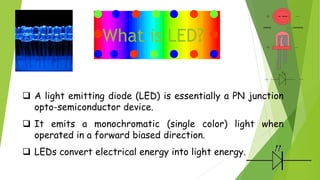
What is LED?
 A light emitting diode (LED) is essentially a PN junction
opto-semiconductor device.
 It emits a monochromatic (single color) light when
operated in a forward biased direction.
 LEDs convert electrical energy into light energy.
How Does An Work?
3
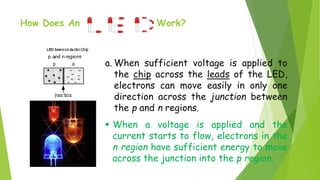
a. When sufficient voltage is applied to
the chip across the leads of the LED,
electrons can move easily in only one
direction across the junction between
the p and n regions.
 When a voltage is applied and the
current starts to flow, electrons in the
n region have sufficient energy to move
across the junction into the p region.
How Does A LED Work?
4
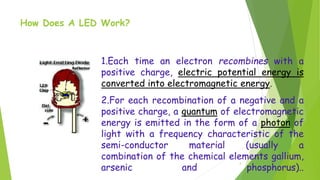
1.Each time an electron recombines with a
positive charge, electric potential energy is
converted into electromagnetic energy.
2.For each recombination of a negative and a
positive charge, a quantum of electromagnetic
energy is emitted in the form of a photon of
light with a frequency characteristic of the
semi-conductor material (usually a
combination of the chemical elements gallium,
arsenic and phosphorus)..
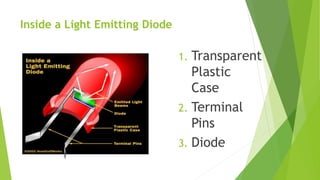
Inside a Light Emitting Diode
1. Transparent
Plastic
Case
2. Terminal
Pins
3. Diode
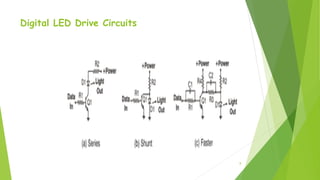
Driving LEDs
Two type of DRIVING LED
 Analog LED Drive Circuits
 Digital LED Drive Circuits
6
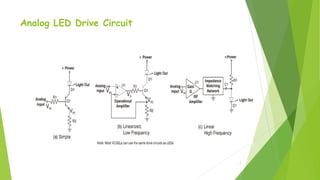
Analog LED Drive Circuit
7
Digital LED Drive Circuits
8
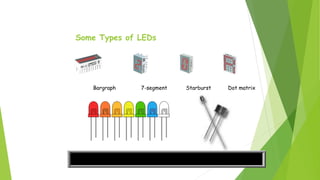
Bargraph 7-segment Starburst Dot matrix
9
Some Types of LEDs
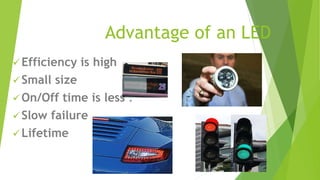
Advantage of an LED
 Efficiency is high
 Small size
 On/Off time is less .
 Slow failure
 Lifetime
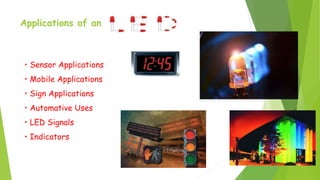
Applications of an
11
• Sensor Applications
• Mobile Applications
• Sign Applications
• Automative Uses
• LED Signals
• Indicators
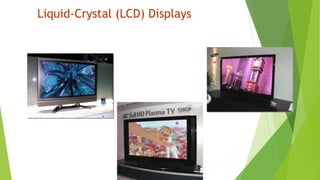
Liquid-Crystal (LCD) Displays
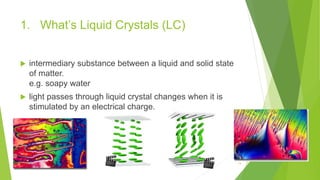
1. What’s Liquid Crystals (LC)
 intermediary substance between a liquid and solid state
of matter.
e.g. soapy water
 light passes through liquid crystal changes when it is
stimulated by an electrical charge.
13
2. Introduction to Liquid Crystal Displays
 A liquid-crystal display (LCD) is a flat panel display
that uses the light modulating properties of liquid
crystals.
 Liquid crystals do not emit light directly
 It consists of an array of tiny segments (called pixels)
that can be manipulated to present information
 Using polarization of lights to display objects
 Common wrist watch and pocket calculator to an
advanced VGA(video graphic array) computer screen
14
Different types of LCDs
There are Two type of LCDs available
1.Passive Matrix LCDs
2.Active Matrix LCDs
15
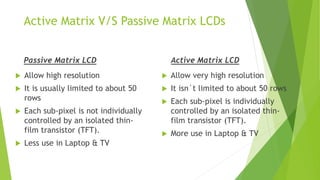
Active Matrix V/S Passive Matrix LCDs
Active Matrix LCD
 Allow very high resolution
 It isn`t limited to about 50 rows
 Each sub-pixel is individually
controlled by an isolated thin-
film transistor (TFT).
 More use in Laptop & TV
Passive Matrix LCD
 Allow high resolution
 It is usually limited to about 50
rows
 Each sub-pixel is not individually
controlled by an isolated thin-
film transistor (TFT).
 Less use in Laptop & TV
LCD Display Technology
Technology Enhancements:
Better color through corrected CCFLs, LEDs
Improved black levels (compensating films)
Higher contrast (pulsed backlights)
Wider viewing angles (compensating films)
Higher resolution (1920x1080)
Improved LC twist times
Advantages
 Very compact and light.
 Low power consumption.
 Very little heat emitted during operation, due to low power consumption.
 No geometric distortion.
 Is very thin compared to a CRT monitor, which allows the monitor to be
placed farther back from the user, reducing close-focusing related eye-
strain.
 Can be made in almost any size or shape.
 No theoretical resolution limit.
 Can be made to large sizes (more than 24 inches) lightly and relatively
inexpensively.
.
Applications
 Thin Film Transistor (TFT)
 Alpha-numeric display
 Back lighting systems
 For brighter displays
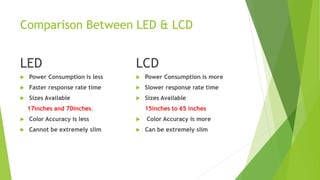
Comparison Between LED & LCD
LED
 Power Consumption is less
 Faster response rate time
 Sizes Available
17inches and 70inches.
 Color Accuracy is less
 Cannot be extremely slim
LCD
 Power Consumption is more
 Slower response rate time
 Sizes Available
15inches to 65 inches
 Color Accuracy is more
 Can be extremely slim
AND
THANKYOUFOR YOUR
PATIENCE….

Difference between led & lcd

  • 1.
    LED & LCD ELECTRONICSAND COMMUNICATION ENGINEERING POORNIMA INSTITUTE OF ENGINEERING & TECNOLOGY, JAIPUR A PRESENTATION ON SUPERVISED BY: Mr. Rahul Gupta Assistant Professor SUBMITTED BY: -Madhusudhan Agarwal
  • 2.
    What is LED? A light emitting diode (LED) is essentially a PN junction opto-semiconductor device.  It emits a monochromatic (single color) light when operated in a forward biased direction.  LEDs convert electrical energy into light energy.
  • 3.
    How Does AnWork? 3 a. When sufficient voltage is applied to the chip across the leads of the LED, electrons can move easily in only one direction across the junction between the p and n regions.  When a voltage is applied and the current starts to flow, electrons in the n region have sufficient energy to move across the junction into the p region.
  • 4.
    How Does ALED Work? 4 1.Each time an electron recombines with a positive charge, electric potential energy is converted into electromagnetic energy. 2.For each recombination of a negative and a positive charge, a quantum of electromagnetic energy is emitted in the form of a photon of light with a frequency characteristic of the semi-conductor material (usually a combination of the chemical elements gallium, arsenic and phosphorus)..
  • 5.
    Inside a LightEmitting Diode 1. Transparent Plastic Case 2. Terminal Pins 3. Diode
  • 6.
    Driving LEDs Two typeof DRIVING LED  Analog LED Drive Circuits  Digital LED Drive Circuits 6
  • 7.
  • 8.
  • 9.
    Bargraph 7-segment StarburstDot matrix 9 Some Types of LEDs
  • 10.
    Advantage of anLED  Efficiency is high  Small size  On/Off time is less .  Slow failure  Lifetime
  • 11.
    Applications of an 11 •Sensor Applications • Mobile Applications • Sign Applications • Automative Uses • LED Signals • Indicators
  • 12.
  • 13.
    1. What’s LiquidCrystals (LC)  intermediary substance between a liquid and solid state of matter. e.g. soapy water  light passes through liquid crystal changes when it is stimulated by an electrical charge. 13
  • 14.
    2. Introduction toLiquid Crystal Displays  A liquid-crystal display (LCD) is a flat panel display that uses the light modulating properties of liquid crystals.  Liquid crystals do not emit light directly  It consists of an array of tiny segments (called pixels) that can be manipulated to present information  Using polarization of lights to display objects  Common wrist watch and pocket calculator to an advanced VGA(video graphic array) computer screen 14
  • 15.
    Different types ofLCDs There are Two type of LCDs available 1.Passive Matrix LCDs 2.Active Matrix LCDs 15
  • 16.
    Active Matrix V/SPassive Matrix LCDs Active Matrix LCD  Allow very high resolution  It isn`t limited to about 50 rows  Each sub-pixel is individually controlled by an isolated thin- film transistor (TFT).  More use in Laptop & TV Passive Matrix LCD  Allow high resolution  It is usually limited to about 50 rows  Each sub-pixel is not individually controlled by an isolated thin- film transistor (TFT).  Less use in Laptop & TV
  • 17.
    LCD Display Technology TechnologyEnhancements: Better color through corrected CCFLs, LEDs Improved black levels (compensating films) Higher contrast (pulsed backlights) Wider viewing angles (compensating films) Higher resolution (1920x1080) Improved LC twist times
  • 18.
    Advantages  Very compactand light.  Low power consumption.  Very little heat emitted during operation, due to low power consumption.  No geometric distortion.  Is very thin compared to a CRT monitor, which allows the monitor to be placed farther back from the user, reducing close-focusing related eye- strain.  Can be made in almost any size or shape.  No theoretical resolution limit.  Can be made to large sizes (more than 24 inches) lightly and relatively inexpensively. .
  • 19.
    Applications  Thin FilmTransistor (TFT)  Alpha-numeric display  Back lighting systems  For brighter displays
  • 20.
    Comparison Between LED& LCD LED  Power Consumption is less  Faster response rate time  Sizes Available 17inches and 70inches.  Color Accuracy is less  Cannot be extremely slim LCD  Power Consumption is more  Slower response rate time  Sizes Available 15inches to 65 inches  Color Accuracy is more  Can be extremely slim
  • 21.
  • 22.