Building Material and
Sciences-IV
Assignment-4
HOT AND COLD
ROLLED SECTIONS
Submitted by: SHRUTI GARG
B.Arch 2nd year-A
Q.1) Explain hot &; cold rolled sections. With Examples.
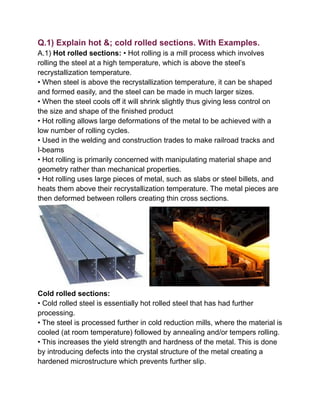
A.1) Hot rolled sections: • Hot rolling is a mill process which involves
rolling the steel at a high temperature, which is above the steel’s
recrystallization temperature.
• When steel is above the recrystallization temperature, it can be shaped
and formed easily, and the steel can be made in much larger sizes.
• When the steel cools off it will shrink slightly thus giving less control on
the size and shape of the finished product
• Hot rolling allows large deformations of the metal to be achieved with a
low number of rolling cycles.
• Used in the welding and construction trades to make railroad tracks and
I-beams
• Hot rolling is primarily concerned with manipulating material shape and
geometry rather than mechanical properties.
• Hot rolling uses large pieces of metal, such as slabs or steel billets, and
heats them above their recrystallization temperature. The metal pieces are
then deformed between rollers creating thin cross sections.
Cold rolled sections:
• Cold rolled steel is essentially hot rolled steel that has had further
processing.
• The steel is processed further in cold reduction mills, where the material is
cooled (at room temperature) followed by annealing and/or tempers rolling.
• This increases the yield strength and hardness of the metal. This is done
by introducing defects into the crystal structure of the metal creating a
hardened microstructure which prevents further slip.
• Cold rolled steel is manufactured at temperatures below its
recrystallization temperature, typically at around room temperature.
Because the steel is manufactured at a much lower temperature, there’s no
need to worry about the steel shrinking or changing form or appearance.
• The cold rolled steel end products like cold finished steel bar have a
much smoother appearance and may have square corners more accurate
in dimension and finish.
• Cold rolled steel is much more preferred in the machining world where the
quality of the steel is an important factor of the quality of the final product,
and the appearance of the steel is also an important factor. • Cold finished
bars are typically harder to work with than hot rolled due to the increased
carbon content.
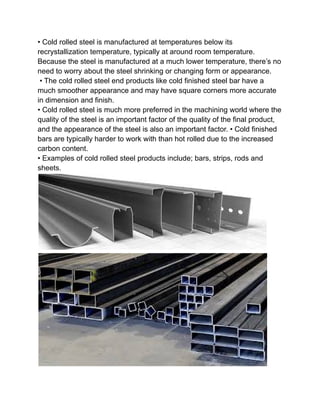
• Examples of cold rolled steel products include; bars, strips, rods and
sheets.
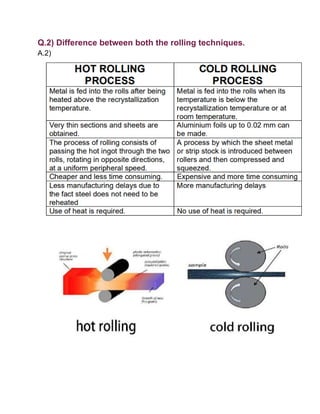
Q.2) Difference between both the rolling techniques.
A.2)
Q.3) Explain advantages & disadvantages of hot & cold rolled
sections.
A.3) Following are the advantages and disadvantages of hot and cold
rolled sections:
Q.4) Explain the types of sections which are made by rolling
sections.
A.4) Following types of sections are made by rolling sections:
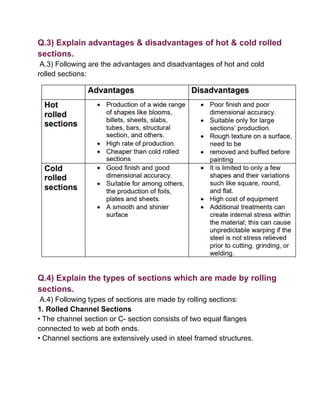
1. Rolled Channel Sections
• The channel section or C- section consists of two equal flanges
connected to web at both ends.
• Channel sections are extensively used in steel framed structures.
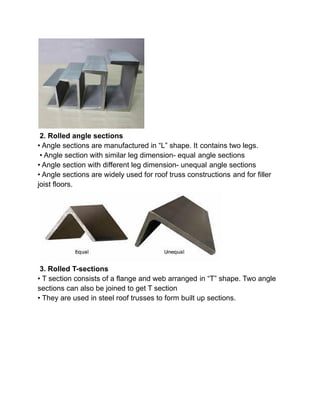
2. Rolled angle sections
• Angle sections are manufactured in “L” shape. It contains two legs.
• Angle section with similar leg dimension- equal angle sections
• Angle section with different leg dimension- unequal angle sections
• Angle sections are widely used for roof truss constructions and for filler
joist floors.
3. Rolled T-sections
• T section consists of a flange and web arranged in “T” shape. Two angle
sections can also be joined to get T section
• They are used in steel roof trusses to form built up sections.
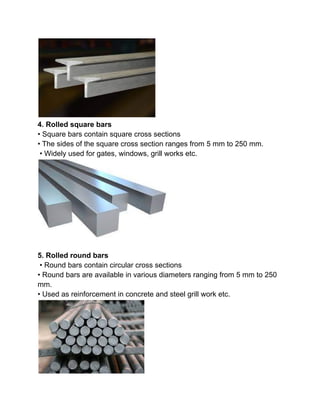
4. Rolled square bars
• Square bars contain square cross sections
• The sides of the square cross section ranges from 5 mm to 250 mm.
• Widely used for gates, windows, grill works etc.
5. Rolled round bars
• Round bars contain circular cross sections
• Round bars are available in various diameters ranging from 5 mm to 250
mm.
• Used as reinforcement in concrete and steel grill work etc.
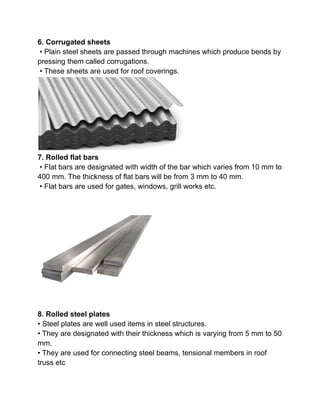
6. Corrugated sheets
• Plain steel sheets are passed through machines which produce bends by
pressing them called corrugations.
• These sheets are used for roof coverings.
7. Rolled flat bars
• Flat bars are designated with width of the bar which varies from 10 mm to
400 mm. The thickness of flat bars will be from 3 mm to 40 mm.
• Flat bars are used for gates, windows, grill works etc.
8. Rolled steel plates
• Steel plates are well used items in steel structures.
• They are designated with their thickness which is varying from 5 mm to 50
mm.
• They are used for connecting steel beams, tensional members in roof
truss etc
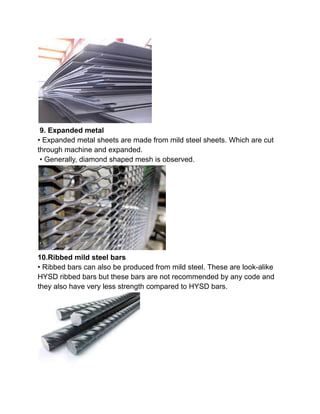
9. Expanded metal
• Expanded metal sheets are made from mild steel sheets. Which are cut
through machine and expanded.
• Generally, diamond shaped mesh is observed.
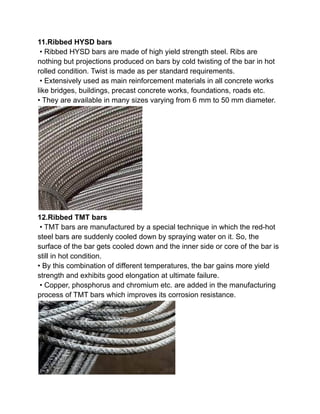
10.Ribbed mild steel bars
• Ribbed bars can also be produced from mild steel. These are look-alike
HYSD ribbed bars but these bars are not recommended by any code and
they also have very less strength compared to HYSD bars.
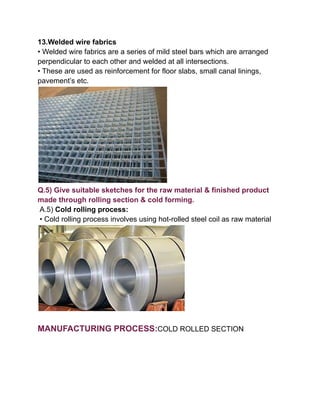
11.Ribbed HYSD bars
• Ribbed HYSD bars are made of high yield strength steel. Ribs are
nothing but projections produced on bars by cold twisting of the bar in hot
rolled condition. Twist is made as per standard requirements.
• Extensively used as main reinforcement materials in all concrete works
like bridges, buildings, precast concrete works, foundations, roads etc.
• They are available in many sizes varying from 6 mm to 50 mm diameter.
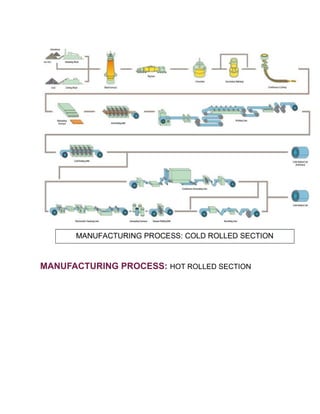
12.Ribbed TMT bars
• TMT bars are manufactured by a special technique in which the red-hot
steel bars are suddenly cooled down by spraying water on it. So, the
surface of the bar gets cooled down and the inner side or core of the bar is
still in hot condition.
• By this combination of different temperatures, the bar gains more yield
strength and exhibits good elongation at ultimate failure.
• Copper, phosphorus and chromium etc. are added in the manufacturing
process of TMT bars which improves its corrosion resistance.
13.Welded wire fabrics
• Welded wire fabrics are a series of mild steel bars which are arranged
perpendicular to each other and welded at all intersections.
• These are used as reinforcement for floor slabs, small canal linings,
pavement’s etc.
Q.5) Give suitable sketches for the raw material & finished product
made through rolling section & cold forming.
A.5) Cold rolling process:
• Cold rolling process involves using hot-rolled steel coil as raw material
MANUFACTURING PROCESS:COLD ROLLED SECTION
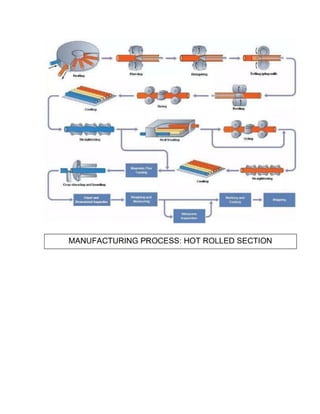
MANUFACTURING PROCESS: HOT ROLLED SECTION
hot and cold rolled sections -bms

hot and cold rolled sections -bms

  • 1.
    Building Material and Sciences-IV Assignment-4 HOTAND COLD ROLLED SECTIONS Submitted by: SHRUTI GARG B.Arch 2nd year-A
  • 2.
    Q.1) Explain hot&; cold rolled sections. With Examples. A.1) Hot rolled sections: • Hot rolling is a mill process which involves rolling the steel at a high temperature, which is above the steel’s recrystallization temperature. • When steel is above the recrystallization temperature, it can be shaped and formed easily, and the steel can be made in much larger sizes. • When the steel cools off it will shrink slightly thus giving less control on the size and shape of the finished product • Hot rolling allows large deformations of the metal to be achieved with a low number of rolling cycles. • Used in the welding and construction trades to make railroad tracks and I-beams • Hot rolling is primarily concerned with manipulating material shape and geometry rather than mechanical properties. • Hot rolling uses large pieces of metal, such as slabs or steel billets, and heats them above their recrystallization temperature. The metal pieces are then deformed between rollers creating thin cross sections. Cold rolled sections: • Cold rolled steel is essentially hot rolled steel that has had further processing. • The steel is processed further in cold reduction mills, where the material is cooled (at room temperature) followed by annealing and/or tempers rolling. • This increases the yield strength and hardness of the metal. This is done by introducing defects into the crystal structure of the metal creating a hardened microstructure which prevents further slip.
  • 3.
    • Cold rolledsteel is manufactured at temperatures below its recrystallization temperature, typically at around room temperature. Because the steel is manufactured at a much lower temperature, there’s no need to worry about the steel shrinking or changing form or appearance. • The cold rolled steel end products like cold finished steel bar have a much smoother appearance and may have square corners more accurate in dimension and finish. • Cold rolled steel is much more preferred in the machining world where the quality of the steel is an important factor of the quality of the final product, and the appearance of the steel is also an important factor. • Cold finished bars are typically harder to work with than hot rolled due to the increased carbon content. • Examples of cold rolled steel products include; bars, strips, rods and sheets.
  • 4.
    Q.2) Difference betweenboth the rolling techniques. A.2)
  • 5.
    Q.3) Explain advantages& disadvantages of hot & cold rolled sections. A.3) Following are the advantages and disadvantages of hot and cold rolled sections: Q.4) Explain the types of sections which are made by rolling sections. A.4) Following types of sections are made by rolling sections: 1. Rolled Channel Sections • The channel section or C- section consists of two equal flanges connected to web at both ends. • Channel sections are extensively used in steel framed structures.
  • 6.
    2. Rolled anglesections • Angle sections are manufactured in “L” shape. It contains two legs. • Angle section with similar leg dimension- equal angle sections • Angle section with different leg dimension- unequal angle sections • Angle sections are widely used for roof truss constructions and for filler joist floors. 3. Rolled T-sections • T section consists of a flange and web arranged in “T” shape. Two angle sections can also be joined to get T section • They are used in steel roof trusses to form built up sections.
  • 7.
    4. Rolled squarebars • Square bars contain square cross sections • The sides of the square cross section ranges from 5 mm to 250 mm. • Widely used for gates, windows, grill works etc. 5. Rolled round bars • Round bars contain circular cross sections • Round bars are available in various diameters ranging from 5 mm to 250 mm. • Used as reinforcement in concrete and steel grill work etc.
  • 8.
    6. Corrugated sheets •Plain steel sheets are passed through machines which produce bends by pressing them called corrugations. • These sheets are used for roof coverings. 7. Rolled flat bars • Flat bars are designated with width of the bar which varies from 10 mm to 400 mm. The thickness of flat bars will be from 3 mm to 40 mm. • Flat bars are used for gates, windows, grill works etc. 8. Rolled steel plates • Steel plates are well used items in steel structures. • They are designated with their thickness which is varying from 5 mm to 50 mm. • They are used for connecting steel beams, tensional members in roof truss etc
  • 9.
    9. Expanded metal •Expanded metal sheets are made from mild steel sheets. Which are cut through machine and expanded. • Generally, diamond shaped mesh is observed. 10.Ribbed mild steel bars • Ribbed bars can also be produced from mild steel. These are look-alike HYSD ribbed bars but these bars are not recommended by any code and they also have very less strength compared to HYSD bars.
  • 10.
    11.Ribbed HYSD bars •Ribbed HYSD bars are made of high yield strength steel. Ribs are nothing but projections produced on bars by cold twisting of the bar in hot rolled condition. Twist is made as per standard requirements. • Extensively used as main reinforcement materials in all concrete works like bridges, buildings, precast concrete works, foundations, roads etc. • They are available in many sizes varying from 6 mm to 50 mm diameter. 12.Ribbed TMT bars • TMT bars are manufactured by a special technique in which the red-hot steel bars are suddenly cooled down by spraying water on it. So, the surface of the bar gets cooled down and the inner side or core of the bar is still in hot condition. • By this combination of different temperatures, the bar gains more yield strength and exhibits good elongation at ultimate failure. • Copper, phosphorus and chromium etc. are added in the manufacturing process of TMT bars which improves its corrosion resistance.
  • 11.
    13.Welded wire fabrics •Welded wire fabrics are a series of mild steel bars which are arranged perpendicular to each other and welded at all intersections. • These are used as reinforcement for floor slabs, small canal linings, pavement’s etc. Q.5) Give suitable sketches for the raw material & finished product made through rolling section & cold forming. A.5) Cold rolling process: • Cold rolling process involves using hot-rolled steel coil as raw material MANUFACTURING PROCESS:COLD ROLLED SECTION
  • 12.