Downloaded 207 times
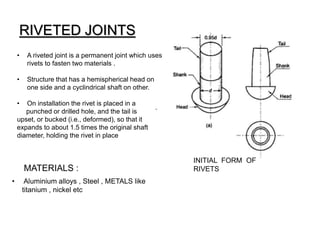
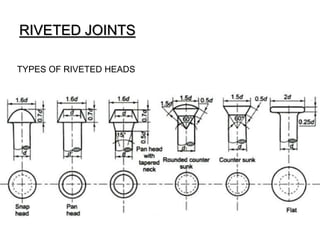
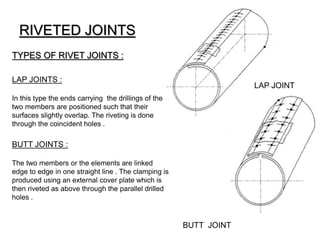
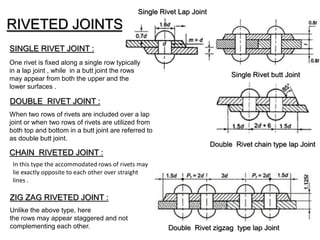

Riveted joints use rivets to permanently fasten two materials together. A rivet has a hemispherical head on one side and a cylindrical shaft on the other. During installation, the tail of the rivet is deformed to expand its diameter and hold the rivet in place. Common riveted joint types include lap joints, where the ends of two materials overlap with coinciding holes, and butt joints, where two materials are joined edge to edge using an external cover plate riveted through parallel holes. Riveted joints can be single rivet joints with one rivet in a row, or double rivet joints with two rows of rivets.


