BUILDING MATERIAL AND
SCIENCES-IV
ASSIGNMENT-6
PAINTS
SUBMITTED BY:
SHRUTI GARG
INTRODUCTION TO PAINTS
● Paint is a liquid or mastic material that can be applied to surfaces to
colour, protect and provide texture.
● They are usually stored as a liquid and dry into a thin film after
application.
● Paints be categorised decorative, are applied on site, or industrial,
applied in factories as part of the manufacturing process.
● Paints can be applied with a brush or roller, or by dipping, flow coating,
spraying, hot spraying, electrostatic spraying, airless spraying,
electrodeposition, powder coating, vacuum impregnation, immersion.
● For different surfaces different types of paints from different
companies are used.
● Some of the leading companies of India are Asian paints, Nerolac,
Berger, Nippon etc.
COMPOSITION OF PAINTS
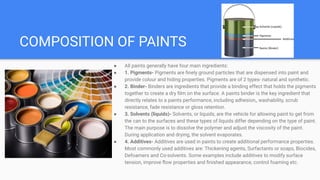
● All paints generally have four main ingredients:
● 1. Pigments- Pigments are finely ground particles that are dispensed into paint and
provide colour and hiding properties. Pigments are of 2 types- natural and synthetic.
● 2. Binder- Binders are ingredients that provide a binding effect that holds the pigments
together to create a dry film on the surface. A paints binder is the key ingredient that
directly relates to a paints performance, including adhesion,, washability, scrub
resistance, fade resistance or gloss retention.
● 3. Solvents (liquids)- Solvents, or liquids, are the vehicle for allowing paint to get from
the can to the surfaces and these types of liquids differ depending on the type of paint.
The main purpose is to dissolve the polymer and adjust the viscosity of the paint.
During application and drying, the solvent evaporates.
● 4. Additives- Additives are used in paints to create additional performance properties.
Most commonly used additives are: Thickening agents, Surfactants or soaps, Biocides,
Defoamers and Co-solvents. Some examples include additives to modify surface
tension, improve flow properties and finished appearance, control foaming etc.
APPLICATION OF PAINT ON THE WALLS
❏ Surface preparation
❏ Surface preparation is important because it directly affects the surface finish of the
paint. A paint scraper, a putty knife or a sand paper is used to remove loose particles
or flakes and the surface is made enough and free from dust, dirt, grease etc.
❏ All loose material is removed and filled with plaster or putty mixture.
❏ Primer coating
❏ It is essential, especially when the walls to be painted are stained, porous, have water
damage or when we are painting a light colour over a dark colour or vice versa.
Primers help provide a smooth surface, making the surface less absorbent, thus
increasing the spreading capacity of the paint. Using primer on the kitchen,
bathroom and exterior walls is especially important to aid in the prevention of
mildew. Primer helps give uniform colour and texture to the finished paint, and
provide better adhesion to the top coats. The type of primer used is also dependent
on the kind of surface to be painted, i.e. different primers exist for interior walls,
exterior walls, wood, metals etc.
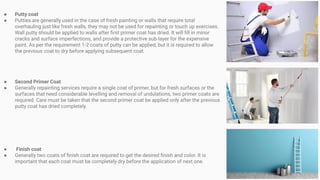
● Putty coat
● Putties are generally used in the case of fresh painting or walls that require total
overhauling just like fresh walls, they may not be used for repainting or touch up exercises.
Wall putty should be applied to walls after first primer coat has dried. It will fill in minor
cracks and surface imperfections, and provide a protective sub-layer for the expensive
paint. As per the requirement 1-2 coats of putty can be applied, but it is required to allow
the previous coat to dry before applying subsequent coat.
● Second Primer Coat
● Generally repainting services require a single coat of primer, but for fresh surfaces or the
surfaces that need considerable levelling and removal of undulations, two primer coats are
required. Care must be taken that the second primer coat be applied only after the previous
putty coat has dried completely.
● Finish coat
● Generally two coats of finish coat are required to get the desired finish and color. It is
important that each coat must be completely dry before the application of next one.
TYPES OF PAINT
● Distemper:
● Distemper are water based paints.
● These are durable and economic.
● The distemper composes of the following constituents colouring agents,
chalk and lime.
● Distempers are available in powder. They are to be mixed with hot water
before use.
● The surface to be distempered should be thoroughly rubbed and cleaned.
Distemper is usually applied in two coats.
● Primer :
● A primer or undercoat is a preparatory coating put on materials before
painting.
● Priming ensures better adhesion of paint to the surface, increases paint
durability, and provides additional protection for the material being painted.
● A primer consists of 20–30% synthetic resin, 60–80% solvent and 2–5%
additive agent.
● Enamel paints:
● Enamels are hard, washable and usually glossy paints.
● They can be oil based or alkyd based and come in several sheens, from
eggshell or low-lustre to satin, semi- gloss and high-gloss.
● They find application not only on metal surfaces but also on interior walls and
wooden surfaces.
● Applying enamel paint on wood enables the paint to last longer, giving the
surface a hard, glossy and durable finish
● Emulsion paint:
● These are the superior quality of paint formed by mixing oil/water and an
emulsifying agent to prevent the combination separating.
● They have much better ease of application, are washable and have a greater
overall decorative appeal. They have much better ease of application, are
washable and have a greater overall decorative appeal. they have higher
coverage than enamels and distempers, they are mostly washable and can be
easily applied on concrete and stucco surfaces. As per the interior and
exterior painting requirements both interior and exterior emulsion paints exist.
● Texture paints:
● These are used to create to desired visual effects on the walls. By the use of
brushes, rollers, putty knives, trowels and other applications a variety of patterns
can be created.
● Other paints can be applied on the textures to create desired effects. Sometimes,
texture paints are tinted prior to application, giving the desired colour.
● Texture paints also help in covering undulations and levelling surfaces.
● Cement paint:
● Cement paints are covered under powder paints which are used for exterior
cemented walls, all types of masonry surfaces like Bungalows, Multistorey
buildings, Bridges, Dams, Houses.
● Cement paints are used externally to prevent rain penetration, as well as for
decorative purposes, and can retain some water roofing qualities for as long as ten
years on vertical surfaces.
● For making different colours cement paints a certain percentage of pigments are
used in the base cement paint.
● Can supplement the role of putty
● Wood finishes:
● Wood Finish Paints are different from the usual wall paints and are
formulated specifically for application on wooden surfaces.
● They have better capacity of adhering to the wooden surfaces and
enhancing the appeal of the wooden textures. These include wood sealers,
varnishes, preservatives etc.
● Wood Finishes protect the wooden surfaces from moisture and make its
appearance richer and deeper.
● Wood finish is different than painting in a way that, painting hides the
original wooden surface while Wood finishes improve the appearance of
the surface. Finishing is done by adding a liquid on the surface of the
wood.
● Sealers:
● These are base coats applied to a surface to reduce absorption of
subsequent coats of paint or varnish, or to prevent bleeding through the
finish coat.
● Sealer paint can be used as a substitute for a primer, or before the primer
is applied to the base surface.
● The main purpose of sealer paint is to provide good adhesion between the
substrate and the new paint or the primer.
APPLICATIONS OF PAINTS
● Wooden finishes are used for coating furniture.
● Metal finishes used to improve its exterior appearance, durability,
surface friction.
● Metal finishes are used to avoid corrosion. Used for metal surfaces like
pipe, external structures which may allowed to corrosive nature etc.
● Graphite paint is made of graphite which is in black colour. It is used for
painting underground structures like mines etc. Iron structures are
coated with graphite paints.
● Plastic paints are used for coating walls, slabs, decks etc.
● Used for painting aircrafts, motor cars etc..
● Used for painting doors, windows, stairs, decks etc.
● Used to protect all sorts of buildings and structures from the effects of
water and sun.
● Paint also helps to prevent the wood from drying out in the hot sun.
THANK YOU

BMS_PAINTS.pdf

  • 1.
  • 2.
    INTRODUCTION TO PAINTS ●Paint is a liquid or mastic material that can be applied to surfaces to colour, protect and provide texture. ● They are usually stored as a liquid and dry into a thin film after application. ● Paints be categorised decorative, are applied on site, or industrial, applied in factories as part of the manufacturing process. ● Paints can be applied with a brush or roller, or by dipping, flow coating, spraying, hot spraying, electrostatic spraying, airless spraying, electrodeposition, powder coating, vacuum impregnation, immersion. ● For different surfaces different types of paints from different companies are used. ● Some of the leading companies of India are Asian paints, Nerolac, Berger, Nippon etc.
  • 3.
    COMPOSITION OF PAINTS ●All paints generally have four main ingredients: ● 1. Pigments- Pigments are finely ground particles that are dispensed into paint and provide colour and hiding properties. Pigments are of 2 types- natural and synthetic. ● 2. Binder- Binders are ingredients that provide a binding effect that holds the pigments together to create a dry film on the surface. A paints binder is the key ingredient that directly relates to a paints performance, including adhesion,, washability, scrub resistance, fade resistance or gloss retention. ● 3. Solvents (liquids)- Solvents, or liquids, are the vehicle for allowing paint to get from the can to the surfaces and these types of liquids differ depending on the type of paint. The main purpose is to dissolve the polymer and adjust the viscosity of the paint. During application and drying, the solvent evaporates. ● 4. Additives- Additives are used in paints to create additional performance properties. Most commonly used additives are: Thickening agents, Surfactants or soaps, Biocides, Defoamers and Co-solvents. Some examples include additives to modify surface tension, improve flow properties and finished appearance, control foaming etc.
  • 4.
    APPLICATION OF PAINTON THE WALLS ❏ Surface preparation ❏ Surface preparation is important because it directly affects the surface finish of the paint. A paint scraper, a putty knife or a sand paper is used to remove loose particles or flakes and the surface is made enough and free from dust, dirt, grease etc. ❏ All loose material is removed and filled with plaster or putty mixture. ❏ Primer coating ❏ It is essential, especially when the walls to be painted are stained, porous, have water damage or when we are painting a light colour over a dark colour or vice versa. Primers help provide a smooth surface, making the surface less absorbent, thus increasing the spreading capacity of the paint. Using primer on the kitchen, bathroom and exterior walls is especially important to aid in the prevention of mildew. Primer helps give uniform colour and texture to the finished paint, and provide better adhesion to the top coats. The type of primer used is also dependent on the kind of surface to be painted, i.e. different primers exist for interior walls, exterior walls, wood, metals etc.
  • 5.
    ● Putty coat ●Putties are generally used in the case of fresh painting or walls that require total overhauling just like fresh walls, they may not be used for repainting or touch up exercises. Wall putty should be applied to walls after first primer coat has dried. It will fill in minor cracks and surface imperfections, and provide a protective sub-layer for the expensive paint. As per the requirement 1-2 coats of putty can be applied, but it is required to allow the previous coat to dry before applying subsequent coat. ● Second Primer Coat ● Generally repainting services require a single coat of primer, but for fresh surfaces or the surfaces that need considerable levelling and removal of undulations, two primer coats are required. Care must be taken that the second primer coat be applied only after the previous putty coat has dried completely. ● Finish coat ● Generally two coats of finish coat are required to get the desired finish and color. It is important that each coat must be completely dry before the application of next one.
  • 6.
    TYPES OF PAINT ●Distemper: ● Distemper are water based paints. ● These are durable and economic. ● The distemper composes of the following constituents colouring agents, chalk and lime. ● Distempers are available in powder. They are to be mixed with hot water before use. ● The surface to be distempered should be thoroughly rubbed and cleaned. Distemper is usually applied in two coats. ● Primer : ● A primer or undercoat is a preparatory coating put on materials before painting. ● Priming ensures better adhesion of paint to the surface, increases paint durability, and provides additional protection for the material being painted. ● A primer consists of 20–30% synthetic resin, 60–80% solvent and 2–5% additive agent.
  • 7.
    ● Enamel paints: ●Enamels are hard, washable and usually glossy paints. ● They can be oil based or alkyd based and come in several sheens, from eggshell or low-lustre to satin, semi- gloss and high-gloss. ● They find application not only on metal surfaces but also on interior walls and wooden surfaces. ● Applying enamel paint on wood enables the paint to last longer, giving the surface a hard, glossy and durable finish ● Emulsion paint: ● These are the superior quality of paint formed by mixing oil/water and an emulsifying agent to prevent the combination separating. ● They have much better ease of application, are washable and have a greater overall decorative appeal. They have much better ease of application, are washable and have a greater overall decorative appeal. they have higher coverage than enamels and distempers, they are mostly washable and can be easily applied on concrete and stucco surfaces. As per the interior and exterior painting requirements both interior and exterior emulsion paints exist.
  • 8.
    ● Texture paints: ●These are used to create to desired visual effects on the walls. By the use of brushes, rollers, putty knives, trowels and other applications a variety of patterns can be created. ● Other paints can be applied on the textures to create desired effects. Sometimes, texture paints are tinted prior to application, giving the desired colour. ● Texture paints also help in covering undulations and levelling surfaces. ● Cement paint: ● Cement paints are covered under powder paints which are used for exterior cemented walls, all types of masonry surfaces like Bungalows, Multistorey buildings, Bridges, Dams, Houses. ● Cement paints are used externally to prevent rain penetration, as well as for decorative purposes, and can retain some water roofing qualities for as long as ten years on vertical surfaces. ● For making different colours cement paints a certain percentage of pigments are used in the base cement paint. ● Can supplement the role of putty
  • 9.
    ● Wood finishes: ●Wood Finish Paints are different from the usual wall paints and are formulated specifically for application on wooden surfaces. ● They have better capacity of adhering to the wooden surfaces and enhancing the appeal of the wooden textures. These include wood sealers, varnishes, preservatives etc. ● Wood Finishes protect the wooden surfaces from moisture and make its appearance richer and deeper. ● Wood finish is different than painting in a way that, painting hides the original wooden surface while Wood finishes improve the appearance of the surface. Finishing is done by adding a liquid on the surface of the wood. ● Sealers: ● These are base coats applied to a surface to reduce absorption of subsequent coats of paint or varnish, or to prevent bleeding through the finish coat. ● Sealer paint can be used as a substitute for a primer, or before the primer is applied to the base surface. ● The main purpose of sealer paint is to provide good adhesion between the substrate and the new paint or the primer.
  • 10.
    APPLICATIONS OF PAINTS ●Wooden finishes are used for coating furniture. ● Metal finishes used to improve its exterior appearance, durability, surface friction. ● Metal finishes are used to avoid corrosion. Used for metal surfaces like pipe, external structures which may allowed to corrosive nature etc. ● Graphite paint is made of graphite which is in black colour. It is used for painting underground structures like mines etc. Iron structures are coated with graphite paints. ● Plastic paints are used for coating walls, slabs, decks etc. ● Used for painting aircrafts, motor cars etc.. ● Used for painting doors, windows, stairs, decks etc. ● Used to protect all sorts of buildings and structures from the effects of water and sun. ● Paint also helps to prevent the wood from drying out in the hot sun.
  • 11.