Teacher’s notes included in the Notes Page.
Flash activity. These activities are not editable.
Useful websites for further information.
Icons key:
For more detailed instructions, see the Getting Started presentation.
Accompanying worksheet.
© Boardworks Ltd 20121 of 9
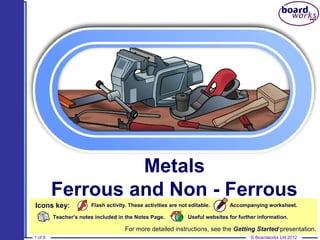
Metals
Ferrous and Non - Ferrous
© Boardworks Ltd 20122 of 9
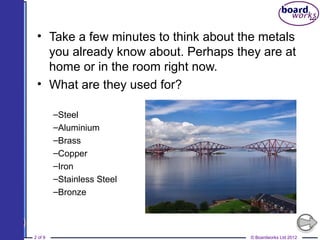
• Take a few minutes to think about the metals
you already know about. Perhaps they are at
home or in the room right now.
• What are they used for?
–Steel
–Aluminium
–Brass
–Copper
–Iron
–Stainless Steel
–Bronze
© Boardworks Ltd 20123 of 9
Metals
• Metals make up the largest class of chemical
elements in the Periodic Table.
• Approximately three quarters of elements are
metals. Most metals are silvery in colour,
have a characteristic lustre, and are solid
(rather than liquid or gaseous).
• Most metals are also malleable (can be
shaped with a hammer), ductile (can be
drawn into a wire), and good conductors of
both heat and electricity.
© Boardworks Ltd 20124 of 9
What you need to learn…
 Ferrous Metals
 Non-ferrous Metals
 Alloy Metals
© Boardworks Ltd 20125 of 9
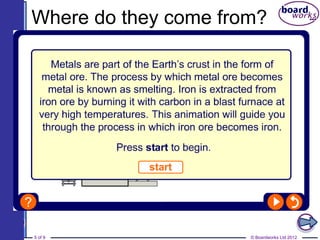
Where do they come from?
© Boardworks Ltd 20126 of 9
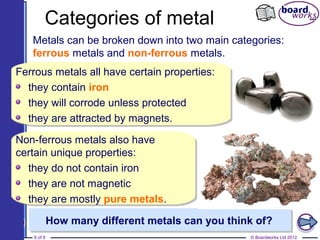
Metals can be broken down into two main categories:
ferrous metals and non-ferrous metals.
Categories of metal
Ferrous metals all have certain properties:
they contain iron
they will corrode unless protected
they are attracted by magnets.
Non-ferrous metals also have
certain unique properties:
they do not contain iron
they are not magnetic
they are mostly pure metals.
How many different metals can you think of?
© Boardworks Ltd 20127 of 9
Metalwork
© Boardworks Ltd 20128 of 9
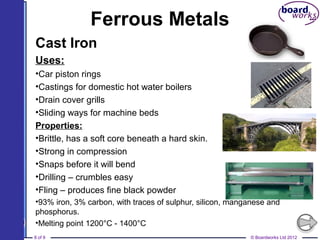
Ferrous Metals
Cast Iron
Uses:
•Car piston rings
•Castings for domestic hot water boilers
•Drain cover grills
•Sliding ways for machine beds
Properties:
•Brittle, has a soft core beneath a hard skin.
•Strong in compression
•Snaps before it will bend
•Drilling – crumbles easy
•Fling – produces fine black powder
•93% iron, 3% carbon, with traces of sulphur, silicon, manganese and
phosphorus.
•Melting point 1200°C - 1400°C
© Boardworks Ltd 20129 of 9
Ferrous Metals
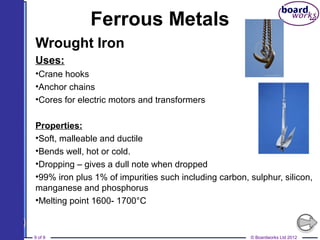
Wrought Iron
Uses:
•Crane hooks
•Anchor chains
•Cores for electric motors and transformers
Properties:
•Soft, malleable and ductile
•Bends well, hot or cold.
•Dropping – gives a dull note when dropped
•99% iron plus 1% of impurities such including carbon, sulphur, silicon,
manganese and phosphorus
•Melting point 1600- 1700°C
© Boardworks Ltd 201210 of 9
Non - Ferrous Metals
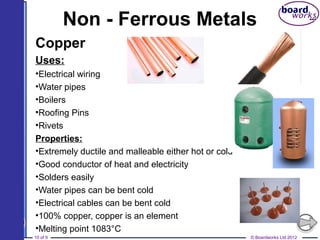
Copper
Uses:
•Electrical wiring
•Water pipes
•Boilers
•Roofing Pins
•Rivets
Properties:
•Extremely ductile and malleable either hot or cold
•Good conductor of heat and electricity
•Solders easily
•Water pipes can be bent cold
•Electrical cables can be bent cold
•100% copper, copper is an element
•Melting point 1083°C
© Boardworks Ltd 201211 of 9
Non - Ferrous Metals
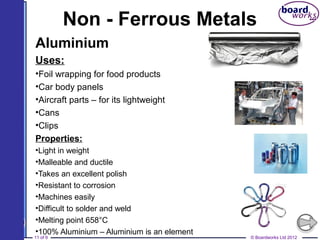
Aluminium
Uses:
•Foil wrapping for food products
•Car body panels
•Aircraft parts – for its lightweight
•Cans
•Clips
Properties:
•Light in weight
•Malleable and ductile
•Takes an excellent polish
•Resistant to corrosion
•Machines easily
•Difficult to solder and weld
•Melting point 658°C
•100% Aluminium – Aluminium is an element
© Boardworks Ltd 201212 of 9
Non - Ferrous Metals
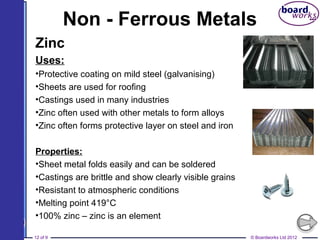
Zinc
Uses:
•Protective coating on mild steel (galvanising)
•Sheets are used for roofing
•Castings used in many industries
•Zinc often used with other metals to form alloys
•Zinc often forms protective layer on steel and iron
Properties:
•Sheet metal folds easily and can be soldered
•Castings are brittle and show clearly visible grains
•Resistant to atmospheric conditions
•Melting point 419°C
•100% zinc – zinc is an element
© Boardworks Ltd 201213 of 9
Non - Ferrous Metals
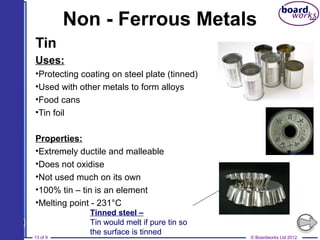
Tin
Uses:
•Protecting coating on steel plate (tinned)
•Used with other metals to form alloys
•Food cans
•Tin foil
Properties:
•Extremely ductile and malleable
•Does not oxidise
•Not used much on its own
•100% tin – tin is an element
•Melting point - 231°C
Tinned steel –
Tin would melt if pure tin so
the surface is tinned
© Boardworks Ltd 201214 of 9
Non - Ferrous Metals
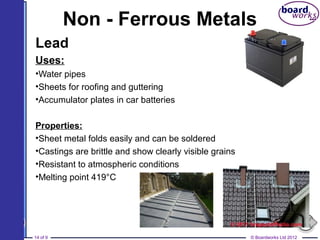
Lead
Uses:
•Water pipes
•Sheets for roofing and guttering
•Accumulator plates in car batteries
Properties:
•Sheet metal folds easily and can be soldered
•Castings are brittle and show clearly visible grains
•Resistant to atmospheric conditions
•Melting point 419°C
© Boardworks Ltd 201215 of 9
Non - Ferrous Metals
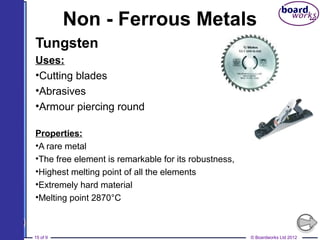
Tungsten
Uses:
•Cutting blades
•Abrasives
•Armour piercing round
Properties:
•A rare metal
•The free element is remarkable for its robustness,
•Highest melting point of all the elements
•Extremely hard material
•Melting point 2870°C
© Boardworks Ltd 201216 of 9
1. Which metal would be most suitable for a church roof?
2. Which metal would be most suitable for domestic wiring
in a new build?
3. Which common metal might you expect to find
transporting the water throughout a house?
4. What are the properties of Aluminium?
5. Which metal would likely to be used for the tips of a
circular saw blade and why?
6. Galvanising is typically the use of which metal to give a
surface coat?
7. Give an example of a product/s that uses Cast Iron
8. Give an example of a product/s that uses Wrought Iron
© Boardworks Ltd 201217 of 9
Homework
Research 3 types of Alloys:
•State the uses of that alloy and its properties
•http://www.youtube.com/watch?v=9LHDSB1n11k
© Boardworks Ltd 201218 of 9
What you need to learn…
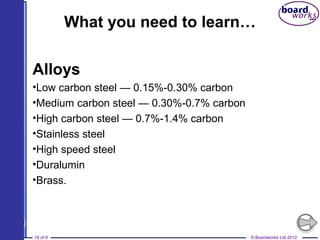
Alloys
•Low carbon steel — 0.15%-0.30% carbon
•Medium carbon steel — 0.30%-0.7% carbon
•High carbon steel — 0.7%-1.4% carbon
•Stainless steel
•High speed steel
•Duralumin
•Brass.
© Boardworks Ltd 201219 of 9
© Boardworks Ltd 201220 of 9
© Boardworks Ltd 201221 of 9
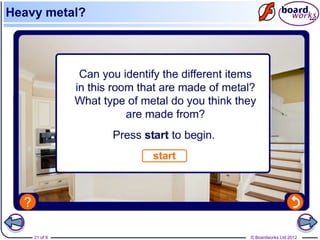
Heavy metal?
© Boardworks Ltd 201222 of 9
Examples of metals
© Boardworks Ltd 201223 of 9
Examples of metals
© Boardworks Ltd 201224 of 9
Properties of metals

Ferrous and non-ferrous metals

  • 1.
    Teacher’s notes includedin the Notes Page. Flash activity. These activities are not editable. Useful websites for further information. Icons key: For more detailed instructions, see the Getting Started presentation. Accompanying worksheet. © Boardworks Ltd 20121 of 9 Metals Ferrous and Non - Ferrous
  • 2.
    © Boardworks Ltd20122 of 9 • Take a few minutes to think about the metals you already know about. Perhaps they are at home or in the room right now. • What are they used for? –Steel –Aluminium –Brass –Copper –Iron –Stainless Steel –Bronze
  • 3.
    © Boardworks Ltd20123 of 9 Metals • Metals make up the largest class of chemical elements in the Periodic Table. • Approximately three quarters of elements are metals. Most metals are silvery in colour, have a characteristic lustre, and are solid (rather than liquid or gaseous). • Most metals are also malleable (can be shaped with a hammer), ductile (can be drawn into a wire), and good conductors of both heat and electricity.
  • 4.
    © Boardworks Ltd20124 of 9 What you need to learn…  Ferrous Metals  Non-ferrous Metals  Alloy Metals
  • 5.
    © Boardworks Ltd20125 of 9 Where do they come from?
  • 6.
    © Boardworks Ltd20126 of 9 Metals can be broken down into two main categories: ferrous metals and non-ferrous metals. Categories of metal Ferrous metals all have certain properties: they contain iron they will corrode unless protected they are attracted by magnets. Non-ferrous metals also have certain unique properties: they do not contain iron they are not magnetic they are mostly pure metals. How many different metals can you think of?
  • 7.
    © Boardworks Ltd20127 of 9 Metalwork
  • 8.
    © Boardworks Ltd20128 of 9 Ferrous Metals Cast Iron Uses: •Car piston rings •Castings for domestic hot water boilers •Drain cover grills •Sliding ways for machine beds Properties: •Brittle, has a soft core beneath a hard skin. •Strong in compression •Snaps before it will bend •Drilling – crumbles easy •Fling – produces fine black powder •93% iron, 3% carbon, with traces of sulphur, silicon, manganese and phosphorus. •Melting point 1200°C - 1400°C
  • 9.
    © Boardworks Ltd20129 of 9 Ferrous Metals Wrought Iron Uses: •Crane hooks •Anchor chains •Cores for electric motors and transformers Properties: •Soft, malleable and ductile •Bends well, hot or cold. •Dropping – gives a dull note when dropped •99% iron plus 1% of impurities such including carbon, sulphur, silicon, manganese and phosphorus •Melting point 1600- 1700°C
  • 10.
    © Boardworks Ltd201210 of 9 Non - Ferrous Metals Copper Uses: •Electrical wiring •Water pipes •Boilers •Roofing Pins •Rivets Properties: •Extremely ductile and malleable either hot or cold •Good conductor of heat and electricity •Solders easily •Water pipes can be bent cold •Electrical cables can be bent cold •100% copper, copper is an element •Melting point 1083°C
  • 11.
    © Boardworks Ltd201211 of 9 Non - Ferrous Metals Aluminium Uses: •Foil wrapping for food products •Car body panels •Aircraft parts – for its lightweight •Cans •Clips Properties: •Light in weight •Malleable and ductile •Takes an excellent polish •Resistant to corrosion •Machines easily •Difficult to solder and weld •Melting point 658°C •100% Aluminium – Aluminium is an element
  • 12.
    © Boardworks Ltd201212 of 9 Non - Ferrous Metals Zinc Uses: •Protective coating on mild steel (galvanising) •Sheets are used for roofing •Castings used in many industries •Zinc often used with other metals to form alloys •Zinc often forms protective layer on steel and iron Properties: •Sheet metal folds easily and can be soldered •Castings are brittle and show clearly visible grains •Resistant to atmospheric conditions •Melting point 419°C •100% zinc – zinc is an element
  • 13.
    © Boardworks Ltd201213 of 9 Non - Ferrous Metals Tin Uses: •Protecting coating on steel plate (tinned) •Used with other metals to form alloys •Food cans •Tin foil Properties: •Extremely ductile and malleable •Does not oxidise •Not used much on its own •100% tin – tin is an element •Melting point - 231°C Tinned steel – Tin would melt if pure tin so the surface is tinned
  • 14.
    © Boardworks Ltd201214 of 9 Non - Ferrous Metals Lead Uses: •Water pipes •Sheets for roofing and guttering •Accumulator plates in car batteries Properties: •Sheet metal folds easily and can be soldered •Castings are brittle and show clearly visible grains •Resistant to atmospheric conditions •Melting point 419°C
  • 15.
    © Boardworks Ltd201215 of 9 Non - Ferrous Metals Tungsten Uses: •Cutting blades •Abrasives •Armour piercing round Properties: •A rare metal •The free element is remarkable for its robustness, •Highest melting point of all the elements •Extremely hard material •Melting point 2870°C
  • 16.
    © Boardworks Ltd201216 of 9 1. Which metal would be most suitable for a church roof? 2. Which metal would be most suitable for domestic wiring in a new build? 3. Which common metal might you expect to find transporting the water throughout a house? 4. What are the properties of Aluminium? 5. Which metal would likely to be used for the tips of a circular saw blade and why? 6. Galvanising is typically the use of which metal to give a surface coat? 7. Give an example of a product/s that uses Cast Iron 8. Give an example of a product/s that uses Wrought Iron
  • 17.
    © Boardworks Ltd201217 of 9 Homework Research 3 types of Alloys: •State the uses of that alloy and its properties •http://www.youtube.com/watch?v=9LHDSB1n11k
  • 18.
    © Boardworks Ltd201218 of 9 What you need to learn… Alloys •Low carbon steel — 0.15%-0.30% carbon •Medium carbon steel — 0.30%-0.7% carbon •High carbon steel — 0.7%-1.4% carbon •Stainless steel •High speed steel •Duralumin •Brass.
  • 19.
    © Boardworks Ltd201219 of 9
  • 20.
    © Boardworks Ltd201220 of 9
  • 21.
    © Boardworks Ltd201221 of 9 Heavy metal?
  • 22.
    © Boardworks Ltd201222 of 9 Examples of metals
  • 23.
    © Boardworks Ltd201223 of 9 Examples of metals
  • 24.
    © Boardworks Ltd201224 of 9 Properties of metals

Editor's Notes

  • #6 Teacher’s note: This is a good opportunity to explore how other metals are extracted from the Earth. Students could be asked to conduct online research to try and find out how different metals are extracted from the Earth and also what some of the problems are with these methods of extraction. As we moved towards the Iron Age, the ease and strength with which metals could be shaped made them invaluable. Initially small pieces of gold and copper were found and could be used without much processing but these were used mainly for decorative purposes. To gather any significant amounts of metals, mining was needed. For example, copper was extracted from the mixture of minerals, rocks and dirt known as copper ore. This meant that lots of copper could be used in the production of household products such as pans and spears. Stages in mining copper: 1) Extract the ore. 2) Wash it to remove gangue (rocks dirt etc) leaving pure ore. 3) Smelt (heat) the ore in a blast furnace with carbon and air. 4) Copper flows out.
  • #7 Teacher’s note: There are a wide variety of metals that the students could cite as examples. They should be able to list the metals that were shown as examples in the previous activity. A sample list of some metals they may know are: steel, aluminium, brass, copper, iron, stainless steel, bronze. You may also wish to discuss ferrous and non-ferrous metals at this stage in more depth. Some points that you may wish to mention include: The Periodic table - do students recognize Fe? Fe = ferrous = containing iron Iron is the basis for all ferrous metals but as a material in its own right (in today’s terms) it has little practical use. To make it suitable for use in today’s demanding environments, we combine it with other materials (alloying) to enhance its properties. Carbon is one of the main materials which is combined with iron ore to make useful materials. Photo credits: Ferrous © David Burden, Shutterstock.com Non-ferrous © Terry Davis, Shutterstock.com
  • #8 Photo credits: Pure metals © Steffen Foerster Photography, Shutterstock.com Alloys © Ford Photography, Shutterstock.com
  • #22 Photo credit: © John Wollwerth, Shutterstock.com
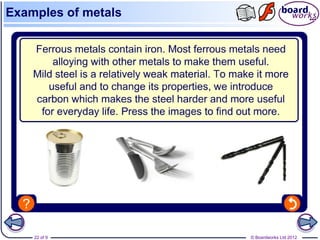
  • #23 Teacher’s note: The more carbon that is added to steel, the harder the alloyed steel. Unfortunately, when we add carbon to steel, this reduces the ductility and malleability of the material. There will always be a trade-off between hardness and brittleness when combining carbon with steel. However, there are several processes such as case-hardening, hardening, tempering, normalizing and annealing which can be employed to counteract some of these properties. Photo credits: Can © Galayko Sergey, Shutterstock.com Cutlery © Robyn Mackenzie Image of drill bits courtesy of Middlesex University Teaching Resources (www.mutr.co.uk).
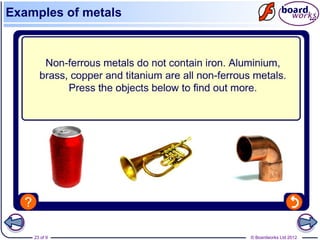
  • #24 Photo credits: Can and trumpet © 2009 http://www.sxc.hu Photo credit: Pipe © Gordon Ball LRPS, Shutterstock.com
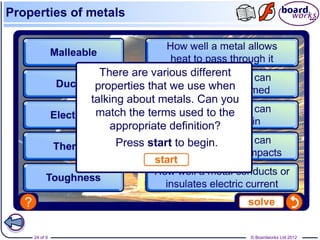
  • #25 Teacher’s note: There are various other properties of metals that you may wish to let your students know about. Some of these are included here: Hardness – ability to withstand indents, abrasive wear and deformation Durability – ability to withstand wear and tear Strength – ability to withstand force without breaking or permanently bending (tensile, compressive, bending, shear and torsional strength) Plasticity – ability to be changed permanently in shape (deformed) by an external force without breaking Elasticity – ability to bend and flex when subjected to a force and then return to its original shape when the force is removed (like an elastic band) Brittleness – opposite of toughness. Photo credit: © Mircea BEZERGHEANU, Shutterstock.com