


ELASTICITY
Prof. Dr. M. Rajesh, PT, M.P.T(cardio), BCRC
TRINITY MISSION AND MEDICAL FOUNDATION
MADURAI
INTRODUCTION
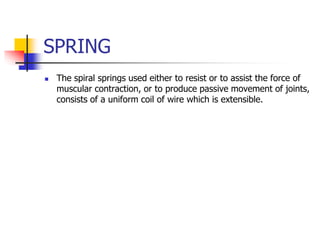
 Elasticity is the property of a body which
enables it to regain its original form after it
has been distorted by the application of a
force. The latter is known as a stress
whilst the quantity(the change in length
per unit length), which measures the
extent of the change in size or shape, is
called strain.
 HOOKES LAW – the strain is proportional
to the stress producing it.
 Springs, rubber elastic and sorbo rubber all
possess the property of elasticity, and are
in common use in physiotherapy.
SPRING
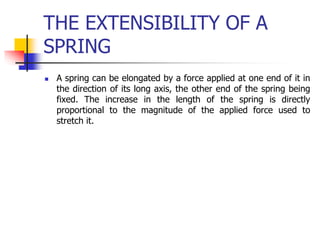
 The spiral springs used either to resist or to assist the force of
muscular contraction, or to produce passive movement of joints,
consists of a uniform coil of wire which is extensible.
THE EXTENSIBILITY OF A
SPRING
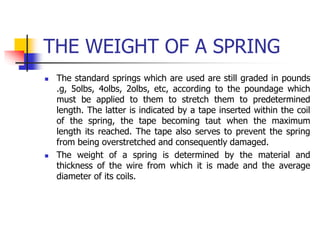
 A spring can be elongated by a force applied at one end of it in
the direction of its long axis, the other end of the spring being
fixed. The increase in the length of the spring is directly
proportional to the magnitude of the applied force used to
stretch it.
THE WEIGHT OF A SPRING
 The standard springs which are used are still graded in pounds
.g, 5olbs, 4olbs, 2olbs, etc, according to the poundage which
must be applied to them to stretch them to predetermined
length. The latter is indicated by a tape inserted within the coil
of the spring, the tape becoming taut when the maximum
length its reached. The tape also serves to prevent the spring
from being overstretched and consequently damaged.
 The weight of a spring is determined by the material and
thickness of the wire from which it is made and the average
diameter of its coils.
THE RECOIL OF A SPRING
 When the applied force which stretches a spring is removed and
the spring returns to its original length the potential energy
stored in it during extension is released as kinetic energy, and
almost all of this appears ultimately as heat in the coils of the
spring.
OSCILLATORY MOVEMENT
PRODUED BY A SPRING
 If a weight applied to stretch a vertical spring is raised and then
released again as oscillatory movement is produced by the
spring, the amplitude of which decreases progressively until the
spring comes to rest in equilibrium.
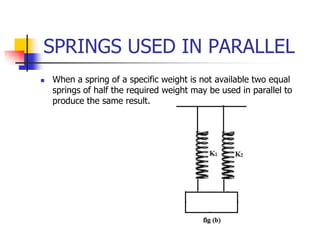
SPRINGS USED IN PARALLEL
 When a spring of a specific weight is not available two equal
springs of half the required weight may be used in parallel to
produce the same result.
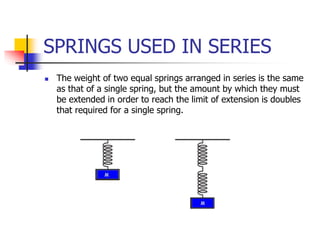
SPRINGS USED IN SERIES
 The weight of two equal springs arranged in series is the same
as that of a single spring, but the amount by which they must
be extended in order to reach the limit of extension is doubles
that required for a single spring.
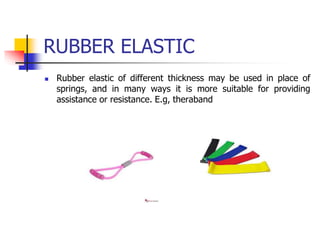
RUBBER ELASTIC
 Rubber elastic of different thickness may be used in place of
springs, and in many ways it is more suitable for providing
assistance or resistance. E.g, theraband
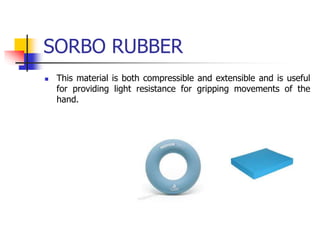
SORBO RUBBER
 This material is both compressible and extensible and is useful
for providing light resistance for gripping movements of the
hand.
SPRINGS IN PHYSIOTHERAPY
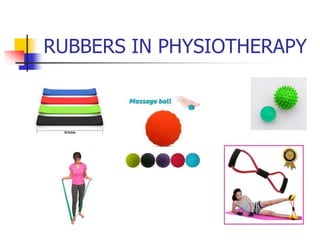
RUBBERS IN PHYSIOTHERAPY
THANK YOU
Prof. Dr. M. RAJESH, PT,M.P.T(cardio),B.C.R.C
TRINITY MISSIOIN AND MEDICAL FOUNDATION
MADURAI.
Visit:
www.skpfc.wordpress.com

Elasticity

  • 1.
    ELASTICITY Prof. Dr. M.Rajesh, PT, M.P.T(cardio), BCRC TRINITY MISSION AND MEDICAL FOUNDATION MADURAI
  • 2.
    INTRODUCTION  Elasticity isthe property of a body which enables it to regain its original form after it has been distorted by the application of a force. The latter is known as a stress whilst the quantity(the change in length per unit length), which measures the extent of the change in size or shape, is called strain.  HOOKES LAW – the strain is proportional to the stress producing it.  Springs, rubber elastic and sorbo rubber all possess the property of elasticity, and are in common use in physiotherapy.
  • 3.
    SPRING  The spiralsprings used either to resist or to assist the force of muscular contraction, or to produce passive movement of joints, consists of a uniform coil of wire which is extensible.
  • 4.
    THE EXTENSIBILITY OFA SPRING  A spring can be elongated by a force applied at one end of it in the direction of its long axis, the other end of the spring being fixed. The increase in the length of the spring is directly proportional to the magnitude of the applied force used to stretch it.
  • 5.
    THE WEIGHT OFA SPRING  The standard springs which are used are still graded in pounds .g, 5olbs, 4olbs, 2olbs, etc, according to the poundage which must be applied to them to stretch them to predetermined length. The latter is indicated by a tape inserted within the coil of the spring, the tape becoming taut when the maximum length its reached. The tape also serves to prevent the spring from being overstretched and consequently damaged.  The weight of a spring is determined by the material and thickness of the wire from which it is made and the average diameter of its coils.
  • 6.
    THE RECOIL OFA SPRING  When the applied force which stretches a spring is removed and the spring returns to its original length the potential energy stored in it during extension is released as kinetic energy, and almost all of this appears ultimately as heat in the coils of the spring.
  • 7.
    OSCILLATORY MOVEMENT PRODUED BYA SPRING  If a weight applied to stretch a vertical spring is raised and then released again as oscillatory movement is produced by the spring, the amplitude of which decreases progressively until the spring comes to rest in equilibrium.
  • 8.
    SPRINGS USED INPARALLEL  When a spring of a specific weight is not available two equal springs of half the required weight may be used in parallel to produce the same result.
  • 9.
    SPRINGS USED INSERIES  The weight of two equal springs arranged in series is the same as that of a single spring, but the amount by which they must be extended in order to reach the limit of extension is doubles that required for a single spring.
  • 10.
    RUBBER ELASTIC  Rubberelastic of different thickness may be used in place of springs, and in many ways it is more suitable for providing assistance or resistance. E.g, theraband
  • 11.
    SORBO RUBBER  Thismaterial is both compressible and extensible and is useful for providing light resistance for gripping movements of the hand.
  • 12.
  • 13.
  • 14.
    THANK YOU Prof. Dr.M. RAJESH, PT,M.P.T(cardio),B.C.R.C TRINITY MISSIOIN AND MEDICAL FOUNDATION MADURAI. Visit: www.skpfc.wordpress.com