INERTIA
Inertia
A property of a matter which resist change
to the state of motion or rest.
Law of Inertia
= Newton’s 1st Law of Motion

An object at rest tends to stay at rest and a
moving object tends to continue its uniform
motion with the same speed and in the
same direction unless being acted upon by
an external force.
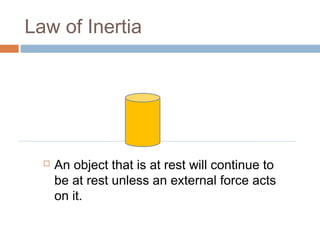
Law of Inertia



An object that is at rest will continue to
be at rest unless an external force acts
on it.
Law of Inertia



An object that is moving will continue
to move in a straight line unless an
external force acts on it.
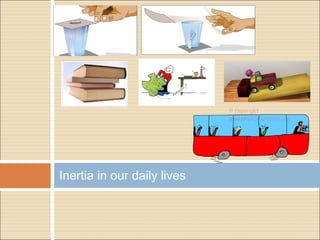
Inertia in our daily lives
Examples of inertia in our daily
lives



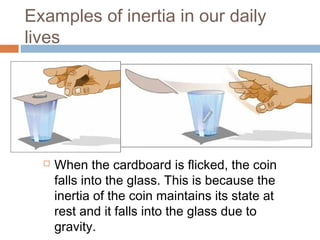
When the cardboard is flicked, the coin
falls into the glass. This is because the
inertia of the coin maintains its state at
rest and it falls into the glass due to
gravity.
Examples of inertia in our daily
lives


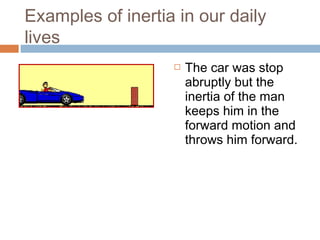
The car was stop
abruptly but the
inertia of the man
keeps him in the
forward motion and
throws him forward.
Phenomena



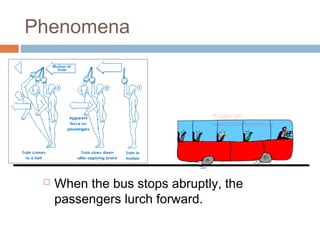
When the bus stops abruptly, the
passengers lurch forward.
Phenomena



If the bus accelerates suddenly, the
passengers fall backward.
Phenomena


When a car moves
on a sharp bend,
the passenger lurch
outward. Why?
Phenomena


Why does the dog
shake itself after a
bath?
Phenomena


As you jump down
from the merry go
round, what must
you do in order to
avoid falling down.
Applications of inertia
Application


A wet umbrella is
rotated vigorously
and then stops
abruptly. Droplets of
water on the
umbrella are spun
off because its
inertia causes them
to continue moving
even when the
umbrella has
Application


What do you do to
get the sauce out
from the bottle?
Application


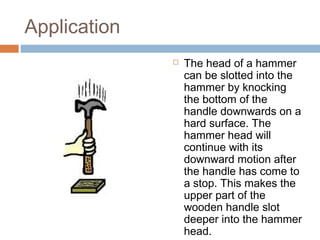
The head of a hammer
can be slotted into the
hammer by knocking
the bottom of the
handle downwards on a
hard surface. The
hammer head will
continue with its
downward motion after
the handle has come to
a stop. This makes the
upper part of the
wooden handle slot
deeper into the hammer
head.
Application

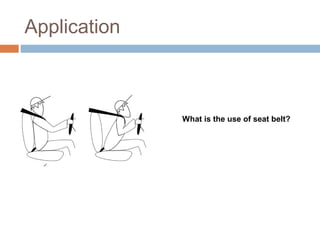
What is the use of seat belt?
Experiment







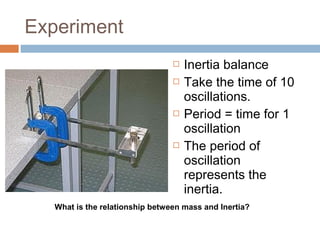
Inertia balance
Take the time of 10
oscillations.
Period = time for 1
oscillation
The period of
oscillation
represents the
inertia.

What is the relationship between mass and Inertia?






A hacksaw
can be used
to replace
inertia
balance.
Place
plasticine at
the end of
the hacksaw
as mass.
Oscillate it
Aim: To investigate the relationship between mass and inertia.
Inference:
Hypothesis:
Variables: mv:
rv:
cv

Mass, m (g)
20
40
60
80
100

Time of 10 oscillations, t (s)

Period, T = t/ (s)
10
Graph of T against m
Period, T (s)

?

Mass, m (g)
What is the conclusion of the
experiment?


Mass increases, period of oscillation
increases, therefore inertia increases.
Experiment




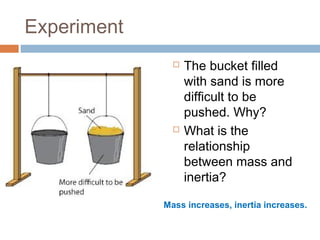
The bucket filled
with sand is more
difficult to be
pushed. Why?
What is the
relationship
between mass and
inertia?

Mass increases, inertia increases.
Experiment
When the string is pulled slowly, string P will snap.
When the string is yanked suddenly, string Q will snap!
Why?

When the string is pulled slowly, string P has to bear the
pulling force and the weight of the ball.
When the string is yanked suddenly, the inertia of the ball
prevents it from moving down therefore string Q snaps!
Phenomena


Why is a sumo
fighter so huge?
Phenomena




Why is difficult for a
train to stop?

Why can Titanic
stop in time to avoid
crashing the
iceberg?
Phenomena




Why does a liquid
product being
carried in three
separate
compartment
instead of one in a
tanker truck?
This is to reduce the
inertia of the impact
of the liquid if the
truck stops
suddenly.

Inertia

  • 1.
  • 2.
    Inertia A property ofa matter which resist change to the state of motion or rest.
  • 3.
    Law of Inertia =Newton’s 1st Law of Motion An object at rest tends to stay at rest and a moving object tends to continue its uniform motion with the same speed and in the same direction unless being acted upon by an external force.
  • 4.
    Law of Inertia  Anobject that is at rest will continue to be at rest unless an external force acts on it.
  • 5.
    Law of Inertia  Anobject that is moving will continue to move in a straight line unless an external force acts on it.
  • 6.
    Inertia in ourdaily lives
  • 7.
    Examples of inertiain our daily lives  When the cardboard is flicked, the coin falls into the glass. This is because the inertia of the coin maintains its state at rest and it falls into the glass due to gravity.
  • 8.
    Examples of inertiain our daily lives  The car was stop abruptly but the inertia of the man keeps him in the forward motion and throws him forward.
  • 9.
    Phenomena  When the busstops abruptly, the passengers lurch forward.
  • 10.
    Phenomena  If the busaccelerates suddenly, the passengers fall backward.
  • 11.
    Phenomena  When a carmoves on a sharp bend, the passenger lurch outward. Why?
  • 12.
    Phenomena  Why does thedog shake itself after a bath?
  • 13.
    Phenomena  As you jumpdown from the merry go round, what must you do in order to avoid falling down.
  • 14.
  • 15.
    Application  A wet umbrellais rotated vigorously and then stops abruptly. Droplets of water on the umbrella are spun off because its inertia causes them to continue moving even when the umbrella has
  • 16.
    Application  What do youdo to get the sauce out from the bottle?
  • 17.
    Application  The head ofa hammer can be slotted into the hammer by knocking the bottom of the handle downwards on a hard surface. The hammer head will continue with its downward motion after the handle has come to a stop. This makes the upper part of the wooden handle slot deeper into the hammer head.
  • 18.
    Application What is theuse of seat belt?
  • 20.
    Experiment     Inertia balance Take thetime of 10 oscillations. Period = time for 1 oscillation The period of oscillation represents the inertia. What is the relationship between mass and Inertia?
  • 21.
       A hacksaw can beused to replace inertia balance. Place plasticine at the end of the hacksaw as mass. Oscillate it
  • 22.
    Aim: To investigatethe relationship between mass and inertia. Inference: Hypothesis: Variables: mv: rv: cv Mass, m (g) 20 40 60 80 100 Time of 10 oscillations, t (s) Period, T = t/ (s) 10
  • 23.
    Graph of Tagainst m Period, T (s) ? Mass, m (g)
  • 24.
    What is theconclusion of the experiment?  Mass increases, period of oscillation increases, therefore inertia increases.
  • 25.
    Experiment   The bucket filled withsand is more difficult to be pushed. Why? What is the relationship between mass and inertia? Mass increases, inertia increases.
  • 26.
    Experiment When the stringis pulled slowly, string P will snap. When the string is yanked suddenly, string Q will snap! Why? When the string is pulled slowly, string P has to bear the pulling force and the weight of the ball. When the string is yanked suddenly, the inertia of the ball prevents it from moving down therefore string Q snaps!
  • 27.
    Phenomena  Why is asumo fighter so huge?
  • 28.
    Phenomena   Why is difficultfor a train to stop? Why can Titanic stop in time to avoid crashing the iceberg?
  • 29.
    Phenomena   Why does aliquid product being carried in three separate compartment instead of one in a tanker truck? This is to reduce the inertia of the impact of the liquid if the truck stops suddenly.