Chemical Basis for Life
Learning Objectives List the characteristics of each of the subatomic particles. Differentiate between a molecule and a compound. List and describe the types of chemical bonds that may form between elements. Give the general equations for synthesis, decomposition, and exchange reactions. Differentiate between organic and inorganic compounds; hydrophobic and hydrophilic molecules; acids and bases. List the unique properties of the water molecule. Describe the actions of a buffer system. List the components of carbohydrates, lipids, proteins, and nucleic acids. List the functions of body proteins. Describe the actions of enzymes.
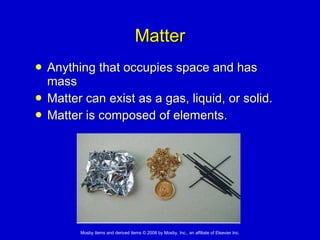
Matter Anything that occupies space and has mass  Matter can exist as a gas, liquid, or solid. Matter is composed of elements.
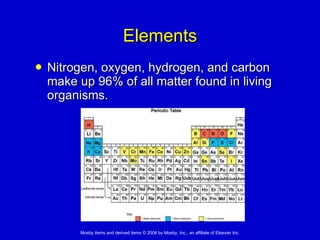
Elements Nitrogen, oxygen, hydrogen, and carbon make up 96% of all matter found in living organisms.
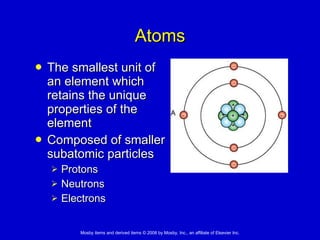
Atoms The smallest unit of  an element which  retains the unique  properties of the  element  Composed of smaller  subatomic particles  Protons Neutrons Electrons
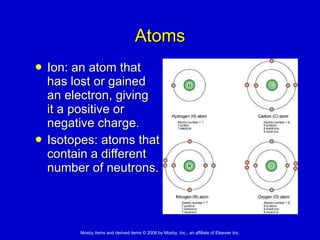
Atoms Ion: an atom that  has lost or gained  an electron, giving  it a positive or  negative charge.  Isotopes: atoms that  contain a different  number of neutrons.
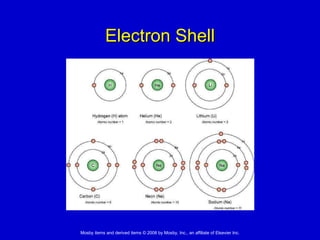
Electron Shell The area around the nucleus where electrons have their most likely position. Electrons of lower energy exist in the first electron shell closest to the nucleus; electrons of higher energy are in the second electron shell.
Electron Shell
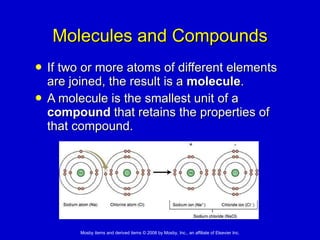
Molecules and Compounds If two or more atoms of different elements are joined, the result is a  molecule . A molecule is the smallest unit of a  compound  that retains the properties of that compound.
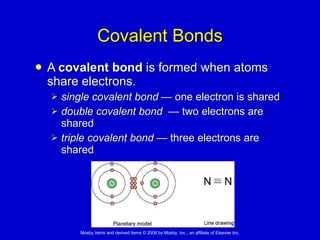
Covalent Bonds A  covalent bond  is formed when atoms share electrons. single covalent bond   —  one electron is shared  double covalent bond  —  two electrons are shared  triple covalent bond   —  three electrons are shared
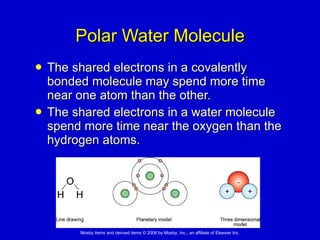
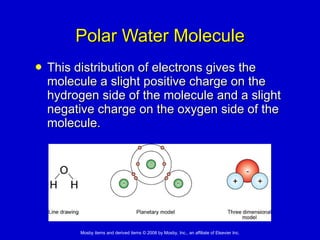
Polar Water Molecule The shared electrons in a covalently bonded molecule may spend more time near one atom than the other.  The shared electrons in a water molecule spend more time near the oxygen than the hydrogen atoms.
Polar Water Molecule This distribution of electrons gives the molecule a slight positive charge on the hydrogen side of the molecule and a slight negative charge on the oxygen side of the molecule.
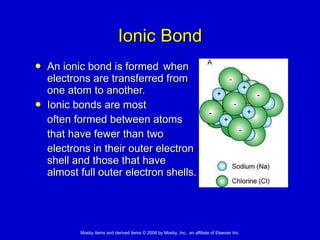
Ionic Bond An ionic bond is formed  when  electrons are transferred from  one atom to another. Ionic bonds are most  often formed between atoms  that have fewer than two  electrons in their outer electron  shell and those that have  almost full outer electron shells.
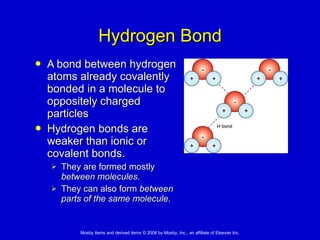
Hydrogen Bond A  bond between hydrogen atoms already covalently bonded in a molecule to oppositely charged particles Hydrogen bonds are weaker than ionic or covalent bonds.  They are formed mostly  between   molecules.   They can also form  between parts of the same molecule .
Chemical Reactions The formation and breaking of chemical bonds They require energy input or release energy. Three types of chemical reactions: Synthesis Decomposition Exchange reactions
Chemical Reactions Factors that influence reaction rates Concentration of reactants Temperature of the environment Activation energy Some reactions require the presence of a catalyst or enzyme. Reaction speed is increased when there are more catalyst proteins present.
Inorganic Compounds Inorganic molecules  Do not contain hydrocarbon groups  Often have ionic bonding  Examples:  water, salts, acids, and bases.
Role of Water Water is the universal solvent.  Water is an ideal transport medium. Water has a high heat capacity and a high heat of vaporization. Water is used for lubrication.
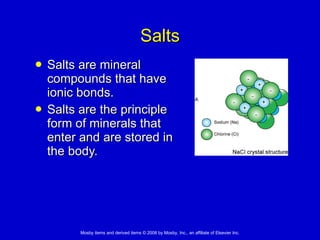
Salts Salts are mineral compounds that have ionic bonds. Salts are the principle form of minerals that enter and are stored in the body.
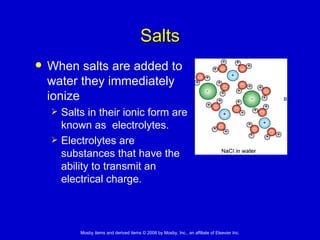
Salts When salts are added to water they immediately ionize Salts in their ionic form are known as  electrolytes. Electrolytes are substances that have the ability to transmit an electrical charge.
Acids and Bases Acids: Ionically bonded substances that release hydrogen ions (H + ) in water Example: hydrochloric acid (HCl) dissociates into H +  and Cl −  ions   Bases: Ionically bonded substances that release a hydroxyl ion (OH − ) in water Example: sodium hydroxide (NaOH) dissociates into Na +  and OH −  ions Acids and bases are also electrolytes  —  when they ionize in water, they can transmit electricity.
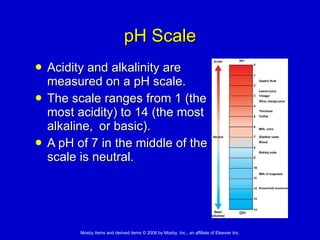
pH Scale Acidity and alkalinity are  measured on a pH scale.  The scale ranges from 1 (the  most acidity) to 14 (the most  alkaline,  or basic).  A pH of 7 in the middle of the  scale is neutral.
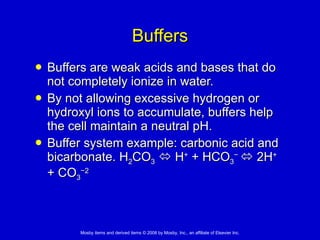
Buffers Buffers are weak acids and bases that do not completely ionize in water.  By not allowing excessive hydrogen or hydroxyl ions to accumulate, buffers help the cell maintain a neutral pH.  Buffer system example: carbonic acid and bicarbonate. H 2 CO 3     H +  + HCO 3 −    2H +  + CO 3 −2
Organic and Inorganic Compounds Organic compounds  Contain hydrocarbon groups and often contain a functional group  Usually are covalently bonded  Examples: carbohydrates, lipids, proteins, and nucleic acids Many of the organic molecules used in the body are  macromolecules .
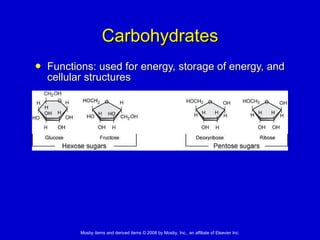
Carbohydrates Functions: used for energy, storage of energy, and cellular structures
Carbohydrates Functions: used for energy, storage of energy, and cellular structures Monosaccharides: contain three to seven carbon atoms in a chain or ring.   Example: glucose, chemical formula C 6 H 12 O 6   Disaccharides: two monosaccharides joined together   Example: glucose + fructose = sucrose.   Polysaccharides: combinations of many monosaccharides Examples: glycogen, starch, and cellulose
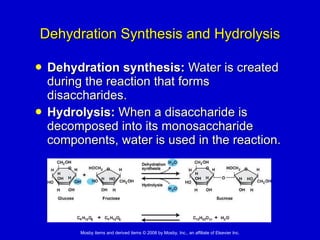
Dehydration Synthesis and Hydrolysis Dehydration synthesis:  Water is created during the reaction that forms disaccharides. Hydrolysis:  When a disaccharide is decomposed into its monosaccharide components, water is used in the reaction.
Lipids Functions: used in the body for energy and stored in fat for future energy needs Four classes of lipids:  neutral fats phospholipids steroids  eicosanoids
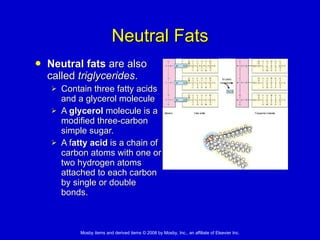
Neutral Fats Neutral fats  are also called  triglycerides .  Contain three fatty acids and a glycerol molecule  A  glycerol  molecule is a modified three-carbon simple sugar. A f atty acid  is a chain of carbon atoms with one or two hydrogen atoms attached to each carbon by single or double bonds.
Saturated vs. Unsaturated Fats A fatty acid is called  saturated  when all the bonds in the hydrocarbon chain are single bonds and as many hydrogen atoms as possible are attached to carbon.  A fatty acid is called  unsaturated  when there are some double bonds between the carbon and hydrogen atoms.
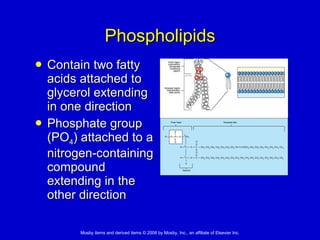
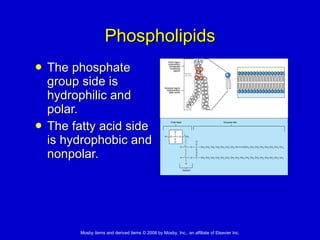
Phospholipids Contain two fatty acids attached to glycerol extending in one direction  Phosphate group (PO 4 ) attached to a nitrogen-containing compound extending in the other direction
Phospholipids The phosphate group side is hydrophilic and polar. The fatty acid side is hydrophobic and nonpolar.
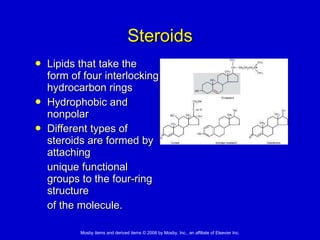
Steroids Lipids that take the form of four interlocking hydrocarbon rings  Hydrophobic and nonpolar  Different types of steroids are formed by attaching  unique functional groups to the four-ring structure  of the molecule.
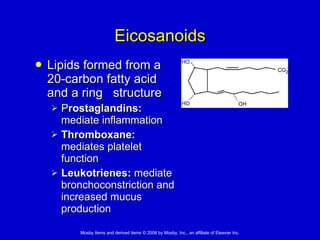
Eicosanoids Lipids formed from a 20-carbon fatty acid and a ring  structure  P rostaglandins:  mediate inflammation Thromboxane:  mediates platelet function  Leukotrienes:  mediate bronchoconstriction and increased mucus production
Proteins Proteins  are the most abundant organic molecules in the body.  Composed primarily of C, O, H, and N Made of amino acids Functions: used for cell structures and structural body tissues, for controlling chemical reactions, for regulating growth, for transporting molecules, for defending the body against invaders, for catalyzing all reactions occurring in the body
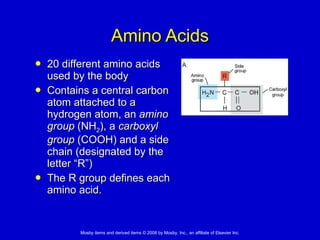
Amino Acids 20 different amino acids used by the body  Contains a central carbon atom attached to a hydrogen atom, an  amino group  (NH 2 ), a  carboxyl group  (COOH) and a side chain (designated by the letter “R”) The R group defines each amino acid.
Amino Acids The specific combination of amino acids is determined by the cell’s DNA.  Two amino acids are linked together by dehydration synthesis.  The carboxyl group of one amino acid links with the amino group of another amino acid via a  peptide bond . A  polypeptide  is a chain of ten or more amino acids linked together.
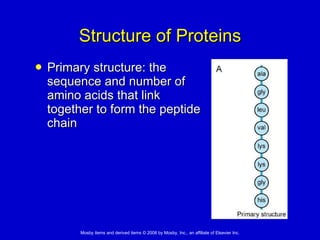
Structure of Proteins Primary structure: the  sequence and number of  amino acids that link  together to form the peptide  chain
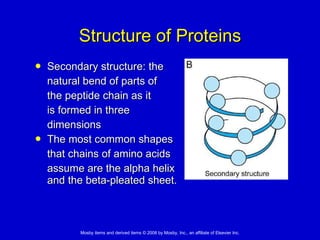
Structure of Proteins Secondary structure: the  natural bend of parts of  the peptide chain as it  is formed in three  dimensions The most common shapes  that chains of amino acids  assume are the alpha helix  and the beta-pleated sheet.
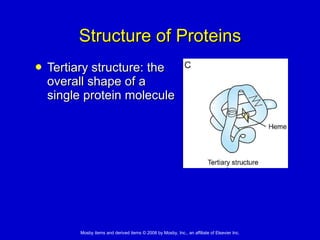
Structure of Proteins Tertiary structure: the overall shape of a single protein molecule
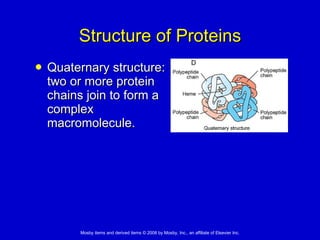
Structure of Proteins Quaternary structure: two or more protein chains join to form a complex macromolecule.
Types of Proteins Structural proteins  are stable, rigid, water-insoluble proteins that are used for adding strength to tissues or cells. Examples: collagen, fibrin, and keratin Functional proteins  are generally water-soluble and have a flexible, three-dimensional shape that can change under different circumstances. Examples:  hemoglobin, antibodies, enzymes,  and protein-based hormones
Enzymes Enzymes are proteins that act as catalysts to speed up a chemical reaction without themselves being altered or destroyed.  Enzymes are specific to the reaction they catalyze. Substrates  are the substances enzymes act upon.
Enzymes An enzyme fits its substrate exactly and is itself unaltered at the end of the reaction. Enzymatic reactions often take place in a series of reactions, with the products of one reaction acting as the substrate for the next reaction.
Nucleic Acids Nucleic acids  are the largest molecules in the body  Composed of C, O, H, N, and P  Two classes of nucleic acids:  DNA (deoxyribonucleic acid)  —  exists mainly in the nucleus (but also in mitochondria) and is the molecule that contains all the instructions needed by the cell to build protein  RNA (ribonucleic acid)   —  transfers instructions out of the nucleus and into the cytoplasm of the cell; builds proteins
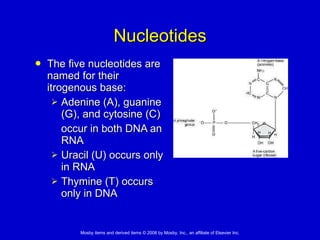
Nucleotides Molecular building blocks of nucleic acids  Consist of a nitrogenous base plus a 5-carbon (pentose) sugar plus a phosphate group  The sugar in DNA is deoyxribose and in RNA, ribose.
Nucleotides The five nucleotides are named for their itrogenous base:  Adenine (A), guanine (G), and cytosine (C)  occur in both DNA an RNA  Uracil (U) occurs only in RNA  Thymine (T) occurs only in DNA
Nucleotides The nucleic acid is formed by the sugar and phosphate groups joined in a long chain with the nitrogenous base. The information needed to produce proteins is determined by the order of the nucleotides.
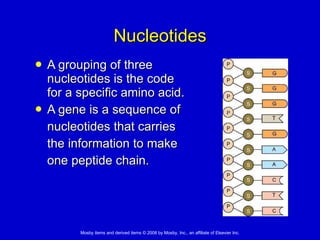
Nucleotides A grouping of three  nucleotides is the code  for a specific amino acid.  A gene is a sequence of  nucleotides that carries  the information to make  one peptide chain.
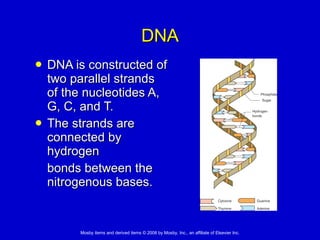
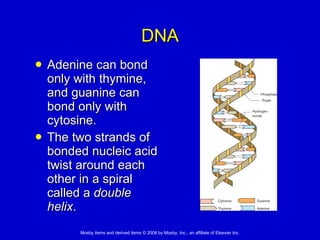
DNA DNA is constructed of two parallel strands of the nucleotides A, G, C, and T.  The strands are connected by hydrogen  bonds between the nitrogenous bases.
DNA Adenine can bond only with thymine, and guanine can bond only with cytosine.  The two strands of bonded nucleic acid twist around each other in a spiral called a  double helix .
RNA RNA consists of a single strand of the nucleotides  A, G, C, and U.  Three types of RNA:  Transfer Messenger Ribosomal RNA
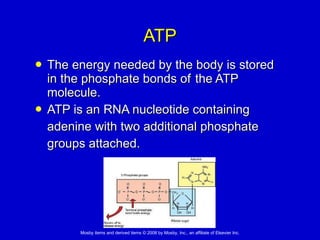
ATP The energy needed by the body is stored in the phosphate bonds of  the ATP molecule. ATP is an RNA nucleotide containing  adenine with two additional phosphate  groups attached.

2. Chemical Basis for Life

  • 1.
  • 2.
    Learning Objectives Listthe characteristics of each of the subatomic particles. Differentiate between a molecule and a compound. List and describe the types of chemical bonds that may form between elements. Give the general equations for synthesis, decomposition, and exchange reactions. Differentiate between organic and inorganic compounds; hydrophobic and hydrophilic molecules; acids and bases. List the unique properties of the water molecule. Describe the actions of a buffer system. List the components of carbohydrates, lipids, proteins, and nucleic acids. List the functions of body proteins. Describe the actions of enzymes.
  • 3.
    Matter Anything thatoccupies space and has mass Matter can exist as a gas, liquid, or solid. Matter is composed of elements.
  • 4.
    Elements Nitrogen, oxygen,hydrogen, and carbon make up 96% of all matter found in living organisms.
  • 5.
    Atoms The smallestunit of an element which retains the unique properties of the element Composed of smaller subatomic particles Protons Neutrons Electrons
  • 6.
    Atoms Ion: anatom that has lost or gained an electron, giving it a positive or negative charge. Isotopes: atoms that contain a different number of neutrons.
  • 7.
    Electron Shell Thearea around the nucleus where electrons have their most likely position. Electrons of lower energy exist in the first electron shell closest to the nucleus; electrons of higher energy are in the second electron shell.
  • 8.
  • 9.
    Molecules and CompoundsIf two or more atoms of different elements are joined, the result is a molecule . A molecule is the smallest unit of a compound that retains the properties of that compound.
  • 10.
    Covalent Bonds A covalent bond is formed when atoms share electrons. single covalent bond — one electron is shared double covalent bond — two electrons are shared triple covalent bond — three electrons are shared
  • 11.
    Polar Water MoleculeThe shared electrons in a covalently bonded molecule may spend more time near one atom than the other. The shared electrons in a water molecule spend more time near the oxygen than the hydrogen atoms.
  • 12.
    Polar Water MoleculeThis distribution of electrons gives the molecule a slight positive charge on the hydrogen side of the molecule and a slight negative charge on the oxygen side of the molecule.
  • 13.
    Ionic Bond Anionic bond is formed when electrons are transferred from one atom to another. Ionic bonds are most often formed between atoms that have fewer than two electrons in their outer electron shell and those that have almost full outer electron shells.
  • 14.
    Hydrogen Bond A bond between hydrogen atoms already covalently bonded in a molecule to oppositely charged particles Hydrogen bonds are weaker than ionic or covalent bonds. They are formed mostly between molecules. They can also form between parts of the same molecule .
  • 15.
    Chemical Reactions Theformation and breaking of chemical bonds They require energy input or release energy. Three types of chemical reactions: Synthesis Decomposition Exchange reactions
  • 16.
    Chemical Reactions Factorsthat influence reaction rates Concentration of reactants Temperature of the environment Activation energy Some reactions require the presence of a catalyst or enzyme. Reaction speed is increased when there are more catalyst proteins present.
  • 17.
    Inorganic Compounds Inorganicmolecules Do not contain hydrocarbon groups Often have ionic bonding Examples: water, salts, acids, and bases.
  • 18.
    Role of WaterWater is the universal solvent. Water is an ideal transport medium. Water has a high heat capacity and a high heat of vaporization. Water is used for lubrication.
  • 19.
    Salts Salts aremineral compounds that have ionic bonds. Salts are the principle form of minerals that enter and are stored in the body.
  • 20.
    Salts When saltsare added to water they immediately ionize Salts in their ionic form are known as electrolytes. Electrolytes are substances that have the ability to transmit an electrical charge.
  • 21.
    Acids and BasesAcids: Ionically bonded substances that release hydrogen ions (H + ) in water Example: hydrochloric acid (HCl) dissociates into H + and Cl − ions Bases: Ionically bonded substances that release a hydroxyl ion (OH − ) in water Example: sodium hydroxide (NaOH) dissociates into Na + and OH − ions Acids and bases are also electrolytes — when they ionize in water, they can transmit electricity.
  • 22.
    pH Scale Acidityand alkalinity are measured on a pH scale. The scale ranges from 1 (the most acidity) to 14 (the most alkaline, or basic). A pH of 7 in the middle of the scale is neutral.
  • 23.
    Buffers Buffers areweak acids and bases that do not completely ionize in water. By not allowing excessive hydrogen or hydroxyl ions to accumulate, buffers help the cell maintain a neutral pH. Buffer system example: carbonic acid and bicarbonate. H 2 CO 3  H + + HCO 3 −  2H + + CO 3 −2
  • 24.
    Organic and InorganicCompounds Organic compounds Contain hydrocarbon groups and often contain a functional group Usually are covalently bonded Examples: carbohydrates, lipids, proteins, and nucleic acids Many of the organic molecules used in the body are macromolecules .
  • 25.
    Carbohydrates Functions: usedfor energy, storage of energy, and cellular structures
  • 26.
    Carbohydrates Functions: usedfor energy, storage of energy, and cellular structures Monosaccharides: contain three to seven carbon atoms in a chain or ring. Example: glucose, chemical formula C 6 H 12 O 6 Disaccharides: two monosaccharides joined together Example: glucose + fructose = sucrose. Polysaccharides: combinations of many monosaccharides Examples: glycogen, starch, and cellulose
  • 27.
    Dehydration Synthesis andHydrolysis Dehydration synthesis: Water is created during the reaction that forms disaccharides. Hydrolysis: When a disaccharide is decomposed into its monosaccharide components, water is used in the reaction.
  • 28.
    Lipids Functions: usedin the body for energy and stored in fat for future energy needs Four classes of lipids: neutral fats phospholipids steroids eicosanoids
  • 29.
    Neutral Fats Neutralfats are also called triglycerides . Contain three fatty acids and a glycerol molecule A glycerol molecule is a modified three-carbon simple sugar. A f atty acid is a chain of carbon atoms with one or two hydrogen atoms attached to each carbon by single or double bonds.
  • 30.
    Saturated vs. UnsaturatedFats A fatty acid is called saturated when all the bonds in the hydrocarbon chain are single bonds and as many hydrogen atoms as possible are attached to carbon. A fatty acid is called unsaturated when there are some double bonds between the carbon and hydrogen atoms.
  • 31.
    Phospholipids Contain twofatty acids attached to glycerol extending in one direction Phosphate group (PO 4 ) attached to a nitrogen-containing compound extending in the other direction
  • 32.
    Phospholipids The phosphategroup side is hydrophilic and polar. The fatty acid side is hydrophobic and nonpolar.
  • 33.
    Steroids Lipids thattake the form of four interlocking hydrocarbon rings Hydrophobic and nonpolar Different types of steroids are formed by attaching unique functional groups to the four-ring structure of the molecule.
  • 34.
    Eicosanoids Lipids formedfrom a 20-carbon fatty acid and a ring structure P rostaglandins: mediate inflammation Thromboxane: mediates platelet function Leukotrienes: mediate bronchoconstriction and increased mucus production
  • 35.
    Proteins Proteins are the most abundant organic molecules in the body. Composed primarily of C, O, H, and N Made of amino acids Functions: used for cell structures and structural body tissues, for controlling chemical reactions, for regulating growth, for transporting molecules, for defending the body against invaders, for catalyzing all reactions occurring in the body
  • 36.
    Amino Acids 20different amino acids used by the body Contains a central carbon atom attached to a hydrogen atom, an amino group (NH 2 ), a carboxyl group (COOH) and a side chain (designated by the letter “R”) The R group defines each amino acid.
  • 37.
    Amino Acids Thespecific combination of amino acids is determined by the cell’s DNA. Two amino acids are linked together by dehydration synthesis. The carboxyl group of one amino acid links with the amino group of another amino acid via a peptide bond . A polypeptide is a chain of ten or more amino acids linked together.
  • 38.
    Structure of ProteinsPrimary structure: the sequence and number of amino acids that link together to form the peptide chain
  • 39.
    Structure of ProteinsSecondary structure: the natural bend of parts of the peptide chain as it is formed in three dimensions The most common shapes that chains of amino acids assume are the alpha helix and the beta-pleated sheet.
  • 40.
    Structure of ProteinsTertiary structure: the overall shape of a single protein molecule
  • 41.
    Structure of ProteinsQuaternary structure: two or more protein chains join to form a complex macromolecule.
  • 42.
    Types of ProteinsStructural proteins are stable, rigid, water-insoluble proteins that are used for adding strength to tissues or cells. Examples: collagen, fibrin, and keratin Functional proteins are generally water-soluble and have a flexible, three-dimensional shape that can change under different circumstances. Examples: hemoglobin, antibodies, enzymes, and protein-based hormones
  • 43.
    Enzymes Enzymes areproteins that act as catalysts to speed up a chemical reaction without themselves being altered or destroyed. Enzymes are specific to the reaction they catalyze. Substrates are the substances enzymes act upon.
  • 44.
    Enzymes An enzymefits its substrate exactly and is itself unaltered at the end of the reaction. Enzymatic reactions often take place in a series of reactions, with the products of one reaction acting as the substrate for the next reaction.
  • 45.
    Nucleic Acids Nucleicacids are the largest molecules in the body Composed of C, O, H, N, and P Two classes of nucleic acids: DNA (deoxyribonucleic acid) — exists mainly in the nucleus (but also in mitochondria) and is the molecule that contains all the instructions needed by the cell to build protein RNA (ribonucleic acid) — transfers instructions out of the nucleus and into the cytoplasm of the cell; builds proteins
  • 46.
    Nucleotides Molecular buildingblocks of nucleic acids Consist of a nitrogenous base plus a 5-carbon (pentose) sugar plus a phosphate group The sugar in DNA is deoyxribose and in RNA, ribose.
  • 47.
    Nucleotides The fivenucleotides are named for their itrogenous base: Adenine (A), guanine (G), and cytosine (C) occur in both DNA an RNA Uracil (U) occurs only in RNA Thymine (T) occurs only in DNA
  • 48.
    Nucleotides The nucleicacid is formed by the sugar and phosphate groups joined in a long chain with the nitrogenous base. The information needed to produce proteins is determined by the order of the nucleotides.
  • 49.
    Nucleotides A groupingof three nucleotides is the code for a specific amino acid. A gene is a sequence of nucleotides that carries the information to make one peptide chain.
  • 50.
    DNA DNA isconstructed of two parallel strands of the nucleotides A, G, C, and T. The strands are connected by hydrogen bonds between the nitrogenous bases.
  • 51.
    DNA Adenine canbond only with thymine, and guanine can bond only with cytosine. The two strands of bonded nucleic acid twist around each other in a spiral called a double helix .
  • 52.
    RNA RNA consistsof a single strand of the nucleotides A, G, C, and U. Three types of RNA: Transfer Messenger Ribosomal RNA
  • 53.
    ATP The energyneeded by the body is stored in the phosphate bonds of the ATP molecule. ATP is an RNA nucleotide containing adenine with two additional phosphate groups attached.

Editor's Notes

  • #21 Change text to read: — When salts are added to water they immediately ionize — Salts in their ionic form are known as electrolytes. — Electrolytes are substances that have the ability to transmit an electrical charge.
  • #26 Put figure from next slide on this one with one bullet: Functions. Then put the next three bullets on the following slide.
  • #27 Three bulleted items from previous slide go on this slide.
  • #30 Enlarge the font.
  • #38 Check type size.