iKX - BGS History and Evolution of ERP & SAP By Arun Dixit July 16th, 2011
Why ERP? The three letter acronym ‘ERP’ means ‘Enterprise Resource Planning’ Integration (Functional and Geographical Islands) Best business practices (Whole suite of BPR may not be required) Standardization (Do it right first time and every time) Enables the integration of business processes and systems to achieve enterprise-wide operational efficiency.
Why ERP? Improves the performance of a business by consolidating the operations of an entire multi-site enterprise into one database, one application, and one user interface.
Why not ERP? Complexity (Not Easy to implement and maintain) Cost (Cost of Implementation and support is high) Inflexible (Good ERP is tightly integrated with functions)
Important TLAs ERP IMS/IMCS/ICS MRP MRP-I or mrp MRP-II or MRP SAP R/3 and ABAP ECC SCM CRM SRM APO BPR
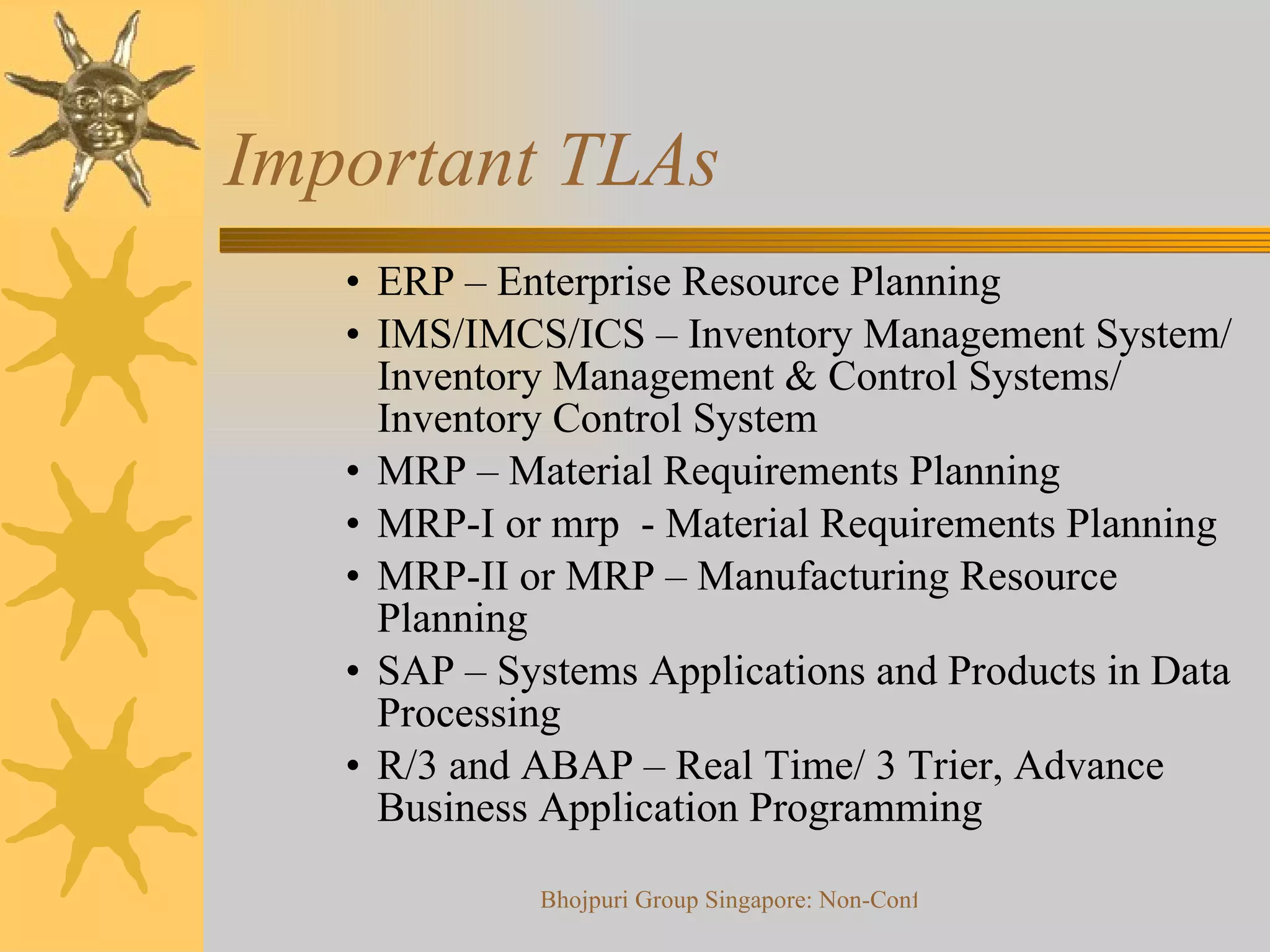
Important TLAs ERP – Enterprise Resource Planning IMS/IMCS/ICS – Inventory Management System/ Inventory Management & Control Systems/ Inventory Control System MRP – Material Requirements Planning MRP-I or mrp  - Material Requirements Planning MRP-II or MRP – Manufacturing Resource Planning  SAP – Systems Applications and Products in Data Processing R/3 and ABAP – Real Time/ 3 Trier, Advance Business Application Programming
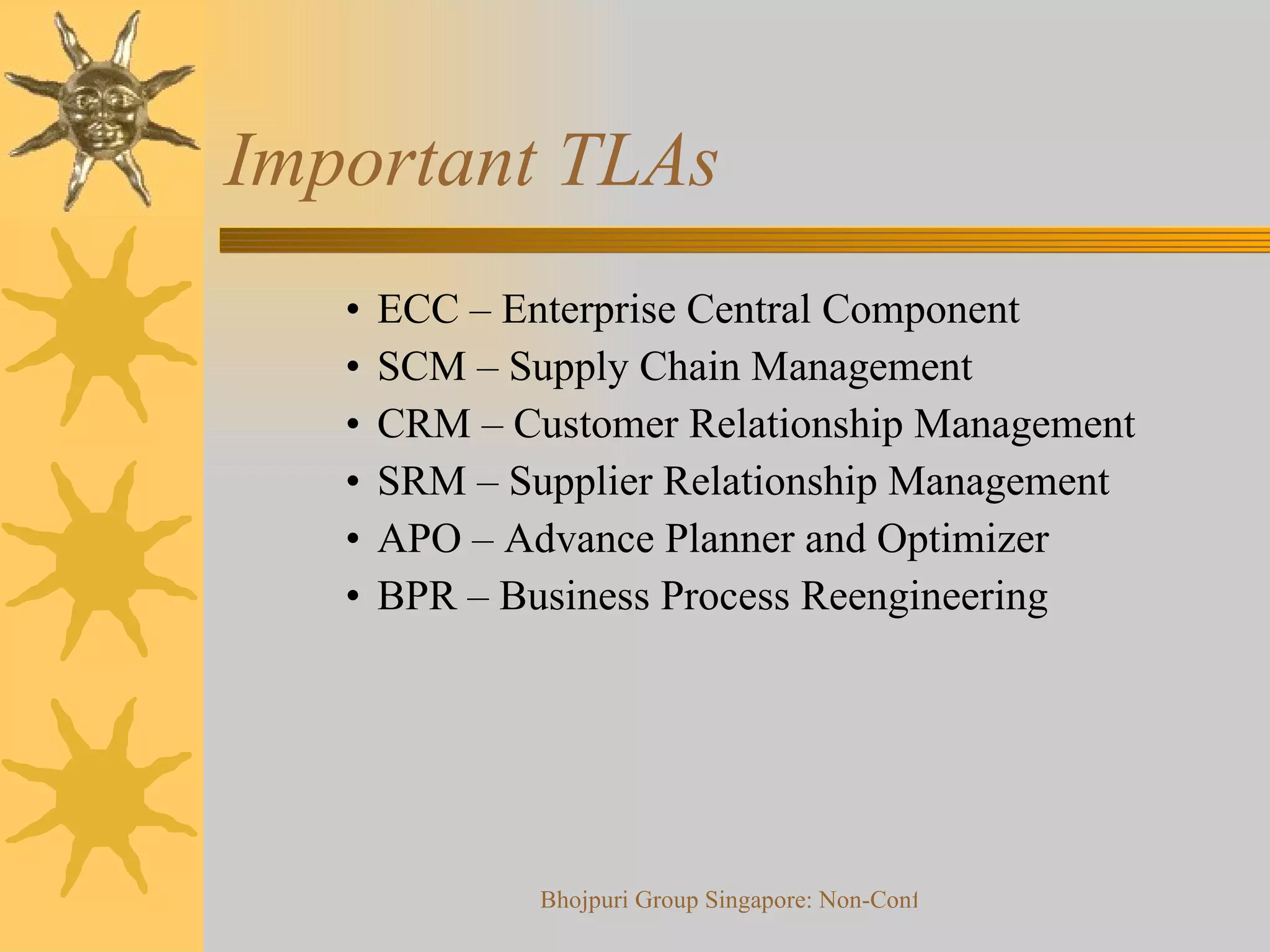
Important TLAs ECC – Enterprise Central Component SCM – Supply Chain Management CRM – Customer Relationship Management SRM – Supplier Relationship Management APO – Advance Planner and Optimizer BPR – Business Process Reengineering
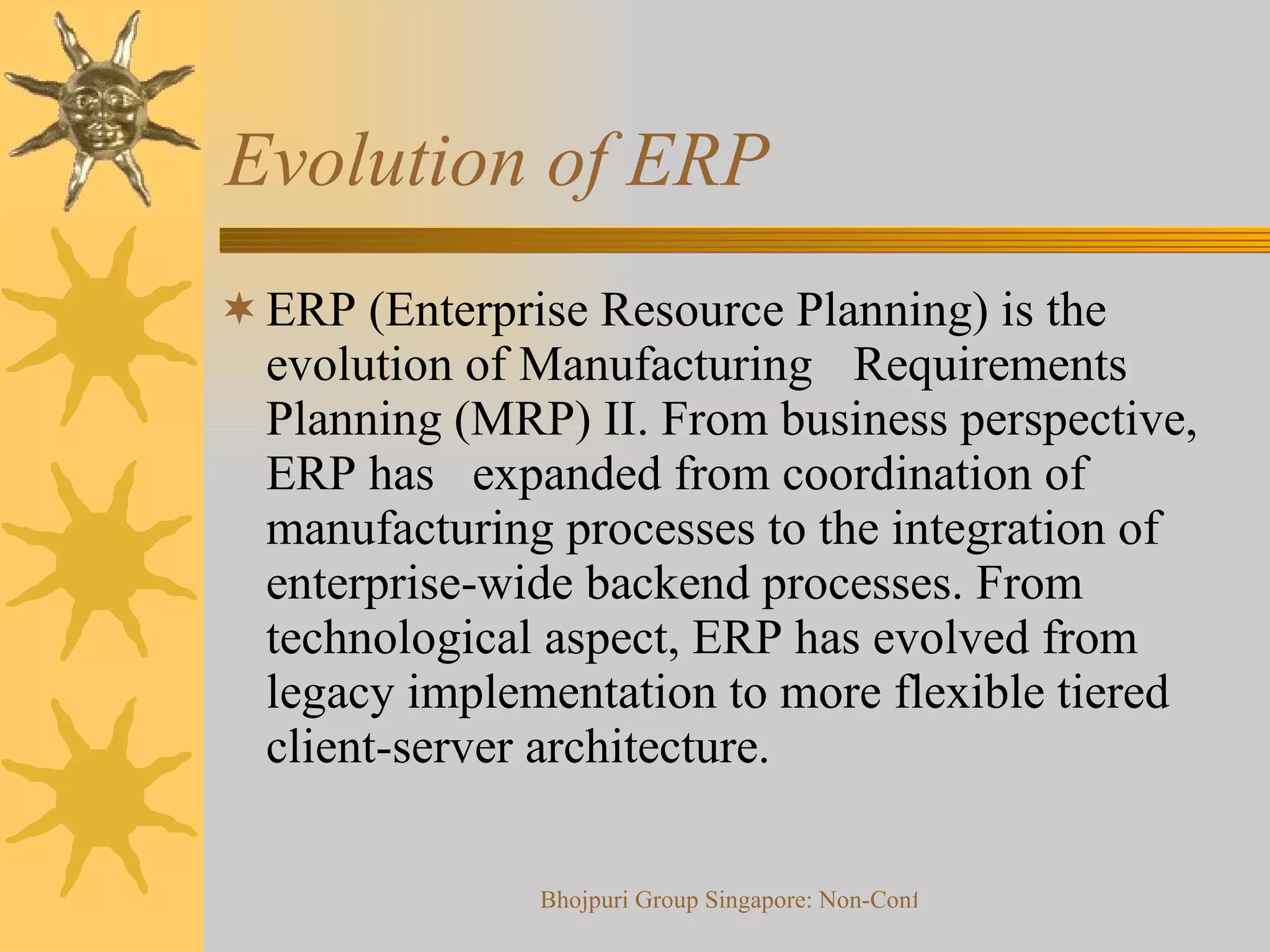
Evolution of ERP ERP (Enterprise Resource Planning) is the evolution of Manufacturing  Requirements Planning (MRP) II. From business perspective, ERP has  expanded from coordination of manufacturing processes to the integration of enterprise-wide backend processes. From technological aspect, ERP has evolved from legacy implementation to more flexible tiered client-server architecture.
Evolution of ERP 1960 – IMC (Inventory Management & Control) 1970 – MRP (Material Requirements Planning) - mrp 1980 – MRP II (Manufacturing Resource Planning) MRP = mrp + crp 1990 – ERP (Enterprise Resource Planning) 2000 – Extended ERP (Integration and collaboration outside the window)
Famous ERP Vendors -  SAP -  PeopleSoft -  Oracle -  JD Edwards -  Baan -  MFG/PRO -  Navision (Microsoft Dynamics NAV)
History of SAP Q: What is SAP? A: SAP R/3 is an ERP (Enterprise Resource Planning) software Package.  In the acronym SAP: S   Systems A   Applications   P   Products  in Data Processing
History of SAP SAP was founded in 1972 as Systemanalyse und Programmentwicklung in  Mannheim, Baden-Württemberg by following five former IBM engineers: 1. Dietmar Hopp 2. Hans-Werner Hector 3. Hasso Plattner 4. Klaus Tschira 5. Claus Wellenreuther
History of SAP The acronym was later changed to stand for Systeme, Anwendungen und Produkte in der Datenverarbeitung ("Systems, Applications and Products in  Data Processing").
History of SAP Timeline: 1972: SAP AG founded in Germany.  1979: SAP R/2 introduced for mainframe computers. 1992: SAP R/3 released as client-server application.  1996: SAP R/3 became partially Internet enabled.  1997: Developed and launched the new dimension product line including CRM, SCM, and Data Warehousing solutions.  1999: SAP announced mySAP.com, the next generation of its Enterprise  Application System, based on the Internet architecture. 2000-2005: Introduced mySAP business Suite, NetWeaver, and XApplications.
SAP Benefits The benefits of SAP are:   - Integration   - Flexibility   - Real-Time data processing and reporting   - Designed for all types of business   - Worldwide Usage   - Multiple languages support   - Multiple currency support
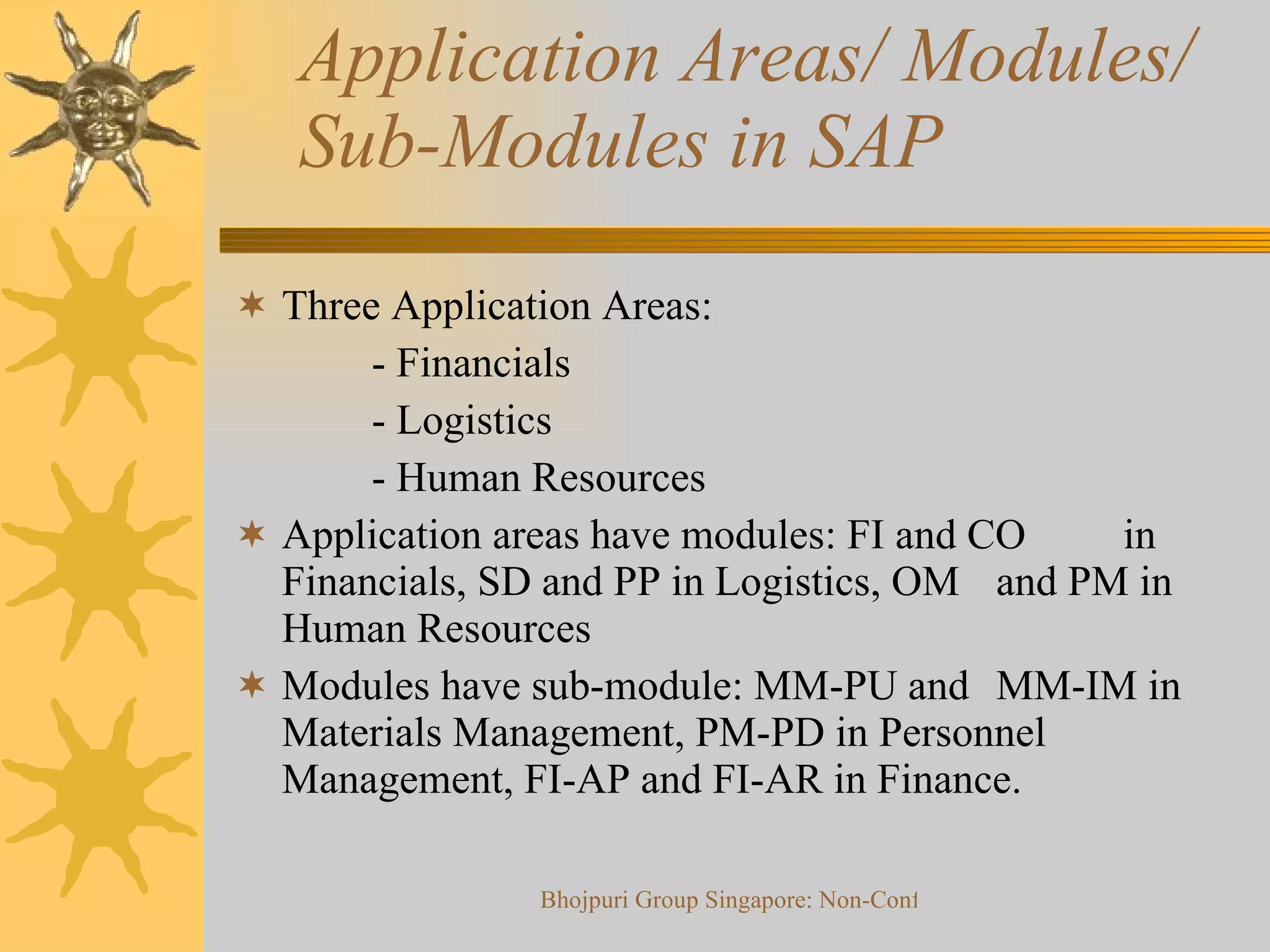
Application Areas/ Modules/  Sub-Modules in SAP Three Application Areas:   - Financials   - Logistics   - Human Resources Application areas have modules: FI and CO  in Financials, SD and PP in Logistics, OM  and PM in Human Resources  Modules have sub-module: MM-PU and  MM-IM in Materials Management, PM-PD in Personnel Management, FI-AP and FI-AR in Finance.
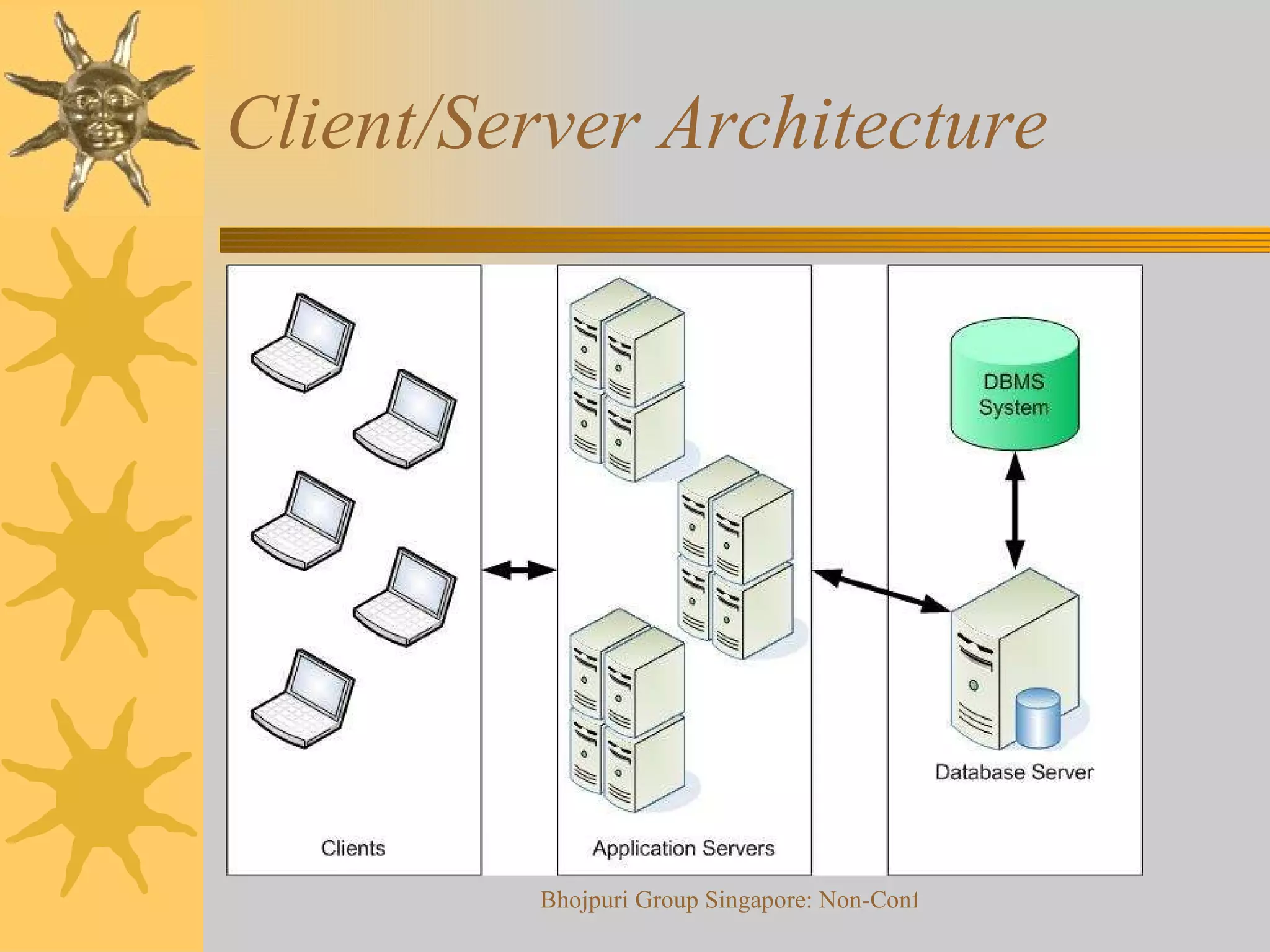
Client/Server Architecture 3 Tier Client/Server Architecture
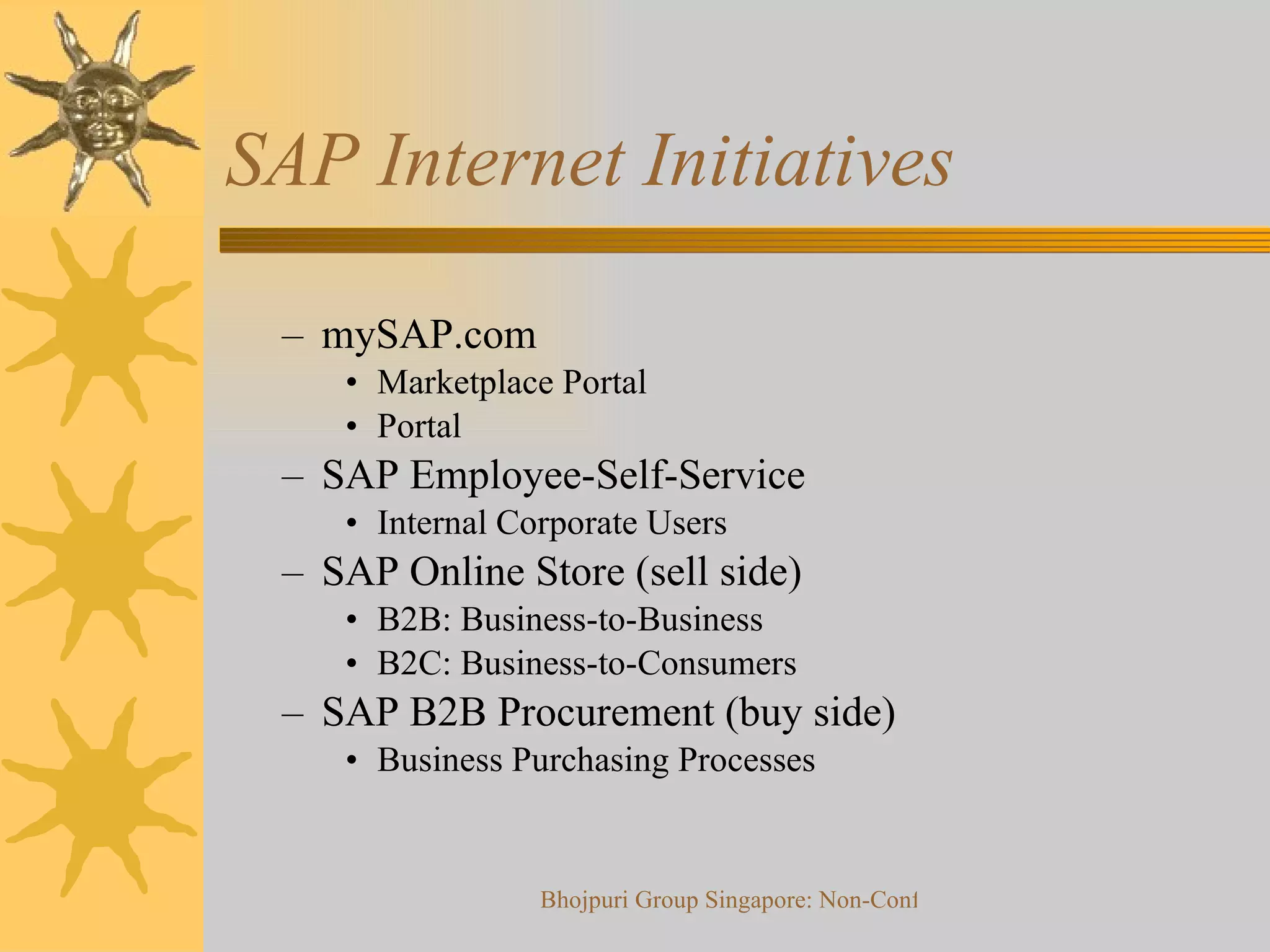
SAP Internet Initiatives mySAP.com Marketplace Portal Portal SAP Employee-Self-Service Internal Corporate Users SAP Online Store (sell side) B2B: Business-to-Business B2C: Business-to-Consumers SAP B2B Procurement (buy side) Business Purchasing Processes
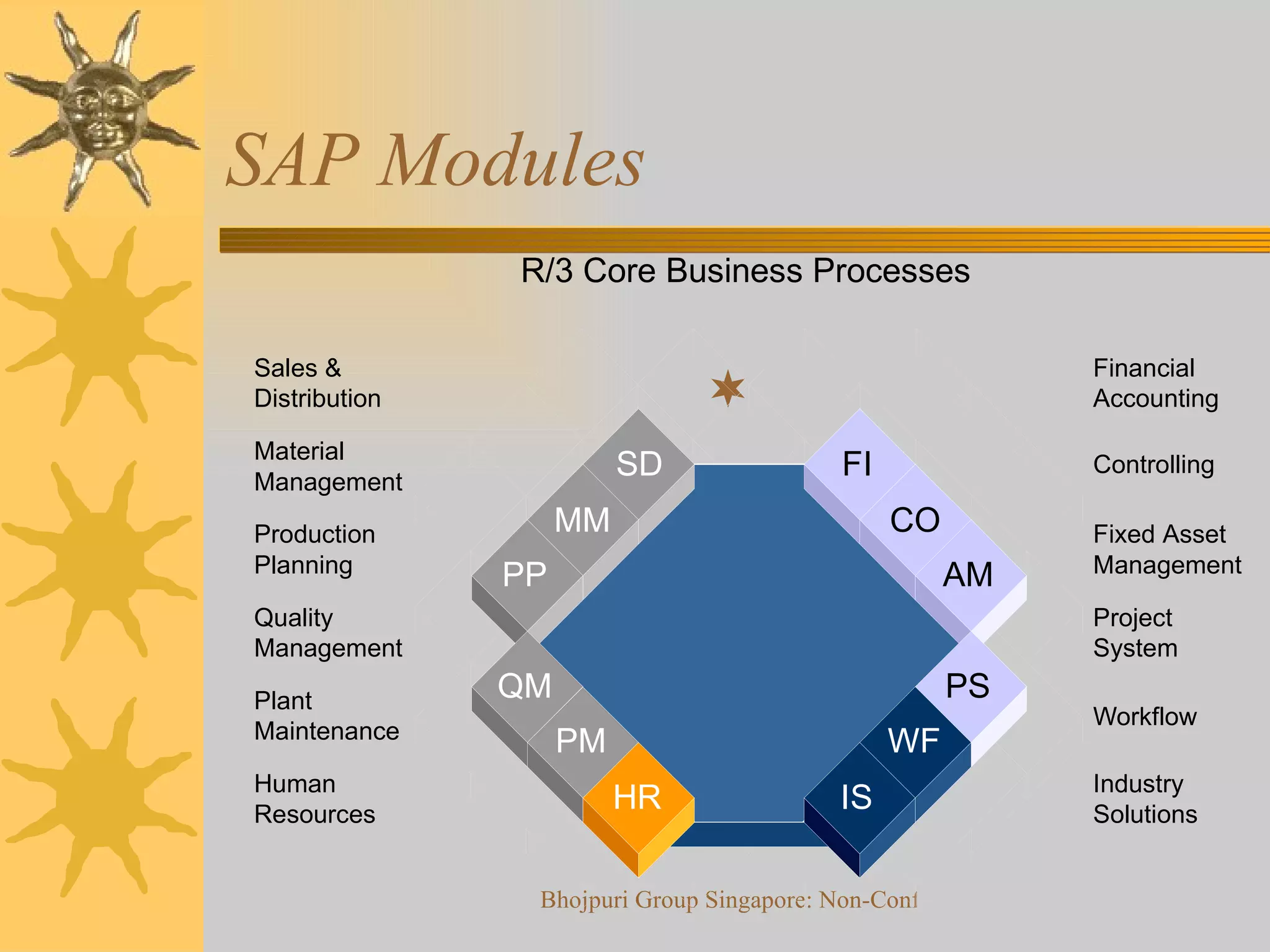
SAP Modules
Definition of Modules  Sales and Distribution (SD)  supports the tasks and activities carried out in sales, delivery, and billing. Key elements are:  Pre-sales support Inquiry processing Quotation processing  Sales order processing Delivery processing Billing and sales information system Materials Management (MM)  supports the procurement and inventory functions, such as purchasing, inventory management, reorder point processing.
Definition of Modules  Production Planning (PP)  is used to plan and control the manufacturing activities of a  company. This module includes; bills of material, routings, work centers, sales and operations planning, master production scheduling, material requirements planning, shop floor control, production orders, product costing, etc.
Definition of Modules  Quality Management (QM)  is a quality control and information system supporting  inspection, and control for manufacturing and procurement.  Plant Maintenance (PM)  is a complex manufacturing process where equipment can be rebuilt and service maintenance provided.  Plant Maintenance is tightly integrated with PP. Human Resources (HR)  is a complete integrated system for supporting the planning and control of personnel activities.
Definition of Modules  Financial Accounting (FI)  designed for automated management and external reporting of general ledger, accounts receivable, accounts payable and other sub-ledger accounts Controlling (CO)  represents the company's flow of cost and revenue and used for internal or managerial reporting.
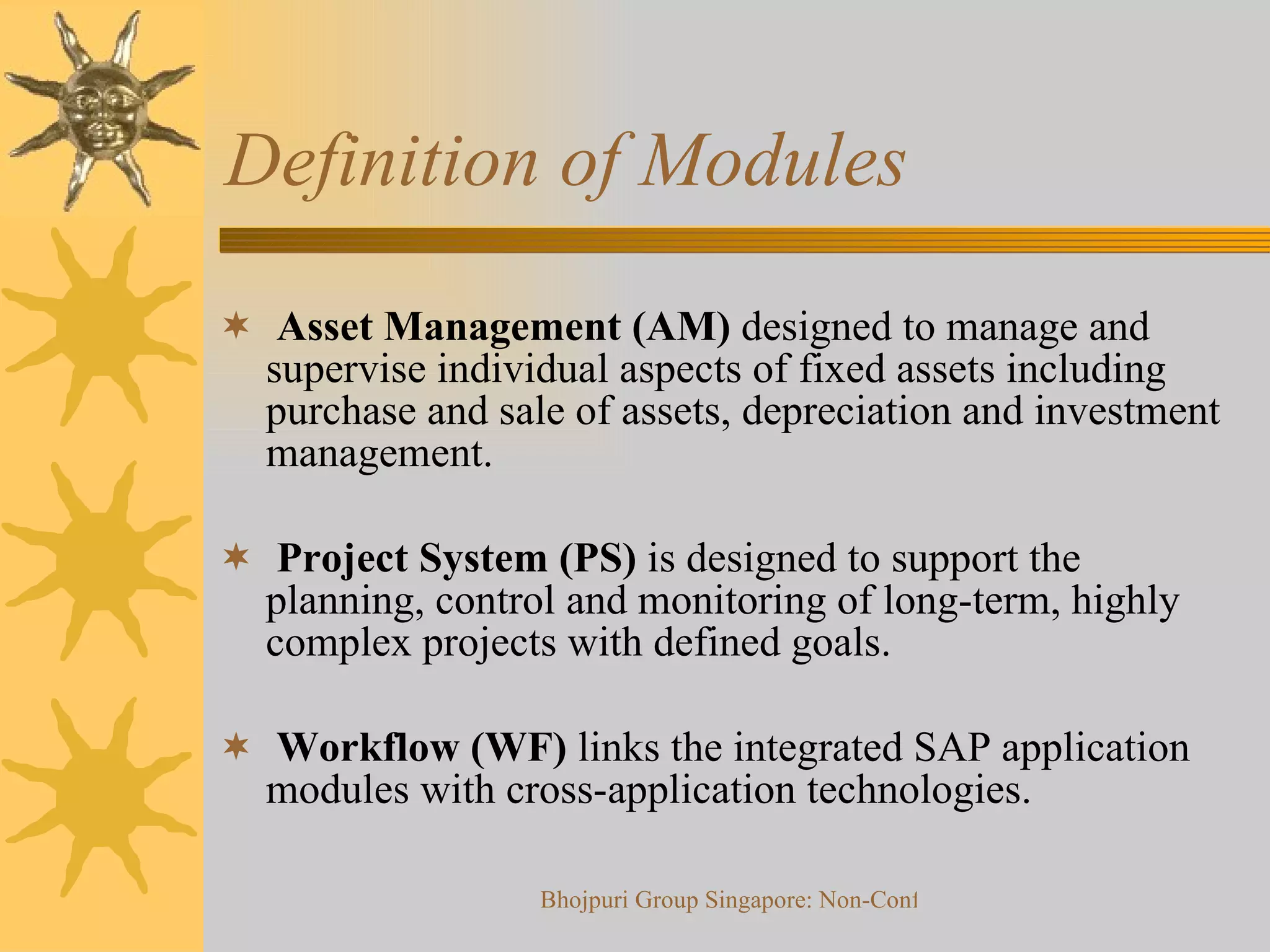
Definition of Modules  Asset Management (AM)  designed to manage and supervise individual aspects of fixed assets including purchase and sale of assets, depreciation and investment management.  Project System (PS)  is designed to support the planning, control and monitoring of long-term, highly complex projects with defined goals.  Workflow (WF)  links the integrated SAP application modules with cross-application technologies.
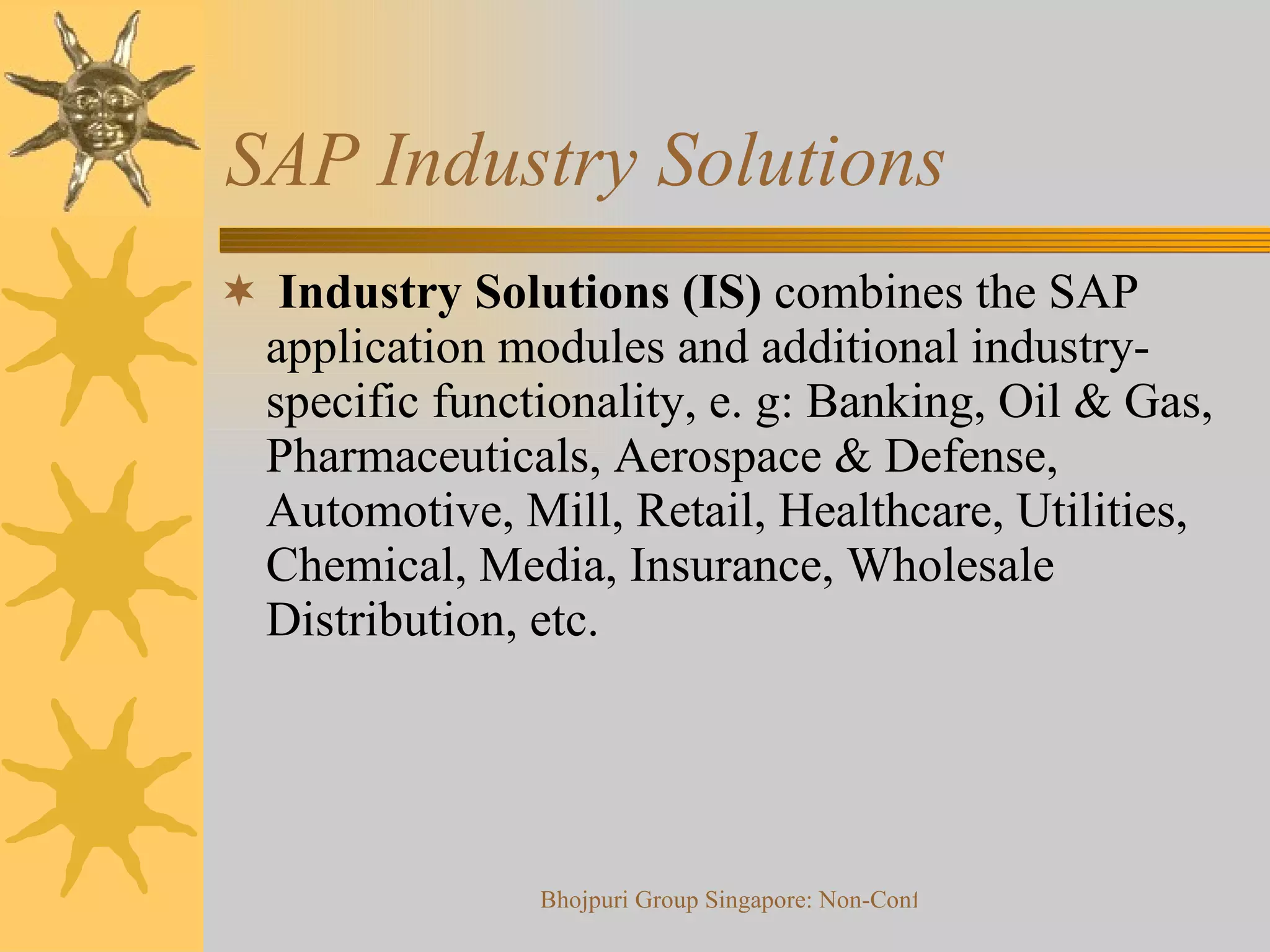
SAP Industry Solutions  Industry Solutions (IS)  combines the SAP application modules and additional industry-specific functionality, e. g: Banking, Oil & Gas, Pharmaceuticals, Aerospace & Defense, Automotive, Mill, Retail, Healthcare, Utilities, Chemical, Media, Insurance, Wholesale Distribution, etc.
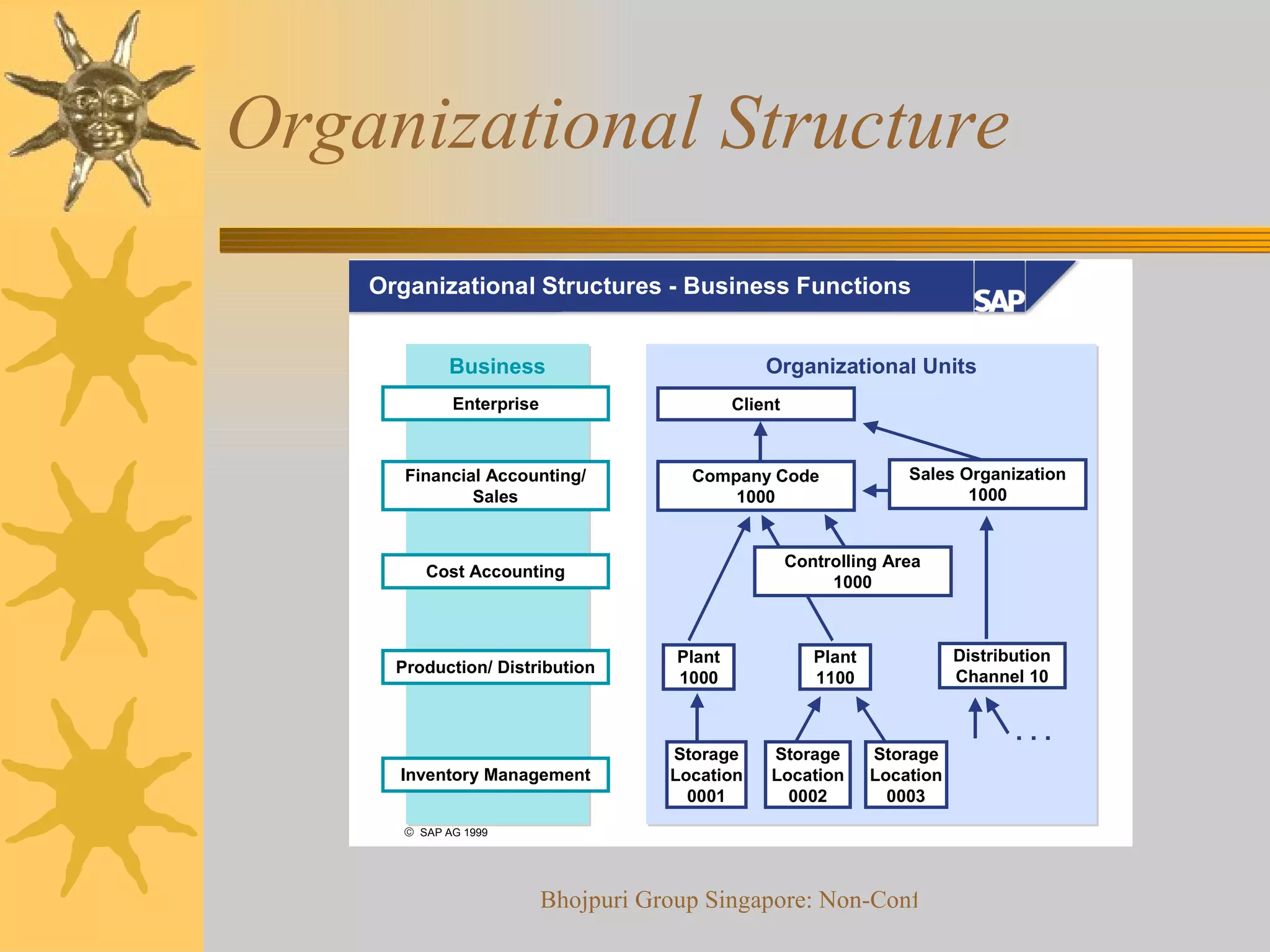
Organizational Structure
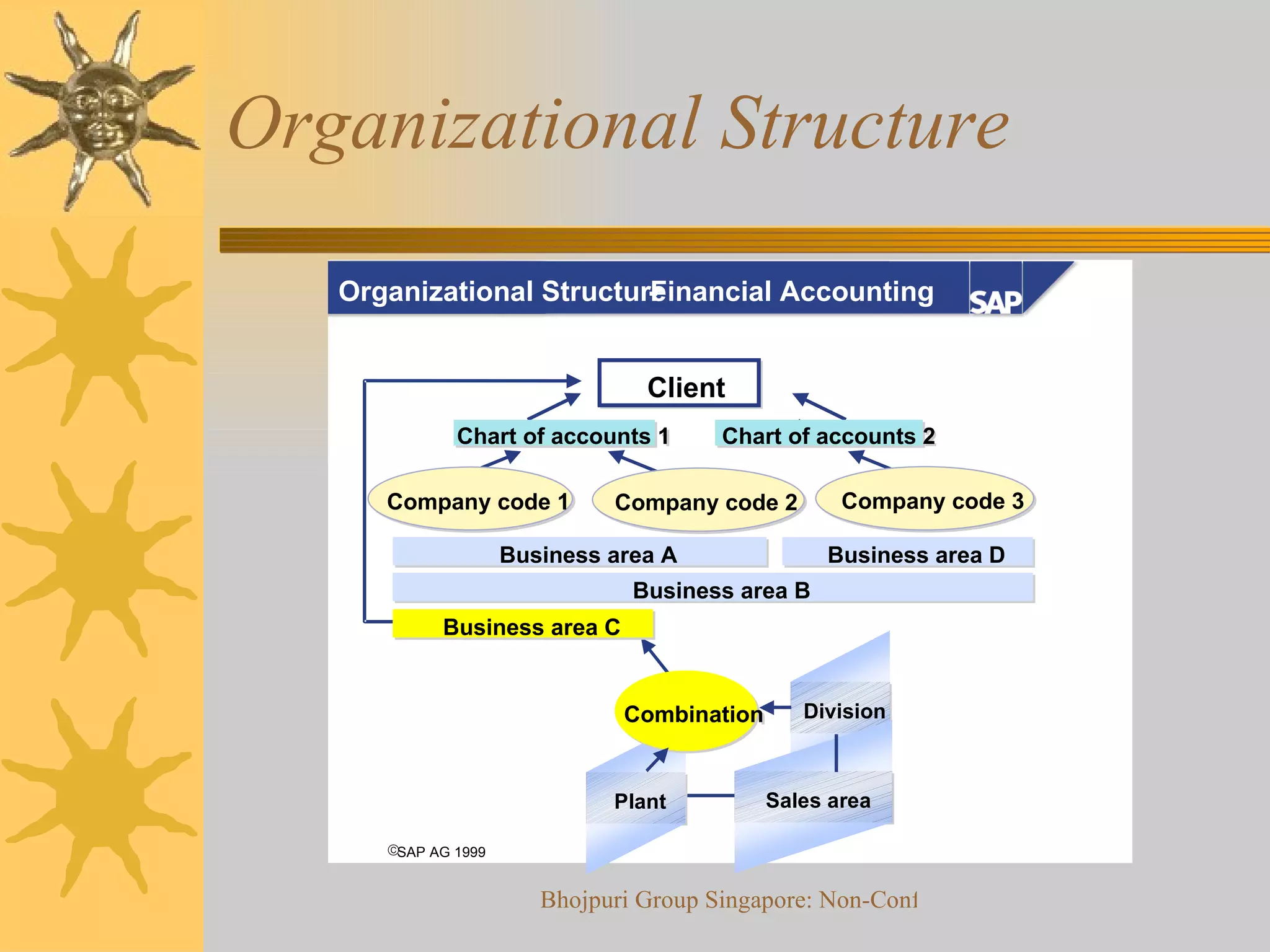
Organizational Structure  SAP AG 1999 Chart of accounts 1 Chart of accounts 1 Company code 1 Company code 1 Chart of accounts 2 Chart of accounts 2 Company code 2 Company code 2 Business area A Business area A Business area B Business area B Business area C Business area C Business area D Business area D Division Division Sales area Sales area Plant Plant Combination Combination Client Company code 3 Company code 3 Organizational Structure  - Financial Accounting
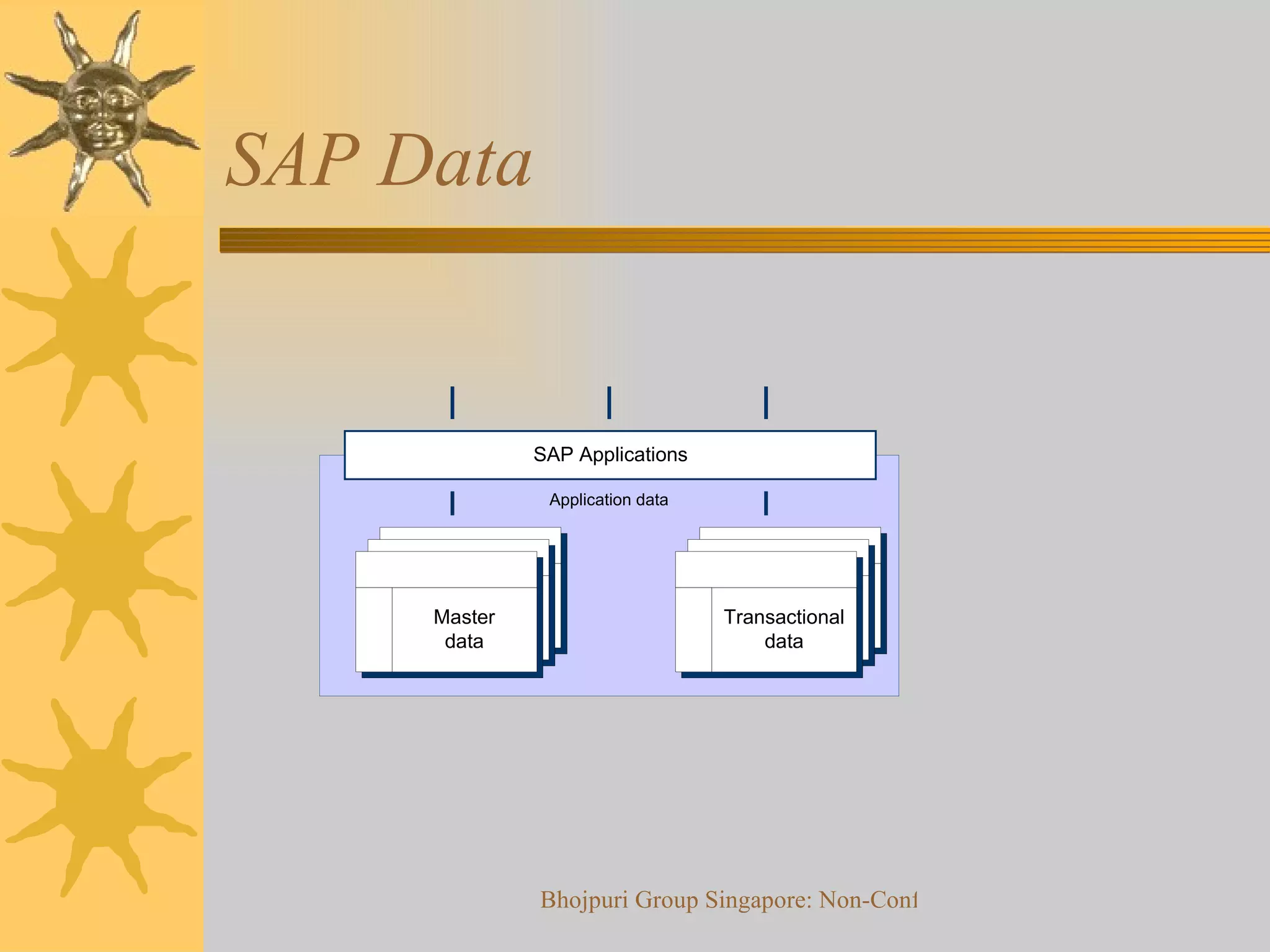
SAP Data
Questions

History and Evolution of ERP & SAP

  • 1.
    iKX - BGSHistory and Evolution of ERP & SAP By Arun Dixit July 16th, 2011
  • 2.
    Why ERP? Thethree letter acronym ‘ERP’ means ‘Enterprise Resource Planning’ Integration (Functional and Geographical Islands) Best business practices (Whole suite of BPR may not be required) Standardization (Do it right first time and every time) Enables the integration of business processes and systems to achieve enterprise-wide operational efficiency.
  • 3.
    Why ERP? Improvesthe performance of a business by consolidating the operations of an entire multi-site enterprise into one database, one application, and one user interface.
  • 4.
    Why not ERP?Complexity (Not Easy to implement and maintain) Cost (Cost of Implementation and support is high) Inflexible (Good ERP is tightly integrated with functions)
  • 5.
    Important TLAs ERPIMS/IMCS/ICS MRP MRP-I or mrp MRP-II or MRP SAP R/3 and ABAP ECC SCM CRM SRM APO BPR
  • 6.
    Important TLAs ERP– Enterprise Resource Planning IMS/IMCS/ICS – Inventory Management System/ Inventory Management & Control Systems/ Inventory Control System MRP – Material Requirements Planning MRP-I or mrp - Material Requirements Planning MRP-II or MRP – Manufacturing Resource Planning SAP – Systems Applications and Products in Data Processing R/3 and ABAP – Real Time/ 3 Trier, Advance Business Application Programming
  • 7.
    Important TLAs ECC– Enterprise Central Component SCM – Supply Chain Management CRM – Customer Relationship Management SRM – Supplier Relationship Management APO – Advance Planner and Optimizer BPR – Business Process Reengineering
  • 8.
    Evolution of ERPERP (Enterprise Resource Planning) is the evolution of Manufacturing Requirements Planning (MRP) II. From business perspective, ERP has expanded from coordination of manufacturing processes to the integration of enterprise-wide backend processes. From technological aspect, ERP has evolved from legacy implementation to more flexible tiered client-server architecture.
  • 9.
    Evolution of ERP1960 – IMC (Inventory Management & Control) 1970 – MRP (Material Requirements Planning) - mrp 1980 – MRP II (Manufacturing Resource Planning) MRP = mrp + crp 1990 – ERP (Enterprise Resource Planning) 2000 – Extended ERP (Integration and collaboration outside the window)
  • 10.
    Famous ERP Vendors- SAP - PeopleSoft - Oracle - JD Edwards - Baan - MFG/PRO - Navision (Microsoft Dynamics NAV)
  • 11.
    History of SAPQ: What is SAP? A: SAP R/3 is an ERP (Enterprise Resource Planning) software Package. In the acronym SAP: S Systems A Applications P Products in Data Processing
  • 12.
    History of SAPSAP was founded in 1972 as Systemanalyse und Programmentwicklung in Mannheim, Baden-Württemberg by following five former IBM engineers: 1. Dietmar Hopp 2. Hans-Werner Hector 3. Hasso Plattner 4. Klaus Tschira 5. Claus Wellenreuther
  • 13.
    History of SAPThe acronym was later changed to stand for Systeme, Anwendungen und Produkte in der Datenverarbeitung ("Systems, Applications and Products in Data Processing").
  • 14.
    History of SAPTimeline: 1972: SAP AG founded in Germany. 1979: SAP R/2 introduced for mainframe computers. 1992: SAP R/3 released as client-server application. 1996: SAP R/3 became partially Internet enabled. 1997: Developed and launched the new dimension product line including CRM, SCM, and Data Warehousing solutions. 1999: SAP announced mySAP.com, the next generation of its Enterprise Application System, based on the Internet architecture. 2000-2005: Introduced mySAP business Suite, NetWeaver, and XApplications.
  • 15.
    SAP Benefits Thebenefits of SAP are: - Integration - Flexibility - Real-Time data processing and reporting - Designed for all types of business - Worldwide Usage - Multiple languages support - Multiple currency support
  • 16.
    Application Areas/ Modules/ Sub-Modules in SAP Three Application Areas: - Financials - Logistics - Human Resources Application areas have modules: FI and CO in Financials, SD and PP in Logistics, OM and PM in Human Resources Modules have sub-module: MM-PU and MM-IM in Materials Management, PM-PD in Personnel Management, FI-AP and FI-AR in Finance.
  • 17.
    Client/Server Architecture 3Tier Client/Server Architecture
  • 18.
    SAP Internet InitiativesmySAP.com Marketplace Portal Portal SAP Employee-Self-Service Internal Corporate Users SAP Online Store (sell side) B2B: Business-to-Business B2C: Business-to-Consumers SAP B2B Procurement (buy side) Business Purchasing Processes
  • 19.
  • 20.
    Definition of Modules Sales and Distribution (SD) supports the tasks and activities carried out in sales, delivery, and billing. Key elements are: Pre-sales support Inquiry processing Quotation processing Sales order processing Delivery processing Billing and sales information system Materials Management (MM) supports the procurement and inventory functions, such as purchasing, inventory management, reorder point processing.
  • 21.
    Definition of Modules Production Planning (PP) is used to plan and control the manufacturing activities of a company. This module includes; bills of material, routings, work centers, sales and operations planning, master production scheduling, material requirements planning, shop floor control, production orders, product costing, etc.
  • 22.
    Definition of Modules Quality Management (QM) is a quality control and information system supporting inspection, and control for manufacturing and procurement. Plant Maintenance (PM) is a complex manufacturing process where equipment can be rebuilt and service maintenance provided. Plant Maintenance is tightly integrated with PP. Human Resources (HR) is a complete integrated system for supporting the planning and control of personnel activities.
  • 23.
    Definition of Modules Financial Accounting (FI) designed for automated management and external reporting of general ledger, accounts receivable, accounts payable and other sub-ledger accounts Controlling (CO) represents the company's flow of cost and revenue and used for internal or managerial reporting.
  • 24.
    Definition of Modules Asset Management (AM) designed to manage and supervise individual aspects of fixed assets including purchase and sale of assets, depreciation and investment management. Project System (PS) is designed to support the planning, control and monitoring of long-term, highly complex projects with defined goals. Workflow (WF) links the integrated SAP application modules with cross-application technologies.
  • 25.
    SAP Industry Solutions Industry Solutions (IS) combines the SAP application modules and additional industry-specific functionality, e. g: Banking, Oil & Gas, Pharmaceuticals, Aerospace & Defense, Automotive, Mill, Retail, Healthcare, Utilities, Chemical, Media, Insurance, Wholesale Distribution, etc.
  • 26.
  • 27.
    Organizational Structure SAP AG 1999 Chart of accounts 1 Chart of accounts 1 Company code 1 Company code 1 Chart of accounts 2 Chart of accounts 2 Company code 2 Company code 2 Business area A Business area A Business area B Business area B Business area C Business area C Business area D Business area D Division Division Sales area Sales area Plant Plant Combination Combination Client Company code 3 Company code 3 Organizational Structure - Financial Accounting
  • 28.
  • 29.