THE ERP


                                Presenter’s
Amany faroun
Reham Hararah
Manal Al-Nablsi
Leen Al-Khayat


                  Submitted To: Dr.Mohammad Obeidat
Agenda

•Full definition of ERP system
•Goal of ERP
•Why ERP?
•Steps to implement an ERP system
•Difficulty of implementation
•Offices before and after ERP
•The ERP Modules
•Advantages & disadvantages of ERP
•Costs of ERP
•Conclusion
What is ERP ?

..E..
An Enterprise is a group of people with a common goal, which
  has certain resources at its disposal to achieve that goal.

..R..
Resources included are money, and all other things that are
  required to run the enterprise.

..P..
Planning is done to ensure that nothing goes wrong.
In general ERP is :

“a business strategy and set of industry-
domain-specific applications that build customer
and shareholder communities value network
system by enabling and optimizing enterprise
and inter-enterprise collaborative operational
and financial processes”(Source: Gartner’s Research Note
SPA-12-0420)
.
Goal of ERP

The goal of our enterprise is simply to get, keep, and grow customers.
GET
• Acquire profitable customers
KEEP
• Retain profitable customers longer.
• Win back profitable customers
• Eliminate unprofitable customers
GROW
• Up sell additional products in a solution
• Cross sell other products to customers
• Reduce service and operations cost.
Why ERP?
•ERP offers solutions for all
business functions

•Packages available for
organizations of all sizes and
types

•Global nature (multi
currency)
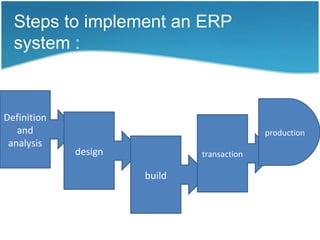
Steps to implement an ERP
  system :


Definition
   and                                      production
 analysis
             design           transaction

                      build
Difficulty of implementation

•Very complex

•Extremely costly and time intensive
Typical: over $10,000,000 and over a
year to implement

•Company may implement only certain
modules of entire ERP system

•You will need an outside consultant
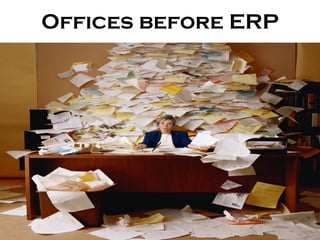
Offices before ERP
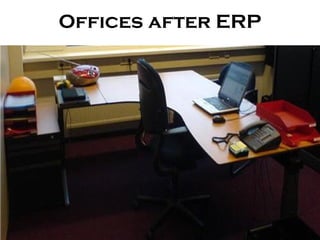
Offices after ERP
The ERP Modules

•   Financials
•   Production Management
•   HR Management
•   Sales & Marketing
•   Asset Management
•   Quality Management
•   Material Management
•   Event Planning
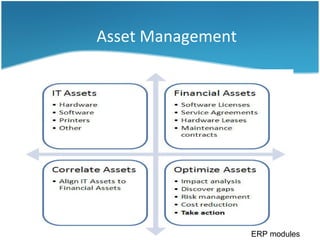
Asset Management


                   ERP modules
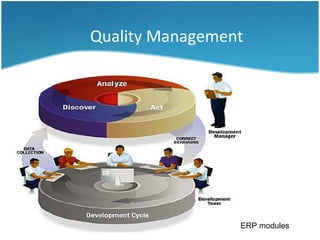
Quality Management


                 ERP modules
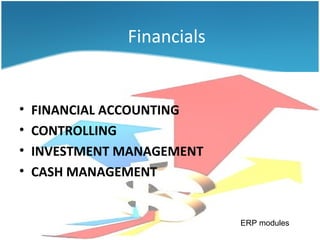
Financials


•   FINANCIAL ACCOUNTING
•   CONTROLLING
•   INVESTMENT MANAGEMENT
•   CASH MANAGEMENT


                            ERP modules
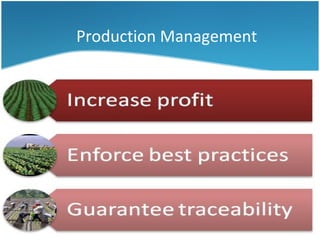
Production Management


                    ERP modules
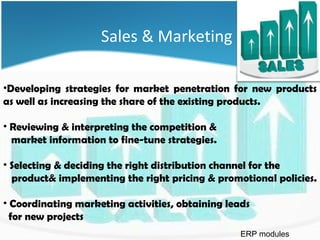
Sales & Marketing

•Developing strategies for market penetration for new products
as well as increasing the share of the existing products.

• Reviewing & interpreting the competition &
  market information to fine-tune strategies.

• Selecting & deciding the right distribution channel for the
  product& implementing the right pricing & promotional policies.

• Coordinating marketing activities, obtaining leads
  for new projects
                                                  ERP modules
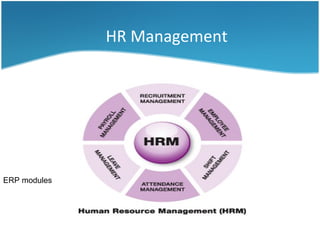
HR Management


ERP modules
Advantages of ERP
 •   Integration
 •   Efficiency
 •   Cost reduction
 •   Less personnel
 •   Accuracy

 Disadvantages
 • Take time to implement
 • Security issues
Costs of ERP

• Direct costs
..hardware
.. Software
..and people on the project

• Indirect costs
..the total cycle life of ERP
..maintenance and upgrades
..increasing salaries and the on going production
Conclusion
•To successfully implement; a proper
mix of people, processes and
technology should be maintained

• Technology is an enabler, not the
driver (it is there to assist the
organization to achieve business
goals)
r ioN
           o T
        s f N
     N K TTe
   A
 H rA
T u
 Y o
Q
QA
 &
 &
References

•ERP Implementation Fundamentals
Richard Byrom
Oracle Consultant, Speaker and Author
http://www.richardbyrom.com

•http://projectmanagement.ittoolbox.com/docume
nts/research/

•ERP demystified(second edition). Copy right
2008, Alexis leon

Erp presentation

  • 1.
    THE ERP Presenter’s Amany faroun Reham Hararah Manal Al-Nablsi Leen Al-Khayat Submitted To: Dr.Mohammad Obeidat
  • 2.
    Agenda •Full definition ofERP system •Goal of ERP •Why ERP? •Steps to implement an ERP system •Difficulty of implementation •Offices before and after ERP •The ERP Modules •Advantages & disadvantages of ERP •Costs of ERP •Conclusion
  • 4.
    What is ERP? ..E.. An Enterprise is a group of people with a common goal, which has certain resources at its disposal to achieve that goal. ..R.. Resources included are money, and all other things that are required to run the enterprise. ..P.. Planning is done to ensure that nothing goes wrong.
  • 5.
    In general ERPis : “a business strategy and set of industry- domain-specific applications that build customer and shareholder communities value network system by enabling and optimizing enterprise and inter-enterprise collaborative operational and financial processes”(Source: Gartner’s Research Note SPA-12-0420) .
  • 6.
    Goal of ERP Thegoal of our enterprise is simply to get, keep, and grow customers. GET • Acquire profitable customers KEEP • Retain profitable customers longer. • Win back profitable customers • Eliminate unprofitable customers GROW • Up sell additional products in a solution • Cross sell other products to customers • Reduce service and operations cost.
  • 7.
    Why ERP? •ERP offerssolutions for all business functions •Packages available for organizations of all sizes and types •Global nature (multi currency)
  • 8.
    Steps to implementan ERP system : Definition and production analysis design transaction build
  • 9.
    Difficulty of implementation •Verycomplex •Extremely costly and time intensive Typical: over $10,000,000 and over a year to implement •Company may implement only certain modules of entire ERP system •You will need an outside consultant
  • 10.
  • 11.
  • 12.
    The ERP Modules • Financials • Production Management • HR Management • Sales & Marketing • Asset Management • Quality Management • Material Management • Event Planning
  • 13.
    Asset Management ERP modules
  • 14.
  • 15.
    Financials • FINANCIAL ACCOUNTING • CONTROLLING • INVESTMENT MANAGEMENT • CASH MANAGEMENT ERP modules
  • 16.
  • 17.
    Sales & Marketing •Developingstrategies for market penetration for new products as well as increasing the share of the existing products. • Reviewing & interpreting the competition & market information to fine-tune strategies. • Selecting & deciding the right distribution channel for the product& implementing the right pricing & promotional policies. • Coordinating marketing activities, obtaining leads for new projects ERP modules
  • 18.
  • 19.
    Advantages of ERP • Integration • Efficiency • Cost reduction • Less personnel • Accuracy Disadvantages • Take time to implement • Security issues
  • 20.
    Costs of ERP •Direct costs ..hardware .. Software ..and people on the project • Indirect costs ..the total cycle life of ERP ..maintenance and upgrades ..increasing salaries and the on going production
  • 21.
    Conclusion •To successfully implement;a proper mix of people, processes and technology should be maintained • Technology is an enabler, not the driver (it is there to assist the organization to achieve business goals)
  • 22.
    r ioN o T s f N N K TTe A H rA T u Y o
  • 23.
  • 24.
    References •ERP Implementation Fundamentals RichardByrom Oracle Consultant, Speaker and Author http://www.richardbyrom.com •http://projectmanagement.ittoolbox.com/docume nts/research/ •ERP demystified(second edition). Copy right 2008, Alexis leon

Editor's Notes

  • #6 Thus Enterprise Resource planning is a method of effective planning of all the resources in an organization
  • #9 1. Definition and Analysis Hold discussions with various functional personnel to establish the actual number of systems operating at client site, what they are used for, why and how often Produce the Project Scoping Document outlining current situation, proposed solution and budgeted time Challenge : REQUISITE EXPERTISE - No two clients are the same 2. Design Prepare various functional reports - specifies current scenario and wish list Prepare Design document which specifies how the system is going to work Prepare test scripts to be followed on system testing Map out the interface paths to various modules Challenge : INFORMATION SHARING - Availability of staff 3. Build Configure system as per set up document specifications i.e. transfer conceptual model into reality Test system to verify accuracy (preliminary tests) Challenge : TECHNICAL ENVIRONMENT - System functionality 4. Transition Train users on their specific areas Assist in test data compilation and system testing by users Finalise the Live system and captured opening balances Challenge : USER RESISTANCE Understanding and acceptance data preparation 5. Production Official hand holding Effectiveness assessment Business and Technical Direction recommendations
  • #14 Asset management refers to the professional management of investments such as stocks and bonds, along with real  estate . Typically, asset management is only practiced by the very wealthy, as the services of a professional firm can demand considerable sums of money, and successful asset management usually requires a large and diverse portfolio.
  • #15 quality management  has a specific meaning within many business sectors. This specific definition, which does not aim to assure 'good quality' by the more general definition, but rather to ensure that an organization or product is consistent
  • #16 financial accounting     A  field  of  accounting  that treats  money  as a  means  of measuring  economic performance  instead of as a  factor  of  production . It encompasses the entire  system  of  monitoring  and  control  of money as it  flows  in and out of an organization as  assets  and  liabilities , and  revenues  and  expenses . controlling     The basic  management   function  of (1) establishing  benchmarks  or standards, (2) comparing actual  performance  against them, and (3) taking  corrective action , if  required . Investment management A generic term that most commonly refers to the buying and selling of investments within a portfolio.  Cash management is a broad term that refers to the collection, concentration, and  disbursement  of cash.
  • #17 production management The  job  of coordinating and  controlling  the  activities   required  to make a  product , typically involving  effective   control  of  scheduling ,  cost ,  performance ,  quality , and  waste   requirements .
  • #18 Sales  is sales! It's converting an inquiry or lead into a contract or shipment. Sales is not market research, business development or advertising. Marketing is finding out what people want, why they want it and how much they’ll spend. Don't confuse marketing with advertising.
  • #19 Human resource management  ( HRM , or simply  HR ) is the  management  of an  organization 's  workforce , or  human resources . It is responsible for the  attraction ,  selection ,  training ,  assessment , and rewarding  of employees, while also overseeing organizational  leadership  and  culture , and ensuring compliance with  employment and labor laws .