Introduction to SAP
Agenda Understanding ERP  Overview of SAP Understanding different Modules, Transaction code and Master data
What is an ERP? Short for Enterprise Resource Planning Integration of business functions such as  Inventory Control ,  Order tracking ,  Customer service ,  Finance  and  Human resources   into one seamless application Usually runs on a RDBMS
Why ERP One system might manage  accounting . Another might control  production planning . A third might serve the  Human Resources department .  Some large companies had hundreds of different systems, and many companies built custom systems from scratch to meet their business needs.
Why ERP Sometimes different computer systems didn't communicate with each other. Duplicate information had to be entered by hand in each system.  This was  slow, inefficient and subject to errors.
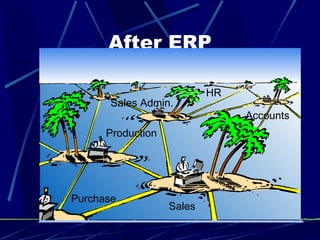
After ERP Sales  Accounts  Production HR  Purchase Sales Admin.
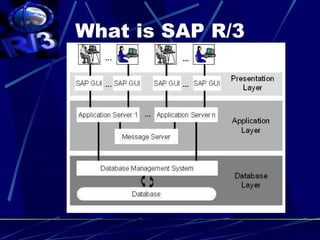
SAP Overview SAP R/3 is an ERP (Enterprise Resource Planning) system  SAP = Systems, Applications and Products in Data Processing  (R = real time, 3 = 3 tier) It is pronounced as separate letters, and not as the word “sap
What is SAP R/3
History and Facts About SAP SAP was founded in 1972 in Mannheim, Germany by Wellenreuther, Hopp, Hector, Plattner and Tschira SAP system comprises of a number of fully integrated modules, which covers virtually every aspect of the business World's third-largest independent software provider with  56,000 installations  serving  12 million users  at  18,800 organizations  in  120 countries  Number one vendor of standard business application software, with a market share of 85% In North America and  65% Worldwide.
History and Facts About SAP Available in 14 languages. 34% of SAP's customers worldwide are under $200 million.  10 out of the top 10 US companies with the highest market value use SAP software.  8 of the top 10 largest US corporations use SAP software.  8 of the top 10 highest profit US companies use SAP software.  More than 7500 customers in over 90 countries have chosen SAP
Why do companies use SAP Old software system no longer meet needs. Companies need accurate, reliable and real time information. To increase accountability To improve Business processes
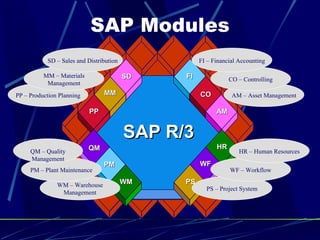
SAP Modules SAP R/3 FI WF PS PM WM PP MM SD HR AM CO QM PP – Production Planning WM – Warehouse Management PM – Plant Maintenance AM – Asset Management PS – Project System MM – Materials Management SD – Sales and Distribution QM – Quality Management WF – Workflow HR – Human Resources CO – Controlling FI – Financial Accounting
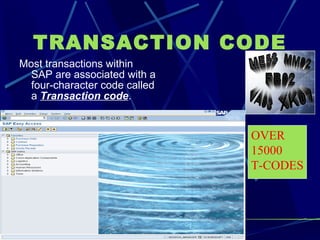
TRANSACTION CODE Most transactions within SAP are associated with a four-character code called a  Transaction code .  OVER  15000 T-CODES
MASTER DATA Master data  is important, long-term data stored within the SAP system.  Vendors, customers, plant IDs, the chart of accounts, and product numbers are all examples of information that is stored as  master data records
DOCUMENT A  document  is data created in association with a particular business event or transaction.  Sales orders, purchase orders, material requisitions, and general ledger postings are all examples of documents stored within SAP.  Every document created in SAP is assigned a  document number  that uniquely identifies it.
Questions??? Questions??? Questions??? Questions??? Questions??? Questions???

Sap Intro

  • 1.
  • 2.
    Agenda Understanding ERP Overview of SAP Understanding different Modules, Transaction code and Master data
  • 3.
    What is anERP? Short for Enterprise Resource Planning Integration of business functions such as Inventory Control , Order tracking , Customer service , Finance and Human resources into one seamless application Usually runs on a RDBMS
  • 4.
    Why ERP Onesystem might manage accounting . Another might control production planning . A third might serve the Human Resources department . Some large companies had hundreds of different systems, and many companies built custom systems from scratch to meet their business needs.
  • 5.
    Why ERP Sometimesdifferent computer systems didn't communicate with each other. Duplicate information had to be entered by hand in each system. This was slow, inefficient and subject to errors.
  • 6.
    After ERP Sales Accounts Production HR Purchase Sales Admin.
  • 7.
    SAP Overview SAPR/3 is an ERP (Enterprise Resource Planning) system SAP = Systems, Applications and Products in Data Processing (R = real time, 3 = 3 tier) It is pronounced as separate letters, and not as the word “sap
  • 8.
  • 9.
    History and FactsAbout SAP SAP was founded in 1972 in Mannheim, Germany by Wellenreuther, Hopp, Hector, Plattner and Tschira SAP system comprises of a number of fully integrated modules, which covers virtually every aspect of the business World's third-largest independent software provider with 56,000 installations serving 12 million users at 18,800 organizations in 120 countries Number one vendor of standard business application software, with a market share of 85% In North America and 65% Worldwide.
  • 10.
    History and FactsAbout SAP Available in 14 languages. 34% of SAP's customers worldwide are under $200 million. 10 out of the top 10 US companies with the highest market value use SAP software. 8 of the top 10 largest US corporations use SAP software. 8 of the top 10 highest profit US companies use SAP software. More than 7500 customers in over 90 countries have chosen SAP
  • 11.
    Why do companiesuse SAP Old software system no longer meet needs. Companies need accurate, reliable and real time information. To increase accountability To improve Business processes
  • 12.
    SAP Modules SAPR/3 FI WF PS PM WM PP MM SD HR AM CO QM PP – Production Planning WM – Warehouse Management PM – Plant Maintenance AM – Asset Management PS – Project System MM – Materials Management SD – Sales and Distribution QM – Quality Management WF – Workflow HR – Human Resources CO – Controlling FI – Financial Accounting
  • 13.
    TRANSACTION CODE Mosttransactions within SAP are associated with a four-character code called a Transaction code . OVER 15000 T-CODES
  • 14.
    MASTER DATA Masterdata is important, long-term data stored within the SAP system. Vendors, customers, plant IDs, the chart of accounts, and product numbers are all examples of information that is stored as master data records
  • 15.
    DOCUMENT A document is data created in association with a particular business event or transaction. Sales orders, purchase orders, material requisitions, and general ledger postings are all examples of documents stored within SAP. Every document created in SAP is assigned a document number that uniquely identifies it.
  • 16.
    Questions??? Questions??? Questions???Questions??? Questions??? Questions???

Editor's Notes

  • #8 What is SAP? Well it is an ERP of course!!
  • #13 Let us see a few of the R/3 Modules in brief Financial Accounting Financial Accounting is designed for automated management and external reporting of general ledger, accounts receivable, accounts payable and other sub-ledger accounts with a user defined chart of accounts. As entries are made relating to sales production and payments journal entries are automatically posted. This connection means that the "books" are designed to reflect the real situation. Controlling Controlling represents the company's flow of cost and revenue. It is a management instrument for organizational decisions. It is also automatically updated as events occur. Assets Management Asset Management is designed to manage and supervise individual aspects of fixed assets including purchase and sale of assets, depreciation and investment management. Sales and Distribution Sales and Distribution helps to optimize all the tasks and activities carried out in sales, delivery and billing. The key elements are; pre-sales support, inquiry processing, quotation processing, sales order processing, delivery processing, billing and sales information system. Materials Management Materials Management supports the procurement and inventory functions occurring in day-to-day business operations such as purchasing, inventory management, reorder point processing, etc. Production Planning Production Planning is used to plan and control the manufacturing activities of a company. This module includes; bills of material, routings, work centers, sales and operations planning, master production scheduling, material requirements planning, shop floor control, production orders, product costing, etc Quality Management Quality Management is a quality control and information system supporting quality planning, inspection, and control for manufacturing and procurement. Plant Maintenance In a complex manufacturing process, maintenance means more than sweeping the floors. Equipment must be services and rebuilt. These tasks affect the production plans. Plant Maintenance module supports and supervises these maintenance. Warehouse Management Warehouse Management provides flexible, automated support to assist in processing all goods movements and in maintaining current stock inventories in the warehousing complex. Human Resources Human Resources is a complete integrated system for supporting the planning and control of personnel activities. Workflow Workflow is a solution which has been integrated fully in the R/3 System and which enables customer-specific business process flows to be coordinated and controlled on a cross-application and cross-workplace basis. Project System Project System is designed to support the planning, control and monitoring of long-term, highly complex projects with defined goals.