Monojit Banerjee [email_address] Enterprise Resource Planning [ERP] Evolution of
Evolution of  Enterprise Information Systems (EIS)
The earlier generation EIS packages were based on  individual business function automations  such as  inventory management systems  and  financial accounting systems .  Also, the focus of manufacturing systems in the  1960s  was on  inventory control . Most of the software packages then (usually customized) were designed to handle inventory based on traditional inventory concepts. Evolution of Enterprise Information Systems (EIS)
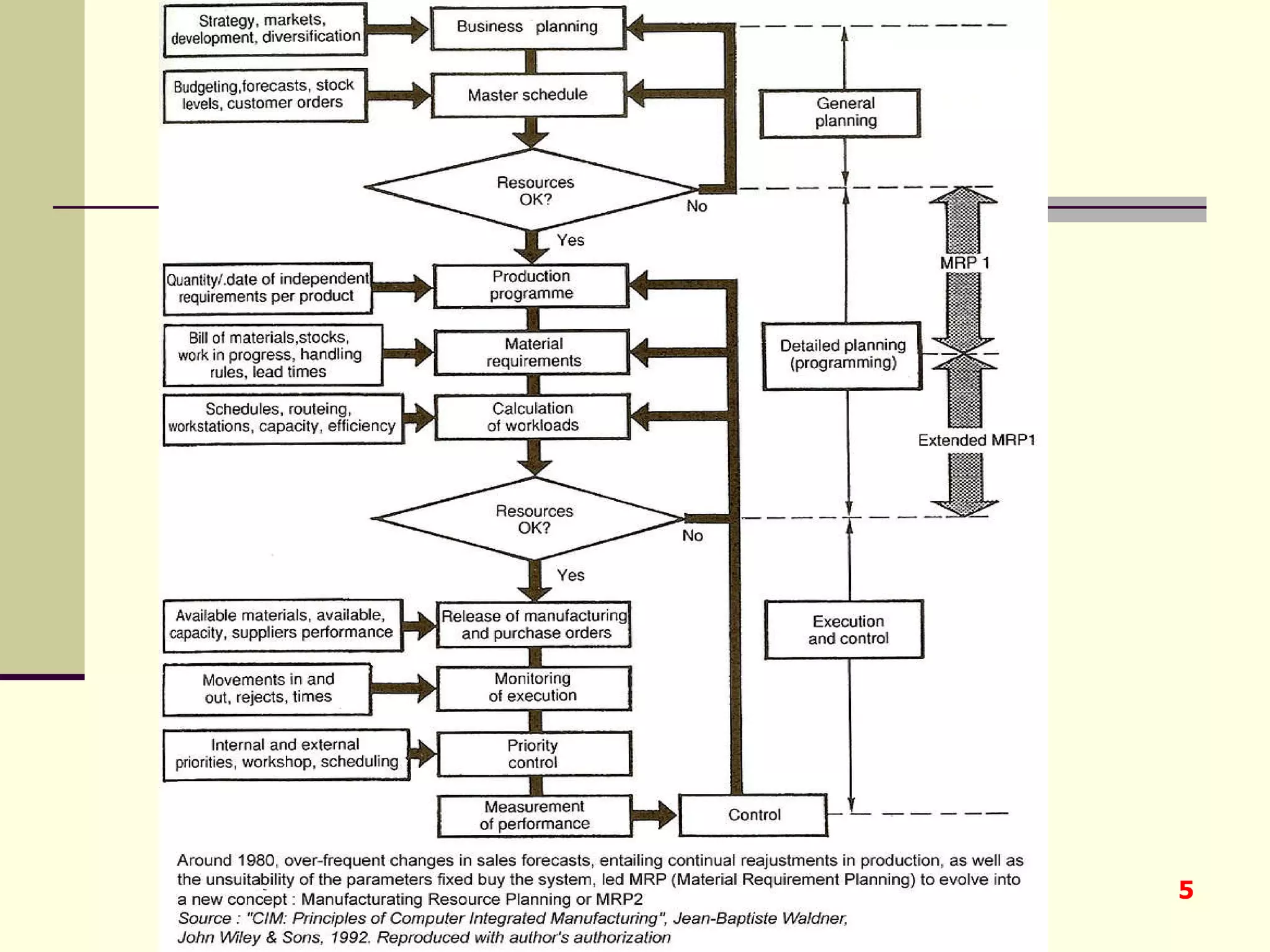
In the  1970s , the focus shifted to  MRP-I   (Materials Requirement Planning)  systems, which translated the master schedule built for the end items into time-phased net requirements for sub-assemblies, components, and raw materials planning and procurement.  In the  1980s , the concept of  MRP-II (Manufacturing Resource Planning)  evolved, which was an extension of MRP-I to the shop floor and distribution management activities. Evolution of Enterprise Information Systems (EIS)
 
In the early  1990s ,  MRP-II  was  further extended to cover  areas such as  engineering ,  finance ,  human resources ,  sales and distribution , and  projects management , that is,  the complete gamut of activities within any business enterprise .  Hence, the term  ERP  was coined.  ERP is focussed within an enterprise.  MRP-II was based on mainframe technology and hence was highly centralized and server-centric. ERP is based on  client-server computing architecture  and hence  distributed in nature . Evolution of Enterprise Information Systems (EIS)
Now the concept of  ERP-II  ( Extended ERP  or  EERP ) is fast evolving covering all the  internal as well as external business functions such as  SCM  and  CRM .  ERP-II is built on object technology, or  component architecture. Evolution of Enterprise Information Systems (EIS)
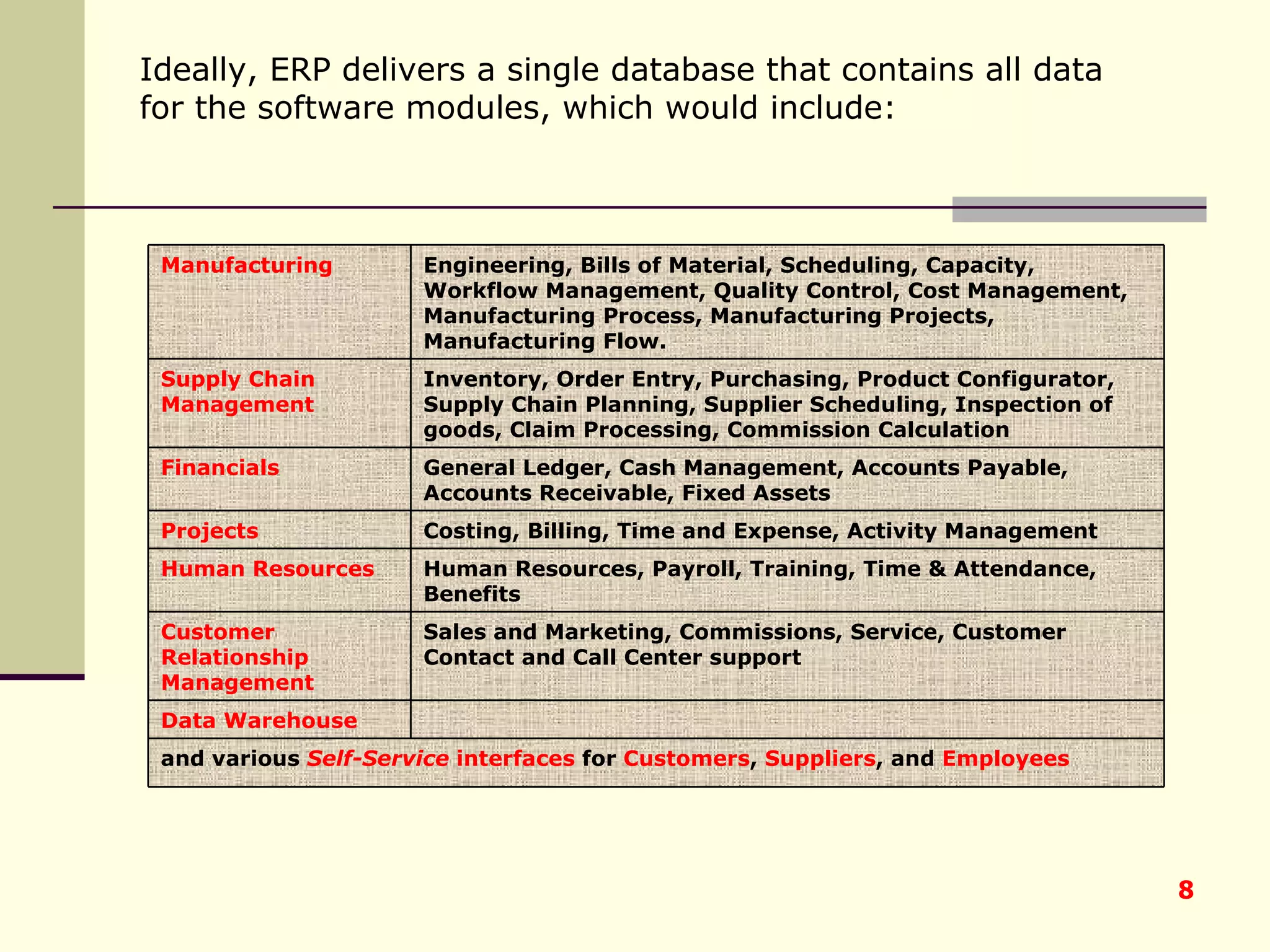
Ideally, ERP delivers a single database that contains all data for the software modules, which would include: and various  Self-Service  interfaces  for  Customers ,  Suppliers , and  Employees Data Warehouse   Sales and Marketing, Commissions, Service, Customer Contact and Call Center support Customer Relationship Management  Human Resources, Payroll, Training, Time & Attendance, Benefits Human Resources   Costing, Billing, Time and Expense, Activity Management Projects General Ledger, Cash Management, Accounts Payable, Accounts Receivable, Fixed Assets Financials Inventory, Order Entry, Purchasing, Product Configurator, Supply Chain Planning, Supplier Scheduling, Inspection of goods, Claim Processing, Commission Calculation Supply Chain Management Engineering, Bills of Material, Scheduling, Capacity, Workflow Management, Quality Control, Cost Management, Manufacturing Process, Manufacturing Projects, Manufacturing Flow. Manufacturing
Enterprise Resource Planning is a term originally derived from manufacturing resource planning ( MRP II ) that followed material requirements planning ( MRP I ).  MRP evolved into ERP when " routings " became major part of the software architecture and a company's  capacity planning  activity also became a part of the standard software activity.
ERP systems typically handle the  manufacturing ,  logistics ,  distribution ,  inventory ,  shipping ,  invoicing , and  accounting  for a company.  Enterprise Resource Planning or ERP software can aid in the control of many business activities, like  sales ,  marketing ,  delivery ,  billing ,  production ,  inventory   management ,  quality management , and  human resources management .
ERPs are often incorrectly called  back office systems  indicating that customers and the general public are not directly involved.  This is contrasted with  front office systems  like  customer relationship management  ( CRM )  systems that deal directly with the customers, or the  eBusiness   systems  such as  eCommerce ,  eGovernment ,  eTelecom , and  eFinance , or  supplier relationship management  ( SRM )  systems.
ERPs are  cross-functional   and  enterprise wide .  All functional departments that are involved in operations or production are integrated in one system . In addition to  manufacturing ,  warehousing ,  logistics , and  Information Technology , this would include  accounting ,  human resources ,  marketing , and  strategic management . ERP II means open ERP architecture of components. The older, monolithic ERP systems became component oriented.
EAS  (  Enterprise Application Suite  )  is a new name for formerly developed ERP systems which include (almost) all segments of business, using ordinary Internet browsers as thin clients.
Before   Prior to the concept of ERP systems, departments within an organization would have their own computer systems. For example, the  Human Resources (HR) department , the  Payroll (PR) department , and the  Financials department .  The HR computer system (Often called  HRMS  or  HRIS ) would typically contain information on the department, reporting structure, and personal details of employees.  The PR department would typically calculate and store paycheck information.  The Financials department would typically store financial transactions for the organization.
Each system would have to rely on a set of common data to communicate with each other .  For the HRIS to send salary information to the PR system, an employee number would need to be assigned and remain static between the two systems to accurately identify an employee .  The Financials system was not interested in the employee level data, but only the payouts made by the PR systems, such as the Tax payments to various authorities, payments for employee benefits to providers, and so on.  This provided  complications . For instance, a person could not be paid in the Payroll system without an employee number. Before
After ERP software, among other things,  combined the data of formerly disparate applications .  This made the worry of keeping employee numbers in synchronization across multiple systems disappear.  It standardised and reduced the number of software specialities required within larger organizations .
Thank You

Evolution of ERP

  • 1.
    Monojit Banerjee [email_address]Enterprise Resource Planning [ERP] Evolution of
  • 2.
    Evolution of Enterprise Information Systems (EIS)
  • 3.
    The earlier generationEIS packages were based on individual business function automations such as inventory management systems and financial accounting systems . Also, the focus of manufacturing systems in the 1960s was on inventory control . Most of the software packages then (usually customized) were designed to handle inventory based on traditional inventory concepts. Evolution of Enterprise Information Systems (EIS)
  • 4.
    In the 1970s , the focus shifted to MRP-I (Materials Requirement Planning) systems, which translated the master schedule built for the end items into time-phased net requirements for sub-assemblies, components, and raw materials planning and procurement. In the 1980s , the concept of MRP-II (Manufacturing Resource Planning) evolved, which was an extension of MRP-I to the shop floor and distribution management activities. Evolution of Enterprise Information Systems (EIS)
  • 5.
  • 6.
    In the early 1990s , MRP-II was further extended to cover areas such as engineering , finance , human resources , sales and distribution , and projects management , that is, the complete gamut of activities within any business enterprise . Hence, the term ERP was coined. ERP is focussed within an enterprise. MRP-II was based on mainframe technology and hence was highly centralized and server-centric. ERP is based on client-server computing architecture and hence distributed in nature . Evolution of Enterprise Information Systems (EIS)
  • 7.
    Now the conceptof ERP-II ( Extended ERP or EERP ) is fast evolving covering all the internal as well as external business functions such as SCM and CRM . ERP-II is built on object technology, or component architecture. Evolution of Enterprise Information Systems (EIS)
  • 8.
    Ideally, ERP deliversa single database that contains all data for the software modules, which would include: and various Self-Service interfaces for Customers , Suppliers , and Employees Data Warehouse   Sales and Marketing, Commissions, Service, Customer Contact and Call Center support Customer Relationship Management  Human Resources, Payroll, Training, Time & Attendance, Benefits Human Resources   Costing, Billing, Time and Expense, Activity Management Projects General Ledger, Cash Management, Accounts Payable, Accounts Receivable, Fixed Assets Financials Inventory, Order Entry, Purchasing, Product Configurator, Supply Chain Planning, Supplier Scheduling, Inspection of goods, Claim Processing, Commission Calculation Supply Chain Management Engineering, Bills of Material, Scheduling, Capacity, Workflow Management, Quality Control, Cost Management, Manufacturing Process, Manufacturing Projects, Manufacturing Flow. Manufacturing
  • 9.
    Enterprise Resource Planningis a term originally derived from manufacturing resource planning ( MRP II ) that followed material requirements planning ( MRP I ). MRP evolved into ERP when " routings " became major part of the software architecture and a company's capacity planning activity also became a part of the standard software activity.
  • 10.
    ERP systems typicallyhandle the manufacturing , logistics , distribution , inventory , shipping , invoicing , and accounting for a company. Enterprise Resource Planning or ERP software can aid in the control of many business activities, like sales , marketing , delivery , billing , production , inventory management , quality management , and human resources management .
  • 11.
    ERPs are oftenincorrectly called back office systems indicating that customers and the general public are not directly involved. This is contrasted with front office systems like customer relationship management ( CRM ) systems that deal directly with the customers, or the eBusiness systems such as eCommerce , eGovernment , eTelecom , and eFinance , or supplier relationship management ( SRM ) systems.
  • 12.
    ERPs are cross-functional and enterprise wide . All functional departments that are involved in operations or production are integrated in one system . In addition to manufacturing , warehousing , logistics , and Information Technology , this would include accounting , human resources , marketing , and strategic management . ERP II means open ERP architecture of components. The older, monolithic ERP systems became component oriented.
  • 13.
    EAS ( Enterprise Application Suite ) is a new name for formerly developed ERP systems which include (almost) all segments of business, using ordinary Internet browsers as thin clients.
  • 14.
    Before Prior to the concept of ERP systems, departments within an organization would have their own computer systems. For example, the Human Resources (HR) department , the Payroll (PR) department , and the Financials department . The HR computer system (Often called HRMS or HRIS ) would typically contain information on the department, reporting structure, and personal details of employees. The PR department would typically calculate and store paycheck information. The Financials department would typically store financial transactions for the organization.
  • 15.
    Each system wouldhave to rely on a set of common data to communicate with each other . For the HRIS to send salary information to the PR system, an employee number would need to be assigned and remain static between the two systems to accurately identify an employee . The Financials system was not interested in the employee level data, but only the payouts made by the PR systems, such as the Tax payments to various authorities, payments for employee benefits to providers, and so on. This provided complications . For instance, a person could not be paid in the Payroll system without an employee number. Before
  • 16.
    After ERP software,among other things, combined the data of formerly disparate applications . This made the worry of keeping employee numbers in synchronization across multiple systems disappear. It standardised and reduced the number of software specialities required within larger organizations .
  • 17.