


Mail us: businessconsulting007@gmail.com
SAP Overview and
Architecture
ANKIT SHARMA
SAP Trainer
Agenda
1. SAP History.
2. Why SAP required ?
3. Advantage and Disadvantage of SAP
4. SAP Architecture.
5. SAP Landscape
SAP ? ? ? ?
• SAP stands for Systems Applications and Products in
Data Processing.
• SAP by definition is also name of the ERP software as well
the name of the Company.
• SAP is #1 in the ERP market.
SAP
• SAP is the world leader in enterprise applications in terms of
software and software-related service revenue. Based on market
capitalization, it is the world’s third largest independent software
manufacturer.
• As of 2010, SAP has more than 140,000 installations worldwide,
over 25 industry-specific business solutions and more than 75,000
customers in 120 countries
• Other Competitive products in the market are Oracle, Microsoft
Dynamics etc
SAP History
 5 EX-IBM Engineers founded SAP.
Dietmar Hopp, Klaus Tschira, Hans-Werner Hector, Hasso Plattner, and Claus
Wellenreuther
SAP was started in 1972 in Germany.
Initially there vision was : Standard application software for real-time data processing is
developed.
The first client of this company was the German branch of Imperial Chemical Industries
SAP History
SAP has issued several releases, such as SAP R/1, SAP R/2, and SAP
R/3.
The R in these releases stands for “Real-Time” data processing.
The 3 in the R/3 stands for “three-tier” client-server architecture.
The most current release of SAP is SAP Business Suite 7.
SAP R/1
SAP R/1
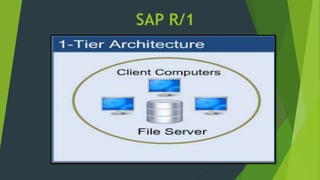
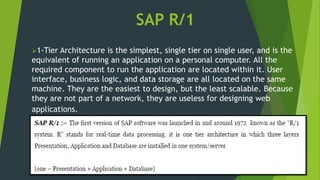
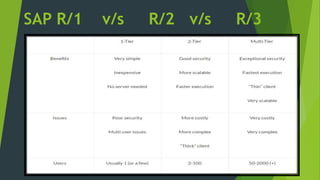
1-Tier Architecture is the simplest, single tier on single user, and is the
equivalent of running an application on a personal computer. All the
required component to run the application are located within it. User
interface, business logic, and data storage are all located on the same
machine. They are the easiest to design, but the least scalable. Because
they are not part of a network, they are useless for designing web
applications.
SAP R/2
SAP R/2
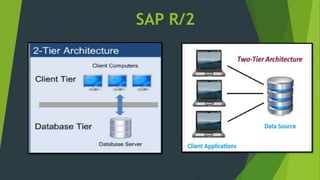
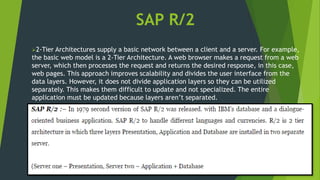
2-Tier Architectures supply a basic network between a client and a server. For example,
the basic web model is a 2-Tier Architecture. A web browser makes a request from a web
server, which then processes the request and returns the desired response, in this case,
web pages. This approach improves scalability and divides the user interface from the
data layers. However, it does not divide application layers so they can be utilized
separately. This makes them difficult to update and not specialized. The entire
application must be updated because layers aren’t separated.
SAP R/3
SAP R/3
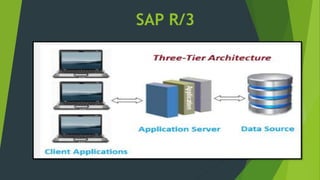
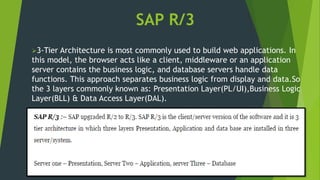
3-Tier Architecture is most commonly used to build web applications. In
this model, the browser acts like a client, middleware or an application
server contains the business logic, and database servers handle data
functions. This approach separates business logic from display and data.So
the 3 layers commonly known as: Presentation Layer(PL/UI),Business Logic
Layer(BLL) & Data Access Layer(DAL).
SAP R/1 v/s R/2 v/s R/3
SAP Modules
SAP Divided into two Area:
1. SAP Functional Module
2. SAP Technical Module
SAP Functional Module
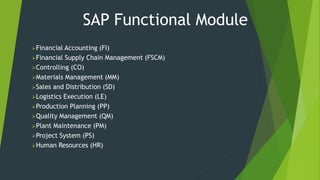
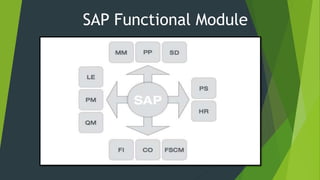
Financial Accounting (FI)
Financial Supply Chain Management (FSCM)
Controlling (CO)
Materials Management (MM)
Sales and Distribution (SD)
Logistics Execution (LE)
Production Planning (PP)
Quality Management (QM)
Plant Maintenance (PM)
Project System (PS)
Human Resources (HR)
SAP Functional Module
SAP Technical Module
ABAP – Advance Business Application Programming
BASIS
BI – Business Information
BW – Business Warehouse
HANA – High performance analytic appliance
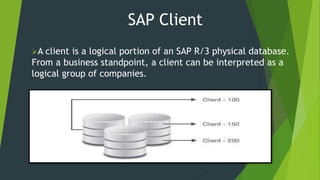
SAP Client
A client is a logical portion of an SAP R/3 physical database.
From a business standpoint, a client can be interpreted as a
logical group of companies.
SAP Client
All customizing (configuration) and development (ABAP) work
in SAP R/3 is performed in a client.
However, the data from both customizing and development
work may be stored within an individual client (client
dependent data) or among all clients (client independent data)
in the system.
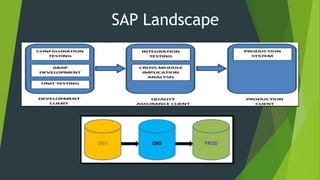
SAP Landscape
SAP Landscape
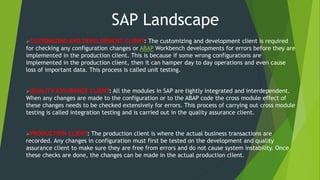
CUSTOMIZING AND DEVELOPMENT CLIENT: The customizing and development client is required
for checking any configuration changes or ABAP Workbench developments for errors before they are
implemented in the production client. This is because if some wrong configurations are
implemented in the production client, then it can hamper day to day operations and even cause
loss of important data. This process is called unit testing.
QUALITY ASSURANCE CLIENT: All the modules in SAP are tightly integrated and interdependent.
When any changes are made to the configuration or to the ABAP code the cross module effect of
these changes needs to be checked extensively for errors. This process of carrying out cross module
testing is called integration testing and is carried out in the quality assurance client.
PRODUCTION CLIENT: The production client is where the actual business transactions are
recorded. Any changes in configuration must first be tested on the development and quality
assurance client to make sure they are free from errors and do not cause system instability. Once
these checks are done, the changes can be made in the actual production client.
Advantage of SAP
1. Flexibility.
2. Customized solutions to suit your business.
3. Highly integrated with other modules.
4. Industry specific modules with a deep insight.
5. Continuous support.
Student Assignment
1. History of SAP
2. Benefits of SAP
3. SAP Architecture
4. SAP Modules
5. SAP Landscape
SAP Overview and Architecture

SAP Overview and Architecture

  • 1.
  • 2.
  • 3.
    Agenda 1. SAP History. 2.Why SAP required ? 3. Advantage and Disadvantage of SAP 4. SAP Architecture. 5. SAP Landscape
  • 4.
    SAP ? ?? ? • SAP stands for Systems Applications and Products in Data Processing. • SAP by definition is also name of the ERP software as well the name of the Company. • SAP is #1 in the ERP market.
  • 5.
    SAP • SAP isthe world leader in enterprise applications in terms of software and software-related service revenue. Based on market capitalization, it is the world’s third largest independent software manufacturer. • As of 2010, SAP has more than 140,000 installations worldwide, over 25 industry-specific business solutions and more than 75,000 customers in 120 countries • Other Competitive products in the market are Oracle, Microsoft Dynamics etc
  • 6.
    SAP History  5EX-IBM Engineers founded SAP. Dietmar Hopp, Klaus Tschira, Hans-Werner Hector, Hasso Plattner, and Claus Wellenreuther SAP was started in 1972 in Germany. Initially there vision was : Standard application software for real-time data processing is developed. The first client of this company was the German branch of Imperial Chemical Industries
  • 7.
    SAP History SAP hasissued several releases, such as SAP R/1, SAP R/2, and SAP R/3. The R in these releases stands for “Real-Time” data processing. The 3 in the R/3 stands for “three-tier” client-server architecture. The most current release of SAP is SAP Business Suite 7.
  • 8.
  • 9.
    SAP R/1 1-Tier Architectureis the simplest, single tier on single user, and is the equivalent of running an application on a personal computer. All the required component to run the application are located within it. User interface, business logic, and data storage are all located on the same machine. They are the easiest to design, but the least scalable. Because they are not part of a network, they are useless for designing web applications.
  • 10.
  • 11.
    SAP R/2 2-Tier Architecturessupply a basic network between a client and a server. For example, the basic web model is a 2-Tier Architecture. A web browser makes a request from a web server, which then processes the request and returns the desired response, in this case, web pages. This approach improves scalability and divides the user interface from the data layers. However, it does not divide application layers so they can be utilized separately. This makes them difficult to update and not specialized. The entire application must be updated because layers aren’t separated.
  • 12.
  • 13.
    SAP R/3 3-Tier Architectureis most commonly used to build web applications. In this model, the browser acts like a client, middleware or an application server contains the business logic, and database servers handle data functions. This approach separates business logic from display and data.So the 3 layers commonly known as: Presentation Layer(PL/UI),Business Logic Layer(BLL) & Data Access Layer(DAL).
  • 14.
    SAP R/1 v/sR/2 v/s R/3
  • 15.
    SAP Modules SAP Dividedinto two Area: 1. SAP Functional Module 2. SAP Technical Module
  • 16.
    SAP Functional Module FinancialAccounting (FI) Financial Supply Chain Management (FSCM) Controlling (CO) Materials Management (MM) Sales and Distribution (SD) Logistics Execution (LE) Production Planning (PP) Quality Management (QM) Plant Maintenance (PM) Project System (PS) Human Resources (HR)
  • 17.
  • 18.
    SAP Technical Module ABAP– Advance Business Application Programming BASIS BI – Business Information BW – Business Warehouse HANA – High performance analytic appliance
  • 19.
    SAP Client A clientis a logical portion of an SAP R/3 physical database. From a business standpoint, a client can be interpreted as a logical group of companies.
  • 20.
    SAP Client All customizing(configuration) and development (ABAP) work in SAP R/3 is performed in a client. However, the data from both customizing and development work may be stored within an individual client (client dependent data) or among all clients (client independent data) in the system.
  • 21.
  • 22.
    SAP Landscape CUSTOMIZING ANDDEVELOPMENT CLIENT: The customizing and development client is required for checking any configuration changes or ABAP Workbench developments for errors before they are implemented in the production client. This is because if some wrong configurations are implemented in the production client, then it can hamper day to day operations and even cause loss of important data. This process is called unit testing. QUALITY ASSURANCE CLIENT: All the modules in SAP are tightly integrated and interdependent. When any changes are made to the configuration or to the ABAP code the cross module effect of these changes needs to be checked extensively for errors. This process of carrying out cross module testing is called integration testing and is carried out in the quality assurance client. PRODUCTION CLIENT: The production client is where the actual business transactions are recorded. Any changes in configuration must first be tested on the development and quality assurance client to make sure they are free from errors and do not cause system instability. Once these checks are done, the changes can be made in the actual production client.
  • 23.
    Advantage of SAP 1.Flexibility. 2. Customized solutions to suit your business. 3. Highly integrated with other modules. 4. Industry specific modules with a deep insight. 5. Continuous support.
  • 24.
    Student Assignment 1. Historyof SAP 2. Benefits of SAP 3. SAP Architecture 4. SAP Modules 5. SAP Landscape