By : Rajnikant George Puspendra  Pal Singh Rashmi Kala Tirkey  11/17/09
ERP is enterprise  resource planning. It Is cross-functional enterprise system driven by an integrated suite of software module that support the basic internal business process of an organization. The purpose served by an ERP system is that of organizing, codifying and standardization of  business process and information or  data 11/17/09
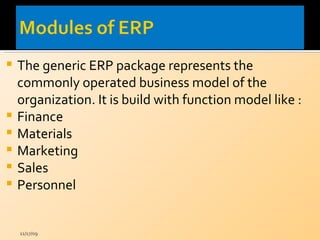
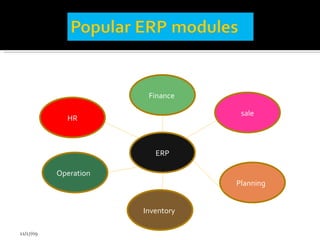
The generic ERP package represents the commonly operated business model of the organization. It is build with function model like : Finance  Materials  Marketing  Sales  Personnel  11/17/09
ERP Inventory  Planning  sale Finance  HR Operation  11/17/09
All kind of organizations small scale, large scale organizations benefit from the implementation of ERP financial module. The financial module is the core of many ERP software systems. It can gather financial data from various functional departments, and generates valuable financial reports such general ledger, trail balance, as balance sheet and quarterly financial statements. 11/17/09
Human Resources is another widely implemented ERP module. HR module streamlines the management of human resources and human capitals. HR modules routinely maintain a complete employee database including contact information, salary details, attendance, performance evaluation and promotion of all employees. Advanced HR module is integrated with knowledge management systems to optimally utilize the expertise of all employees.  produce pay checks and payroll reports; maintain personnel records; pursue Talent Management, Training,  Time and attendance benefit  11/17/09
In the process of evolution of manufacturing requirements planning (MRP) II into ERP, while vendors have developed more robust software for production planning, consulting firms have accumulated vast knowledge of implementing production planning module. Production planning optimizes the utilization of manufacturing capacity, parts, components and material resources using historical production data and sales forecasting.  Process definition with inputs, outputs, by-products and overheads Definition of Bill of Material for all products up to any number of levels Planning based on customer wise production advice and sales forecast. 11/17/09
Purchase module streamline procurement of required raw materials. It automates the processes of identifying potential suppliers, negotiating price, awarding purchase order to the supplier, and billing processes. Purchase module is tightly integrated with the inventory control and production planning modules. Purchasing module is often integrated with supply chain management software. 11/17/09
Inventory module facilitates processes of maintaining the appropriate level of stock in a warehouse. The activities of inventory control involves in identifying inventory requirements, setting targets, providing replenishment techniques and options, monitoring item usages, reconciling the inventory balances, and reporting inventory status. Integration of inventory control module with sales, purchase, finance modules allows ERP systems to generate vigilant executive level reports. 11/17/09
Sales module implements functions of order placement, order scheduling, shipping and invoicing. Sales module is closely integrated with organizations' ecommerce websites. Many ERP vendors offer online store front as part of the sales module. ERP marketing module along with CRP supports lead generation, direct mailing campaign and other marketing works. Scheduling of the promotion is possible using this.   11/17/09
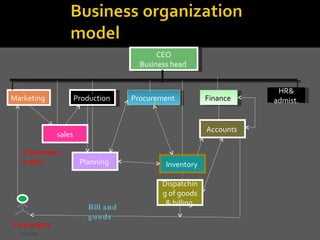
CEO Business head  Marketing  Production  Procurement  Finance  HR& admist. sales Planning  Accounts  Inventory  Dispatching of goods & billing  Customer  Customer order Bill and goods 11/17/09
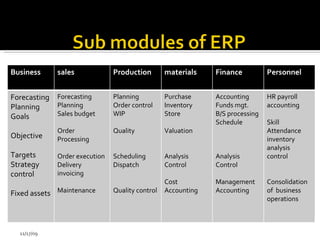
11/17/09 Business sales Production  materials Finance  Personnel  Forecasting Planning  Goals Objective  Targets Strategy control  Fixed assets  Forecasting Planning Sales budget Order Processing Order execution Delivery invoicing Maintenance  Planning  Order control WIP Quality  Scheduling Dispatch  Quality control  Purchase  Inventory Store  Valuation Analysis Control  Cost Accounting  Accounting  Funds mgt. B/S processing  Schedule  Analysis Control Management  Accounting  HR payroll accounting  Skill Attendance inventory  analysis control  Consolidation of  business  operations
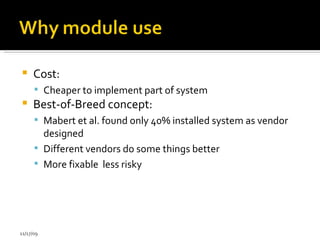
Cost: Cheaper to implement part of system Best-of-Breed concept: Mabert et al. found only 40% installed system as vendor designed Different vendors do some things better More fixable  less risky  11/17/09
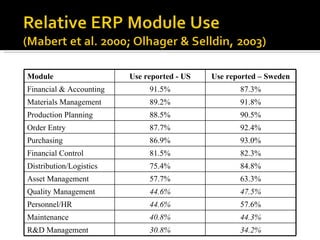
Module Use reported - US Use reported – Sweden Financial & Accounting 91.5% 87.3% Materials Management 89.2% 91.8% Production Planning 88.5% 90.5% Order Entry 87.7% 92.4% Purchasing 86.9% 93.0% Financial Control 81.5% 82.3% Distribution/Logistics 75.4% 84.8% Asset Management 57.7% 63.3% Quality Management 44.6% 47.5% Personnel/HR 44.6% 57.6% Maintenance 40.8% 44.3% R&D Management 30.8% 34.2%
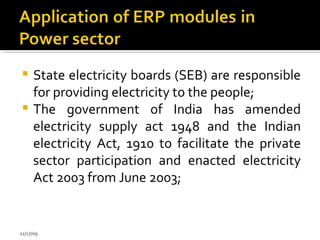
State electricity boards (SEB) are responsible for providing electricity to the people; The government of India has amended electricity supply act 1948 and the Indian electricity Act, 1910 to facilitate the private sector participation and enacted electricity Act 2003 from June 2003; 11/17/09
Information technology is widely acknowledged to be crucial for efficient operation and management of all industrial system.  This is equally true of the power utilities, which need to handle a large amount of information for their efficient operation. The entire gamut of the operation in the power sector will resolving around better availability of quality power and efficient mangt of energy.  11/17/09
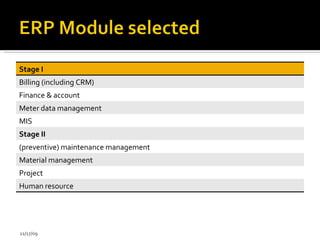
11/17/09 Stage I Billing (including CRM) Finance & account  Meter data management  MIS Stage II (preventive) maintenance management  Material management  Project Human resource
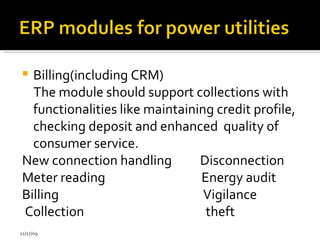
Billing(including CRM) The module should support collections with functionalities like maintaining credit profile, checking deposit and enhanced  quality of consumer service.  New connection  handling  Disconnection  Meter reading  Energy audit  Billing  Vigilance  Collection  theft  11/17/09
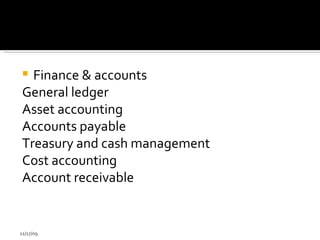
Finance & accounts  General ledger Asset accounting  Accounts payable  Treasury and cash management  Cost accounting  Account receivable  11/17/09
Meter data management : the system should be able to capture details, energy withdrawn at various level. Central database  Distributed data collection  Data analysis  ►   MIS: As integrated solution module rolled out the data entry of basic might reduce and the MIS system should basic data from the system database. 11/17/09
Maintenance management: the system should help in preventive , proactive  and breakdown maintenance. The system should track all assets and functionality for maintenance planning . Recommend schedule  Forecast maintenance Forecast resource requirement  costing Component equipment and tools Maintain bills of materials and vendor details  Cost management  11/17/09
Human resources  : The objective of the HRM module is to manage entire life cycle of an employee in an organization. Employees information and organization structure details Recruitment &  selection  Manpower planning Leave management  Training  Performance appraisal management Separation  11/17/09
Thank you  11/17/09

ERP module

  • 1.
    By : RajnikantGeorge Puspendra Pal Singh Rashmi Kala Tirkey 11/17/09
  • 2.
    ERP is enterprise resource planning. It Is cross-functional enterprise system driven by an integrated suite of software module that support the basic internal business process of an organization. The purpose served by an ERP system is that of organizing, codifying and standardization of business process and information or data 11/17/09
  • 3.
    The generic ERPpackage represents the commonly operated business model of the organization. It is build with function model like : Finance Materials Marketing Sales Personnel 11/17/09
  • 4.
    ERP Inventory Planning sale Finance HR Operation 11/17/09
  • 5.
    All kind oforganizations small scale, large scale organizations benefit from the implementation of ERP financial module. The financial module is the core of many ERP software systems. It can gather financial data from various functional departments, and generates valuable financial reports such general ledger, trail balance, as balance sheet and quarterly financial statements. 11/17/09
  • 6.
    Human Resources isanother widely implemented ERP module. HR module streamlines the management of human resources and human capitals. HR modules routinely maintain a complete employee database including contact information, salary details, attendance, performance evaluation and promotion of all employees. Advanced HR module is integrated with knowledge management systems to optimally utilize the expertise of all employees.  produce pay checks and payroll reports; maintain personnel records; pursue Talent Management, Training, Time and attendance benefit 11/17/09
  • 7.
    In the processof evolution of manufacturing requirements planning (MRP) II into ERP, while vendors have developed more robust software for production planning, consulting firms have accumulated vast knowledge of implementing production planning module. Production planning optimizes the utilization of manufacturing capacity, parts, components and material resources using historical production data and sales forecasting.  Process definition with inputs, outputs, by-products and overheads Definition of Bill of Material for all products up to any number of levels Planning based on customer wise production advice and sales forecast. 11/17/09
  • 8.
    Purchase module streamlineprocurement of required raw materials. It automates the processes of identifying potential suppliers, negotiating price, awarding purchase order to the supplier, and billing processes. Purchase module is tightly integrated with the inventory control and production planning modules. Purchasing module is often integrated with supply chain management software. 11/17/09
  • 9.
    Inventory module facilitatesprocesses of maintaining the appropriate level of stock in a warehouse. The activities of inventory control involves in identifying inventory requirements, setting targets, providing replenishment techniques and options, monitoring item usages, reconciling the inventory balances, and reporting inventory status. Integration of inventory control module with sales, purchase, finance modules allows ERP systems to generate vigilant executive level reports. 11/17/09
  • 10.
    Sales module implementsfunctions of order placement, order scheduling, shipping and invoicing. Sales module is closely integrated with organizations' ecommerce websites. Many ERP vendors offer online store front as part of the sales module. ERP marketing module along with CRP supports lead generation, direct mailing campaign and other marketing works. Scheduling of the promotion is possible using this.   11/17/09
  • 11.
    CEO Business head Marketing Production Procurement Finance HR& admist. sales Planning Accounts Inventory Dispatching of goods & billing Customer Customer order Bill and goods 11/17/09
  • 12.
    11/17/09 Business salesProduction materials Finance Personnel Forecasting Planning Goals Objective Targets Strategy control Fixed assets Forecasting Planning Sales budget Order Processing Order execution Delivery invoicing Maintenance Planning Order control WIP Quality Scheduling Dispatch Quality control Purchase Inventory Store Valuation Analysis Control Cost Accounting Accounting Funds mgt. B/S processing Schedule Analysis Control Management Accounting HR payroll accounting Skill Attendance inventory analysis control Consolidation of business operations
  • 13.
    Cost: Cheaper toimplement part of system Best-of-Breed concept: Mabert et al. found only 40% installed system as vendor designed Different vendors do some things better More fixable less risky 11/17/09
  • 14.
    Module Use reported- US Use reported – Sweden Financial & Accounting 91.5% 87.3% Materials Management 89.2% 91.8% Production Planning 88.5% 90.5% Order Entry 87.7% 92.4% Purchasing 86.9% 93.0% Financial Control 81.5% 82.3% Distribution/Logistics 75.4% 84.8% Asset Management 57.7% 63.3% Quality Management 44.6% 47.5% Personnel/HR 44.6% 57.6% Maintenance 40.8% 44.3% R&D Management 30.8% 34.2%
  • 15.
    State electricity boards(SEB) are responsible for providing electricity to the people; The government of India has amended electricity supply act 1948 and the Indian electricity Act, 1910 to facilitate the private sector participation and enacted electricity Act 2003 from June 2003; 11/17/09
  • 16.
    Information technology iswidely acknowledged to be crucial for efficient operation and management of all industrial system. This is equally true of the power utilities, which need to handle a large amount of information for their efficient operation. The entire gamut of the operation in the power sector will resolving around better availability of quality power and efficient mangt of energy. 11/17/09
  • 17.
    11/17/09 Stage IBilling (including CRM) Finance & account Meter data management MIS Stage II (preventive) maintenance management Material management Project Human resource
  • 18.
    Billing(including CRM) Themodule should support collections with functionalities like maintaining credit profile, checking deposit and enhanced quality of consumer service. New connection handling Disconnection Meter reading Energy audit Billing Vigilance Collection theft 11/17/09
  • 19.
    Finance & accounts General ledger Asset accounting Accounts payable Treasury and cash management Cost accounting Account receivable 11/17/09
  • 20.
    Meter data management: the system should be able to capture details, energy withdrawn at various level. Central database Distributed data collection Data analysis ► MIS: As integrated solution module rolled out the data entry of basic might reduce and the MIS system should basic data from the system database. 11/17/09
  • 21.
    Maintenance management: thesystem should help in preventive , proactive and breakdown maintenance. The system should track all assets and functionality for maintenance planning . Recommend schedule Forecast maintenance Forecast resource requirement costing Component equipment and tools Maintain bills of materials and vendor details Cost management 11/17/09
  • 22.
    Human resources : The objective of the HRM module is to manage entire life cycle of an employee in an organization. Employees information and organization structure details Recruitment & selection Manpower planning Leave management Training Performance appraisal management Separation 11/17/09
  • 23.
    Thank you 11/17/09