UNIT - V
HIGHWAY MAINTENANCE
HIGHWAY MAINTENANCE 2
Need For Highway Maintenance
• The road maintenance is one of the main components of road system.
• The maintenance operation involves the assessment of road condition.
• Even if the highways are well designed & construction they may require effective
maintenance.
General causes of failure of pavement:
Some of the general causes of pavement failure leading maintenance measures,
I. Defects (Imperfections) in quality of material used
II. Defects in quality of construction & quality control during the constructions.
III. Inadequate surface & subsurface drainage in the locality.
IV. The settlement of the foundation of the embankment of the filled materials itself.
V. The environmental factors., such as intensity of rainfall, temperature variations,
soil erosion, high water table, snow, snowfall, frost action.,etc
HIGHWAY MAINTENANCE 3
Classification of Maintenance works
In maintenance works it is generally classified as given below:
• Routine maintenance – patch repairs, maintenance of shoulders, to
maintain cross slope, the road side
drains.,etc
• Periodic maintenance – It include all renewals of surface pavement
& wearing course.
• Special repairs - Re-construction of pavement, overlay of
construction, widening of roads, repairs
damages caused by the flood, signals.,etc
HIGHWAY MAINTENANCE 4
Failures in flexible Pavement Components
• The uneven settlement of any one component layer of the flexible pavement
structure could enough to cause pavement failure.
• This demands that each of the layers should be carefully designed & laid.
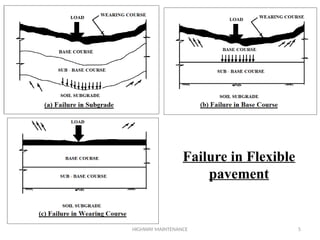
• The figure illustrate below the concept of pavement failure, ultimately there
is surface deformation when failure takes place either in subgrade or base
course.
Failure in subgrade:
One of the prime cause of flexible pavement failure is excessive
deformation in subgrade soil.
The failure of subgrade may be attributed due to two basic reasons:
1. Inadequate stability
2. Excessive stress application
HIGHWAY MAINTENANCE 5
Failure in Flexible
pavement
HIGHWAY MAINTENANCE 6
Cont.,
Failure in Sub-base or Base Course:
The following are the chief types of sub-base or base course failures:
1. Inadequate stability or strength
2. Loss of binding action
3. Loss of base course materials
4. Inadequate wearing course
5. Use of inferior (Lower) materials and crushing of base course materials
6. Lack of lateral confinement for the granular base course.
HIGHWAY MAINTENANCE 7
Following are some of the typical flexible pavement failures:
1. Alligator (or) cracking
2. Consolidation of pavement layers
3. Shear failure
4. Longitudinal cracking
5. Frost heaving
6. Lack of binding to the lower course
7. Reflection cracking
8. Formation of waves and corrugation.
Characteristics (TYPICAL) of flexible Pavement Failures
HIGHWAY MAINTENANCE 8
Alligator (or) cracking:
o This is the most common type of failure and occurs due to relative
(related) movement of pavement layer materials.
• This may be caused by the repeated application of heavy wheel
loads (In a particular point), resulting in fatigue failure (or due to
moisture variations resulting in swelling & shrinkage of subgrade).
Consolidation of pavement layer:
• Formation of ruts are mainly attributed to the consolidation of one
or more layers of pavement.
• Shallow ruts on the surface course can also be due to wearing along
the wheel path. Mostly it may estimated by depending upon the,
deformation has been caused in the subgrade or in subsequent
layers.
Cont.,
HIGHWAY MAINTENANCE 9
Shear Failure & Cracking:
Shear failures are associated with the inherent (natural) weakness
of the pavement mixtures.
The shearing resistance being low due to inadequate stability or
excessively heavy loading.
The failure causes upheaval of pavement materials by forming a
fracture or cracking.
Cont.,
HIGHWAY MAINTENANCE 10
Longitudinal Cracking:
• Due to frost action and differential volume changes in subgrade
longitudinal cracking is caused in pavement traversing (crossing)
through the full pavement thickness.
• Settlement (Compaction) Fill
• Sliding of side slopes
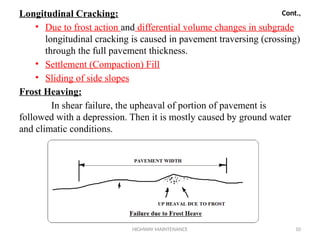
Frost Heaving:
In shear failure, the upheaval of portion of pavement is
followed with a depression. Then it is mostly caused by ground water
and climatic conditions.
Cont.,
HIGHWAY MAINTENANCE 11
Lack of Binding with Lower Layer:
Slipping (or Sliding) occurs when the surface course is not
bound with the underlying (primary) base. This is also results in
forming of patches or pot holes.
Another one case, when the prime/tack coat b/w two layers is
lacking.
Cont.,
HIGHWAY MAINTENANCE 12
Reflection Cracking:
• It is mostly caused by bituminous overlays provided over existing
cement concrete pavements.
• The structural action of the total pavement section is not much
influenced (Partial) by the presence of reflection cracks.
• To allow surface water to seep through and cause damage to the soil
subgrade or result in ‘mud pumping’.
FAILURES IN CEMENT CONCRETE PAVEMENTS
Failure of cement concrete pavement are recognized mainly by the
formation of structural cracking.
The failures are mainly due to two factors.
1. Deficiency (Lack or Shortage) of pavement materials
2. Structural inadequacy of the pavement system.
Cont.,
HIGHWAY MAINTENANCE 13
HIGHWAY MAINTENANCE 14
1. Deficiency of pavement materials
Following are the chief causes would give rise to the different defects or
failure of cement concrete pavements:
I. Soft aggregates
II. Poor workmanship in joint construction
III. Poor joint filler
IV. Poor surface finish
V. Improper and insufficient curing
The various defects (Faults or imperfections) that creep in due to the above
are:
i. Disintegration (Breakdown) of cement concrete
ii. Formation of cracking
iii. Spalling (lack of alignment) of joints
iv. Poor riding surface
v. Slippery (greasy or oily) surface
vi. Formation of shrinkage cracks
vii. Ingress (Entrance) of surface water and further progressive failures.
Cont.,
HIGHWAY MAINTENANCE 15
2. Structural inadequacy of the pavement system.
Inadequate subgrade support pavement thickness would be a
major cause of developing structural cracking in pavements.
Following are the causes and types of failure which develop:
i. Inadequate pavement thickness
ii. Inadequate subgrade support and poor subgrade soil
iii. Incorrect spacing of joints
Above would give rise to the failures of the following types:
1. Cracking of slab corners
2. Cracking of pavements longitudinally
3. Settlement of slabs
4. Widening of joints
5. Mud pumping (The Soil Slurry ejects in to the pavement Joints)
Cont.,
HIGHWAY MAINTENANCE 16
Following are some typical and basic types of failures in rigid
pavements, which are dealt (distributed) here in details:
1. Scaling of cement concrete
2. Shrinkage cracks
3. Spalling of joints
4. Warping cracks
5. Mud pumping
6. Structural cracks
7. Scaling of cement concrete
The scaling (climbing) is mainly attributed due to the deficiency
in the mix or presence of some chemical impurities, which damage mix.
Excessive vibration given to mix – cement mortar comes to top.
So, it will create abraded (roughened) surface.
Characteristics (TYPICAL) of rigid Pavement Failures
HIGHWAY MAINTENANCE 17
2. Shrinkage cracks:
The shrinkage cracks normally develop, i.e., immediately
after the construction of cement concrete pavement.
The placement of cracks are in longitudinal as well as in
transverse direction.
3. Spalling of joints:
The concreting is completed without noticing this faulty
alignment of the filler material (concrete filling or joints construction or
finishing works or reinforcement settings).
Thus this forms an overhang of a concrete layer on the top side
and the joint later on shows excessive cracking and subsidence.
4. Warping (Distorting or bending) cracks:
If the joints are not well designed to accommodate the warping
of slabs at edges, this results in development of excessive stresses due to
warping and the slab develops cracking at the edges in an irregular
pattern.
Cont.,
HIGHWAY MAINTENANCE 18
5. Mud Pumping:
When the soil slurry ejects out through the joints and cracks of
cement concrete pavement caused during the downward movement of
slab under the heavy wheel loads.
Following factors are which cause the mud pumping:
i. Extent (Degree or Amount) of slab deflection
ii. Type of subgrade soil
iii. Amount of free water
Cont.,
HIGHWAY MAINTENANCE 19
Pavement Evaluation
To examine the efficiency & effectiveness of the basic components of the pavement such
as,
– subgrade,
– base course,
– surface course,
– pavement thickness,
– loading & Environment.
The methods of pavement evaluation are,
 Structural evaluation of pavement
 Evaluation of pavement surface condition
(To evaluate the surface conditions of flexible pavement by the unevenness, ruts, patches, and
cracks)
(To evaluate the surface conditions of Rigid pavement may be assessed by the cracks
developed & Faulty joints affecting the Riding the Quality) – Profilograph, indicator,
profilometer or roughometer.
1. Structural evaluation of pavement
The structural evaluation of both flexible and rigid pavement may be carried out by ‘Plate
bearing test’.
The structural capacity of the pavement may be assessed by the load carried at a specified
deflection of the plate or by the amount of deflection at a specified load on the plate.
HIGHWAY MAINTENANCE 20
• Field investigation and tests carried out in various countries have
shown that the performance of flexible pavement is closely related to
be elastic deflection under loads or its rebound deflection.
• In above all case, and based on that various equipment used.
• “Benkelman Beam” is most commonly used, as the measurements
are simple and easy.
Cont.,
HIGHWAY MAINTENANCE 21
“Benkelman Beam” Method
Introduction:
This method was originally devised by ‘A. C. Benkelman’
in U.S.A .
Benkelman beam measurement are preceded by a rating
survey of the road.
So, as to the road was divide into homogenous section of
approximately similar serviceability.
Cont.,
HIGHWAY MAINTENANCE 22
Cont.,
HIGHWAY MAINTENANCE 23
• Components:
 Slender beam – 3.66 m
 Pivoted datum frame – 2.44 m from the probe end
Cont.,

UNIT V - HIGHWAY ENGINEERING MAINTENANCE.pptx

  • 1.
    UNIT - V HIGHWAYMAINTENANCE
  • 2.
    HIGHWAY MAINTENANCE 2 NeedFor Highway Maintenance • The road maintenance is one of the main components of road system. • The maintenance operation involves the assessment of road condition. • Even if the highways are well designed & construction they may require effective maintenance. General causes of failure of pavement: Some of the general causes of pavement failure leading maintenance measures, I. Defects (Imperfections) in quality of material used II. Defects in quality of construction & quality control during the constructions. III. Inadequate surface & subsurface drainage in the locality. IV. The settlement of the foundation of the embankment of the filled materials itself. V. The environmental factors., such as intensity of rainfall, temperature variations, soil erosion, high water table, snow, snowfall, frost action.,etc
  • 3.
    HIGHWAY MAINTENANCE 3 Classificationof Maintenance works In maintenance works it is generally classified as given below: • Routine maintenance – patch repairs, maintenance of shoulders, to maintain cross slope, the road side drains.,etc • Periodic maintenance – It include all renewals of surface pavement & wearing course. • Special repairs - Re-construction of pavement, overlay of construction, widening of roads, repairs damages caused by the flood, signals.,etc
  • 4.
    HIGHWAY MAINTENANCE 4 Failuresin flexible Pavement Components • The uneven settlement of any one component layer of the flexible pavement structure could enough to cause pavement failure. • This demands that each of the layers should be carefully designed & laid. • The figure illustrate below the concept of pavement failure, ultimately there is surface deformation when failure takes place either in subgrade or base course. Failure in subgrade: One of the prime cause of flexible pavement failure is excessive deformation in subgrade soil. The failure of subgrade may be attributed due to two basic reasons: 1. Inadequate stability 2. Excessive stress application
  • 5.
    HIGHWAY MAINTENANCE 5 Failurein Flexible pavement
  • 6.
    HIGHWAY MAINTENANCE 6 Cont., Failurein Sub-base or Base Course: The following are the chief types of sub-base or base course failures: 1. Inadequate stability or strength 2. Loss of binding action 3. Loss of base course materials 4. Inadequate wearing course 5. Use of inferior (Lower) materials and crushing of base course materials 6. Lack of lateral confinement for the granular base course.
  • 7.
    HIGHWAY MAINTENANCE 7 Followingare some of the typical flexible pavement failures: 1. Alligator (or) cracking 2. Consolidation of pavement layers 3. Shear failure 4. Longitudinal cracking 5. Frost heaving 6. Lack of binding to the lower course 7. Reflection cracking 8. Formation of waves and corrugation. Characteristics (TYPICAL) of flexible Pavement Failures
  • 8.
    HIGHWAY MAINTENANCE 8 Alligator(or) cracking: o This is the most common type of failure and occurs due to relative (related) movement of pavement layer materials. • This may be caused by the repeated application of heavy wheel loads (In a particular point), resulting in fatigue failure (or due to moisture variations resulting in swelling & shrinkage of subgrade). Consolidation of pavement layer: • Formation of ruts are mainly attributed to the consolidation of one or more layers of pavement. • Shallow ruts on the surface course can also be due to wearing along the wheel path. Mostly it may estimated by depending upon the, deformation has been caused in the subgrade or in subsequent layers. Cont.,
  • 9.
    HIGHWAY MAINTENANCE 9 ShearFailure & Cracking: Shear failures are associated with the inherent (natural) weakness of the pavement mixtures. The shearing resistance being low due to inadequate stability or excessively heavy loading. The failure causes upheaval of pavement materials by forming a fracture or cracking. Cont.,
  • 10.
    HIGHWAY MAINTENANCE 10 LongitudinalCracking: • Due to frost action and differential volume changes in subgrade longitudinal cracking is caused in pavement traversing (crossing) through the full pavement thickness. • Settlement (Compaction) Fill • Sliding of side slopes Frost Heaving: In shear failure, the upheaval of portion of pavement is followed with a depression. Then it is mostly caused by ground water and climatic conditions. Cont.,
  • 11.
    HIGHWAY MAINTENANCE 11 Lackof Binding with Lower Layer: Slipping (or Sliding) occurs when the surface course is not bound with the underlying (primary) base. This is also results in forming of patches or pot holes. Another one case, when the prime/tack coat b/w two layers is lacking. Cont.,
  • 12.
    HIGHWAY MAINTENANCE 12 ReflectionCracking: • It is mostly caused by bituminous overlays provided over existing cement concrete pavements. • The structural action of the total pavement section is not much influenced (Partial) by the presence of reflection cracks. • To allow surface water to seep through and cause damage to the soil subgrade or result in ‘mud pumping’. FAILURES IN CEMENT CONCRETE PAVEMENTS Failure of cement concrete pavement are recognized mainly by the formation of structural cracking. The failures are mainly due to two factors. 1. Deficiency (Lack or Shortage) of pavement materials 2. Structural inadequacy of the pavement system. Cont.,
  • 13.
  • 14.
    HIGHWAY MAINTENANCE 14 1.Deficiency of pavement materials Following are the chief causes would give rise to the different defects or failure of cement concrete pavements: I. Soft aggregates II. Poor workmanship in joint construction III. Poor joint filler IV. Poor surface finish V. Improper and insufficient curing The various defects (Faults or imperfections) that creep in due to the above are: i. Disintegration (Breakdown) of cement concrete ii. Formation of cracking iii. Spalling (lack of alignment) of joints iv. Poor riding surface v. Slippery (greasy or oily) surface vi. Formation of shrinkage cracks vii. Ingress (Entrance) of surface water and further progressive failures. Cont.,
  • 15.
    HIGHWAY MAINTENANCE 15 2.Structural inadequacy of the pavement system. Inadequate subgrade support pavement thickness would be a major cause of developing structural cracking in pavements. Following are the causes and types of failure which develop: i. Inadequate pavement thickness ii. Inadequate subgrade support and poor subgrade soil iii. Incorrect spacing of joints Above would give rise to the failures of the following types: 1. Cracking of slab corners 2. Cracking of pavements longitudinally 3. Settlement of slabs 4. Widening of joints 5. Mud pumping (The Soil Slurry ejects in to the pavement Joints) Cont.,
  • 16.
    HIGHWAY MAINTENANCE 16 Followingare some typical and basic types of failures in rigid pavements, which are dealt (distributed) here in details: 1. Scaling of cement concrete 2. Shrinkage cracks 3. Spalling of joints 4. Warping cracks 5. Mud pumping 6. Structural cracks 7. Scaling of cement concrete The scaling (climbing) is mainly attributed due to the deficiency in the mix or presence of some chemical impurities, which damage mix. Excessive vibration given to mix – cement mortar comes to top. So, it will create abraded (roughened) surface. Characteristics (TYPICAL) of rigid Pavement Failures
  • 17.
    HIGHWAY MAINTENANCE 17 2.Shrinkage cracks: The shrinkage cracks normally develop, i.e., immediately after the construction of cement concrete pavement. The placement of cracks are in longitudinal as well as in transverse direction. 3. Spalling of joints: The concreting is completed without noticing this faulty alignment of the filler material (concrete filling or joints construction or finishing works or reinforcement settings). Thus this forms an overhang of a concrete layer on the top side and the joint later on shows excessive cracking and subsidence. 4. Warping (Distorting or bending) cracks: If the joints are not well designed to accommodate the warping of slabs at edges, this results in development of excessive stresses due to warping and the slab develops cracking at the edges in an irregular pattern. Cont.,
  • 18.
    HIGHWAY MAINTENANCE 18 5.Mud Pumping: When the soil slurry ejects out through the joints and cracks of cement concrete pavement caused during the downward movement of slab under the heavy wheel loads. Following factors are which cause the mud pumping: i. Extent (Degree or Amount) of slab deflection ii. Type of subgrade soil iii. Amount of free water Cont.,
  • 19.
    HIGHWAY MAINTENANCE 19 PavementEvaluation To examine the efficiency & effectiveness of the basic components of the pavement such as, – subgrade, – base course, – surface course, – pavement thickness, – loading & Environment. The methods of pavement evaluation are,  Structural evaluation of pavement  Evaluation of pavement surface condition (To evaluate the surface conditions of flexible pavement by the unevenness, ruts, patches, and cracks) (To evaluate the surface conditions of Rigid pavement may be assessed by the cracks developed & Faulty joints affecting the Riding the Quality) – Profilograph, indicator, profilometer or roughometer. 1. Structural evaluation of pavement The structural evaluation of both flexible and rigid pavement may be carried out by ‘Plate bearing test’. The structural capacity of the pavement may be assessed by the load carried at a specified deflection of the plate or by the amount of deflection at a specified load on the plate.
  • 20.
    HIGHWAY MAINTENANCE 20 •Field investigation and tests carried out in various countries have shown that the performance of flexible pavement is closely related to be elastic deflection under loads or its rebound deflection. • In above all case, and based on that various equipment used. • “Benkelman Beam” is most commonly used, as the measurements are simple and easy. Cont.,
  • 21.
    HIGHWAY MAINTENANCE 21 “BenkelmanBeam” Method Introduction: This method was originally devised by ‘A. C. Benkelman’ in U.S.A . Benkelman beam measurement are preceded by a rating survey of the road. So, as to the road was divide into homogenous section of approximately similar serviceability. Cont.,
  • 22.
  • 23.
    HIGHWAY MAINTENANCE 23 •Components:  Slender beam – 3.66 m  Pivoted datum frame – 2.44 m from the probe end Cont.,