DRAINAGE OF ROADS- SUB
DRAINS, CULVERTS, DITCHES, GUT
TERS, DROP INLETS AND CATCH
BASINS

GROUP MEMBERS:
MATALA MAYAMBI TRESOR
WASEEM AKRAM
KANONGA MUNYUNGU ARTHUR
ROAD
DRAINAGE

IMPORTANCE OF ROAD DRAINAGE








It is recognised that a road requires a drainage system to deal
with stormwater runoff. Therefore, the drainage system
becomes an important and integral consideration in the
planning and design of road infrastructure.
In order to provide an appropriate and economic drainage
system, all road projects, irrespective of location, size, cost or
complexity, must consider and address the following aspects:
provision of an acceptable level of flood immunity and
accessibility;
impact of flooding of public and private property;


conveyance of stormwater through the road reserve at a
development and environmental cost that is acceptable to the
community as a whole;



protection of the roadway asset;



safety of all road users;



pollutant discharge from the road reserve to receiving waters;



land degradation caused by erosion and sedimentation during road
construction, operation and maintenance;



any impact on habitats for terrestrial and aquatic flora and fauna;



any impact on the movement of terrestrial and aquatic fauna.
Inappropriate road drainage infrastructure for example, can
change the characteristics of a waterway by altering:



flooding patterns, including flow distribution;



flood heights;



peak water levels;



water velocities, especially through bridges and culverts;



duration of inundation;



erosion and sedimentation patterns;



fauna transfer; and



terrestrial and aquatic fauna habitats.
These changes may create impacts that lead to in service
issues that require additional unplanned investment to
address:



Flood mitigation works;



Erosion and sedimentation problems;



Reductions in adjoining land valuations;



Salinity issues; and



Increases in pollutant levels.
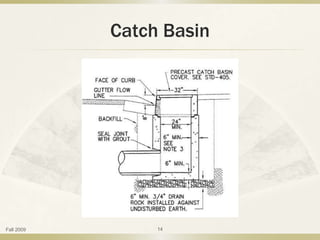
CATCH
BASIN
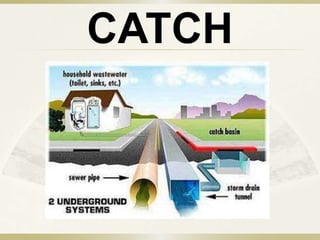
A basin, typically with
a grated cover, to
which surface runoff
drains. The basin
may be along a curb
side or in the middle
of a field. The bottom
of the basin is typically
connected to a
drainage pipe, and the
basin serves as an
inlet to the storm drain
system.

Fall 2009

13
Catch Basin

Fall 2009

14
CULVERT




A culvert is a drain or pipe that
allows water to flow under a
road, railroad, trail, or similar
obstruction. Culverts differ from
bridges mainly in size and
construction.
Culverts are generally smaller
than bridges, ranging from 0.3metre (1 ft) pipes to larger
reinforced concrete structures.
Culverts are typically
surrounded by soil.
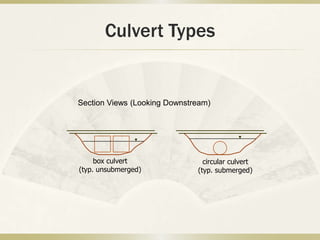
Culvert Types

Section Views (Looking Downstream)

box culvert
(typ. unsubmerged)

circular culvert
(typ. submerged)






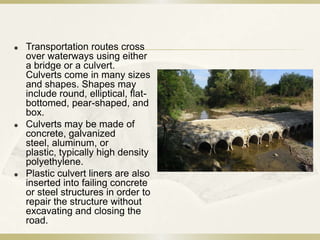
Transportation routes cross
over waterways using either
a bridge or a culvert.
Culverts come in many sizes
and shapes. Shapes may
include round, elliptical, flatbottomed, pear-shaped, and
box.
Culverts may be made of
concrete, galvanized
steel, aluminum, or
plastic, typically high density
polyethylene.
Plastic culvert liners are also
inserted into failing concrete
or steel structures in order to
repair the structure without
excavating and closing the
road.
GUTTERS
STREET GUTTER






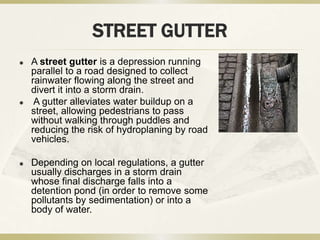
A street gutter is a depression running
parallel to a road designed to collect
rainwater flowing along the street and
divert it into a storm drain.
A gutter alleviates water buildup on a
street, allowing pedestrians to pass
without walking through puddles and
reducing the risk of hydroplaning by road
vehicles.
Depending on local regulations, a gutter
usually discharges in a storm drain
whose final discharge falls into a
detention pond (in order to remove some
pollutants by sedimentation) or into a
body of water.
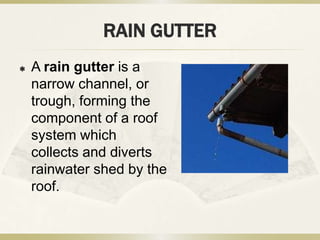
RAIN GUTTER


A rain gutter is a
narrow channel, or
trough, forming the
component of a roof
system which
collects and diverts
rainwater shed by the
roof.
DITCHES
DITCHES






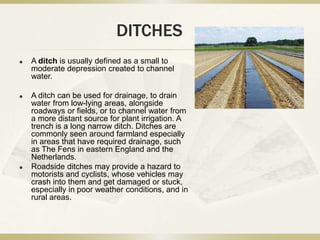
A ditch is usually defined as a small to
moderate depression created to channel
water.
A ditch can be used for drainage, to drain
water from low-lying areas, alongside
roadways or fields, or to channel water from
a more distant source for plant irrigation. A
trench is a long narrow ditch. Ditches are
commonly seen around farmland especially
in areas that have required drainage, such
as The Fens in eastern England and the
Netherlands.
Roadside ditches may provide a hazard to
motorists and cyclists, whose vehicles may
crash into them and get damaged or stuck,
especially in poor weather conditions, and in
rural areas.


Road drainage

  • 1.
    DRAINAGE OF ROADS-SUB DRAINS, CULVERTS, DITCHES, GUT TERS, DROP INLETS AND CATCH BASINS GROUP MEMBERS: MATALA MAYAMBI TRESOR WASEEM AKRAM KANONGA MUNYUNGU ARTHUR
  • 2.
  • 3.
  • 7.
    IMPORTANCE OF ROADDRAINAGE     It is recognised that a road requires a drainage system to deal with stormwater runoff. Therefore, the drainage system becomes an important and integral consideration in the planning and design of road infrastructure. In order to provide an appropriate and economic drainage system, all road projects, irrespective of location, size, cost or complexity, must consider and address the following aspects: provision of an acceptable level of flood immunity and accessibility; impact of flooding of public and private property;
  • 8.
     conveyance of stormwaterthrough the road reserve at a development and environmental cost that is acceptable to the community as a whole;  protection of the roadway asset;  safety of all road users;  pollutant discharge from the road reserve to receiving waters;  land degradation caused by erosion and sedimentation during road construction, operation and maintenance;  any impact on habitats for terrestrial and aquatic flora and fauna;  any impact on the movement of terrestrial and aquatic fauna.
  • 9.
    Inappropriate road drainageinfrastructure for example, can change the characteristics of a waterway by altering:  flooding patterns, including flow distribution;  flood heights;  peak water levels;  water velocities, especially through bridges and culverts;  duration of inundation;  erosion and sedimentation patterns;  fauna transfer; and  terrestrial and aquatic fauna habitats.
  • 10.
    These changes maycreate impacts that lead to in service issues that require additional unplanned investment to address:  Flood mitigation works;  Erosion and sedimentation problems;  Reductions in adjoining land valuations;  Salinity issues; and  Increases in pollutant levels.
  • 11.
  • 13.
    A basin, typicallywith a grated cover, to which surface runoff drains. The basin may be along a curb side or in the middle of a field. The bottom of the basin is typically connected to a drainage pipe, and the basin serves as an inlet to the storm drain system. Fall 2009 13
  • 14.
  • 15.
  • 16.
      A culvert isa drain or pipe that allows water to flow under a road, railroad, trail, or similar obstruction. Culverts differ from bridges mainly in size and construction. Culverts are generally smaller than bridges, ranging from 0.3metre (1 ft) pipes to larger reinforced concrete structures. Culverts are typically surrounded by soil.
  • 17.
    Culvert Types Section Views(Looking Downstream) box culvert (typ. unsubmerged) circular culvert (typ. submerged)
  • 18.
       Transportation routes cross overwaterways using either a bridge or a culvert. Culverts come in many sizes and shapes. Shapes may include round, elliptical, flatbottomed, pear-shaped, and box. Culverts may be made of concrete, galvanized steel, aluminum, or plastic, typically high density polyethylene. Plastic culvert liners are also inserted into failing concrete or steel structures in order to repair the structure without excavating and closing the road.
  • 20.
  • 21.
    STREET GUTTER    A streetgutter is a depression running parallel to a road designed to collect rainwater flowing along the street and divert it into a storm drain. A gutter alleviates water buildup on a street, allowing pedestrians to pass without walking through puddles and reducing the risk of hydroplaning by road vehicles. Depending on local regulations, a gutter usually discharges in a storm drain whose final discharge falls into a detention pond (in order to remove some pollutants by sedimentation) or into a body of water.
  • 22.
    RAIN GUTTER  A raingutter is a narrow channel, or trough, forming the component of a roof system which collects and diverts rainwater shed by the roof.
  • 23.
  • 24.
    DITCHES    A ditch isusually defined as a small to moderate depression created to channel water. A ditch can be used for drainage, to drain water from low-lying areas, alongside roadways or fields, or to channel water from a more distant source for plant irrigation. A trench is a long narrow ditch. Ditches are commonly seen around farmland especially in areas that have required drainage, such as The Fens in eastern England and the Netherlands. Roadside ditches may provide a hazard to motorists and cyclists, whose vehicles may crash into them and get damaged or stuck, especially in poor weather conditions, and in rural areas.
  • 25.