Chiral Chromatography
Separation of enantiomers
Presented by
Vipul A. Sansare
Bombay College of
Pharmacy
Dept.: Pharmaceutics
2016-17
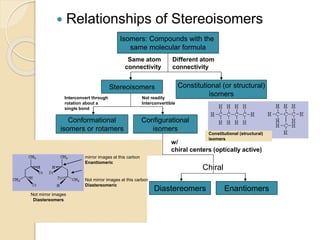
 Relationships of Stereoisomers
Isomers: Compounds with the
same molecular formula
Constitutional (or structural)
isomers
Stereoisomers
Same atom
connectivity
Different atom
connectivity
Interconvert through
rotation about a
single bond
Conformational
isomers or rotamers
Configurational
isomers
Not readily
Interconvertible
EnantiomersDiastereomers
Chiral
w/
chiral centers (optically active)
w/o
chiral centers (opt. inactive)
Geometric isomers
Achiral
Constitutional (structural)
isomers
mirror images at this carbon
Enantiomeric
Not mirror images
Diastereomers
Not mirror images at this carbon
Diastereomeric
Introduction
 Most successful method of separation
of enantiomers.
 Because of unique spatial orientation
of enantiomer it can interact with
enantiometric reagent and retain in
chromatographic system.
 Currently direct and most viable way
to achieve resolution of isomers.
 Separation of stereoisomers in drug is
very important analytical problem and
chiral chromatography has been
shown very effective solution for that.
 Enantiomer shave same
physicochemical properties but they
differ in the rate of reaction with
another chiral reagent.
Why??
 Albuterol (anti-asthmatic inhalant)
◦ D-albuterol may actually cause airway
constriction
◦ Levalbuterol (L-albuterol) avoids side
effects
 Fluoxetine (generic name for Prozac,
depression medication)
◦ R-Fluoxetine – improved efficacy;
minimizes side effects, i.e. anxiety and
sexual dysfunction. Other indications
(eating disorders)
◦ S-Fluoxetine – use for treatment of
migraines
Continue..
 R isomer of thalidomide : sedative
S isomer of thalidomide : teratogenic
 (S,S) ethambutal : antituberculotic
(R,R) ethambutal : neuritis,blindness
Ways for separation of
enantiomers
Indirect liquid chromatographic
resolution via precolumn derivatization
Direct resolution of enantiomers on an
achiral SP.
Direct resolution of enantiomers using
selective chiral SP.
Precolumn derivatization
 In precolumn derivatization, enantiomers
are converted into diastereomers, before
they are fed to the column.
 Enantiomers react with a chiral substance
to get diastereomers.
 Because of difference in affinity of
diastereomers for the SP. diastereomers
can be easily separated by
chromatography.
Continue
 For eg. a mixture of S and R isomers of ibuprofen,
when react with R proline,produces two
diastereomers;
(S,R)IBP + (R)proline
(S)IBP (R)proline + (R)IBP (R)proline
(Diastereomer of (Diastereomer of
S- IBP) R- IBP)
 The chiral reagent should react
quantitatively with enantiomers for
accurate determination of
enantiomeric composition.
 Two diastereomers show different
affinity towards achiral SP. hence can
be separated on achiral SP. using an
achiral mobile phase.
Chiral stationary phase
 Different material employed as chiral
stationary phase.
 Material either bonded or coated on
the silica support and use as
stationary phase.
 Materials use as stationary phase:
-Natural proteins
-Cyclodextrine
-Polymers(cellulose, amylose)
-Macrocyclic glycopeptide
1) Protein based stationary
phase
 It consist of protein bonded to the
silica support(5µm particle size)
 Protein contain no. of chiral centers
and interact strongly to many small
chiral analyte through
Hydrogen bonding
Hydrophobic interaction
Electrostatic interaction
 Available columns
- Chiral AGP from ChromeTech.
- Chiral HAS from ChromeTech.
- Chiral BSA from Regis Technologies.
- Chiral RSA from Chrome Tech.
- Chiral DSA from Chrome Tech
- Chiral MSA from Chrome Tech
 Chiral AGP
-Extremely broad applicability.
Separate all kinds of compounds:
-amines(10,20,30, and quaternary)
-acids(strong and weak)
- amides, esters, alcohols)
• Chiral HAS
-Separate preferentially acids and
amides and esters.
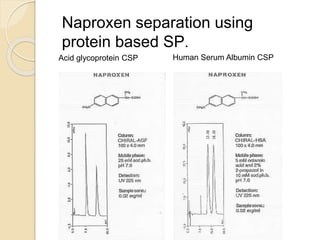
Acid glycoprotein CSP Human Serum Albumin CSP
Naproxen separation using
protein based SP.
Polymer based stationary
phase
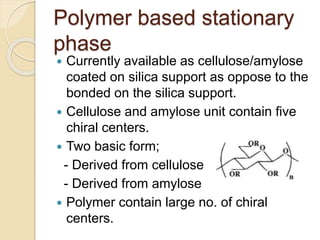
 Currently available as cellulose/amylose
coated on silica support as oppose to the
bonded on the silica support.
 Cellulose and amylose unit contain five
chiral centers.
 Two basic form;
- Derived from cellulose
- Derived from amylose
 Polymer contain large no. of chiral
centers.
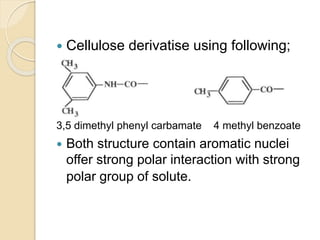
 Cellulose derivatise using following;
3,5 dimethyl phenyl carbamate 4 methyl benzoate
 Both structure contain aromatic nuclei
offer strong polar interaction with strong
polar group of solute.
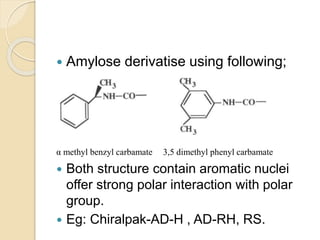
 Amylose derivatise using following;
α methyl benzyl carbamate 3,5 dimethyl phenyl carbamate
 Both structure contain aromatic nuclei
offer strong polar interaction with polar
group.
 Eg: Chiralpak-AD-H , AD-RH, RS.
Macrocyclic glycopeptide
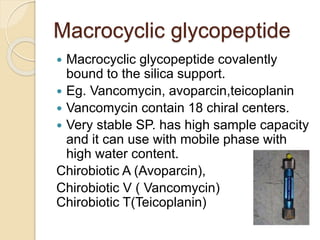
 Macrocyclic glycopeptide covalently
bound to the silica support.
 Eg. Vancomycin, avoparcin,teicoplanin
 Vancomycin contain 18 chiral centers.
 Very stable SP. has high sample capacity
and it can use with mobile phase with
high water content.
Chirobiotic A (Avoparcin),
Chirobiotic V ( Vancomycin)
Chirobiotic T(Teicoplanin)
Cyclodextrine based SP.
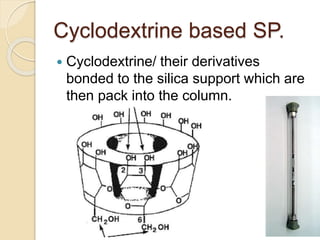
 Cyclodextrine/ their derivatives
bonded to the silica support which are
then pack into the column.
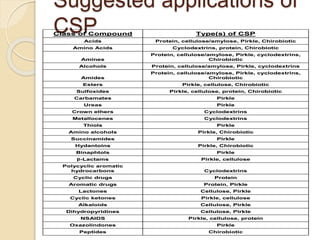
Suggested applications of
CSP
ChirobioticPeptides
PirkleOxazolindones
Pirkle, cellulose, proteinNSAIDS
Cellulose, PirkleDihydropyridines
Cellulose, PirkleAlkaloids
Pirkle, celluloseCyclic ketones
Cellulose, PirkleLactones
Protein, PirkleAromatic drugs
ProteinCyclic drugs
Cyclodextrins
Polycyclic aromatic
hydrocarbons
Pirkle, celluloseβ-Lactams
PirkleBinaphtols
Pirkle, ChirobioticHydantoins
PirkleSuccinamides
Pirkle, ChirobioticAmino alcohols
PirkleThiols
CyclodextrinsMetallocenes
CyclodextrinsCrown ethers
PirkleUreas
PirkleCarbamates
Pirkle, cellulose, protein, ChirobioticSulfoxides
Pirkle, cellulose, ChirobioticEsters
Protein, cellulose/amylose, Pirkle, cyclodextrins,
ChirobioticAmides
Protein, cellulose/amylose, Pirkle, cyclodextrinsAlcohols
Protein, cellulose/amylose, Pirkle, cyclodextrins,
ChirobioticAmines
Cyclodextrins, protein, ChirobioticAmino Acids
Protein, cellulose/amylose, Pirkle, ChirobioticAcids
Type(s) of CSPClass of Compound
ChirobioticPeptides
PirkleOxazolindones
Pirkle, cellulose, proteinNSAIDS
Cellulose, PirkleDihydropyridines
Cellulose, PirkleAlkaloids
Pirkle, celluloseCyclic ketones
Cellulose, PirkleLactones
Protein, PirkleAromatic drugs
ProteinCyclic drugs
Cyclodextrins
Polycyclic aromatic
hydrocarbons
Pirkle, celluloseβ-Lactams
PirkleBinaphtols
Pirkle, ChirobioticHydantoins
PirkleSuccinamides
Pirkle, ChirobioticAmino alcohols
PirkleThiols
CyclodextrinsMetallocenes
CyclodextrinsCrown ethers
PirkleUreas
PirkleCarbamates
Pirkle, cellulose, protein, ChirobioticSulfoxides
Pirkle, cellulose, ChirobioticEsters
Protein, cellulose/amylose, Pirkle, cyclodextrins,
ChirobioticAmides
Protein, cellulose/amylose, Pirkle, cyclodextrinsAlcohols
Protein, cellulose/amylose, Pirkle, cyclodextrins,
ChirobioticAmines
Cyclodextrins, protein, ChirobioticAmino Acids
Protein, cellulose/amylose, Pirkle, ChirobioticAcids
Type(s) of CSPClass of Compound
 Interaction with polar group of analyte
take place at polar hydroxyl group.
Non polar, lipophilic group of analyte
fit into hydrophobic cavity.
 One enantiomer will able to fit into
cavity than other.
 Analyte must have lipophilic group to
fit into cyclodextrine cavity.
 Derivative provide specific type of
interaction with analyte and increase
selectivity.
Thank you

Chiral chromatography

  • 1.
    Chiral Chromatography Separation ofenantiomers Presented by Vipul A. Sansare Bombay College of Pharmacy Dept.: Pharmaceutics 2016-17
  • 2.
     Relationships ofStereoisomers Isomers: Compounds with the same molecular formula Constitutional (or structural) isomers Stereoisomers Same atom connectivity Different atom connectivity Interconvert through rotation about a single bond Conformational isomers or rotamers Configurational isomers Not readily Interconvertible EnantiomersDiastereomers Chiral w/ chiral centers (optically active) w/o chiral centers (opt. inactive) Geometric isomers Achiral Constitutional (structural) isomers mirror images at this carbon Enantiomeric Not mirror images Diastereomers Not mirror images at this carbon Diastereomeric
  • 3.
    Introduction  Most successfulmethod of separation of enantiomers.  Because of unique spatial orientation of enantiomer it can interact with enantiometric reagent and retain in chromatographic system.  Currently direct and most viable way to achieve resolution of isomers.
  • 4.
     Separation ofstereoisomers in drug is very important analytical problem and chiral chromatography has been shown very effective solution for that.  Enantiomer shave same physicochemical properties but they differ in the rate of reaction with another chiral reagent.
  • 5.
    Why??  Albuterol (anti-asthmaticinhalant) ◦ D-albuterol may actually cause airway constriction ◦ Levalbuterol (L-albuterol) avoids side effects  Fluoxetine (generic name for Prozac, depression medication) ◦ R-Fluoxetine – improved efficacy; minimizes side effects, i.e. anxiety and sexual dysfunction. Other indications (eating disorders) ◦ S-Fluoxetine – use for treatment of migraines
  • 6.
    Continue..  R isomerof thalidomide : sedative S isomer of thalidomide : teratogenic  (S,S) ethambutal : antituberculotic (R,R) ethambutal : neuritis,blindness
  • 7.
    Ways for separationof enantiomers Indirect liquid chromatographic resolution via precolumn derivatization Direct resolution of enantiomers on an achiral SP. Direct resolution of enantiomers using selective chiral SP.
  • 8.
    Precolumn derivatization  Inprecolumn derivatization, enantiomers are converted into diastereomers, before they are fed to the column.  Enantiomers react with a chiral substance to get diastereomers.  Because of difference in affinity of diastereomers for the SP. diastereomers can be easily separated by chromatography.
  • 9.
    Continue  For eg.a mixture of S and R isomers of ibuprofen, when react with R proline,produces two diastereomers; (S,R)IBP + (R)proline (S)IBP (R)proline + (R)IBP (R)proline (Diastereomer of (Diastereomer of S- IBP) R- IBP)
  • 10.
     The chiralreagent should react quantitatively with enantiomers for accurate determination of enantiomeric composition.  Two diastereomers show different affinity towards achiral SP. hence can be separated on achiral SP. using an achiral mobile phase.
  • 11.
    Chiral stationary phase Different material employed as chiral stationary phase.  Material either bonded or coated on the silica support and use as stationary phase.  Materials use as stationary phase: -Natural proteins -Cyclodextrine -Polymers(cellulose, amylose) -Macrocyclic glycopeptide
  • 12.
    1) Protein basedstationary phase  It consist of protein bonded to the silica support(5µm particle size)  Protein contain no. of chiral centers and interact strongly to many small chiral analyte through Hydrogen bonding Hydrophobic interaction Electrostatic interaction
  • 13.
     Available columns -Chiral AGP from ChromeTech. - Chiral HAS from ChromeTech. - Chiral BSA from Regis Technologies. - Chiral RSA from Chrome Tech. - Chiral DSA from Chrome Tech - Chiral MSA from Chrome Tech
  • 14.
     Chiral AGP -Extremelybroad applicability. Separate all kinds of compounds: -amines(10,20,30, and quaternary) -acids(strong and weak) - amides, esters, alcohols) • Chiral HAS -Separate preferentially acids and amides and esters.
  • 15.
    Acid glycoprotein CSPHuman Serum Albumin CSP Naproxen separation using protein based SP.
  • 16.
    Polymer based stationary phase Currently available as cellulose/amylose coated on silica support as oppose to the bonded on the silica support.  Cellulose and amylose unit contain five chiral centers.  Two basic form; - Derived from cellulose - Derived from amylose  Polymer contain large no. of chiral centers.
  • 17.
     Cellulose derivatiseusing following; 3,5 dimethyl phenyl carbamate 4 methyl benzoate  Both structure contain aromatic nuclei offer strong polar interaction with strong polar group of solute.
  • 18.
     Amylose derivatiseusing following; α methyl benzyl carbamate 3,5 dimethyl phenyl carbamate  Both structure contain aromatic nuclei offer strong polar interaction with polar group.  Eg: Chiralpak-AD-H , AD-RH, RS.
  • 19.
    Macrocyclic glycopeptide  Macrocyclicglycopeptide covalently bound to the silica support.  Eg. Vancomycin, avoparcin,teicoplanin  Vancomycin contain 18 chiral centers.  Very stable SP. has high sample capacity and it can use with mobile phase with high water content. Chirobiotic A (Avoparcin), Chirobiotic V ( Vancomycin) Chirobiotic T(Teicoplanin)
  • 20.
    Cyclodextrine based SP. Cyclodextrine/ their derivatives bonded to the silica support which are then pack into the column.
  • 21.
    Suggested applications of CSP ChirobioticPeptides PirkleOxazolindones Pirkle,cellulose, proteinNSAIDS Cellulose, PirkleDihydropyridines Cellulose, PirkleAlkaloids Pirkle, celluloseCyclic ketones Cellulose, PirkleLactones Protein, PirkleAromatic drugs ProteinCyclic drugs Cyclodextrins Polycyclic aromatic hydrocarbons Pirkle, celluloseβ-Lactams PirkleBinaphtols Pirkle, ChirobioticHydantoins PirkleSuccinamides Pirkle, ChirobioticAmino alcohols PirkleThiols CyclodextrinsMetallocenes CyclodextrinsCrown ethers PirkleUreas PirkleCarbamates Pirkle, cellulose, protein, ChirobioticSulfoxides Pirkle, cellulose, ChirobioticEsters Protein, cellulose/amylose, Pirkle, cyclodextrins, ChirobioticAmides Protein, cellulose/amylose, Pirkle, cyclodextrinsAlcohols Protein, cellulose/amylose, Pirkle, cyclodextrins, ChirobioticAmines Cyclodextrins, protein, ChirobioticAmino Acids Protein, cellulose/amylose, Pirkle, ChirobioticAcids Type(s) of CSPClass of Compound ChirobioticPeptides PirkleOxazolindones Pirkle, cellulose, proteinNSAIDS Cellulose, PirkleDihydropyridines Cellulose, PirkleAlkaloids Pirkle, celluloseCyclic ketones Cellulose, PirkleLactones Protein, PirkleAromatic drugs ProteinCyclic drugs Cyclodextrins Polycyclic aromatic hydrocarbons Pirkle, celluloseβ-Lactams PirkleBinaphtols Pirkle, ChirobioticHydantoins PirkleSuccinamides Pirkle, ChirobioticAmino alcohols PirkleThiols CyclodextrinsMetallocenes CyclodextrinsCrown ethers PirkleUreas PirkleCarbamates Pirkle, cellulose, protein, ChirobioticSulfoxides Pirkle, cellulose, ChirobioticEsters Protein, cellulose/amylose, Pirkle, cyclodextrins, ChirobioticAmides Protein, cellulose/amylose, Pirkle, cyclodextrinsAlcohols Protein, cellulose/amylose, Pirkle, cyclodextrins, ChirobioticAmines Cyclodextrins, protein, ChirobioticAmino Acids Protein, cellulose/amylose, Pirkle, ChirobioticAcids Type(s) of CSPClass of Compound
  • 22.
     Interaction withpolar group of analyte take place at polar hydroxyl group. Non polar, lipophilic group of analyte fit into hydrophobic cavity.  One enantiomer will able to fit into cavity than other.  Analyte must have lipophilic group to fit into cyclodextrine cavity.  Derivative provide specific type of interaction with analyte and increase selectivity.
  • 23.