Modern Analytical
Chemistry
Chromatography
CHROMATOGRAPHY
Chromatography basically involves the
separation of mixtures due to differences in
the distribution coefficient (equilibrium
distribution) of sample components between 2
different phases.
One of these phases is a mobile phase and
the other is a stationary phase.
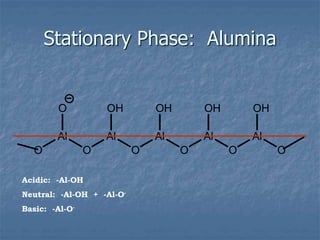
Stationary Phase: Alumina
O
Al
O O
Al
O
OH
Al
O
OH
Al
O
OH
Al
OH
O
Acidic: -Al-OH
Neutral: -Al-OH + -Al-O-
Basic: -Al-O-
Stationary Phase: Silica (SiO2)
OH
Si
O
OH
Si
O
O
O
OH
Si
O
O
OH
Si
O
O
OH
Si
O O
O
Si
O
O
Si
O
O
Si
O
O
Si
O O
O
Si
O
O
Si
O
O
Si
O O
O
Definition:
Different affinity of these 2 components to stationary
phase causes the separation.
Concentration of component A in stationary phase
Concentration of component A in mobile phase
Distribution Coefficient (Equilibrium Distribution )
Some Types of Chromatography
1. Liquid Column Chromatography (Reverse
Phase too)
2. High Pressure (performance) Liquid
Chromatograph (HPLC)
3. Paper Chromatography
4. Thin-layer Chromatography (TLC)
5. Gas Liquid Chromatography
LIQUID COLUMN CHROMATOGRAPHY
A sample mixture is passed through a column
packed with solid particles which may or may
not be coated with another liquid.
With the proper solvents, packing conditions,
some components in the sample will travel the
column more slowly than others resulting in
the desired separation.
A + B + C
OOOOOOOOOOO
OOOOOOOOOOO
OOOOOOOOOO
OOOOOOOOOOO
OOOOOOOOOOO
OOOOOOOOOO
OOOOOOOOOOO
OOOOOOOOOOO
OOOOOOOOOO
OOOOOOOOOOO
OOOOOOOOOOO
OOOOOOOOOO
OOOOOOOOOOO
OOOOOOOOOOO
OOOOOOOOOO
OOOOOOOOOOO
OOOOOOOOOOO
OOOOOOOOOO
OOOOOOOOOOO
OOOOOOOOOOO
OOOOOOOOOO
OOOOOOOOOOO
OOOOOOOOOOO
OOOOOOOOOO
OOOOOOOOOOO
OOOOOOOOOOO
OOOOOOOOOOO
OOOOO OOOO
OOOOOOOOOOO
OOOOOOOOOO
OOOOOOOOOOO
OOOOOOOOOOO
OOOOOOOOOO
OOOOO OOOO
OOOOOOOOOOO
OOOOOOOOOO
OOOOOOOOOOO
OOOOOOOOOOO
OOOOOOOOOO
OOOOOOOOOOO
OOOOOOOOOOO
OOOOOOOOOO
OOOOO OOOO
OOOOOOOOOOO
OOOOOOOOOO
OOOOOOOOOOO
OOOOOOOOOOO
OOOOOOOOOO
OOOOOOOOOOO
OOOOOOOOOOO
Sample
(A+B+C)
Column
Solid Particles
(packing material-
stationary phase)
Eluant (eluate)
DIAGRAM OF SIMPLE LIQUID COLUMN CHROMATOGRAPHY
A
B
C
Solvent(mobile or
moving phase)
Diagram of Simple Liquid Column Chromatography
The 4 basic liquid chromatography modes are named according to the mechanism
involved:
1. Liquid/Solid Chromatography (adsorption chromatography)
A. Normal Phase LSC
B. Reverse Phase LSC
2. Liquid/Liquid Chromatography (partition chromatography)
A. Normal Phase LLC
B. Reverse Phase LLC
3. Ion Exchange Chromatography
4. Gel Permeation Chromatography (exclusion chromatography)
BASIC LIQUID CHROMATOGRAPHY
LIQUID SOLID CHROMATOGRAPHY

Si- O - H

Normal phase LS
Reverse phase LS
Silica Gel
The separation mechanism in LSC is based on the
competition of the components of the mixture sample
for the active sites on an absorbent such as Silica Gel.
LIQUID SOLID CHROMATOGRAPHY
Si - OH
HEXANE
OH
C-CH3
CH3
CH3- C
CH3
CH3
OH
OH
CH3
CH3
WATER-SOLUBLE VITAMINS
1. Niacinamide 2. Pyridoxine
N
CONH2
N
CH2OH
CH2OH
HO
H3C
3. Riboflavin
N
N
NH
N
CH2
HOCH
HOCH
HOCH
CH2OH
O
O
H3C
H3C
Cl
N
S
N
N
H3C
CH2
NH2
CH3
CH2CH2OH
4. Thiamin
WATER-SOLUBLE VITAMINS
0 5 10 15 20
Column:u Bondapak C18
Solvent: MeOH
Sample: Water-Soluble Vitamins
Inject
1
2
3
4
LIQUID-LIQUID CHROMATOGRAPHY
ODPN(oxydipropionylnitrile)
Normal Phase LLC
Reverse Phase LLC
NCCH
3 CH2 OCH2 CH2 CN(Normal)
CH3 (CH2 )16 CH3 (Reverse)
The stationary solid surface is coated with a 2nd liquid (the
Stationary Phase) which is immiscible in the solvent (Mobile) phase.
Partitioning of the sample between 2 phases delays or retains some
components more than others to effect separation.
MOBILE PHASE LIQUID
Liquid-Liquid
Chromatography
(Partition)
Liquid-Solid
Chromatography
(Adsorption)
Liquid Solid
Normal Phase Reverse Phase Normal Phase Reverse Phase
Mobile Phase -
Nonpolar
Stationary phase -
Polar
Mobile Phase -
Polar
Stationary phase -
Nonpolar
FORMAT
STATIONARY
PHASE
Chromatography Schematic
ION-EXCHANGE CHROMATOGRAPHY
SO3
-
Na
+
Separation in Ion-exchange Chromatography is based on the
competition of different ionic compounds of the sample for the
active sites on the ion-exchange resin (column-packing).
REMEMBER…
 The stationary phase is POLAR
 The more polar component interacts more
strongly with the stationary phase
 The more polar component moves more
slowly.
 The non-polar component moves more
rapidly.
MECHANISM OF ION-EXCHANGE
CHROMATOGRAPHY OF AMINO ACIDS
SO3
-
SO3
-
Na
+
COO
-
H3N
+
Na
+
COOH
H3N
+
pH2
pH4.5
Ion-exchange Resin
H3N
+
SO3
-
SO3
-
SO3
-
SO3
-
SO3
-
SO3
-
H3N
+
COOH
OH
COOH
COOH
H3N+
H3N
+
OH
COO
-
Na
+
H3N
+
COO
-
Na
+
Na
+
H
+
OH
-
= H2O
H
+
OH
-
= H2O
Na
+
Na
+
pH3.5
Mobile Phase
Stationary Phase
Exchange Resin
pH4.5
Chromatography of Amino Acids
GEL-PERMEATION CHROMATOGRAPHY
Gel-Permeation Chromatography is a mechanical sorting of molecules
based on the size of the molecules in solution.
Small molecules are able to permeate more pores and are, therefore,
retained longer than large molecules.
SOLVENTS
Polar Solvents
Water > Methanol > Acetonitrile > Ethanol >
Oxydipropionitrile
Non-polar Solvents
N-Decane > N-Hexane > N-Pentane >
Cyclohexane
SELECTING AN OPERATING MODE
Sample Type LC Mode
Positional isomers LSC or LLC
Moderate Polarity Molecules LSC or LLC
Compounds with Similar Functionality LSC or LLC
Ionizable Species IEC
Compounds with Differing SolubilityLLC
Mixture of Varying Sized Molecules GCC
1. Ultraviolet Detector
200-400nm
254 nm
2. Reflective Index Detector
Universal Detector
Detectors
Liquid Chromatography Set Up
HPLC Chromatography
1. Pump System. Mobil phase pressures up to 6000 psi are
necessary to achieve reasonable column elution times (~ minutes).
Typical flow rates are 0.1 to 10 mL/minute.
2. Injection System. Used to introduce small samples (0.1 to 500
µL) into the carrier stream under high pressure.
3. Reservoirs (Solvents). Multiple solvents are necessary for
performing gradient elution's (i.e. changing the polarity of the mobil
phase during a run).
4. Chromatographic Column. Typically 10-30 cm in length
containing a packing of 5-10 µm diameter. Many types of columns
are available, depending on the type of liquid chromatography
desired.
5. Detector. Many types are available including UV, IR, refractive
index, fluorescence, conductivity, mass spectrometry, and
electrochemical. Diode array detectors are used when wavelength
scans are desired.
Schematic of an HPLC System
HPLC System
Pump System
Desirable Features:
 Must generate pressures
up to 6,000 psi
 To allow for separation in
reasonable time frames
 Flow-rates range from 0.1
to 10 mL/minute
 Limited pulsing in the
system
 Many HPLC systems have a
dual pump system to
minimize pulsing
 Flow control and
reproducibility < 0.5%
 Corrosion resistance
Sample Injection System
Used to
introduce small
samples (0.001
to 0.5 mL) into
the carrier
stream under
high pressure
HPLC Detectors
 No universal or versatile detector
 Types
 General – respond to mobil phase bulk
properties which vary in the presence of
solutes (e.g. refractive index)
 Specific – respond to some properties of the
solute (not possessed by the mobil phase
(e.g. UV adsorption)
 “Hyphenated” detector – LC-MS
Absorbance Detectors
 The UV/Vis source usually comes
from a monochromator so the
wavelength can be selected, or
scanned.
 Absorbance increases as eluate
passes through the cell.
 If wavelength scanning is desired, the
flow is stopped long enough for the
scan to take place.
 It’s possible to have the same setup
using IR light, although not as
common since many useful solvents
are not IR transparent.
Diode
Array
Detector
HPLC Detectors
HPLC Column
 Must operate in high pressure
 Usually constructed of metals
 Typical dimensions
 10-30 cm long
 1-3 cm ID
 Contains packing material
which holds the stationary
phase
 Many types exist
 Typical packing materials are 5-
10 µm in diameter
 Guard column used to extend
life of main column
Type of HPLC
Depends on:
1. Molecular
weight of solute
2. Water solubility
of the solute
3. Polarity of the
solute
4. Ionic/non-ionic
character of the
solute
Separation Principles in HPLC
General Rule of Thumb:
Polarity of analytes ≈ polarity of stationary
phase ≠ polarity of mobile phase
To achieve good separation, the analytes
should interact with the stationary phase,
but not too strongly or the retention time
will become very long
Increasing Mobil
phase Polarity,
Decreases
Elution Time
Reversed order
of elution
Typical Applications of
HPLC Chromatography
Field of Application Separation
Pharmaceuticals Antibiotics, Sedatives, Steroids, Analgesics
Biochemical Amino acids, Proteins, Carbohydrates, Lipids
Food Products Artificial Sweeteners, Antioxidants,
Preservatives
Industrical Chemicals Condensed Aromatics, Surfactants,
Propellants, Dyes
Forensic Chemistry Drugs, Poisons, Blood Alcohol, narcotics
Clinical Medicine Bile Acids, Drug Metabolites, Urine Extracts,
Estrogens
Pollutants Pesticides, Herbicides, Phenols, PCBs
HPLC of Orange Juice Compounds
How to Increase HPLC Resolution
1. Increase column length
2. Decrease column diameter
3. Decrease flow-rate
4. Pack column uniformly
5. Use uniform stationary phase (packing material)
6. Decrease sample size
7. Select proper stationary phase
8. Select proper mobile phase
9. Use proper pressure
10. Use gradient elution
Separating Proteins from Mixtures
In order to understand and study proteins it is
essential to separate them from the biological fluid.
Proteins can be separated from each other based on
differences in physical properties
Due to different amino acid sequences proteins differ
in solubility, size, charge, and binding affinity and can
be separated on either of these properties.
The inside of a cell. White shapes are
proteins (several 10s of thousands per
cell).
Water, Chemical bonds and groups Amino acids, pH dependence
C
COO-
H R
H3N+
Protein primary sequence, peptide bonds, secondary structures
Protein studies: Understanding protein
structure and function relationships
All proteins have a distinctive 3D structural
conformation
This unique structure enables its function
Amino acid sequence determines structure
A major goal of biochemistry is to determine how
amino acid sequences specify the 3D conformations
of proteins and to catalogue all proteins in cells.
Characterization
cell
Protein purification:
general experimental
setup
Homogenize
Centrifugation
Column
chromatography
Characterization
Gel permeation chromatography:
separating on basis of size
Mixture of proteins
1. A mixture of proteins in a small volume
is applied to a column filled with
porous beads
2. Because large proteins cannot enter the
beads, they emerge sooner than do
small ones
3. A detector (e.g. UV) is used to detect
protein fragments
4. Fragments are collected separately
UV
time
Affinity Chromatography: separating on
the basis of affinity
X
X X
X
X
X
X
X
To separate proteins that recognize
a chemical group X
1. X is covalently attached to beads that
are packed in a column
2. Sample of proteins is added
3. Washed with buffer to remove non
specifically bound protein
4. Eluted with high concentration of
soluble X
XX
X
X X
X
X X
X
Separation on the basis of charge
All proteins are charged. Their charges depend on the
relative number of acid and basic amino acids in their
primary structure.
All proteins have a pH value where they are uncharged:
the isolelectic point (pI)
H2N- Met Ala Asn Cys His Glu Ser Thr Glu Arg-COOH
Ionic amino acids
Separation on the basis of charge (continued)
H2N- Met Ala Asn Cys His Glu Ser Thr Glu Arg-COOH
His: 6.0
Glu: 4.1
Arg: 12.5
N-terminal amine: 8.0
C-terminal acid: 3.1
For this peptide:
pI=pKa/N= 6.3
Positively charged at pH < 6.3
Negatively charged at pH > 6.3
Ion Exchange Chromatography:
separation on basis of net charge
+
+ +
+
+
+
+
+
--
-
+
--
-
+ -
-
-- +
+
+
-
-
--
--
-
-
-
--
--
-
--
--
- -
-
--
--
1. Positive or negatively charged resin can be
used for separation of positive or
negatively charged proteins
2. Sample of proteins is added
3. Washed with buffer to remove non
specifically bound protein
4. Elute with increasing concentration of salt
5. Proteins with highest net charge come of
last
Why hydrogels are used for protein separations
1. Correct protein folding in aqueous environment
2. Proteins can denature on surfaces
3. Hydrogels are >90% water, good environment for proteins
1. 2.
3.
In Normal Phase Liquid Chromatography:
The column packing in the column is very polar!
Polar compounds are going to be attracted to the polar
column packing by hydrogen bonding or dipole-dipole
attractions. Polar compounds are going to move slowly!
Non-polar compounds are going to come off the column first,
while the polar compounds are going to come off column last.
Usually, one starts will a less polar solvent to remove
the less polar compounds, and then you slowly
increase the polarity of the solvent to remove the more
polar compounds.
Compare Reverse Phase to
Normal Phase Column Chromatography
Reverse Phase
Column Chromatography
 The stationary phase (column packing) is
now NON-POLAR
 Non-polar compounds will move more
slowly because they are attracted to the
column packing.
 The more polar component moves more
quickly down the column.
 Polar solvents, such as water and
methanol are used in reverse phase
chromatography
 Used mainly in columns, such as HPLC
Reverse phase chromatography
Silica is alkylated with long chain hydrocarbon groups, using 18
carbons long. This is usually referred to as C-18 silica.
O
Si
O
O
Si
O
O
O
O
Si
O
O
O
Si
O
O
O
Si
O
O
O
Si
O
O
Si
O
O
Si
O
O
Si
O
O
O
Si
O
O
Si
O
O
Si
O
O
O
CH2
CH3
17
Si
CH3
CH3
CH2
CH3
17
Si
CH3
CH3
SiCH3)3
SiCH3)3
SiCH3)3
Summary of Methodology
One of the main aims of biochemistry is to
characterize and catalogue all proteins in the cell
We have discussed some important tools for
separating proteins based on physical properties
such as size, affinity, charge.
Chromatography methods: ion exchange, affinity,
gel permeation chromatography
Electrophoresis: iso electric focusing, SDS PAGE,
2D gels (in the Biochemistry lecture series)
Overview of Paper Chromatography
 Works on principle of
Partition.
 Separates dried liquid
samples.
 Mobile phase is solvent
used.
 Stationary phase is water
bound to surface of
paper.
 Advantage : its cheap!
Important Concepts in
Paper Chromatography
 Capillary Action – the movement of liquid within the spaces of
a porous material due to the forces of adhesion, cohesion, and
surface tension. The liquid is able to move up the filter paper
because its attraction to itself is stronger than the force of gravity.
 Solubility – the degree to which a material (solute) dissolves into
a solvent. Solutes dissolve into solvents that have similar
properties. (Like dissolves like) This allows different solutes to be
separated by different combinations of solvents.
Separation of components depends on both their solubility in the
mobile phase and their differential affinity to the mobile phase
and the stationary phase.
Paper/TLC
Chromatography
Animation
Simple Example of Paper
Chromatography using “Sharpie” Pens
Dye Separation in a Black “Sharpie”
Concentration of Isopropanol
0% 20% 50% 70% 100%
1. Dyes separated – purple and black
2. Not soluble in low concentrations of
isopropanol
3. Partially soluble in concentrations of
isopropanol >20%
Thin Layer Chromatography
 Works mainly on
principle of
adsorption.
 Mobile phase is the
solvent
 Stationary phase is
the solid on the plate.
TLC vs. Column Chromatography
 Thin-layer chromatography and column
chromatography and are different types of
liquid chromatography.
 The mobile (moving) phase is a liquid.
The stationary phase is usually silica or
alumina. This phase is very polar.
 The principle of operation is the same!
Thin Layer Chromatography
The surface of a plate consists of a very thin layer of silica on a plastic or
aluminum backing. The silica is very polar. This is the stationary phase. Material
is spotted at the origin (bottom) of the TLC plate.
The plate is placed into a glass jar with a small amount of a solvent in a glass jar.
This solvent acts as the moving phase.
The plate is removed from the bottle when the solvent is close to the top of the
plate.
The spots are visualized (explanation to follow).
Non-polar compounds will be less strongly attracted to the plate and will spend
more time in the moving phase. This compound will move faster and will appear
closer to the top of the plate.
Polar compounds will be more strongly attracted to the plate and will spend less
time in the moving phase and appear lower on the plate.
Thin-Layer Chromatography: A
Two-Component Mixture
More polar!
Less polar!
solvent front
origin mixture
solvent front
component B
component A
origin
solvent front
component B
component A
origin
Increasing Development Time
Thin-Layer Chromatography:
Determination of Rf Values
solvent front
component B
component A
origin
dS
dB
dA
Rf of component A =
dA
dS
Rf of component B =
dB
dS
The Rf value is a decimal
fraction, generally only
reported to two decimal
places
Thin-Layer
Chromatography:
Qualitative
Analysis
A B unknown
Visualization Method
 The previous slide shows colored spots. Most of
the time, the spots won’t show unless they are
visualized!
 Vizualization is a method that is used to render
the TLC spots visible.
 A visualization method can be:
 Ultraviolet light
 Iodine vapors to stain spots
 Colored reagents to stain spots
 Reagents that selectively stain spots while leaving
others unaffected.
TLC Advantages
Advantages over paper:
 Its faster
 It gives a better separation.
 It is more versatile as the solid on the
plate can be varied.
Uses of TLC
 To determine how many components
there are in a mixture (is it really pure?)
 To determine the best solvent conditions
for separation on a column
 To identify the substances being studied
 To monitor the composition of fractions
collected from column chromatography
 To monitor the progress of a reaction
Gas-Liquid Chromatography
 Works on principle of Partition.
 Mobile phase is the carrier gas.
 Stationary phase is oil bound to surface of
beads within the column.
Most Common Stationary Phases
1. Separation of mixture of polar compounds
Carbowax 20M (polyethylene glycol)
2. Separation of mixtures of non-polar compounds
OV101 or SE-30 (polymer of methylsilicone)
3. Methylester of fatty acids
DEGS (diethylene glycol succinate)
Gas-Liquid Chromatography
 Retention time is used to identify a
component of a mixture. It depends on:-
 The temperature of the column.
 The length of the column.
 The material used to pack the column.
 The gas pressure.
Gas –Liquid Chromatography
 The area under a peak is proportional to the
amount of substance present.
Filters/Traps
Air
Hydrogen
Gas
Carrier
Column
Gas Chromatography
 gas
system
 inlet
 column
 detector
 data
system
Data system
Syringe/Sampler
Inlets
Detectors
Regulators
H
RESET
Schematic Diagram of Flame Ionization Detector
Collector
Jet
Flame
Detector electronics
 - 220 volts
Column
Chassis ground
Signal output
Gas-Liquid Chromatography
 Gas-Liquid Chromatography is often combined
with mass spectroscopy. The GC separates
the components then the MS analyses them.
One possible Use of GC:
SEMI- QUANTITATIVE ANALYSIS OF FATTY ACIDS
C
C
C
Detector Response
RetentionTime
14
16
18 Peak Area (cm )
Sample Concentration (mg/ml)
2
4
6
8
10
0.5 1.0 1.5 2.0 2.5 3.0
2
The content % of C fatty acids =
C
C + C + C






= the content % of C fatty acids
14
14
Gas Chromatogram of Methyl Esters of Fatty Acids
Another GC Use:
TENTATIVE IDENTIFICATION OF UNKNOWN COMPOUNDS
Response
GC Retention Time on Carbowax-20 (min)
Mixture of known compounds
Hexane
Octane
Decane
1.6 min = RT
Response
Unknown compound may be Hexane
1.6 min = RT
Retention Time on Carbowax-20 (min)
GLC ADVANTAGES
1. Very good separation
2. Time (analysis is short)
3. Small sample is needed - l
4. Good detection system
5. Quantitatively analyzed
DISADVANTAGES OF GAS CHROMATOGRAPHY
Material has to be volatilized at 250º C without decomposition!
R C OH CH3OH H2SO4
O
R C O CH3
O
CH2 O C R
CH O C R
CH2 O C R
O
O
O
CH3OH
O
R C O CH3
CH3ONa
Fatty Acids Methylester
Reflux
+ 3
Volatile in Gas
Chromatography
Volatile in Gas
Chromatography
+ +
Summary of Some Chromatographic Techniques
Technique Stationary Phase Mobile Phase Typical Application
Paper Trapped water in
the paper Organic Solvent
 amino acid
mixtures
 food colors or dyes
Thin Layer Oxide Coating
Organic Solvent
 detect amino acids
 composition of dyes
and food colors
Column Oxide packing or
resin Organic Solvent
 preparative
 separation of plant
pigments
Gas-Liquid Oxide or volatile
liquid on a solid
support
Gas
 analysis of oil
mixtures
 detect drugs &
steroids
 fruit esters
High Performance
Liquid
Oxide Packing or
Resin or
Molecular Sieve
Liquid
 analyze foods,
pesticides, etc
detect iron in body
fluids
detect blood alcohol

Chromatography general (materi)

  • 1.
  • 2.
    CHROMATOGRAPHY Chromatography basically involvesthe separation of mixtures due to differences in the distribution coefficient (equilibrium distribution) of sample components between 2 different phases. One of these phases is a mobile phase and the other is a stationary phase.
  • 3.
    Stationary Phase: Alumina O Al OO Al O OH Al O OH Al O OH Al OH O Acidic: -Al-OH Neutral: -Al-OH + -Al-O- Basic: -Al-O-
  • 4.
    Stationary Phase: Silica(SiO2) OH Si O OH Si O O O OH Si O O OH Si O O OH Si O O O Si O O Si O O Si O O Si O O O Si O O Si O O Si O O O
  • 5.
    Definition: Different affinity ofthese 2 components to stationary phase causes the separation. Concentration of component A in stationary phase Concentration of component A in mobile phase Distribution Coefficient (Equilibrium Distribution )
  • 6.
    Some Types ofChromatography 1. Liquid Column Chromatography (Reverse Phase too) 2. High Pressure (performance) Liquid Chromatograph (HPLC) 3. Paper Chromatography 4. Thin-layer Chromatography (TLC) 5. Gas Liquid Chromatography
  • 7.
    LIQUID COLUMN CHROMATOGRAPHY Asample mixture is passed through a column packed with solid particles which may or may not be coated with another liquid. With the proper solvents, packing conditions, some components in the sample will travel the column more slowly than others resulting in the desired separation.
  • 8.
    A + B+ C OOOOOOOOOOO OOOOOOOOOOO OOOOOOOOOO OOOOOOOOOOO OOOOOOOOOOO OOOOOOOOOO OOOOOOOOOOO OOOOOOOOOOO OOOOOOOOOO OOOOOOOOOOO OOOOOOOOOOO OOOOOOOOOO OOOOOOOOOOO OOOOOOOOOOO OOOOOOOOOO OOOOOOOOOOO OOOOOOOOOOO OOOOOOOOOO OOOOOOOOOOO OOOOOOOOOOO OOOOOOOOOO OOOOOOOOOOO OOOOOOOOOOO OOOOOOOOOO OOOOOOOOOOO OOOOOOOOOOO OOOOOOOOOOO OOOOO OOOO OOOOOOOOOOO OOOOOOOOOO OOOOOOOOOOO OOOOOOOOOOO OOOOOOOOOO OOOOO OOOO OOOOOOOOOOO OOOOOOOOOO OOOOOOOOOOO OOOOOOOOOOO OOOOOOOOOO OOOOOOOOOOO OOOOOOOOOOO OOOOOOOOOO OOOOO OOOO OOOOOOOOOOO OOOOOOOOOO OOOOOOOOOOO OOOOOOOOOOO OOOOOOOOOO OOOOOOOOOOO OOOOOOOOOOO Sample (A+B+C) Column Solid Particles (packing material- stationary phase) Eluant (eluate) DIAGRAM OF SIMPLE LIQUID COLUMN CHROMATOGRAPHY A B C Solvent(mobile or moving phase) Diagram of Simple Liquid Column Chromatography
  • 9.
    The 4 basicliquid chromatography modes are named according to the mechanism involved: 1. Liquid/Solid Chromatography (adsorption chromatography) A. Normal Phase LSC B. Reverse Phase LSC 2. Liquid/Liquid Chromatography (partition chromatography) A. Normal Phase LLC B. Reverse Phase LLC 3. Ion Exchange Chromatography 4. Gel Permeation Chromatography (exclusion chromatography) BASIC LIQUID CHROMATOGRAPHY
  • 10.
    LIQUID SOLID CHROMATOGRAPHY  Si-O - H  Normal phase LS Reverse phase LS Silica Gel The separation mechanism in LSC is based on the competition of the components of the mixture sample for the active sites on an absorbent such as Silica Gel.
  • 11.
    LIQUID SOLID CHROMATOGRAPHY Si- OH HEXANE OH C-CH3 CH3 CH3- C CH3 CH3 OH OH CH3 CH3
  • 12.
    WATER-SOLUBLE VITAMINS 1. Niacinamide2. Pyridoxine N CONH2 N CH2OH CH2OH HO H3C 3. Riboflavin N N NH N CH2 HOCH HOCH HOCH CH2OH O O H3C H3C Cl N S N N H3C CH2 NH2 CH3 CH2CH2OH 4. Thiamin
  • 13.
    WATER-SOLUBLE VITAMINS 0 510 15 20 Column:u Bondapak C18 Solvent: MeOH Sample: Water-Soluble Vitamins Inject 1 2 3 4
  • 14.
    LIQUID-LIQUID CHROMATOGRAPHY ODPN(oxydipropionylnitrile) Normal PhaseLLC Reverse Phase LLC NCCH 3 CH2 OCH2 CH2 CN(Normal) CH3 (CH2 )16 CH3 (Reverse) The stationary solid surface is coated with a 2nd liquid (the Stationary Phase) which is immiscible in the solvent (Mobile) phase. Partitioning of the sample between 2 phases delays or retains some components more than others to effect separation.
  • 15.
    MOBILE PHASE LIQUID Liquid-Liquid Chromatography (Partition) Liquid-Solid Chromatography (Adsorption) LiquidSolid Normal Phase Reverse Phase Normal Phase Reverse Phase Mobile Phase - Nonpolar Stationary phase - Polar Mobile Phase - Polar Stationary phase - Nonpolar FORMAT STATIONARY PHASE Chromatography Schematic
  • 16.
    ION-EXCHANGE CHROMATOGRAPHY SO3 - Na + Separation inIon-exchange Chromatography is based on the competition of different ionic compounds of the sample for the active sites on the ion-exchange resin (column-packing).
  • 17.
    REMEMBER…  The stationaryphase is POLAR  The more polar component interacts more strongly with the stationary phase  The more polar component moves more slowly.  The non-polar component moves more rapidly.
  • 18.
    MECHANISM OF ION-EXCHANGE CHROMATOGRAPHYOF AMINO ACIDS SO3 - SO3 - Na + COO - H3N + Na + COOH H3N + pH2 pH4.5 Ion-exchange Resin
  • 19.
  • 20.
    GEL-PERMEATION CHROMATOGRAPHY Gel-Permeation Chromatographyis a mechanical sorting of molecules based on the size of the molecules in solution. Small molecules are able to permeate more pores and are, therefore, retained longer than large molecules.
  • 21.
    SOLVENTS Polar Solvents Water >Methanol > Acetonitrile > Ethanol > Oxydipropionitrile Non-polar Solvents N-Decane > N-Hexane > N-Pentane > Cyclohexane
  • 22.
    SELECTING AN OPERATINGMODE Sample Type LC Mode Positional isomers LSC or LLC Moderate Polarity Molecules LSC or LLC Compounds with Similar Functionality LSC or LLC Ionizable Species IEC Compounds with Differing SolubilityLLC Mixture of Varying Sized Molecules GCC
  • 23.
    1. Ultraviolet Detector 200-400nm 254nm 2. Reflective Index Detector Universal Detector Detectors
  • 24.
  • 25.
    HPLC Chromatography 1. PumpSystem. Mobil phase pressures up to 6000 psi are necessary to achieve reasonable column elution times (~ minutes). Typical flow rates are 0.1 to 10 mL/minute. 2. Injection System. Used to introduce small samples (0.1 to 500 µL) into the carrier stream under high pressure. 3. Reservoirs (Solvents). Multiple solvents are necessary for performing gradient elution's (i.e. changing the polarity of the mobil phase during a run). 4. Chromatographic Column. Typically 10-30 cm in length containing a packing of 5-10 µm diameter. Many types of columns are available, depending on the type of liquid chromatography desired. 5. Detector. Many types are available including UV, IR, refractive index, fluorescence, conductivity, mass spectrometry, and electrochemical. Diode array detectors are used when wavelength scans are desired.
  • 26.
    Schematic of anHPLC System
  • 27.
  • 28.
    Pump System Desirable Features: Must generate pressures up to 6,000 psi  To allow for separation in reasonable time frames  Flow-rates range from 0.1 to 10 mL/minute  Limited pulsing in the system  Many HPLC systems have a dual pump system to minimize pulsing  Flow control and reproducibility < 0.5%  Corrosion resistance
  • 29.
    Sample Injection System Usedto introduce small samples (0.001 to 0.5 mL) into the carrier stream under high pressure
  • 30.
    HPLC Detectors  Nouniversal or versatile detector  Types  General – respond to mobil phase bulk properties which vary in the presence of solutes (e.g. refractive index)  Specific – respond to some properties of the solute (not possessed by the mobil phase (e.g. UV adsorption)  “Hyphenated” detector – LC-MS
  • 31.
    Absorbance Detectors  TheUV/Vis source usually comes from a monochromator so the wavelength can be selected, or scanned.  Absorbance increases as eluate passes through the cell.  If wavelength scanning is desired, the flow is stopped long enough for the scan to take place.  It’s possible to have the same setup using IR light, although not as common since many useful solvents are not IR transparent.
  • 32.
  • 33.
  • 34.
    HPLC Column  Mustoperate in high pressure  Usually constructed of metals  Typical dimensions  10-30 cm long  1-3 cm ID  Contains packing material which holds the stationary phase  Many types exist  Typical packing materials are 5- 10 µm in diameter  Guard column used to extend life of main column
  • 35.
    Type of HPLC Dependson: 1. Molecular weight of solute 2. Water solubility of the solute 3. Polarity of the solute 4. Ionic/non-ionic character of the solute
  • 36.
    Separation Principles inHPLC General Rule of Thumb: Polarity of analytes ≈ polarity of stationary phase ≠ polarity of mobile phase To achieve good separation, the analytes should interact with the stationary phase, but not too strongly or the retention time will become very long
  • 37.
  • 38.
    Typical Applications of HPLCChromatography Field of Application Separation Pharmaceuticals Antibiotics, Sedatives, Steroids, Analgesics Biochemical Amino acids, Proteins, Carbohydrates, Lipids Food Products Artificial Sweeteners, Antioxidants, Preservatives Industrical Chemicals Condensed Aromatics, Surfactants, Propellants, Dyes Forensic Chemistry Drugs, Poisons, Blood Alcohol, narcotics Clinical Medicine Bile Acids, Drug Metabolites, Urine Extracts, Estrogens Pollutants Pesticides, Herbicides, Phenols, PCBs
  • 39.
    HPLC of OrangeJuice Compounds
  • 40.
    How to IncreaseHPLC Resolution 1. Increase column length 2. Decrease column diameter 3. Decrease flow-rate 4. Pack column uniformly 5. Use uniform stationary phase (packing material) 6. Decrease sample size 7. Select proper stationary phase 8. Select proper mobile phase 9. Use proper pressure 10. Use gradient elution
  • 41.
    Separating Proteins fromMixtures In order to understand and study proteins it is essential to separate them from the biological fluid. Proteins can be separated from each other based on differences in physical properties Due to different amino acid sequences proteins differ in solubility, size, charge, and binding affinity and can be separated on either of these properties. The inside of a cell. White shapes are proteins (several 10s of thousands per cell).
  • 42.
    Water, Chemical bondsand groups Amino acids, pH dependence C COO- H R H3N+ Protein primary sequence, peptide bonds, secondary structures
  • 43.
    Protein studies: Understandingprotein structure and function relationships All proteins have a distinctive 3D structural conformation This unique structure enables its function Amino acid sequence determines structure A major goal of biochemistry is to determine how amino acid sequences specify the 3D conformations of proteins and to catalogue all proteins in cells. Characterization cell
  • 44.
  • 45.
    Gel permeation chromatography: separatingon basis of size Mixture of proteins 1. A mixture of proteins in a small volume is applied to a column filled with porous beads 2. Because large proteins cannot enter the beads, they emerge sooner than do small ones 3. A detector (e.g. UV) is used to detect protein fragments 4. Fragments are collected separately UV time
  • 46.
    Affinity Chromatography: separatingon the basis of affinity X X X X X X X X To separate proteins that recognize a chemical group X 1. X is covalently attached to beads that are packed in a column 2. Sample of proteins is added 3. Washed with buffer to remove non specifically bound protein 4. Eluted with high concentration of soluble X XX X X X X X X X
  • 47.
    Separation on thebasis of charge All proteins are charged. Their charges depend on the relative number of acid and basic amino acids in their primary structure. All proteins have a pH value where they are uncharged: the isolelectic point (pI) H2N- Met Ala Asn Cys His Glu Ser Thr Glu Arg-COOH
  • 48.
  • 49.
    Separation on thebasis of charge (continued) H2N- Met Ala Asn Cys His Glu Ser Thr Glu Arg-COOH His: 6.0 Glu: 4.1 Arg: 12.5 N-terminal amine: 8.0 C-terminal acid: 3.1 For this peptide: pI=pKa/N= 6.3 Positively charged at pH < 6.3 Negatively charged at pH > 6.3
  • 50.
    Ion Exchange Chromatography: separationon basis of net charge + + + + + + + + -- - + -- - + - - -- + + + - - -- -- - - - -- -- - -- -- - - - -- -- 1. Positive or negatively charged resin can be used for separation of positive or negatively charged proteins 2. Sample of proteins is added 3. Washed with buffer to remove non specifically bound protein 4. Elute with increasing concentration of salt 5. Proteins with highest net charge come of last
  • 51.
    Why hydrogels areused for protein separations 1. Correct protein folding in aqueous environment 2. Proteins can denature on surfaces 3. Hydrogels are >90% water, good environment for proteins 1. 2. 3.
  • 52.
    In Normal PhaseLiquid Chromatography: The column packing in the column is very polar! Polar compounds are going to be attracted to the polar column packing by hydrogen bonding or dipole-dipole attractions. Polar compounds are going to move slowly! Non-polar compounds are going to come off the column first, while the polar compounds are going to come off column last. Usually, one starts will a less polar solvent to remove the less polar compounds, and then you slowly increase the polarity of the solvent to remove the more polar compounds. Compare Reverse Phase to Normal Phase Column Chromatography
  • 53.
    Reverse Phase Column Chromatography The stationary phase (column packing) is now NON-POLAR  Non-polar compounds will move more slowly because they are attracted to the column packing.  The more polar component moves more quickly down the column.  Polar solvents, such as water and methanol are used in reverse phase chromatography  Used mainly in columns, such as HPLC
  • 54.
    Reverse phase chromatography Silicais alkylated with long chain hydrocarbon groups, using 18 carbons long. This is usually referred to as C-18 silica. O Si O O Si O O O O Si O O O Si O O O Si O O O Si O O Si O O Si O O Si O O O Si O O Si O O Si O O O CH2 CH3 17 Si CH3 CH3 CH2 CH3 17 Si CH3 CH3 SiCH3)3 SiCH3)3 SiCH3)3
  • 55.
    Summary of Methodology Oneof the main aims of biochemistry is to characterize and catalogue all proteins in the cell We have discussed some important tools for separating proteins based on physical properties such as size, affinity, charge. Chromatography methods: ion exchange, affinity, gel permeation chromatography Electrophoresis: iso electric focusing, SDS PAGE, 2D gels (in the Biochemistry lecture series)
  • 56.
    Overview of PaperChromatography  Works on principle of Partition.  Separates dried liquid samples.  Mobile phase is solvent used.  Stationary phase is water bound to surface of paper.  Advantage : its cheap!
  • 57.
    Important Concepts in PaperChromatography  Capillary Action – the movement of liquid within the spaces of a porous material due to the forces of adhesion, cohesion, and surface tension. The liquid is able to move up the filter paper because its attraction to itself is stronger than the force of gravity.  Solubility – the degree to which a material (solute) dissolves into a solvent. Solutes dissolve into solvents that have similar properties. (Like dissolves like) This allows different solutes to be separated by different combinations of solvents. Separation of components depends on both their solubility in the mobile phase and their differential affinity to the mobile phase and the stationary phase.
  • 58.
  • 59.
    Simple Example ofPaper Chromatography using “Sharpie” Pens
  • 60.
    Dye Separation ina Black “Sharpie” Concentration of Isopropanol 0% 20% 50% 70% 100% 1. Dyes separated – purple and black 2. Not soluble in low concentrations of isopropanol 3. Partially soluble in concentrations of isopropanol >20%
  • 61.
    Thin Layer Chromatography Works mainly on principle of adsorption.  Mobile phase is the solvent  Stationary phase is the solid on the plate.
  • 62.
    TLC vs. ColumnChromatography  Thin-layer chromatography and column chromatography and are different types of liquid chromatography.  The mobile (moving) phase is a liquid. The stationary phase is usually silica or alumina. This phase is very polar.  The principle of operation is the same!
  • 63.
    Thin Layer Chromatography Thesurface of a plate consists of a very thin layer of silica on a plastic or aluminum backing. The silica is very polar. This is the stationary phase. Material is spotted at the origin (bottom) of the TLC plate. The plate is placed into a glass jar with a small amount of a solvent in a glass jar. This solvent acts as the moving phase. The plate is removed from the bottle when the solvent is close to the top of the plate. The spots are visualized (explanation to follow). Non-polar compounds will be less strongly attracted to the plate and will spend more time in the moving phase. This compound will move faster and will appear closer to the top of the plate. Polar compounds will be more strongly attracted to the plate and will spend less time in the moving phase and appear lower on the plate.
  • 64.
    Thin-Layer Chromatography: A Two-ComponentMixture More polar! Less polar! solvent front origin mixture solvent front component B component A origin solvent front component B component A origin Increasing Development Time
  • 65.
    Thin-Layer Chromatography: Determination ofRf Values solvent front component B component A origin dS dB dA Rf of component A = dA dS Rf of component B = dB dS The Rf value is a decimal fraction, generally only reported to two decimal places
  • 66.
  • 67.
    Visualization Method  Theprevious slide shows colored spots. Most of the time, the spots won’t show unless they are visualized!  Vizualization is a method that is used to render the TLC spots visible.  A visualization method can be:  Ultraviolet light  Iodine vapors to stain spots  Colored reagents to stain spots  Reagents that selectively stain spots while leaving others unaffected.
  • 68.
    TLC Advantages Advantages overpaper:  Its faster  It gives a better separation.  It is more versatile as the solid on the plate can be varied.
  • 69.
    Uses of TLC To determine how many components there are in a mixture (is it really pure?)  To determine the best solvent conditions for separation on a column  To identify the substances being studied  To monitor the composition of fractions collected from column chromatography  To monitor the progress of a reaction
  • 70.
    Gas-Liquid Chromatography  Workson principle of Partition.  Mobile phase is the carrier gas.  Stationary phase is oil bound to surface of beads within the column.
  • 71.
    Most Common StationaryPhases 1. Separation of mixture of polar compounds Carbowax 20M (polyethylene glycol) 2. Separation of mixtures of non-polar compounds OV101 or SE-30 (polymer of methylsilicone) 3. Methylester of fatty acids DEGS (diethylene glycol succinate)
  • 72.
  • 73.
    Gas-Liquid Chromatography  Retentiontime is used to identify a component of a mixture. It depends on:-  The temperature of the column.  The length of the column.  The material used to pack the column.  The gas pressure.
  • 74.
    Gas –Liquid Chromatography The area under a peak is proportional to the amount of substance present.
  • 75.
    Filters/Traps Air Hydrogen Gas Carrier Column Gas Chromatography  gas system inlet  column  detector  data system Data system Syringe/Sampler Inlets Detectors Regulators H RESET
  • 76.
    Schematic Diagram ofFlame Ionization Detector Collector Jet Flame Detector electronics  - 220 volts Column Chassis ground Signal output
  • 77.
    Gas-Liquid Chromatography  Gas-LiquidChromatography is often combined with mass spectroscopy. The GC separates the components then the MS analyses them.
  • 78.
    One possible Useof GC: SEMI- QUANTITATIVE ANALYSIS OF FATTY ACIDS C C C Detector Response RetentionTime 14 16 18 Peak Area (cm ) Sample Concentration (mg/ml) 2 4 6 8 10 0.5 1.0 1.5 2.0 2.5 3.0 2 The content % of C fatty acids = C C + C + C       = the content % of C fatty acids 14 14
  • 79.
    Gas Chromatogram ofMethyl Esters of Fatty Acids
  • 80.
    Another GC Use: TENTATIVEIDENTIFICATION OF UNKNOWN COMPOUNDS Response GC Retention Time on Carbowax-20 (min) Mixture of known compounds Hexane Octane Decane 1.6 min = RT Response Unknown compound may be Hexane 1.6 min = RT Retention Time on Carbowax-20 (min)
  • 81.
    GLC ADVANTAGES 1. Verygood separation 2. Time (analysis is short) 3. Small sample is needed - l 4. Good detection system 5. Quantitatively analyzed
  • 82.
    DISADVANTAGES OF GASCHROMATOGRAPHY Material has to be volatilized at 250º C without decomposition! R C OH CH3OH H2SO4 O R C O CH3 O CH2 O C R CH O C R CH2 O C R O O O CH3OH O R C O CH3 CH3ONa Fatty Acids Methylester Reflux + 3 Volatile in Gas Chromatography Volatile in Gas Chromatography + +
  • 83.
    Summary of SomeChromatographic Techniques Technique Stationary Phase Mobile Phase Typical Application Paper Trapped water in the paper Organic Solvent  amino acid mixtures  food colors or dyes Thin Layer Oxide Coating Organic Solvent  detect amino acids  composition of dyes and food colors Column Oxide packing or resin Organic Solvent  preparative  separation of plant pigments Gas-Liquid Oxide or volatile liquid on a solid support Gas  analysis of oil mixtures  detect drugs & steroids  fruit esters High Performance Liquid Oxide Packing or Resin or Molecular Sieve Liquid  analyze foods, pesticides, etc detect iron in body fluids detect blood alcohol