Hidden Surfaces
Introduction
When we view a picture containing non
 transparent objects and surfaces, then we
 can’t see those objects from view which
 are behind from the objects closer to eye.
 We must remove these hidden surfaces to
 get realistic screen image. The
 identification & removal of these surfaces
 is called the Hidden- surface problem.
    Two approaches for Visible surface
     detection are:
(i) Object-space methods: compares objects
& parts of objects to each other within the
scene definition to determine which surfaces,
as a whole, we should label as visible.
(ii) Image-space methods: visibility is
decided point by point at each pixel position
on the projection plane.
Depth Comparisons
   Also known as Depth Buffer Method or z-
    buffer method, since object depth is usually
    measured from the view plane along z-axis.
   Each surface of a scene is processed
    separately, one point at a time across the
    surface.
   Method is applied to scenes containing
    polygon surfaces.
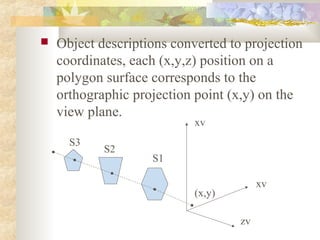
   Object descriptions converted to projection
    coordinates, each (x,y,z) position on a
    polygon surface corresponds to the
    orthographic projection point (x,y) on the
    view plane.
                            xv
      S3
            S2
                    S1

                                         xv
                            (x,y)

                                    zv
      Depth Buffer algo. is implemented in
       normalized coordinates.
      Two buffer areas are required.
(i)    A depth buffer is used to store depth
       values for each (x,y) position as surfaces
       are processed.
(ii)   A refresh buffer stores the intensity
       value for each position.
      Initially, Depth buffer = 0(min depth)
       refresh buffer = background intensity.
   Each surface is then scanned, calculating
    the depth(z value) at each (x,y) pixel
    position.
   Calculated depth value is compared to
    previous one stored in buffer.
   If calculated value is greater than the value
    stored in the depth buffer, then the new
    depth value is stored, & intensity at the
    position is placed in the refresh buffer.
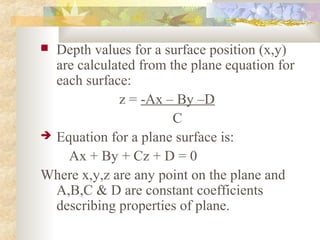
 Depth values for a surface position (x,y)
  are calculated from the plane equation for
  each surface:
             z = -Ax – By –D
                       C
 Equation for a plane surface is:

    Ax + By + Cz + D = 0
Where x,y,z are any point on the plane and
  A,B,C & D are constant coefficients
  describing properties of plane.
   Scan line coherence method solves the
    hidden surface problem one scan line at a
    time from top to bottom.
   The simplest scan line algorithm is a one
    dimensional version of the Depth Buffer.
   Across each scan line, depth calculations
    are made for each overlapping surface to
    determine which is nearest to the view
    plane.
yv            B   E
                               F
                                   Scan Line 1

         S1           S2
     A                             Scan Line 2
         H                         Scan Line 3
                  C


                           G
         D
                                          xv
   When visible surface has been determined,
    the intensity value for that position is
    entered into refresh buffer.
   Define a flag, for each surface that is set on
    & off to indicate whether a position along
    scan line is inside or outside of the surface.
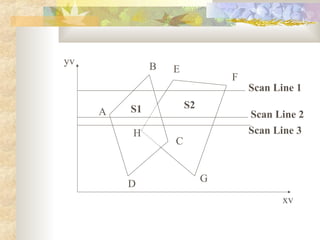
   Active List for scan line 1contains info
    about edges AB,BC,EH, & FG. Between
    edges AB & BC,only the flag for surface
    S1 is on. No depth calculation requires
& refresh buffer contains intensity value for
  S1. Similarly between EH & FG.
 For scan line 2, active edge list contain
  AD, BC, EH & FG. Between the edge AD
  & EH only the flag of S1 is on. But b/w EH
  & BC, the flag for both surfaces are on. In
  this interval depth calculations must be
  made.
 For scan line 3, we can take advantage of
  coherence(regularities in a scene) as we
  pass to next scan line.

Hidden surfaces

  • 1.
  • 2.
    Introduction When we viewa picture containing non transparent objects and surfaces, then we can’t see those objects from view which are behind from the objects closer to eye. We must remove these hidden surfaces to get realistic screen image. The identification & removal of these surfaces is called the Hidden- surface problem.
  • 3.
    Two approaches for Visible surface detection are: (i) Object-space methods: compares objects & parts of objects to each other within the scene definition to determine which surfaces, as a whole, we should label as visible. (ii) Image-space methods: visibility is decided point by point at each pixel position on the projection plane.
  • 4.
    Depth Comparisons  Also known as Depth Buffer Method or z- buffer method, since object depth is usually measured from the view plane along z-axis.  Each surface of a scene is processed separately, one point at a time across the surface.  Method is applied to scenes containing polygon surfaces.
  • 5.
    Object descriptions converted to projection coordinates, each (x,y,z) position on a polygon surface corresponds to the orthographic projection point (x,y) on the view plane. xv S3 S2 S1 xv (x,y) zv
  • 6.
    Depth Buffer algo. is implemented in normalized coordinates.  Two buffer areas are required. (i) A depth buffer is used to store depth values for each (x,y) position as surfaces are processed. (ii) A refresh buffer stores the intensity value for each position.  Initially, Depth buffer = 0(min depth) refresh buffer = background intensity.
  • 7.
    Each surface is then scanned, calculating the depth(z value) at each (x,y) pixel position.  Calculated depth value is compared to previous one stored in buffer.  If calculated value is greater than the value stored in the depth buffer, then the new depth value is stored, & intensity at the position is placed in the refresh buffer.
  • 8.
     Depth valuesfor a surface position (x,y) are calculated from the plane equation for each surface: z = -Ax – By –D C  Equation for a plane surface is: Ax + By + Cz + D = 0 Where x,y,z are any point on the plane and A,B,C & D are constant coefficients describing properties of plane.
  • 9.
    Scan line coherence method solves the hidden surface problem one scan line at a time from top to bottom.  The simplest scan line algorithm is a one dimensional version of the Depth Buffer.  Across each scan line, depth calculations are made for each overlapping surface to determine which is nearest to the view plane.
  • 10.
    yv B E F Scan Line 1 S1 S2 A Scan Line 2 H Scan Line 3 C G D xv
  • 11.
    When visible surface has been determined, the intensity value for that position is entered into refresh buffer.  Define a flag, for each surface that is set on & off to indicate whether a position along scan line is inside or outside of the surface.  Active List for scan line 1contains info about edges AB,BC,EH, & FG. Between edges AB & BC,only the flag for surface S1 is on. No depth calculation requires
  • 12.
    & refresh buffercontains intensity value for S1. Similarly between EH & FG.  For scan line 2, active edge list contain AD, BC, EH & FG. Between the edge AD & EH only the flag of S1 is on. But b/w EH & BC, the flag for both surfaces are on. In this interval depth calculations must be made.  For scan line 3, we can take advantage of coherence(regularities in a scene) as we pass to next scan line.