HEPATITIS B
Dr.Rahul.K.R
Dept. of Swasthavritta
Amrita School of Ayurveda1
Hepatitis B
• Formerly known as ‘serum hepatitis’.
• It is an acute systemic infection with major pathology in liver caused
by hepatitis B virus (HBV).
• Transmitted mainly via parenteral route
• Clinically characterized by a tendency to a long incubation period
• 5-15% cases fail to resolve & become persistent carrier of HBV.
• HBV infection may cause progressive liver disease including active
hepatitis and hepatocellular carcinoma.
• HBV can form alliance with delta virus and produce a new form of
virulent hepatitis.
2
PROBLEM STATEMENT
WORLD
• Endemic through out the world especially in tropical and developing
countries.
• Lowest in countries with high standard of living.
• 2 billion people have evidence of past or current HBV infection.
• 240 million are chronic carriers of HBV.
• The virus causes 60-80% of all primary liver cancer.
• 6 lakh death due to cirrhosis & hepatocellular carcinoma.
• 5-10% adults & upto 90% of infants infected with HBV become carriers &
among these 25% in long term develop serious liver diseases.
3
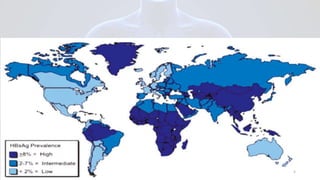
Based on HBsAg carrier rate
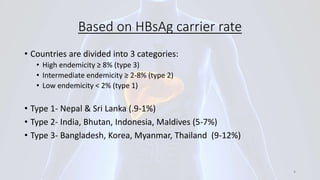
• Countries are divided into 3 categories:
• High endemicity ≥ 8% (type 3)
• Intermediate endemicity ≥ 2-8% (type 2)
• Low endemicity < 2% (type 1)
• Type 1- Nepal & Sri Lanka (.9-1%)
• Type 2- India, Bhutan, Indonesia, Maldives (5-7%)
• Type 3- Bangladesh, Korea, Myanmar, Thailand (9-12%)
4
5
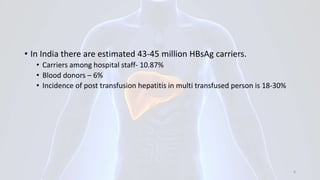
• In India there are estimated 43-45 million HBsAg carriers.
• Carriers among hospital staff- 10.87%
• Blood donors – 6%
• Incidence of post transfusion hepatitis in multi transfused person is 18-30%
6
7
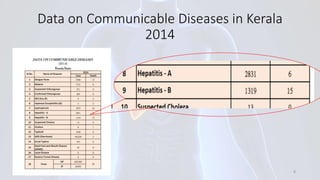
Data on Communicable Diseases in Kerala
2014
8
District wise Data on Communicable Diseases
2014
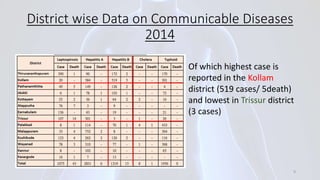
Of which highest case is
reported in the Kollam
district (519 cases/ 5death)
and lowest in Trissur district
(3 cases)
9
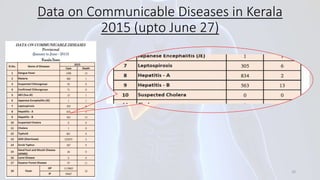
Data on Communicable Diseases in Kerala
2015 (upto June 27)
10
District wise Data on Communicable Diseases
2015 (upto June 27)
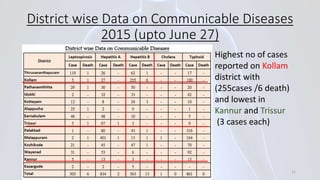
Highest no of cases
reported on Kollam
district with
(255cases /6 death)
and lowest in
Kannur and Trissur
(3 cases each)
11
• On World Hepatitis Day (28 July) WHO highlights the urgent need for
countries to enhance action to prevent viral hepatitis infection and to
ensure that people who have been infected are diagnosed and
offered treatment.
• Know the risks
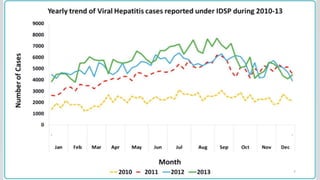
• Demand safe injections
• Be vaccinated
• Get tested, seek treatment
12
Epidemiological determinants
AGENT
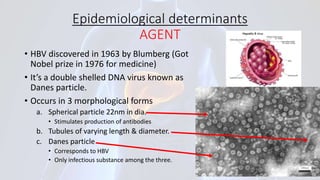
• HBV discovered in 1963 by Blumberg (Got
Nobel prize in 1976 for medicine)
• It’s a double shelled DNA virus known as
Danes particle.
• Occurs in 3 morphological forms
a. Spherical particle 22nm in dia.
• Stimulates production of antibodies
b. Tubules of varying length & diameter.
c. Danes particle
• Corresponds to HBV
• Only infectious substance among the three.
13
Epidemiological determinants
AGENT
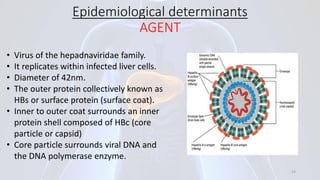
• Virus of the hepadnaviridae family.
• It replicates within infected liver cells.
• Diameter of 42nm.
• The outer protein collectively known as
HBs or surface protein (surface coat).
• Inner to outer coat surrounds an inner
protein shell composed of HBc (core
particle or capsid)
• Core particle surrounds viral DNA and
the DNA polymerase enzyme.
14
15
Epidemiological determinants
RESERVOIR OF INFECTION
• Man is the only reservoir of infection.
• Spread from a case or carrier.
• Persistent carriers aids the continuous survival of the infection.
• Cases may range from in apparent to symptomatic cases.
INFECTIVE MATERIAL
• Contaminated blood is the main source of infection.
• Other sources include- saliva, vaginal secretions and semen of
infected persons.
16
Epidemiological determinants
RESISTANCE
• Virus is stable and capable of surviving in for at least 7 days on
environmental surface.
• Readily destroyed by sodiumhypochlorate and by heat sterilization by
autoclave for 30-60 mnts.
PERIOD OF COMMUNICABILITY
• Virus present in the blood during incubation period and the acute
phase of disease.
• Communicability is usually several months or until disappearance of
HBsAg or the appearance of surface antibody.
17
HOST FACTORS
AGE
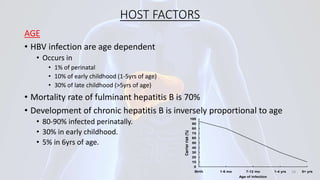
• HBV infection are age dependent
• Occurs in
• 1% of perinatal
• 10% of early childhood (1-5yrs of age)
• 30% of late childhood (>5yrs of age)
• Mortality rate of fulminant hepatitis B is 70%
• Development of chronic hepatitis B is inversely proportional to age
• 80-90% infected perinatally.
• 30% in early childhood.
• 5% in 6yrs of age.
0
10
20
30
40
50
60
70
80
90
100
Birth 1-6 mo 7-12 mo 1-4 yrs 5+ yrs
Age of infection
Carrierrisk(%)
18
HOST FACTORS
HIGH RISK GROUPS
• Infection in surgeons are 50 times greater than in general population
and twice that of other physicians.
• Other risk group includes
• Recipients of blood transfusion
• Health care and lab personnel
• Homosexuals, prostitutes, percutaneous drug abusers
• Infants of HBV positive mothers
• Solid organ transplants and immunocompromised persons.
• Serological screening and vaccination of high risk groups are
recommended
19
HOST FACTORS
HEPATITIS AND HIV
• 10% of HIV infected are coinfected with HBV.
• HBV have minimal effect in the progression of HIV
• There is an increase risk of liver cirrhosis and hepatocellular
carcinoma in HBV affected HIV patients.
• Mortality rate in HBV coinfected HIV patients are high both before
and after HAART.
20
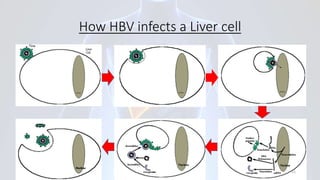
How HBV infects a Liver cell
21
HOST FACTORS
HUMARAL AND CELLULAR RESPONSE
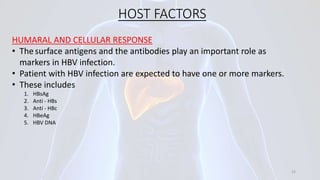
• Thesurface antigens and the antibodies play an important role as
markers in HBV infection.
• Patient with HBV infection are expected to have one or more markers.
• These includes
1. HBsAg
2. Anti - HBs
3. Anti - HBc
4. HBeAg
5. HBV DNA
22
HOST FACTORS
HUMARAL AND CELLULAR RESPONSE
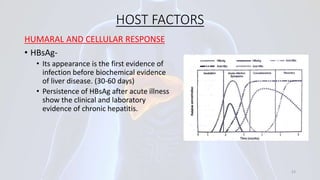
• HBsAg-
• Its appearance is the first evidence of
infection before biochemical evidence
of liver disease. (30-60 days)
• Persistence of HBsAg after acute illness
show the clinical and laboratory
evidence of chronic hepatitis.
23
Cont..
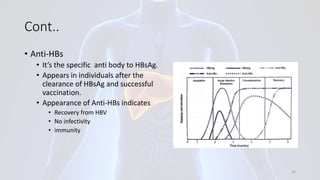
• Anti-HBs
• It’s the specific anti body to HBsAg.
• Appears in individuals after the
clearance of HBsAg and successful
vaccination.
• Appearance of Anti-HBs indicates
• Recovery from HBV
• No infectivity
• immunity
24
Cont..
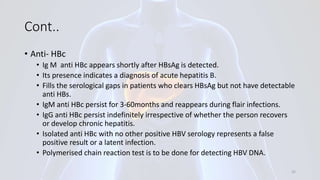
• Anti- HBc
• Ig M anti HBc appears shortly after HBsAg is detected.
• Its presence indicates a diagnosis of acute hepatitis B.
• Fills the serological gaps in patients who clears HBsAg but not have detectable
anti HBs.
• IgM anti HBc persist for 3-60months and reappears during flair infections.
• IgG anti HBc persist indefinitely irrespective of whether the person recovers
or develop chronic hepatitis.
• Isolated anti HBc with no other positive HBV serology represents a false
positive result or a latent infection.
• Polymerised chain reaction test is to be done for detecting HBV DNA.
25
Cont..
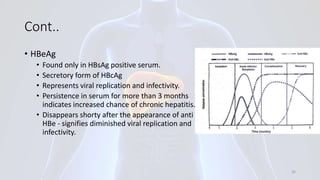
• HBeAg
• Found only in HBsAg positive serum.
• Secretory form of HBcAg
• Represents viral replication and infectivity.
• Persistence in serum for more than 3 months
indicates increased chance of chronic hepatitis.
• Disappears shorty after the appearance of anti
HBe - signifies diminished viral replication and
infectivity.
26
Cont..
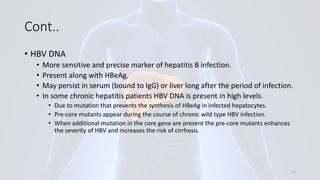
• HBV DNA
• More sensitive and precise marker of hepatitis B infection.
• Present along with HBeAg.
• May persist in serum (bound to IgG) or liver long after the period of infection.
• In some chronic hepatitis patients HBV DNA is present in high levels.
• Due to mutation that prevents the synthesis of HBeAg in infected hepatocytes.
• Pre-core mutants appear during the course of chronic wild type HBV infection.
• When additional mutation in the core gene are present the pre-core mutants enhances
the severity of HBV and increases the risk of cirrhosis.
27
Modes of transmission
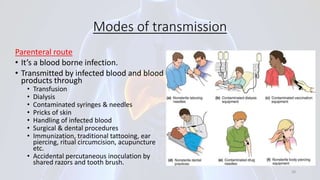
Parenteral route
• It’s a blood borne infection.
• Transmitted by infected blood and blood
products through
• Transfusion
• Dialysis
• Contaminated syringes & needles
• Pricks of skin
• Handling of infected blood
• Surgical & dental procedures
• Immunization, traditional tattooing, ear
piercing, ritual circumcision, acupuncture
etc.
• Accidental percutaneous inoculation by
shared razors and tooth brush.
28
Modes of transmission
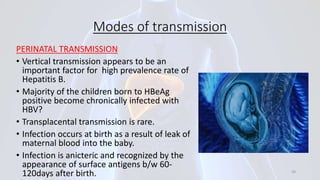
PERINATAL TRANSMISSION
• Vertical transmission appears to be an
important factor for high prevalence rate of
Hepatitis B.
• Majority of the children born to HBeAg
positive become chronically infected with
HBV?
• Transplacental transmission is rare.
• Infection occurs at birth as a result of leak of
maternal blood into the baby.
• Infection is anicteric and recognized by the
appearance of surface antigens b/w 60-
120days after birth. 29
Modes of transmission
SEXUAL TRANSMISSION
• There are ample evidence for spread of infection by intimate contact.
• Sex workers and homosexuals are particular at risk.
OTHER ROUTES
• Horizontal transmission child –child transmission.
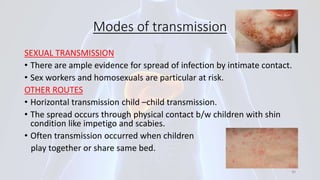
• The spread occurs through physical contact b/w children with shin
condition like impetigo and scabies.
• Often transmission occurred when children
play together or share same bed.
30
Incubation period
• 30-180 days
• Lower doses of virus result longer incubation period.
• Average period of 75 days.
• The virus may be detected within 30 to 60 days after infection.
31
Clinical picture
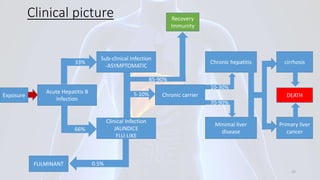
Exposure
Acute Hepatitis B
Infection
Sub-clinical Infection
-ASYMPTOMATIC
DEATH
FULMINANT
Primary liver
cancer
Chronic hepatitis
Minimal liver
disease
cirrhosis
Clinical Infection
JAUNDICE
FLU-LIKE
Recovery
Immunity
Chronic carrier
32
0.5%
33%
66%
5-10%
85-90%
10-30%
70-90%
Clinical symptoms
• Acute (short-term) illness:
• loss of appetite
• tiredness
• pain in muscles, joints, and stomach
• Diarrhoea and vomiting
• jaundice (yellow skin or eyes)
• Chronic (long-term) infection:
• liver damage (cirrhosis)
• liver cancer
• death
33
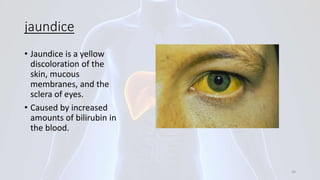
jaundice
• Jaundice is a yellow
discoloration of the
skin, mucous
membranes, and the
sclera of eyes.
• Caused by increased
amounts of bilirubin in
the blood.
34
35
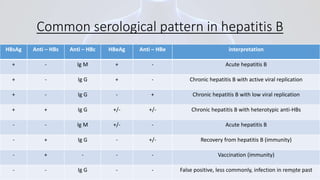
Common serological pattern in hepatitis B
HBsAg Anti – HBs Anti – HBc HBeAg Anti – HBe interpretation
+ - Ig M + - Acute hepatitis B
+ - Ig G + - Chronic hepatitis B with active viral replication
+ - Ig G - + Chronic hepatitis B with low viral replication
+ + Ig G +/- +/- Chronic hepatitis B with heterotypic anti-HBs
- - Ig M +/- - Acute hepatitis B
- + Ig G - +/- Recovery from hepatitis B (immunity)
- + - - - Vaccination (immunity)
- - Ig G - - False positive, less commonly, infection in remote past36
Prevention and containment
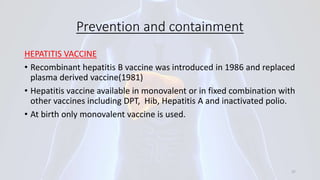
HEPATITIS VACCINE
• Recombinant hepatitis B vaccine was introduced in 1986 and replaced
plasma derived vaccine(1981)
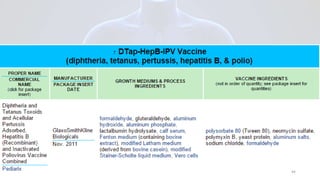
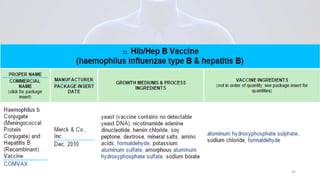
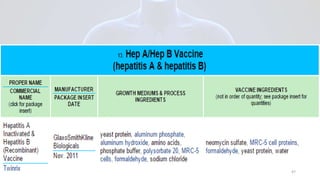
• Hepatitis vaccine available in monovalent or in fixed combination with
other vaccines including DPT, Hib, Hepatitis A and inactivated polio.
• At birth only monovalent vaccine is used.
37
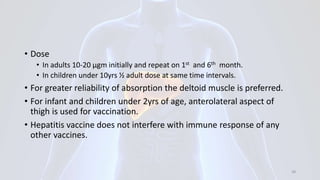
• Dose
• In adults 10-20 μgm initially and repeat on 1st and 6th month.
• In children under 10yrs ½ adult dose at same time intervals.
• For greater reliability of absorption the deltoid muscle is preferred.
• For infant and children under 2yrs of age, anterolateral aspect of
thigh is used for vaccination.
• Hepatitis vaccine does not interfere with immune response of any
other vaccines.
38
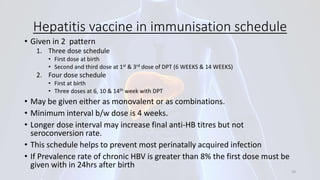
Hepatitis vaccine in immunisation schedule
• Given in 2 pattern
1. Three dose schedule
• First dose at birth
• Second and third dose at 1st & 3rd dose of DPT (6 WEEKS & 14 WEEKS)
2. Four dose schedule
• First at birth
• Three doses at 6, 10 & 14th week with DPT
• May be given either as monovalent or as combinations.
• Minimum interval b/w dose is 4 weeks.
• Longer dose interval may increase final anti-HB titres but not
seroconversion rate.
• This schedule helps to prevent most perinatally acquired infection
• If Prevalence rate of chronic HBV is greater than 8% the first dose must be
given with in 24hrs after birth
39
Cont..
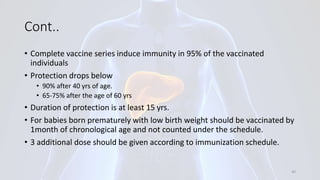
• Complete vaccine series induce immunity in 95% of the vaccinated
individuals
• Protection drops below
• 90% after 40 yrs of age.
• 65-75% after the age of 60 yrs
• Duration of protection is at least 15 yrs.
• For babies born prematurely with low birth weight should be vaccinated by
1month of chronological age and not counted under the schedule.
• 3 additional dose should be given according to immunization schedule.
40
Cont..
• In immune compromised persons the immunogenicity of the vaccine
is low.
• If the vaccine schedule is interrupted then the vaccine is given as
soon as possible and if a 3rd dose is there it should be given in an
interval of 4 weeks.
• All children and adolescents aged below 18 yrs should be vaccinated.
41
Hepatitis B vaccine is Indicated for:
• Group at high risk of contracting HBV infection
• Person with high risk sexual behaviour, partners, and house hold contact with
HBsAg +ve individuals.
• Injecting drug users
• Who requires frequent blood or blood products
• Recipient of solid organ transplantation
• Occupational risk of HBV infection.
• International travellers to HBV endemic countries.
42
Contra indication of the vaccine
• Person with allergic history to the vaccine contents
are contraindicated.
Storage of vaccine
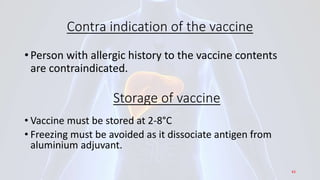
• Vaccine must be stored at 2-8°C
• Freezing must be avoided as it dissociate antigen from
aluminium adjuvant.
43
44
45
46
47
Hepatitis B Ig
• It's given for immediate protection to those who exposed to Hepatitis
B infections like
• Surgeons, nurse or lab workers
• New born infant to carrier mother
• Sexual contact of acute hepatitis B patient
• Patient need protection against HBV after organ transplants
• Should be given as early as possible after accidental inoculation
(ideally with in 6hrs and not later than 48 hrs)
• Patients' blood is drawn at the same time for HBsAg testing
• If the test is negative vaccination should be started immediately
48
Dose of HBIG
• 0.05 – 0.07 ml/kg of body weight
• Two doses given 30 days apart
• HBIG provide passive immunity for approximately 3 months
49
Passive – Active immunization
• More efficient for the person exposed to known HBV infection.
• Prevention of carrier state in new born babies of carrier mother.
Dose
• 0.05 – 0.07 ml/Kg of body weight, HBIG given as soon as possible with
in 24 hrs
• Hepatitis B vaccine 1.0ml within 7 days, 2nd & 3rd dose on 1st and 6th
month of exposure.
50
Treatment
• WHO recommends the use of oral treatments- Tenofovir or Entecavir
• Most potent drug to supress HBV
• Dose 1pill a day
• Most people this treatment does not cure disease but only
suppresses virus replication.
• Treatment with interferon injection is considered
• High cost
• Adverse effects.
51
conclusion
• All blood donors should be screened for HBsAg and +ve once should
be rejected.
• Health personals should be alerted to the importance of sterilization
of all instruments and practice of simple hygiene.
• Carriers should be told not to share razers or tooth brushes and use
barrier methods of contraception, they should not donate blood.
52

Hepatitis B, Viral Hepatitis

  • 1.
    HEPATITIS B Dr.Rahul.K.R Dept. ofSwasthavritta Amrita School of Ayurveda1
  • 2.
    Hepatitis B • Formerlyknown as ‘serum hepatitis’. • It is an acute systemic infection with major pathology in liver caused by hepatitis B virus (HBV). • Transmitted mainly via parenteral route • Clinically characterized by a tendency to a long incubation period • 5-15% cases fail to resolve & become persistent carrier of HBV. • HBV infection may cause progressive liver disease including active hepatitis and hepatocellular carcinoma. • HBV can form alliance with delta virus and produce a new form of virulent hepatitis. 2
  • 3.
    PROBLEM STATEMENT WORLD • Endemicthrough out the world especially in tropical and developing countries. • Lowest in countries with high standard of living. • 2 billion people have evidence of past or current HBV infection. • 240 million are chronic carriers of HBV. • The virus causes 60-80% of all primary liver cancer. • 6 lakh death due to cirrhosis & hepatocellular carcinoma. • 5-10% adults & upto 90% of infants infected with HBV become carriers & among these 25% in long term develop serious liver diseases. 3
  • 4.
    Based on HBsAgcarrier rate • Countries are divided into 3 categories: • High endemicity ≥ 8% (type 3) • Intermediate endemicity ≥ 2-8% (type 2) • Low endemicity < 2% (type 1) • Type 1- Nepal & Sri Lanka (.9-1%) • Type 2- India, Bhutan, Indonesia, Maldives (5-7%) • Type 3- Bangladesh, Korea, Myanmar, Thailand (9-12%) 4
  • 5.
  • 6.
    • In Indiathere are estimated 43-45 million HBsAg carriers. • Carriers among hospital staff- 10.87% • Blood donors – 6% • Incidence of post transfusion hepatitis in multi transfused person is 18-30% 6
  • 7.
  • 8.
    Data on CommunicableDiseases in Kerala 2014 8
  • 9.
    District wise Dataon Communicable Diseases 2014 Of which highest case is reported in the Kollam district (519 cases/ 5death) and lowest in Trissur district (3 cases) 9
  • 10.
    Data on CommunicableDiseases in Kerala 2015 (upto June 27) 10
  • 11.
    District wise Dataon Communicable Diseases 2015 (upto June 27) Highest no of cases reported on Kollam district with (255cases /6 death) and lowest in Kannur and Trissur (3 cases each) 11
  • 12.
    • On WorldHepatitis Day (28 July) WHO highlights the urgent need for countries to enhance action to prevent viral hepatitis infection and to ensure that people who have been infected are diagnosed and offered treatment. • Know the risks • Demand safe injections • Be vaccinated • Get tested, seek treatment 12
  • 13.
    Epidemiological determinants AGENT • HBVdiscovered in 1963 by Blumberg (Got Nobel prize in 1976 for medicine) • It’s a double shelled DNA virus known as Danes particle. • Occurs in 3 morphological forms a. Spherical particle 22nm in dia. • Stimulates production of antibodies b. Tubules of varying length & diameter. c. Danes particle • Corresponds to HBV • Only infectious substance among the three. 13
  • 14.
    Epidemiological determinants AGENT • Virusof the hepadnaviridae family. • It replicates within infected liver cells. • Diameter of 42nm. • The outer protein collectively known as HBs or surface protein (surface coat). • Inner to outer coat surrounds an inner protein shell composed of HBc (core particle or capsid) • Core particle surrounds viral DNA and the DNA polymerase enzyme. 14
  • 15.
  • 16.
    Epidemiological determinants RESERVOIR OFINFECTION • Man is the only reservoir of infection. • Spread from a case or carrier. • Persistent carriers aids the continuous survival of the infection. • Cases may range from in apparent to symptomatic cases. INFECTIVE MATERIAL • Contaminated blood is the main source of infection. • Other sources include- saliva, vaginal secretions and semen of infected persons. 16
  • 17.
    Epidemiological determinants RESISTANCE • Virusis stable and capable of surviving in for at least 7 days on environmental surface. • Readily destroyed by sodiumhypochlorate and by heat sterilization by autoclave for 30-60 mnts. PERIOD OF COMMUNICABILITY • Virus present in the blood during incubation period and the acute phase of disease. • Communicability is usually several months or until disappearance of HBsAg or the appearance of surface antibody. 17
  • 18.
    HOST FACTORS AGE • HBVinfection are age dependent • Occurs in • 1% of perinatal • 10% of early childhood (1-5yrs of age) • 30% of late childhood (>5yrs of age) • Mortality rate of fulminant hepatitis B is 70% • Development of chronic hepatitis B is inversely proportional to age • 80-90% infected perinatally. • 30% in early childhood. • 5% in 6yrs of age. 0 10 20 30 40 50 60 70 80 90 100 Birth 1-6 mo 7-12 mo 1-4 yrs 5+ yrs Age of infection Carrierrisk(%) 18
  • 19.
    HOST FACTORS HIGH RISKGROUPS • Infection in surgeons are 50 times greater than in general population and twice that of other physicians. • Other risk group includes • Recipients of blood transfusion • Health care and lab personnel • Homosexuals, prostitutes, percutaneous drug abusers • Infants of HBV positive mothers • Solid organ transplants and immunocompromised persons. • Serological screening and vaccination of high risk groups are recommended 19
  • 20.
    HOST FACTORS HEPATITIS ANDHIV • 10% of HIV infected are coinfected with HBV. • HBV have minimal effect in the progression of HIV • There is an increase risk of liver cirrhosis and hepatocellular carcinoma in HBV affected HIV patients. • Mortality rate in HBV coinfected HIV patients are high both before and after HAART. 20
  • 21.
    How HBV infectsa Liver cell 21
  • 22.
    HOST FACTORS HUMARAL ANDCELLULAR RESPONSE • Thesurface antigens and the antibodies play an important role as markers in HBV infection. • Patient with HBV infection are expected to have one or more markers. • These includes 1. HBsAg 2. Anti - HBs 3. Anti - HBc 4. HBeAg 5. HBV DNA 22
  • 23.
    HOST FACTORS HUMARAL ANDCELLULAR RESPONSE • HBsAg- • Its appearance is the first evidence of infection before biochemical evidence of liver disease. (30-60 days) • Persistence of HBsAg after acute illness show the clinical and laboratory evidence of chronic hepatitis. 23
  • 24.
    Cont.. • Anti-HBs • It’sthe specific anti body to HBsAg. • Appears in individuals after the clearance of HBsAg and successful vaccination. • Appearance of Anti-HBs indicates • Recovery from HBV • No infectivity • immunity 24
  • 25.
    Cont.. • Anti- HBc •Ig M anti HBc appears shortly after HBsAg is detected. • Its presence indicates a diagnosis of acute hepatitis B. • Fills the serological gaps in patients who clears HBsAg but not have detectable anti HBs. • IgM anti HBc persist for 3-60months and reappears during flair infections. • IgG anti HBc persist indefinitely irrespective of whether the person recovers or develop chronic hepatitis. • Isolated anti HBc with no other positive HBV serology represents a false positive result or a latent infection. • Polymerised chain reaction test is to be done for detecting HBV DNA. 25
  • 26.
    Cont.. • HBeAg • Foundonly in HBsAg positive serum. • Secretory form of HBcAg • Represents viral replication and infectivity. • Persistence in serum for more than 3 months indicates increased chance of chronic hepatitis. • Disappears shorty after the appearance of anti HBe - signifies diminished viral replication and infectivity. 26
  • 27.
    Cont.. • HBV DNA •More sensitive and precise marker of hepatitis B infection. • Present along with HBeAg. • May persist in serum (bound to IgG) or liver long after the period of infection. • In some chronic hepatitis patients HBV DNA is present in high levels. • Due to mutation that prevents the synthesis of HBeAg in infected hepatocytes. • Pre-core mutants appear during the course of chronic wild type HBV infection. • When additional mutation in the core gene are present the pre-core mutants enhances the severity of HBV and increases the risk of cirrhosis. 27
  • 28.
    Modes of transmission Parenteralroute • It’s a blood borne infection. • Transmitted by infected blood and blood products through • Transfusion • Dialysis • Contaminated syringes & needles • Pricks of skin • Handling of infected blood • Surgical & dental procedures • Immunization, traditional tattooing, ear piercing, ritual circumcision, acupuncture etc. • Accidental percutaneous inoculation by shared razors and tooth brush. 28
  • 29.
    Modes of transmission PERINATALTRANSMISSION • Vertical transmission appears to be an important factor for high prevalence rate of Hepatitis B. • Majority of the children born to HBeAg positive become chronically infected with HBV? • Transplacental transmission is rare. • Infection occurs at birth as a result of leak of maternal blood into the baby. • Infection is anicteric and recognized by the appearance of surface antigens b/w 60- 120days after birth. 29
  • 30.
    Modes of transmission SEXUALTRANSMISSION • There are ample evidence for spread of infection by intimate contact. • Sex workers and homosexuals are particular at risk. OTHER ROUTES • Horizontal transmission child –child transmission. • The spread occurs through physical contact b/w children with shin condition like impetigo and scabies. • Often transmission occurred when children play together or share same bed. 30
  • 31.
    Incubation period • 30-180days • Lower doses of virus result longer incubation period. • Average period of 75 days. • The virus may be detected within 30 to 60 days after infection. 31
  • 32.
    Clinical picture Exposure Acute HepatitisB Infection Sub-clinical Infection -ASYMPTOMATIC DEATH FULMINANT Primary liver cancer Chronic hepatitis Minimal liver disease cirrhosis Clinical Infection JAUNDICE FLU-LIKE Recovery Immunity Chronic carrier 32 0.5% 33% 66% 5-10% 85-90% 10-30% 70-90%
  • 33.
    Clinical symptoms • Acute(short-term) illness: • loss of appetite • tiredness • pain in muscles, joints, and stomach • Diarrhoea and vomiting • jaundice (yellow skin or eyes) • Chronic (long-term) infection: • liver damage (cirrhosis) • liver cancer • death 33
  • 34.
    jaundice • Jaundice isa yellow discoloration of the skin, mucous membranes, and the sclera of eyes. • Caused by increased amounts of bilirubin in the blood. 34
  • 35.
  • 36.
    Common serological patternin hepatitis B HBsAg Anti – HBs Anti – HBc HBeAg Anti – HBe interpretation + - Ig M + - Acute hepatitis B + - Ig G + - Chronic hepatitis B with active viral replication + - Ig G - + Chronic hepatitis B with low viral replication + + Ig G +/- +/- Chronic hepatitis B with heterotypic anti-HBs - - Ig M +/- - Acute hepatitis B - + Ig G - +/- Recovery from hepatitis B (immunity) - + - - - Vaccination (immunity) - - Ig G - - False positive, less commonly, infection in remote past36
  • 37.
    Prevention and containment HEPATITISVACCINE • Recombinant hepatitis B vaccine was introduced in 1986 and replaced plasma derived vaccine(1981) • Hepatitis vaccine available in monovalent or in fixed combination with other vaccines including DPT, Hib, Hepatitis A and inactivated polio. • At birth only monovalent vaccine is used. 37
  • 38.
    • Dose • Inadults 10-20 μgm initially and repeat on 1st and 6th month. • In children under 10yrs ½ adult dose at same time intervals. • For greater reliability of absorption the deltoid muscle is preferred. • For infant and children under 2yrs of age, anterolateral aspect of thigh is used for vaccination. • Hepatitis vaccine does not interfere with immune response of any other vaccines. 38
  • 39.
    Hepatitis vaccine inimmunisation schedule • Given in 2 pattern 1. Three dose schedule • First dose at birth • Second and third dose at 1st & 3rd dose of DPT (6 WEEKS & 14 WEEKS) 2. Four dose schedule • First at birth • Three doses at 6, 10 & 14th week with DPT • May be given either as monovalent or as combinations. • Minimum interval b/w dose is 4 weeks. • Longer dose interval may increase final anti-HB titres but not seroconversion rate. • This schedule helps to prevent most perinatally acquired infection • If Prevalence rate of chronic HBV is greater than 8% the first dose must be given with in 24hrs after birth 39
  • 40.
    Cont.. • Complete vaccineseries induce immunity in 95% of the vaccinated individuals • Protection drops below • 90% after 40 yrs of age. • 65-75% after the age of 60 yrs • Duration of protection is at least 15 yrs. • For babies born prematurely with low birth weight should be vaccinated by 1month of chronological age and not counted under the schedule. • 3 additional dose should be given according to immunization schedule. 40
  • 41.
    Cont.. • In immunecompromised persons the immunogenicity of the vaccine is low. • If the vaccine schedule is interrupted then the vaccine is given as soon as possible and if a 3rd dose is there it should be given in an interval of 4 weeks. • All children and adolescents aged below 18 yrs should be vaccinated. 41
  • 42.
    Hepatitis B vaccineis Indicated for: • Group at high risk of contracting HBV infection • Person with high risk sexual behaviour, partners, and house hold contact with HBsAg +ve individuals. • Injecting drug users • Who requires frequent blood or blood products • Recipient of solid organ transplantation • Occupational risk of HBV infection. • International travellers to HBV endemic countries. 42
  • 43.
    Contra indication ofthe vaccine • Person with allergic history to the vaccine contents are contraindicated. Storage of vaccine • Vaccine must be stored at 2-8°C • Freezing must be avoided as it dissociate antigen from aluminium adjuvant. 43
  • 44.
  • 45.
  • 46.
  • 47.
  • 48.
    Hepatitis B Ig •It's given for immediate protection to those who exposed to Hepatitis B infections like • Surgeons, nurse or lab workers • New born infant to carrier mother • Sexual contact of acute hepatitis B patient • Patient need protection against HBV after organ transplants • Should be given as early as possible after accidental inoculation (ideally with in 6hrs and not later than 48 hrs) • Patients' blood is drawn at the same time for HBsAg testing • If the test is negative vaccination should be started immediately 48
  • 49.
    Dose of HBIG •0.05 – 0.07 ml/kg of body weight • Two doses given 30 days apart • HBIG provide passive immunity for approximately 3 months 49
  • 50.
    Passive – Activeimmunization • More efficient for the person exposed to known HBV infection. • Prevention of carrier state in new born babies of carrier mother. Dose • 0.05 – 0.07 ml/Kg of body weight, HBIG given as soon as possible with in 24 hrs • Hepatitis B vaccine 1.0ml within 7 days, 2nd & 3rd dose on 1st and 6th month of exposure. 50
  • 51.
    Treatment • WHO recommendsthe use of oral treatments- Tenofovir or Entecavir • Most potent drug to supress HBV • Dose 1pill a day • Most people this treatment does not cure disease but only suppresses virus replication. • Treatment with interferon injection is considered • High cost • Adverse effects. 51
  • 52.
    conclusion • All blooddonors should be screened for HBsAg and +ve once should be rejected. • Health personals should be alerted to the importance of sterilization of all instruments and practice of simple hygiene. • Carriers should be told not to share razers or tooth brushes and use barrier methods of contraception, they should not donate blood. 52

Editor's Notes

  • #3 Delta virus .Hepatitis D, rna virus
  • #8 IDSP- INTEGRATED DISEASE SURVILANCE PROJECT.
  • #41 Premature babies vaccination starts 2 months from chronological age.
  • #50 Incubation period is less than 100 days so 2 doses is recommended Long term use is not recommended Limited availability and high cost.