Hepatitis
SushilPaudyal
Department ofCommunity Medicine
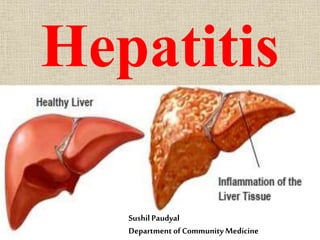
Hepatitis is inflammation of the liver tissue.
Causes
•Infectious
1. Viral
(a) Hepatotropic virus : Hep A, Hep B, Hep C, Hep D, Hep E
(b) Non-hepatotropic virus : Cytomegalovirus, Epstein-Barr
,herpes simplex, Yellow fever
2. Bacterial
E.coli, Neisseria meningitis, mycobacterium
3. Parasitic
Fasciola hepatica, Clonorchis sinensis
•Non infectious
1. Alcohol
2. Drugs
(a) Analgesic : Paracetamol
(b) Antibiotics : isoniazid, nitrofurantion,
amoxicillin, erythromycin
(c) Anticonvulsant : Valoporate, phenytoin
(d) Steroids
(e) Herbal medication
3. Autoimmune : Anti smooth muscle antibodies
4. Metabolic disease : Wilson disease,
hemochromatosis, alpha-1 antitrypsin
defficency
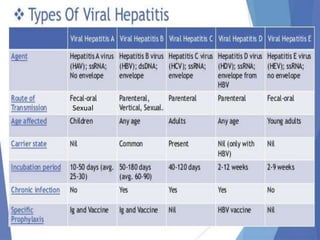
Sexual
Hepatitis B
Also know as serum hepatitis
Hepatitis B prevalence is highest in the Western Pacific
Region and the African Region, where 6.2% and 6.1%
respectively of the adult population is infected.
In the Eastern Mediterranean Region, the South-East
Asia Region and the European Region, an estimated
3.3%, 2.0% and 1.6%% of the general population is
infected, respectively
Problem statement in Nepal
The first ever testing for hepatitis B surface antigen (HBsAg) in Nepalese subjects
was done at the Yale University in sera collected during acute hepatitis epidemic of
1973
When HBsAg was found to be negative in these subjects, the epidemic was
presumed ...and reported as hepatitis A epidemic
Commercial testing for HBsAg has been made available in Nepal since 1983.
Subsequently, a nationwide study revealed the prevalence of hepatitis B to be 0.9%
on an average (1.1% among males and 0.5% among females)
It accounts for nearly 3% of sporadic acute hepatitis cases, 47% of liver cirrhosis,
and 69% of hepatocellular carcinoma
It is estimated that 260,000 individuals are chronically infected with hepatitis B
virus.
Epidemiological Determinants
Agent Factors
(a)Agents :
Causative agent : Hepatitis B virus, Hepadena virus family
Double stranded DNA virus
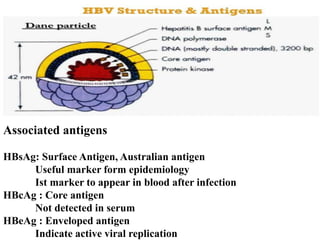
Also known as Dane particle (Diameter : 42nm)
Replicate in the liver cells
Occurs in 3 morphological forms
1. Small spherical particle – stimulate production of surface
antibodies
2. Tubules of varying lengths and diameters
3. Dane particle which corresponds morphologically to hep B
virus infection.
Associated antigens
HBsAg: Surface Antigen, Australian antigen
Useful marker form epidemiology
Ist marker to appear in blood after infection
HBcAg : Core antigen
Not detected in serum
HBeAg : Enveloped antigen
Indicate active viral replication
(b) Reservoir of infection : Man is only reservoir
(c) Carriers
Super carriers
with high HBeAg, high HBsAg titer, DNA
polymerase, HBV
Simple carrier
Low HBsAg titer
(d) Infective material
Contaminated blood
Body secretion like saliva, vaginal secretion and semen
(e) Resistance
Stable and capable of surviving for days on environmental
surface
(f) Period of communicability : Months to years
Host Factors
(a)Age :
Perinatal approx 1% occurrence but has highest
chance to develop chronic HBV 70% approx.
1-5 years : 10 %
>5 years : 30%
(b) High risk group :
Surgeons, dentists, nurses, lab technicians and blood
bank workers
High incidence among homosexual, sex workers, Iv
drug users and infant of HBV carrier mothers
(c) Humoral and cellular response :
Antibodies are produced about 10 days after onset of
jaundice
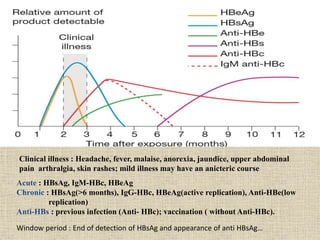
Window period : End of detection of HBsAg and appearance of anti HBsAg…
Clinical illness : Headache, fever, malaise, anorexia, jaundice, upper abdominal
pain arthralgia, skin rashes; mild illness may have an anicteric course
Acute : HBsAg, IgM-HBc, HBeAg
Chronic : HBsAg(>6 months), IgG-HBc, HBeAg(active replication), Anti-HBe(low
replication)
Anti-HBs : previous infection (Anti- HBc); vaccination ( without Anti-HBc).
(a)Mode of Transmission :
1. Parenteral route: Commonest route
2. Percutaneous route : Tattooing, ear piercing,
acupuncture
3. Direct contact : Deep kissing, sexual intercourse
4. Vertical : From carrier mother to babies
5. Horizontal : Child to child through physical
contact with the skin condition like scabies
and impetigo
(b) Incubation Period :
50 -150 days
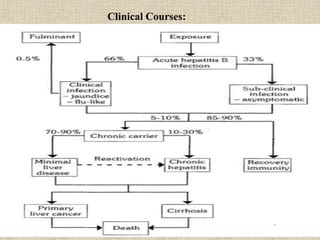
Clinical Courses:
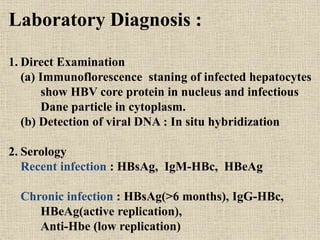
Laboratory Diagnosis :
1. Direct Examination
(a) Immunoflorescence staning of infected hepatocytes
show HBV core protein in nucleus and infectious
Dane particle in cytoplasm.
(b) Detection of viral DNA : In situ hybridization
2. Serology
Recent infection : HBsAg, IgM-HBc, HBeAg
Chronic infection : HBsAg(>6 months), IgG-HBc,
HBeAg(active replication),
Anti-Hbe (low replication)
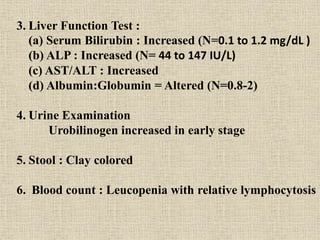
3. Liver Function Test :
(a) Serum Bilirubin : Increased (N=0.1 to 1.2 mg/dL )
(b) ALP : Increased (N= 44 to 147 IU/L)
(c) AST/ALT : Increased
(d) Albumin:Globumin = Altered (N=0.8-2)
4. Urine Examination
Urobilinogen increased in early stage
5. Stool : Clay colored
6. Blood count : Leucopenia with relative lymphocytosis
Management :
1. Acute Hepatitis
Full recovery occur in 90-95% case and remaining turn into chronic
hepatitis
2. Chronic Hepatitis :
Goal of treatment
(a) HBeAg seroconversion
(b) reduction in HBV-DNA
(c) normalization of the LFTs
1. IFN- α either 10 million units thrice weekly or 5 million units daily
for 4-6 months
2. Lamivudine 100 mg daily orally for 48 weeks
3. Adefovir 10 mg daily orally for 48 weeks.
4. Entecavir 0.5 mg orally and 1 mg orally in case of lamivudine
resistance for 48 weeks.
5. Liver transplantation is indicated in FHF and ESLD
Prevention and Control
1. Primary Prevention :
(a) Health Promotion :
Blocking the channel of transmission through
Educating general public who are at the risk about :
- Sterilization of syringes, needles, catguts, surgical
instrument
- Avoiding sharing of toothbrush, razors, syringes among
drugs abusers
- Avoiding homosexuality and multiple sexual partners
-Instruction to the carriers not to donate blood, not to share
their razors
-Use of condoms while having sex
(b) Specific Protection :
(i) Active immunization
(ii) Passive immunization
(i) Active Immunization
(a) Plasma derived vaccine
It is formalin inactivated sub unit viral vaccine for i.m
injection.
Based on surface antigen
Each 1.0 ml dose of vaccine contains 20Ug of HBsAg
Given in 3 doses at 0, 1, 6 months
Children <10 years of age should be given half dose
provide immunity for 3-5 years
Also included in national immunization program as
pentavalent vaccine
(b) Recombinant DNA-yeast derived vaccine
It is a recombinant DNA vaccine elaborated from cultures of
yeast cloned with HBsAg gene
It is immunogenic, safe and effective as plasma derived vaccine
Dose for adults is 10-20 mg at 0, 1 and 6 months
(ii) Passive Immunization
Hepatitis B Immunoglobin
Used for immediate protection
For those acutely exposed to HBsAg positive blood like surgeons,
laboratory workers, new born infant of carrier mothers
Should be given as soon as possible ideally within 6 hours and not 3
later then 48 hours
2 dose given 30 days apart
Provides short term passive protection which last for 3 months.
2. Secondary Prevention
Early Diagnosis and treatment
Identification of HBsAg in blood and treatment with effective drug
therpay like interferon, lamivudine, adofovir
Screening of HBV positive patient having HBsAg
3. Tertiary Prevention
Reduction of no of complication
Complication like:
Fulminant hepatic failure
Cholestatic hepatitis
Relapsing hepatitis (biochemical/clinical)
Hyperbilirubinaemia (in Gilbert’s syndrome)
Renal failure
Cirrhosis
Hepatocellular carcinoma
Aplastic anaemia, pancreatitis, myocarditis, atypical pneumonia,
transverse myelitis and peripheral neuropathy are rare complications
Liver transplantation is the final option.
EPI against Hepatitis B virus infection
It was started on 2005 as tetravalent DPT-HepB but later on 2009 its is given
as one of the component of pentavalent vaccine i.e. DPT-HepB-HiB
Hepatitis B vaccine is a highly purified vaccine produced by recombinant
DNA technique in yeast species and contains aluminum salt as adjuvant
Age of administration : 6, 10, 14 weeks
Route of administration : Intramuscular (Antero-lateral aspect of mid thigh)
Dose : 3(0.5ml)
Stored : 2-8 degree Celsius and is not to be frozen.
Contraindication : anaphylaxis after previous dose(due to petrusis
component).
Adverse reactions : local soreness , pain, fever and fatigue.
Hepatitis B (Nepal senario)

Hepatitis B (Nepal senario)

  • 1.
  • 2.
    Hepatitis is inflammationof the liver tissue. Causes •Infectious 1. Viral (a) Hepatotropic virus : Hep A, Hep B, Hep C, Hep D, Hep E (b) Non-hepatotropic virus : Cytomegalovirus, Epstein-Barr ,herpes simplex, Yellow fever 2. Bacterial E.coli, Neisseria meningitis, mycobacterium 3. Parasitic Fasciola hepatica, Clonorchis sinensis
  • 3.
    •Non infectious 1. Alcohol 2.Drugs (a) Analgesic : Paracetamol (b) Antibiotics : isoniazid, nitrofurantion, amoxicillin, erythromycin (c) Anticonvulsant : Valoporate, phenytoin (d) Steroids (e) Herbal medication 3. Autoimmune : Anti smooth muscle antibodies 4. Metabolic disease : Wilson disease, hemochromatosis, alpha-1 antitrypsin defficency
  • 4.
  • 5.
    Hepatitis B Also knowas serum hepatitis Hepatitis B prevalence is highest in the Western Pacific Region and the African Region, where 6.2% and 6.1% respectively of the adult population is infected. In the Eastern Mediterranean Region, the South-East Asia Region and the European Region, an estimated 3.3%, 2.0% and 1.6%% of the general population is infected, respectively
  • 6.
    Problem statement inNepal The first ever testing for hepatitis B surface antigen (HBsAg) in Nepalese subjects was done at the Yale University in sera collected during acute hepatitis epidemic of 1973 When HBsAg was found to be negative in these subjects, the epidemic was presumed ...and reported as hepatitis A epidemic Commercial testing for HBsAg has been made available in Nepal since 1983. Subsequently, a nationwide study revealed the prevalence of hepatitis B to be 0.9% on an average (1.1% among males and 0.5% among females) It accounts for nearly 3% of sporadic acute hepatitis cases, 47% of liver cirrhosis, and 69% of hepatocellular carcinoma It is estimated that 260,000 individuals are chronically infected with hepatitis B virus.
  • 7.
    Epidemiological Determinants Agent Factors (a)Agents: Causative agent : Hepatitis B virus, Hepadena virus family Double stranded DNA virus Also known as Dane particle (Diameter : 42nm) Replicate in the liver cells Occurs in 3 morphological forms 1. Small spherical particle – stimulate production of surface antibodies 2. Tubules of varying lengths and diameters 3. Dane particle which corresponds morphologically to hep B virus infection.
  • 8.
    Associated antigens HBsAg: SurfaceAntigen, Australian antigen Useful marker form epidemiology Ist marker to appear in blood after infection HBcAg : Core antigen Not detected in serum HBeAg : Enveloped antigen Indicate active viral replication
  • 9.
    (b) Reservoir ofinfection : Man is only reservoir (c) Carriers Super carriers with high HBeAg, high HBsAg titer, DNA polymerase, HBV Simple carrier Low HBsAg titer (d) Infective material Contaminated blood Body secretion like saliva, vaginal secretion and semen (e) Resistance Stable and capable of surviving for days on environmental surface (f) Period of communicability : Months to years
  • 10.
    Host Factors (a)Age : Perinatalapprox 1% occurrence but has highest chance to develop chronic HBV 70% approx. 1-5 years : 10 % >5 years : 30% (b) High risk group : Surgeons, dentists, nurses, lab technicians and blood bank workers High incidence among homosexual, sex workers, Iv drug users and infant of HBV carrier mothers (c) Humoral and cellular response : Antibodies are produced about 10 days after onset of jaundice
  • 11.
    Window period :End of detection of HBsAg and appearance of anti HBsAg… Clinical illness : Headache, fever, malaise, anorexia, jaundice, upper abdominal pain arthralgia, skin rashes; mild illness may have an anicteric course Acute : HBsAg, IgM-HBc, HBeAg Chronic : HBsAg(>6 months), IgG-HBc, HBeAg(active replication), Anti-HBe(low replication) Anti-HBs : previous infection (Anti- HBc); vaccination ( without Anti-HBc).
  • 12.
    (a)Mode of Transmission: 1. Parenteral route: Commonest route 2. Percutaneous route : Tattooing, ear piercing, acupuncture 3. Direct contact : Deep kissing, sexual intercourse 4. Vertical : From carrier mother to babies 5. Horizontal : Child to child through physical contact with the skin condition like scabies and impetigo (b) Incubation Period : 50 -150 days
  • 13.
  • 14.
    Laboratory Diagnosis : 1.Direct Examination (a) Immunoflorescence staning of infected hepatocytes show HBV core protein in nucleus and infectious Dane particle in cytoplasm. (b) Detection of viral DNA : In situ hybridization 2. Serology Recent infection : HBsAg, IgM-HBc, HBeAg Chronic infection : HBsAg(>6 months), IgG-HBc, HBeAg(active replication), Anti-Hbe (low replication)
  • 15.
    3. Liver FunctionTest : (a) Serum Bilirubin : Increased (N=0.1 to 1.2 mg/dL ) (b) ALP : Increased (N= 44 to 147 IU/L) (c) AST/ALT : Increased (d) Albumin:Globumin = Altered (N=0.8-2) 4. Urine Examination Urobilinogen increased in early stage 5. Stool : Clay colored 6. Blood count : Leucopenia with relative lymphocytosis
  • 16.
    Management : 1. AcuteHepatitis Full recovery occur in 90-95% case and remaining turn into chronic hepatitis 2. Chronic Hepatitis : Goal of treatment (a) HBeAg seroconversion (b) reduction in HBV-DNA (c) normalization of the LFTs
  • 17.
    1. IFN- αeither 10 million units thrice weekly or 5 million units daily for 4-6 months 2. Lamivudine 100 mg daily orally for 48 weeks 3. Adefovir 10 mg daily orally for 48 weeks. 4. Entecavir 0.5 mg orally and 1 mg orally in case of lamivudine resistance for 48 weeks. 5. Liver transplantation is indicated in FHF and ESLD
  • 18.
    Prevention and Control 1.Primary Prevention : (a) Health Promotion : Blocking the channel of transmission through Educating general public who are at the risk about : - Sterilization of syringes, needles, catguts, surgical instrument - Avoiding sharing of toothbrush, razors, syringes among drugs abusers - Avoiding homosexuality and multiple sexual partners -Instruction to the carriers not to donate blood, not to share their razors -Use of condoms while having sex
  • 19.
    (b) Specific Protection: (i) Active immunization (ii) Passive immunization (i) Active Immunization (a) Plasma derived vaccine It is formalin inactivated sub unit viral vaccine for i.m injection. Based on surface antigen Each 1.0 ml dose of vaccine contains 20Ug of HBsAg Given in 3 doses at 0, 1, 6 months Children <10 years of age should be given half dose provide immunity for 3-5 years Also included in national immunization program as pentavalent vaccine
  • 20.
    (b) Recombinant DNA-yeastderived vaccine It is a recombinant DNA vaccine elaborated from cultures of yeast cloned with HBsAg gene It is immunogenic, safe and effective as plasma derived vaccine Dose for adults is 10-20 mg at 0, 1 and 6 months (ii) Passive Immunization Hepatitis B Immunoglobin Used for immediate protection For those acutely exposed to HBsAg positive blood like surgeons, laboratory workers, new born infant of carrier mothers Should be given as soon as possible ideally within 6 hours and not 3 later then 48 hours 2 dose given 30 days apart Provides short term passive protection which last for 3 months.
  • 21.
    2. Secondary Prevention EarlyDiagnosis and treatment Identification of HBsAg in blood and treatment with effective drug therpay like interferon, lamivudine, adofovir Screening of HBV positive patient having HBsAg 3. Tertiary Prevention Reduction of no of complication Complication like: Fulminant hepatic failure Cholestatic hepatitis Relapsing hepatitis (biochemical/clinical) Hyperbilirubinaemia (in Gilbert’s syndrome)
  • 22.
    Renal failure Cirrhosis Hepatocellular carcinoma Aplasticanaemia, pancreatitis, myocarditis, atypical pneumonia, transverse myelitis and peripheral neuropathy are rare complications Liver transplantation is the final option.
  • 23.
    EPI against HepatitisB virus infection It was started on 2005 as tetravalent DPT-HepB but later on 2009 its is given as one of the component of pentavalent vaccine i.e. DPT-HepB-HiB Hepatitis B vaccine is a highly purified vaccine produced by recombinant DNA technique in yeast species and contains aluminum salt as adjuvant Age of administration : 6, 10, 14 weeks Route of administration : Intramuscular (Antero-lateral aspect of mid thigh) Dose : 3(0.5ml) Stored : 2-8 degree Celsius and is not to be frozen. Contraindication : anaphylaxis after previous dose(due to petrusis component). Adverse reactions : local soreness , pain, fever and fatigue.

Editor's Notes

  • #12 HBsAg appear in blood during late incubation period but before prodromal phase of acute HBV infection.
  • #14 Fulminant = rapid onset of encephalopathy in conjunction with hepatic synthetic failure