Heparin
by: Bibi UMEZA
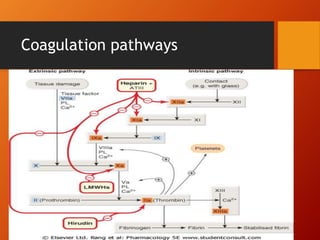
Coagulation pathways
Heparin
• Heparin is a Glycosaminoglycan
• Secretory granules of mast cells
• Commercial heparin – Porcine intestinal mucosa,
Bovine lung
• Doses are specified in units of activity – 150units/mg
Mechanism of action of Heparin
• Heparin acts as a catalytic
template for both antithrombin
and thrombin.
• Increases the rate of reaction by
1000 fold.
• Conformational change in
antithrombin – facilitates
reaction with Xa. (LMW heparins)
• Interfere with platelet
aggregation
• Releases lipoprotein lipase.
Pharmacokinetics
• No oral route
• Intravenous – Immediate onset of action
• Subcutaneous route – delayed by 1-2hrs
• Half life 1-5 hrs
• Anticoagulant of choice in pregnancy
Clinical uses
• Venous thrombosis and
pulmonary embolism.
• Unstable angina or acute
myocardial infarction.
• During and after coronary
angioplasty or stent
placement.
• Low dose s/c heparin in
Preventing venous
thromboembolism.
Administration and monitoring
• Intravenous bolus of 5000units followed by 750-
1000units/hr infusion. OR
• Deep s/c injection of 10,000-20,000 units every
8-12hrs.
• Low dose s/c regimen: 5000units every 8-12hrs.
• Activated partial thromboplastin time (aPTT) is
maintained at 1.5-2.5 times the patients
pretreatment value.
Adverse effects
• Bleeding
(Protamine sulfate 1mg
neutralizes 100u heparin)
• Thrombocytopenia
Other less frequent toxicities
• Mild elevations of serum
transaminase levels
• Osteoporosis
• Hyperkalemia
• Allergic reactions (rare).
Contraindications
• Bleeding disorders,
• Heparin induced thrombocytopenia
• Severe hypertension, threatened abortion, piles,
peptic ulcers
• Subacute bacterial endocarditis, large
malignancies, tuberculosis.
• Ocular and neurosurgery and lumbar puncture
• Caution when patient is on aspirin or other
anticoagulants.
LMW Heparins
• Heparin is fractionated into LMW forms
• Selectively inhibit factor Xa
• Act only by inducing conformational change
in AT III
• Hence smaller effect on aPTT
• Eg. Enoxaparin, Reviparin, Nadroparin,
Dalteparin, Fondaparinux
Mechanism of action
Heparin Vs LMW heparin
Heparin
• High molecular weight
(10,000-20,000)
• SC bioavailability variable
• Short duration of action
• aPTT ( activated partial
thromboplastin time)
monitoring
• Interacts with platelets
• Antigenic, Can cause
Thrombocytopenia
• Cheap
LMW heparin
• Low molecular weight (3000-
7000)
• Better SC bioavailability
• Longer duration of action
(OD, SC)
• aPTT monitoring not required
• Interacts less with platelets
• No thrombocytopenia
• Slightly expensive
Thank you