Anticoagulants,
and
Antiplatelet Drugs
BY: DR. K.S.K JUSU
Department of Haematology
COMAHS- USL
anticoagulants
Drugs that help prevent the clotting of blood
Coagulation will occur intravenously once a blood
vessel has been severed.
Blood begin to solidify to prevent excessive blood
loss and to prevent invasive substances from
entering the blood stream.
Heparin
Is a non molecular mixture of straight chain
mucopolysaccharide.
Average molecular weight of 10000 to 20000.
Potentiates the activity of antithrombin lll.
Must be given via injection.
Its biological half life is about one hour.
Inactivated by liver and excreted in urine
Present in all tissue containing mast cells eg:
lung,liver and intestinal mucosa.
Anticoagulant action of heparin
heparin
activates plasma AT lll
heparin AT lll complex
binds to clotting factors of intrinsic and common
pathways(lla, Xllla, IXa, Xa, and Xlla) and
inactivate them.
Other actions of heparin
Heparin in higher doses inhibits platelet
aggregation and prolongs bleeding time.
In lower doses helps in lipaemia clearing.
pharmacokinetics
Heparin is not absorbed orally
Acts instantaneously when given iv
If given s.c ,injection, anticoagulant effect
develops after 60min.
Heparin does not cross blood-brain barrier or
placenta
Metabolised in liver by heparinase.
Fragments are excreted in urine
Adverse effects
Bleeding due to overdose( most serious)
Thrombocytopenia( mild and transient)
Infrequent transient and reversible alopecia
Osteoporosis-long term use of relatively high dose
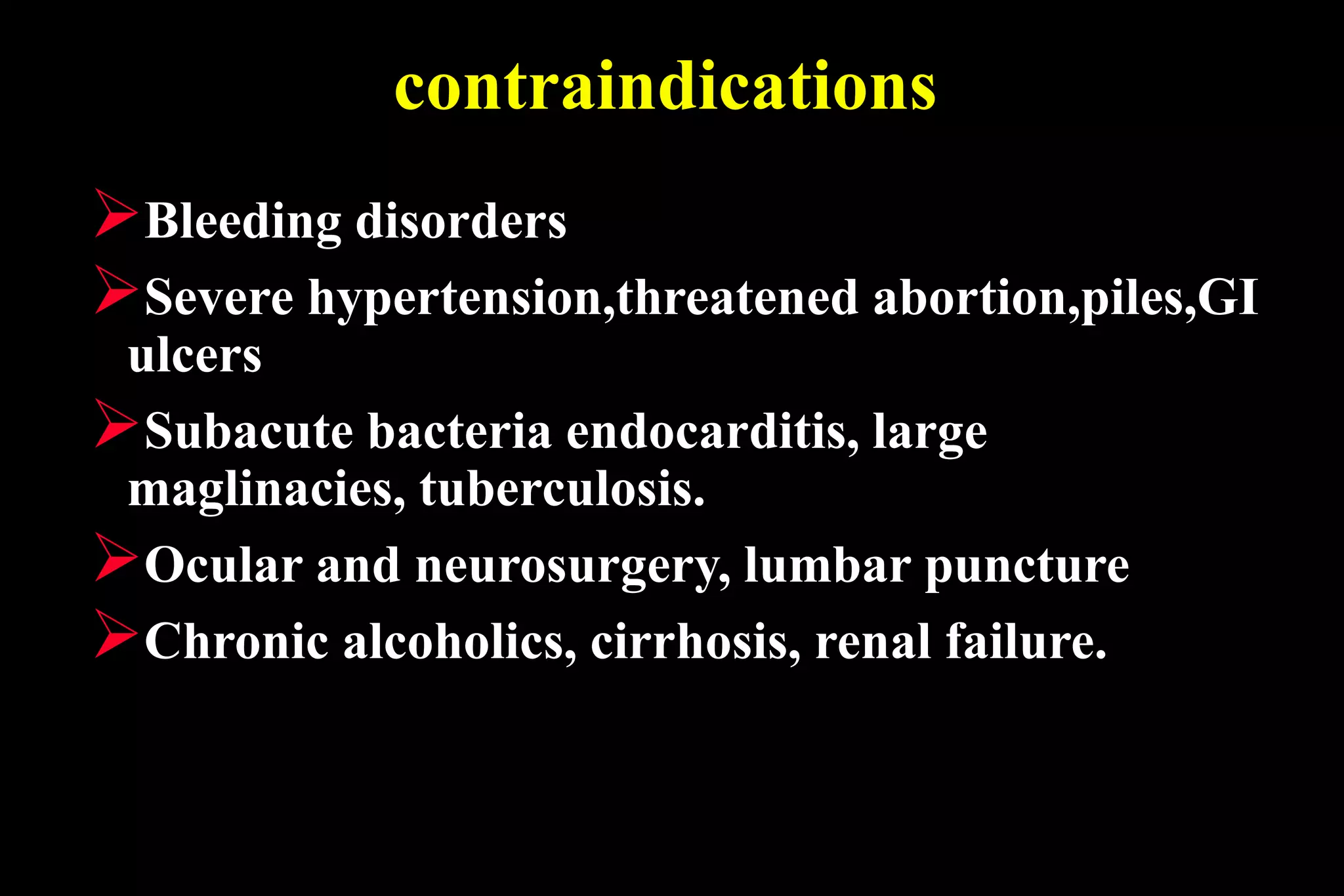
contraindications
Bleeding disorders
Severe hypertension,threatened abortion,piles,GI
ulcers
Subacute bacteria endocarditis, large
maglinacies, tuberculosis.
Ocular and neurosurgery, lumbar puncture
Chronic alcoholics, cirrhosis, renal failure.
LOW MOLECULAR
WEIGHT(LMW) HEPARINS.
Heparin has been fractionated into LMW forms
by different techniques.
Have low molecular weight less than 8000.
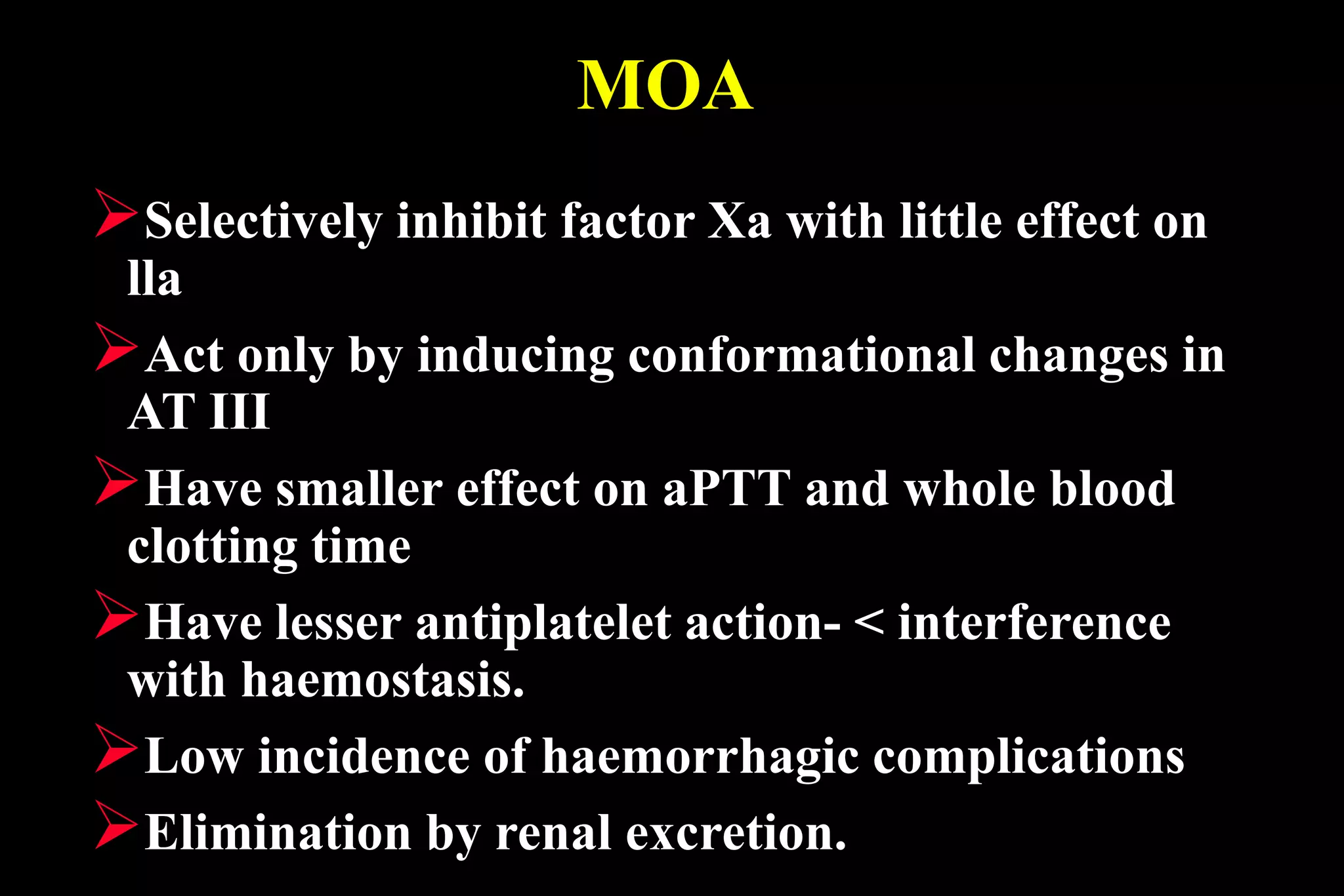
MOA
Selectively inhibit factor Xa with little effect on
lla
Act only by inducing conformational changes in
AT III
Have smaller effect on aPTT and whole blood
clotting time
Have lesser antiplatelet action- < interference
with haemostasis.
Low incidence of haemorrhagic complications
Elimination by renal excretion.
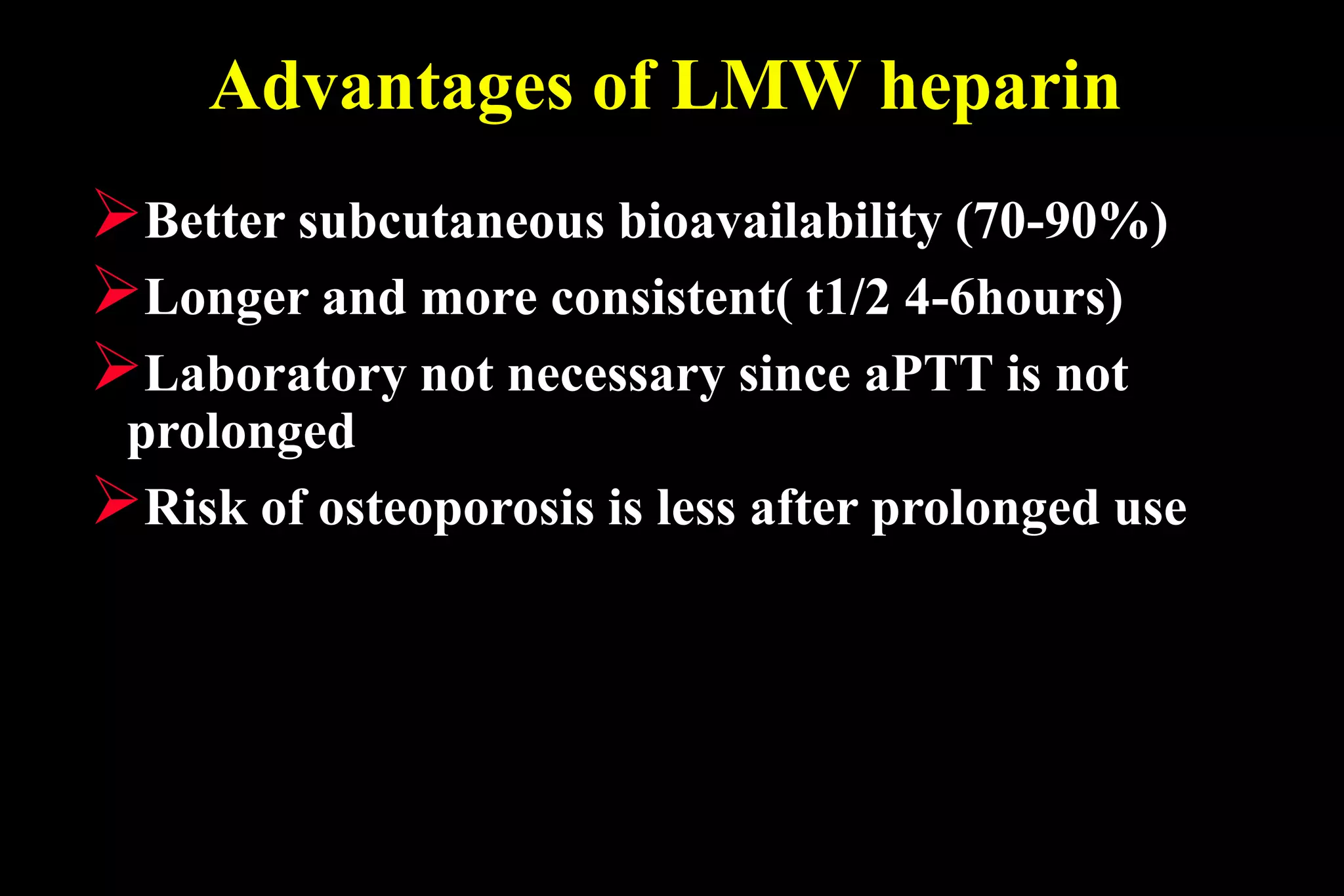
Advantages of LMW heparin
Better subcutaneous bioavailability (70-90%)
Longer and more consistent( t1/2 4-6hours)
Laboratory not necessary since aPTT is not
prolonged
Risk of osteoporosis is less after prolonged use
Indications
As prophylaxis and treatment for DVT.
Prophylaxis of PE in high risk patient undergoing
surgery.
Management of unstable angina and MI.
To maintain patency of canulae and shunts in
dialysis patient.
Examples of LMW heparin
Enoxaparin
Reviparin
Nadroparin
Dalteparin
Pamaparin
Ardeparin
WARFARIN
In the early 20th century, bis-hydroxycoumarin(
dicumarol) was discovered after cows livestock
had eaten spoiled sweet clover and died of a
haemorrhagic disease.
Today its deriavatives are used therapeutically as
anticoagulants and commercially as rodenticides.
Warfarin is the most common oral anticoagulant
used today.
Warfarin….
Is an oral coumarin anticoagulant widely used to
prevent and control thromboembolic disorders.
It is available as R and S type
The s-warfarin has 3-5 times greater
anticoagulation potency than the other.
Mechanism of action
It inhibits hepatic synthesis of vitamin K
dependent factors.
It inhibits the action of vitamin K1- 2,3 epoxide
reductase.
pharmacokinetic
Has 100% bioavailability
It is highly bound to plasma protein, mainly
albumin.
Is distributed to the liver, lung, spleen and
kidneys but less distributed in breast milk
It crosses the placenta
Its anticoagulant effect after single dose is usually
5-7days.
Metabolized by hepatic cytochrome P-450
Indication for warfarin use
Prophylaxis and/or treatment of venous
thrombosis and PE
Prophylaxis and /or treatment of thromboembolic
complications associated with atrial fibrillation
and / or cardiac valve replacement.
Use in ischemic stroke or systemic embolization.
Warfarin monitoring
Prothrombin time(PT)- used to measure the
effect of warfarin. It measures the time taken for
clotting mechanism to progress. Normal range(15-
20 seconds).
International normalization ratio- is a
standardized way of expressing PT. Target range
is 2-3. Note that the longer it takes the blood to
clot, the higher the PT and INR
Adverse effects
Haematologic: haemoptysis, bruising, epistaxis,
bleeding gums, hematuria or haematochezia
Cardiovascular: hypotension, syncope, vasculitis
CNS: dizziness, fatigue, headache, lethargy
Hepatic: elevated liver enzymes, hepatitis,
jaundice.
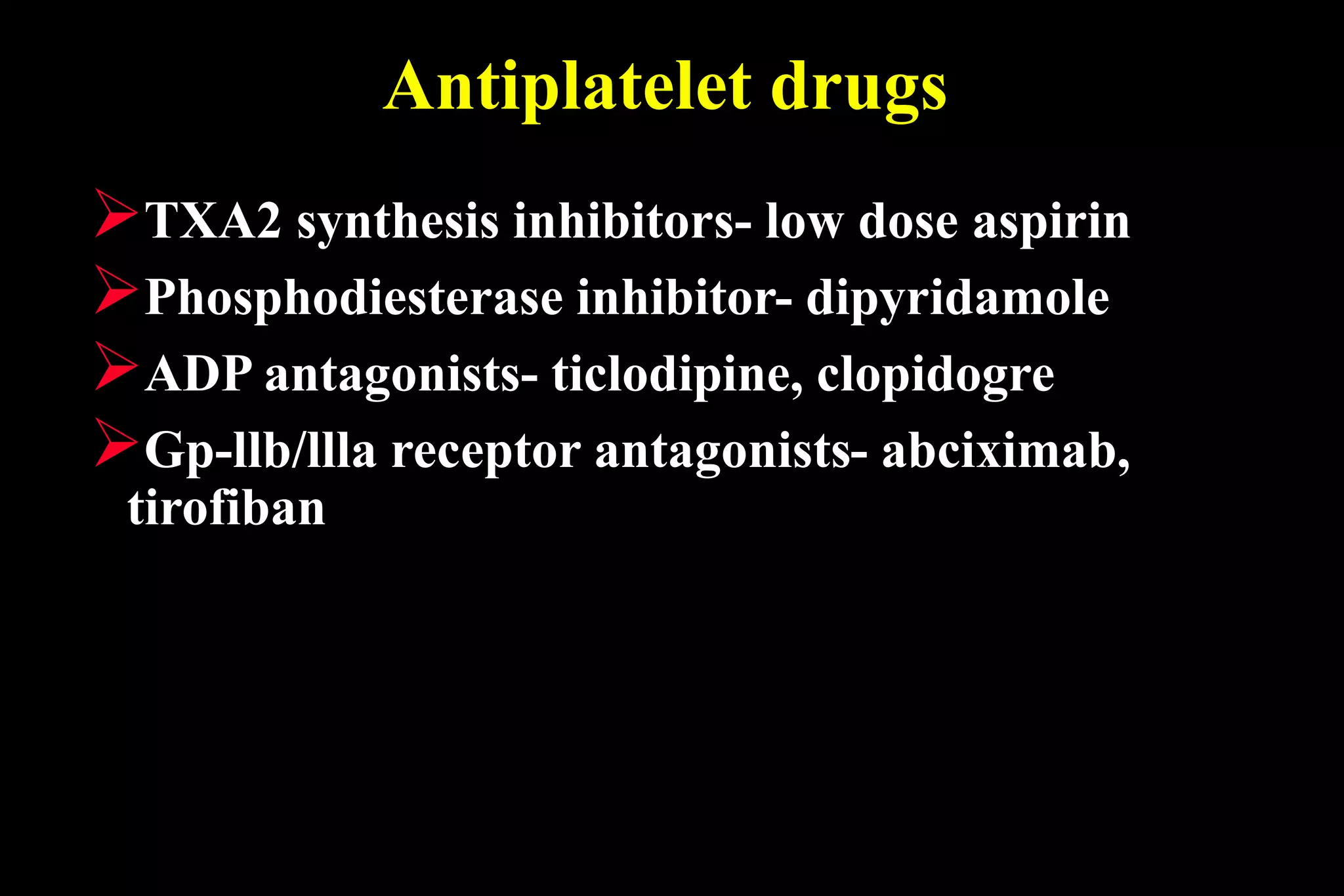
Antiplatelet drugs
TXA2 synthesis inhibitors- low dose aspirin
Phosphodiesterase inhibitor- dipyridamole
ADP antagonists- ticlodipine, clopidogre
Gp-llb/llla receptor antagonists- abciximab,
tirofiban
Aspirin
TXA2
prostaglandin H2
Cyclooxygenase-1 ASPIRIN
arachidonic acid
membrane phospholipids
Dipyridamole
Coronary vasodilator and relatively weak
antiplatelet
Potentiates effect of endogenous prostacycline
In high concentration inhibit phosphodiesterase,
so increase cAMP
Use with aspirin to prevent ischemic stroke in
patients of TIA
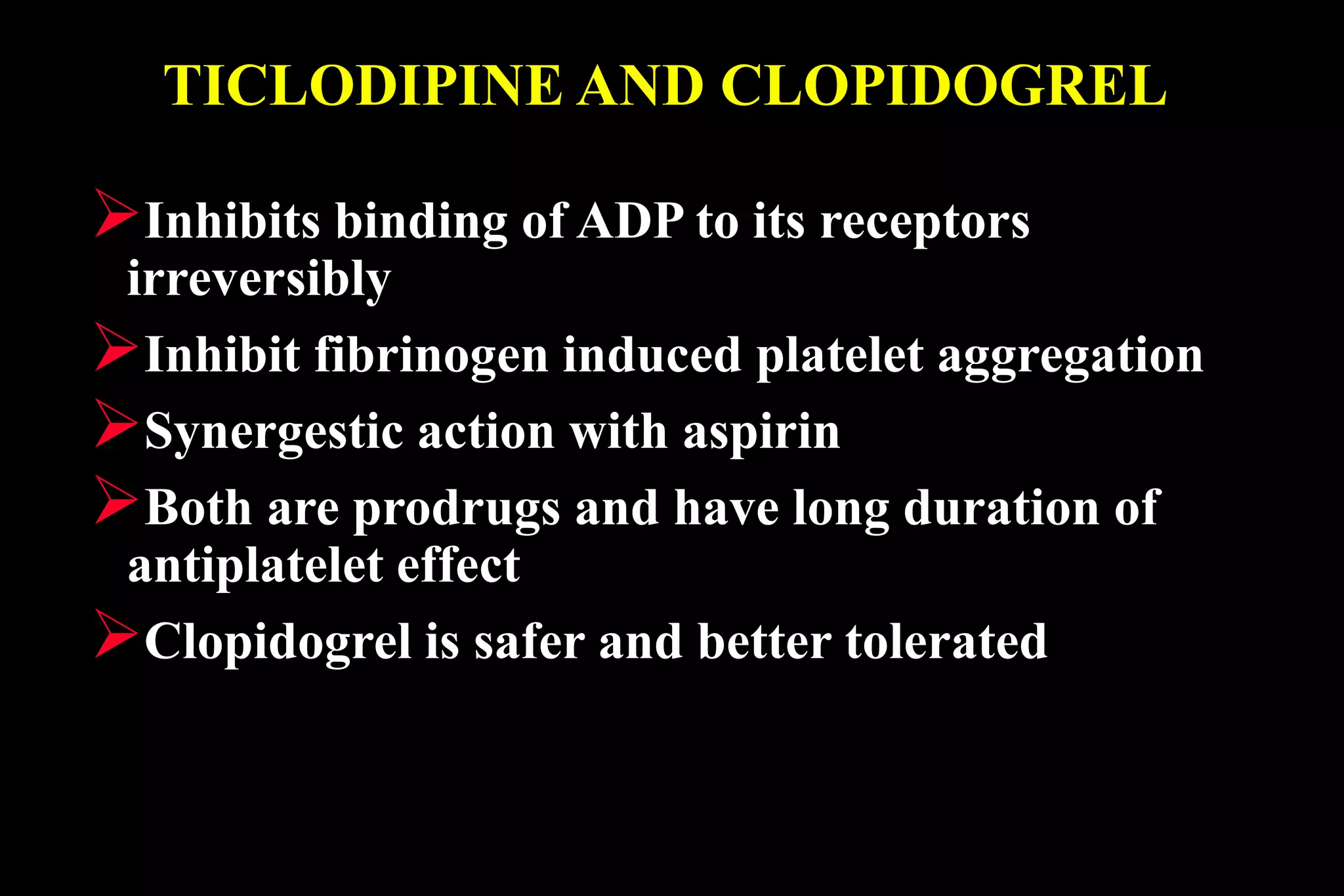
TICLODIPINE AND CLOPIDOGREL
Inhibits binding of ADP to its receptors
irreversibly
Inhibit fibrinogen induced platelet aggregation
Synergestic action with aspirin
Both are prodrugs and have long duration of
antiplatelet effect
Clopidogrel is safer and better tolerated
Uses of antiplatelet drugs
Prosthetic heart valves
Peripheral vascular disease
Coronary vascular diseases- MI, unstable angina
TIA
Venous thrombo-embolism

anticoagulants and antiplatelets.ppt

  • 1.
    Anticoagulants, and Antiplatelet Drugs BY: DR.K.S.K JUSU Department of Haematology COMAHS- USL
  • 2.
    anticoagulants Drugs that helpprevent the clotting of blood Coagulation will occur intravenously once a blood vessel has been severed. Blood begin to solidify to prevent excessive blood loss and to prevent invasive substances from entering the blood stream.
  • 3.
    Heparin Is a nonmolecular mixture of straight chain mucopolysaccharide. Average molecular weight of 10000 to 20000. Potentiates the activity of antithrombin lll. Must be given via injection. Its biological half life is about one hour. Inactivated by liver and excreted in urine Present in all tissue containing mast cells eg: lung,liver and intestinal mucosa.
  • 4.
    Anticoagulant action ofheparin heparin activates plasma AT lll heparin AT lll complex binds to clotting factors of intrinsic and common pathways(lla, Xllla, IXa, Xa, and Xlla) and inactivate them.
  • 5.
    Other actions ofheparin Heparin in higher doses inhibits platelet aggregation and prolongs bleeding time. In lower doses helps in lipaemia clearing.
  • 6.
    pharmacokinetics Heparin is notabsorbed orally Acts instantaneously when given iv If given s.c ,injection, anticoagulant effect develops after 60min. Heparin does not cross blood-brain barrier or placenta Metabolised in liver by heparinase. Fragments are excreted in urine
  • 7.
    Adverse effects Bleeding dueto overdose( most serious) Thrombocytopenia( mild and transient) Infrequent transient and reversible alopecia Osteoporosis-long term use of relatively high dose
  • 8.
    contraindications Bleeding disorders Severe hypertension,threatenedabortion,piles,GI ulcers Subacute bacteria endocarditis, large maglinacies, tuberculosis. Ocular and neurosurgery, lumbar puncture Chronic alcoholics, cirrhosis, renal failure.
  • 9.
    LOW MOLECULAR WEIGHT(LMW) HEPARINS. Heparinhas been fractionated into LMW forms by different techniques. Have low molecular weight less than 8000.
  • 10.
    MOA Selectively inhibit factorXa with little effect on lla Act only by inducing conformational changes in AT III Have smaller effect on aPTT and whole blood clotting time Have lesser antiplatelet action- < interference with haemostasis. Low incidence of haemorrhagic complications Elimination by renal excretion.
  • 11.
    Advantages of LMWheparin Better subcutaneous bioavailability (70-90%) Longer and more consistent( t1/2 4-6hours) Laboratory not necessary since aPTT is not prolonged Risk of osteoporosis is less after prolonged use
  • 12.
    Indications As prophylaxis andtreatment for DVT. Prophylaxis of PE in high risk patient undergoing surgery. Management of unstable angina and MI. To maintain patency of canulae and shunts in dialysis patient.
  • 13.
    Examples of LMWheparin Enoxaparin Reviparin Nadroparin Dalteparin Pamaparin Ardeparin
  • 14.
    WARFARIN In the early20th century, bis-hydroxycoumarin( dicumarol) was discovered after cows livestock had eaten spoiled sweet clover and died of a haemorrhagic disease. Today its deriavatives are used therapeutically as anticoagulants and commercially as rodenticides. Warfarin is the most common oral anticoagulant used today.
  • 15.
    Warfarin…. Is an oralcoumarin anticoagulant widely used to prevent and control thromboembolic disorders. It is available as R and S type The s-warfarin has 3-5 times greater anticoagulation potency than the other.
  • 16.
    Mechanism of action Itinhibits hepatic synthesis of vitamin K dependent factors. It inhibits the action of vitamin K1- 2,3 epoxide reductase.
  • 17.
    pharmacokinetic Has 100% bioavailability Itis highly bound to plasma protein, mainly albumin. Is distributed to the liver, lung, spleen and kidneys but less distributed in breast milk It crosses the placenta Its anticoagulant effect after single dose is usually 5-7days. Metabolized by hepatic cytochrome P-450
  • 18.
    Indication for warfarinuse Prophylaxis and/or treatment of venous thrombosis and PE Prophylaxis and /or treatment of thromboembolic complications associated with atrial fibrillation and / or cardiac valve replacement. Use in ischemic stroke or systemic embolization.
  • 19.
    Warfarin monitoring Prothrombin time(PT)-used to measure the effect of warfarin. It measures the time taken for clotting mechanism to progress. Normal range(15- 20 seconds). International normalization ratio- is a standardized way of expressing PT. Target range is 2-3. Note that the longer it takes the blood to clot, the higher the PT and INR
  • 20.
    Adverse effects Haematologic: haemoptysis,bruising, epistaxis, bleeding gums, hematuria or haematochezia Cardiovascular: hypotension, syncope, vasculitis CNS: dizziness, fatigue, headache, lethargy Hepatic: elevated liver enzymes, hepatitis, jaundice.
  • 21.
    Antiplatelet drugs TXA2 synthesisinhibitors- low dose aspirin Phosphodiesterase inhibitor- dipyridamole ADP antagonists- ticlodipine, clopidogre Gp-llb/llla receptor antagonists- abciximab, tirofiban
  • 22.
  • 23.
    Dipyridamole Coronary vasodilator andrelatively weak antiplatelet Potentiates effect of endogenous prostacycline In high concentration inhibit phosphodiesterase, so increase cAMP Use with aspirin to prevent ischemic stroke in patients of TIA
  • 24.
    TICLODIPINE AND CLOPIDOGREL Inhibitsbinding of ADP to its receptors irreversibly Inhibit fibrinogen induced platelet aggregation Synergestic action with aspirin Both are prodrugs and have long duration of antiplatelet effect Clopidogrel is safer and better tolerated
  • 25.
    Uses of antiplateletdrugs Prosthetic heart valves Peripheral vascular disease Coronary vascular diseases- MI, unstable angina TIA Venous thrombo-embolism