ANATOMY
• EMBRYOLOGY
• GAMETOGENESIS ( 2nd )
• Dr. Chongo Shapi (BSc. HB, MBChB)
• Medical Doctor.
2022/11/08 Dr. Chongo Shapi, BSc. HB, MBChB. 1
OUTLINE
• Introduction
• Concept of chromosome
• Mitosis or meiosis?
• Spermatogenesis
• Oogenesis
2022/11/08 Dr. Chongo Shapi, BSc. HB, MBChB. 2
INTRODUCTION
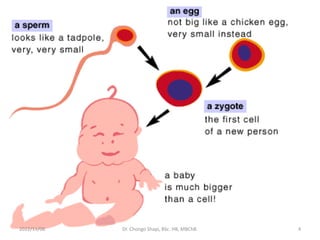
• Gametogenesis is the formation of gametes (sex
cells). The creation of highly specialized sex cells
through a process called MEIOSIS.
• It occurs in the gonads (testis and ovary).
• There are two types of gametogenesis:
(1) Spermatogenesis: formation of sperm in male.
(2) Oogenesis: formation of egg in female.
2022/11/08 Dr. Chongo Shapi, BSc. HB, MBChB. 3
2022/11/08 Dr. Chongo Shapi, BSc. HB, MBChB. 4
SOMATIC AND GERMLINE CELLS
• Development of a fertilized egg into an adult
results in two distinct types of cells
– Somatic cells
• These create all tissues and organs of the adult except
for cells destined to become sperm or egg
• They can only undergo mitosis
– Germline cells
• The final differentiated form of these cells are mature
gametes: the sperm and egg
• These cells undergo mitosis until gametogenesis
– They then undergo meiosis
2022/11/08 Dr. Chongo Shapi, BSc. HB, MBChB. 5
PRIMORDIAL GERM CELLS
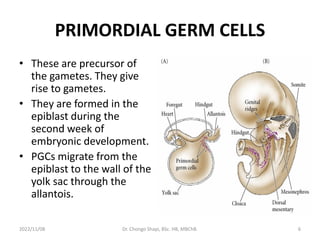
• These are precursor of
the gametes. They give
rise to gametes.
• They are formed in the
epiblast during the
second week of
embryonic development.
• PGCs migrate from the
epiblast to the wall of the
yolk sac through the
allantois.
2022/11/08 Dr. Chongo Shapi, BSc. HB, MBChB. 6
PRIMORDIAL GERM CELLS
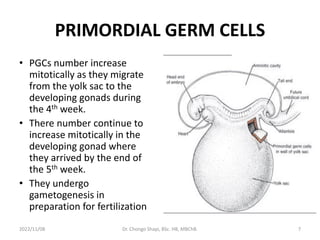
• PGCs number increase
mitotically as they migrate
from the yolk sac to the
developing gonads during
the 4th week.
• There number continue to
increase mitotically in the
developing gonad where
they arrived by the end of
the 5th week.
• They undergo
gametogenesis in
preparation for fertilization
2022/11/08 Dr. Chongo Shapi, BSc. HB, MBChB. 7
Chromosomes in Dividing Cells
• Duplicated
chromosomes are
called chromatids.
• They are held together
by the centromere.
2022/11/08 Dr. Chongo Shapi, BSc. HB, MBChB. 8
REPLICATION OF CHROMOSOMES
• Replication is the process
of duplicating
chromosome.
• The new copy of a
chromosome is formed by
DNA synthesis during S-
phase.
• The chromosome copies
are called sister
chromatids.
• Sister chromatids are held
together at the
centromere.
2022/11/08 Dr. Chongo Shapi, BSc. HB, MBChB. 9
CONT’
• Replication is the
process of duplicating
a chromosome.
• Occurs prior to
division.
• Replicated copies are
called sister
chromatids.
• Held together at
centromere
10
Occurs in
Interphase
2022/11/08 Dr. Chongo Shapi, BSc. HB, MBChB.
KARYOTYPE
• A picture of the
chromosomes from a
human cell arranged in
pairs by size
• First 22 pairs are called
autosomes
• Last pair are the sex
chromosomes
• XX female or XY male
11
2022/11/08 Dr. Chongo Shapi, BSc. HB, MBChB.
Boy or Girl?
12
Y - Chromosome
X - Chromosome
The Y Chromosome Decides
2022/11/08 Dr. Chongo Shapi, BSc. HB, MBChB.
CELL CYCLE AND CELL DIVISION
• Mitosis
• Meiosis
• Mitosis is for growth
and repair.
• Meiosis is for formation
of gametes. (sexual
reproduction).
Cells
Mature
DNA Copied
Cells prepare for
Division
2022/11/08 Dr. Chongo Shapi, BSc. HB, MBChB. 13
MITOSIS
2022/11/08 Dr. Chongo Shapi, BSc. HB, MBChB. 14
Eukaryotic Cell Division
✓ Used for growth and
repair
✓ Produce two new cells
identical to the original
cell
✓ Cells are diploid (2n)
15
Chromosomes during Metaphase
of mitosis
Prophase Metaphase Anaphase Telophase Cytokinesis
2022/11/08 Dr. Chongo Shapi, BSc. HB, MBChB.
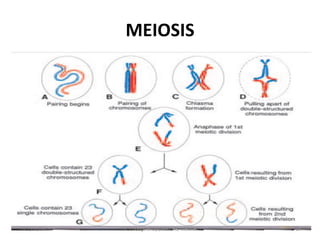
MEIOSIS
• Preceded by interphase
which includes
chromosome replication
• Two meiotic divisions ---
Meiosis I and Meiosis II
• Called Reduction-
division
• Original cell is diploid
(2n)
• Four daughter cells
produced that are
monoploid (1n)
• Daughter cells contain
half the number of
chromosomes as the
original cell
• Produces gametes (eggs
& sperm)
• Occurs in the testes in
males (Spermatogenesis)
• Occurs in the ovaries in
females (Oogenesis)
2022/11/08 Dr. Chongo Shapi, BSc. HB, MBChB. 16
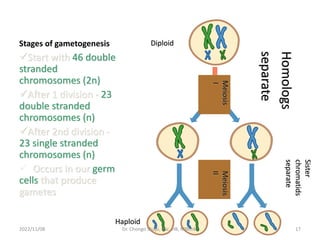
Stages of gametogenesis
Homologs
separate
✓Start with 46 double
stranded
chromosomes (2n)
✓After 1 division - 23
double stranded
chromosomes (n)
✓After 2nd division -
23 single stranded
chromosomes (n)
✓ Occurs in our germ
cells that produce
gametes
Meiosis
I
Meiosis
II
Sister
chromatids
separate
Diploid
Haploid
2022/11/08 Dr. Chongo Shapi, BSc. HB, MBChB. 17
MEIOSIS
2022/11/08 Dr. Chongo Shapi, BSc. HB, MBChB. 18
SPERMATOGENESIS
• Is the series of events that occur in the
seminiferous tubule of the testes that leads to
the production of sperm or spermatozoa.
• Duration/Onset: It begins during puberty,
around the age of 14 years and continues.
• About 250 - 400 million sperm per day.
• The PGCs that migrated to the developing
gonad (testes) differentiated into
spermatogonia.
2022/11/08 Dr. Chongo Shapi, BSc. HB, MBChB. 19
BEFORE PUBERTY AND AFTER
PUBERTY.
• Before puberty: at birth, the germ
cells in the male gonad (testes) are
in the sex cord as large, pale cells
surrounded with supporting cells
called sustentacular cells or sertoli
cells.
• Shorthly before puberty: sex cord
acquires lumen and become the
seminiferous tubules.
• At the same time, the PGCs
differentiated to spermatogonial
stem cells. (spermatogonia).
• SSCs divde mitotically until puberty.
The daughter cells becomes
spermatogonia.
2022/11/08 Dr. Chongo Shapi, BSc. HB, MBChB. 20
AT PUBERTY
• Spermatogenesis begins.
• Each spematogonium divide
mitotically to form distinct
daughter cells type A and B.
• Type A: remains at the
basement menbrane to
maintain the germ cell line.
• Type B: gets pushed
towards the lumen, where it
becomes a primary
spermatocyte destined to
produce four spermatozoa.
2022/11/08 Dr. Chongo Shapi, BSc. HB, MBChB. 21
STAGES OF SPERMATOGENESIS
• Each primary spermatocyte generated
undergoes meiosis to produce four
spermatozoa.
• During meiosis I, the prophase is long
(22 days). This is follow by rapid
completionof meiosis I.
• Each primary spermatocytes forms two
haploid secondary sprmatocytes.
• During meiosis II, secondary
spermatocytess form four haploid
spermatids.
• Throughout all these events, there is
incomplete cytokinesis, therfore, the
cellsare joined by cytoplasmic bridges..
• The spermatids remain embedded in
the deep recesses of sertoli cells
throughout their development.
•
2022/11/08 Dr. Chongo Shapi, BSc. HB, MBChB. 22
Mammalian
Spermatogenesis
1 type A = 16 type B = 64
spermatids
Meiosis I
Meiosis II
2022/11/08 Dr. Chongo Shapi, BSc. HB, MBChB. 23
HORMONAL REGULATION OF
SPERMATOGENESIS
• This involves interactions between the hypothalamus, anterior
pituitary gland and testes.
• They relationship is called brain-testicular axis.
• The hypothalamus releases GnRH which bind to pituitary gland to
release Follicle Stimulating Hormone and Luteinizing Hormone.
• LH binds to the interstitial cells and stimulate them to release
testosterone which trigger spermatogenesis.
• FSH stmimulates spermatogenesis by indirectly by stimulating
sertoli cells to release androgen-binding protein (ABP).
• ABP prompts the spermatogenic cells to bind and concentrate
testosterone.
• FSH makes the cells receptive to testosterone’s stimulatory effects.
2022/11/08 Dr. Chongo Shapi, BSc. HB, MBChB. 24
SPERMIOGENESIS
• is the series of morphological
changes resulting in the
transformation of spermatids into
spermatozoa. Is a streamlining
process.
STAGES:
• Formation of the acrosome that
cover half of the nuclear surface.
• Condensation of the nucleus.
• Formation of the neck, middle
piece, and tail.
• Shedding of most of the
cytoplasm.
Note: In human, from
spermatogonium to mature
spermatozoon takes 64 to 72 days.
2022/11/08 Dr. Chongo Shapi, BSc. HB, MBChB. 25
2022/11/08 Dr. Chongo Shapi, BSc. HB, MBChB. 26
OOGENESIS
✓Occurs in the ovaries
✓Two divisions produce 3
polar bodies that die and 1
egg
✓Polar bodies die because of
unequal division of
cytoplasm
✓Immature egg called oocyte
✓It takes year to complete.
✓It begins during fetal
period.
✓It ends at menopause.
2022/11/08 Dr. Chongo Shapi, BSc. HB, MBChB. 27
PRENATAL STAGE OF OOGENESIS
• This is a series of events that leads to formation of mature
oocyte. The PGCs differentiate into oogonia on getting to
the female gonad.
• Oogonia multiply rapidly by mitosis , and then enter a
growth phase to form primary oocytes. By 3rd month, they
are arranged into clusters each surrounded by follicular
cells.
• By 5th week of prenatal development, about 7 million
oogonia are in the ovary.
• By 7th month, majority of oogonia and primary oocytes
become atretic. Surviving primary oocytes have already
entered meiosis I but arrested at the prophase (diplotene
stage)
2022/11/08 Dr. Chongo Shapi, BSc. HB, MBChB. 28
PRENATAL STAGE OF OOGENESIS
• Each primary oocyte is surrounded by follicular cells,
and called primordial follicle.
• They primary follicles remain arrested until puberty is
reached.
• The arrest is caused by Oocyte Maturation Inhibition
(OMI) produced by the follicular cells. (peptide).
• At birth total primary oocyte is about 600, 000 to 800,
000.
• Most of them become atretic during childhood.
• About 40,000 are present at puberty.
• Less than 500 will be ovulated.
2022/11/08 Dr. Chongo Shapi, BSc. HB, MBChB. 29
AT PUBERTY
• Fluid filled space appear within the granulosa
and coalese to form the antrum (secondary
follicle).
• The antrum enlarged, and the push the oocyte
and granulosa cell around it to the periphery.
• The granulosa cells surrounding the oocytes form
cumulus oophorus.
• At this stage, the theca internal and externa
merge with ovarian stroma.
• At this stage it is called Secondary follicle.
• The secondary follicle continues to enlarge until
it reaches maturity and produce a swelling on
the surface of the ovary.
• A surge in LH induces the Preovulatory Growth
Phase.
• Meiosis I is completed , resulting information of
one secondary oocyte and first polar body.
• The first pola r body is locatd between zona
pellucida and cell membrane of secondary
oocyte. The perivitelline space.
• The enter meiosis II but arrest at metaphase for
about 3 hours before ovulation.
• Meiosis II is not completed until fertilization..
• POOL of growing follicles are
established.
• Each month, 15 to 20 are selected for
maturation but only one will succeed.
• They pass through three (3) stages of
maturation.
- Primary follicle
- secondary/ antral
- preovulatory (graafian follicle)
• Primary oocyte begins to grow, the
follicular cells becomes cuboidal and
become granulosa cells. Primary
follicle is formed.
• Granulosa cells are separated from
the stromal cells by theca folliculi.
• Zona pellucidal (glycoprotein layer) is
secreted by the oocyte and granulosa
on the oocyte surface.
• as the growth continues, theca
folliculi organise into:
- theca interna (secretory cells)
- theca externa (fibrous capsule)
2022/11/08 Dr. Chongo Shapi, BSc. HB, MBChB. 30
2022/11/08 Dr. Chongo Shapi, BSc. HB, MBChB. 31
2022/11/08 Dr. Chongo Shapi, BSc. HB, MBChB. 32
HORMONAL REGULATION OF
OOGENESIS
• Oogenesis is regulated and completed at puberty under the
influence of hormones.
• The hypothalamus releases gonadotropin-releasing
hormone (GnRH) which stimulate the pituitary gland to
release FSH and LH.
• FSH stimulate the development of ovarian follicles. Each
month it stimulate the growth of 15-20 primary follicles.
• FSH also stimulate production of estrogen by follicular cells.
• Luteinizing hormone (LH) serves as the trigger for ovulation
(release of secondary oocyte).
• LH also stimulates follicular and corpus luteum to produce
progesterone.
2022/11/08 Dr. Chongo Shapi, BSc. HB, MBChB. 33
Female Genital System
• The Ovary: female sex gland, produce ova.
• The Uterus: in which the fetus develop.
2022/11/08 Dr. Chongo Shapi, BSc. HB, MBChB. 34
THANK YOU!
• Whatever goes up, surely must come down.
2022/11/08 Dr. Chongo Shapi, BSc. HB, MBChB. 35

Gametogenesis 2nd.pdf

  • 1.
    ANATOMY • EMBRYOLOGY • GAMETOGENESIS( 2nd ) • Dr. Chongo Shapi (BSc. HB, MBChB) • Medical Doctor. 2022/11/08 Dr. Chongo Shapi, BSc. HB, MBChB. 1
  • 2.
    OUTLINE • Introduction • Conceptof chromosome • Mitosis or meiosis? • Spermatogenesis • Oogenesis 2022/11/08 Dr. Chongo Shapi, BSc. HB, MBChB. 2
  • 3.
    INTRODUCTION • Gametogenesis isthe formation of gametes (sex cells). The creation of highly specialized sex cells through a process called MEIOSIS. • It occurs in the gonads (testis and ovary). • There are two types of gametogenesis: (1) Spermatogenesis: formation of sperm in male. (2) Oogenesis: formation of egg in female. 2022/11/08 Dr. Chongo Shapi, BSc. HB, MBChB. 3
  • 4.
    2022/11/08 Dr. ChongoShapi, BSc. HB, MBChB. 4
  • 5.
    SOMATIC AND GERMLINECELLS • Development of a fertilized egg into an adult results in two distinct types of cells – Somatic cells • These create all tissues and organs of the adult except for cells destined to become sperm or egg • They can only undergo mitosis – Germline cells • The final differentiated form of these cells are mature gametes: the sperm and egg • These cells undergo mitosis until gametogenesis – They then undergo meiosis 2022/11/08 Dr. Chongo Shapi, BSc. HB, MBChB. 5
  • 6.
    PRIMORDIAL GERM CELLS •These are precursor of the gametes. They give rise to gametes. • They are formed in the epiblast during the second week of embryonic development. • PGCs migrate from the epiblast to the wall of the yolk sac through the allantois. 2022/11/08 Dr. Chongo Shapi, BSc. HB, MBChB. 6
  • 7.
    PRIMORDIAL GERM CELLS •PGCs number increase mitotically as they migrate from the yolk sac to the developing gonads during the 4th week. • There number continue to increase mitotically in the developing gonad where they arrived by the end of the 5th week. • They undergo gametogenesis in preparation for fertilization 2022/11/08 Dr. Chongo Shapi, BSc. HB, MBChB. 7
  • 8.
    Chromosomes in DividingCells • Duplicated chromosomes are called chromatids. • They are held together by the centromere. 2022/11/08 Dr. Chongo Shapi, BSc. HB, MBChB. 8
  • 9.
    REPLICATION OF CHROMOSOMES •Replication is the process of duplicating chromosome. • The new copy of a chromosome is formed by DNA synthesis during S- phase. • The chromosome copies are called sister chromatids. • Sister chromatids are held together at the centromere. 2022/11/08 Dr. Chongo Shapi, BSc. HB, MBChB. 9
  • 10.
    CONT’ • Replication isthe process of duplicating a chromosome. • Occurs prior to division. • Replicated copies are called sister chromatids. • Held together at centromere 10 Occurs in Interphase 2022/11/08 Dr. Chongo Shapi, BSc. HB, MBChB.
  • 11.
    KARYOTYPE • A pictureof the chromosomes from a human cell arranged in pairs by size • First 22 pairs are called autosomes • Last pair are the sex chromosomes • XX female or XY male 11 2022/11/08 Dr. Chongo Shapi, BSc. HB, MBChB.
  • 12.
    Boy or Girl? 12 Y- Chromosome X - Chromosome The Y Chromosome Decides 2022/11/08 Dr. Chongo Shapi, BSc. HB, MBChB.
  • 13.
    CELL CYCLE ANDCELL DIVISION • Mitosis • Meiosis • Mitosis is for growth and repair. • Meiosis is for formation of gametes. (sexual reproduction). Cells Mature DNA Copied Cells prepare for Division 2022/11/08 Dr. Chongo Shapi, BSc. HB, MBChB. 13
  • 14.
    MITOSIS 2022/11/08 Dr. ChongoShapi, BSc. HB, MBChB. 14
  • 15.
    Eukaryotic Cell Division ✓Used for growth and repair ✓ Produce two new cells identical to the original cell ✓ Cells are diploid (2n) 15 Chromosomes during Metaphase of mitosis Prophase Metaphase Anaphase Telophase Cytokinesis 2022/11/08 Dr. Chongo Shapi, BSc. HB, MBChB.
  • 16.
    MEIOSIS • Preceded byinterphase which includes chromosome replication • Two meiotic divisions --- Meiosis I and Meiosis II • Called Reduction- division • Original cell is diploid (2n) • Four daughter cells produced that are monoploid (1n) • Daughter cells contain half the number of chromosomes as the original cell • Produces gametes (eggs & sperm) • Occurs in the testes in males (Spermatogenesis) • Occurs in the ovaries in females (Oogenesis) 2022/11/08 Dr. Chongo Shapi, BSc. HB, MBChB. 16
  • 17.
    Stages of gametogenesis Homologs separate ✓Startwith 46 double stranded chromosomes (2n) ✓After 1 division - 23 double stranded chromosomes (n) ✓After 2nd division - 23 single stranded chromosomes (n) ✓ Occurs in our germ cells that produce gametes Meiosis I Meiosis II Sister chromatids separate Diploid Haploid 2022/11/08 Dr. Chongo Shapi, BSc. HB, MBChB. 17
  • 18.
    MEIOSIS 2022/11/08 Dr. ChongoShapi, BSc. HB, MBChB. 18
  • 19.
    SPERMATOGENESIS • Is theseries of events that occur in the seminiferous tubule of the testes that leads to the production of sperm or spermatozoa. • Duration/Onset: It begins during puberty, around the age of 14 years and continues. • About 250 - 400 million sperm per day. • The PGCs that migrated to the developing gonad (testes) differentiated into spermatogonia. 2022/11/08 Dr. Chongo Shapi, BSc. HB, MBChB. 19
  • 20.
    BEFORE PUBERTY ANDAFTER PUBERTY. • Before puberty: at birth, the germ cells in the male gonad (testes) are in the sex cord as large, pale cells surrounded with supporting cells called sustentacular cells or sertoli cells. • Shorthly before puberty: sex cord acquires lumen and become the seminiferous tubules. • At the same time, the PGCs differentiated to spermatogonial stem cells. (spermatogonia). • SSCs divde mitotically until puberty. The daughter cells becomes spermatogonia. 2022/11/08 Dr. Chongo Shapi, BSc. HB, MBChB. 20
  • 21.
    AT PUBERTY • Spermatogenesisbegins. • Each spematogonium divide mitotically to form distinct daughter cells type A and B. • Type A: remains at the basement menbrane to maintain the germ cell line. • Type B: gets pushed towards the lumen, where it becomes a primary spermatocyte destined to produce four spermatozoa. 2022/11/08 Dr. Chongo Shapi, BSc. HB, MBChB. 21
  • 22.
    STAGES OF SPERMATOGENESIS •Each primary spermatocyte generated undergoes meiosis to produce four spermatozoa. • During meiosis I, the prophase is long (22 days). This is follow by rapid completionof meiosis I. • Each primary spermatocytes forms two haploid secondary sprmatocytes. • During meiosis II, secondary spermatocytess form four haploid spermatids. • Throughout all these events, there is incomplete cytokinesis, therfore, the cellsare joined by cytoplasmic bridges.. • The spermatids remain embedded in the deep recesses of sertoli cells throughout their development. • 2022/11/08 Dr. Chongo Shapi, BSc. HB, MBChB. 22
  • 23.
    Mammalian Spermatogenesis 1 type A= 16 type B = 64 spermatids Meiosis I Meiosis II 2022/11/08 Dr. Chongo Shapi, BSc. HB, MBChB. 23
  • 24.
    HORMONAL REGULATION OF SPERMATOGENESIS •This involves interactions between the hypothalamus, anterior pituitary gland and testes. • They relationship is called brain-testicular axis. • The hypothalamus releases GnRH which bind to pituitary gland to release Follicle Stimulating Hormone and Luteinizing Hormone. • LH binds to the interstitial cells and stimulate them to release testosterone which trigger spermatogenesis. • FSH stmimulates spermatogenesis by indirectly by stimulating sertoli cells to release androgen-binding protein (ABP). • ABP prompts the spermatogenic cells to bind and concentrate testosterone. • FSH makes the cells receptive to testosterone’s stimulatory effects. 2022/11/08 Dr. Chongo Shapi, BSc. HB, MBChB. 24
  • 25.
    SPERMIOGENESIS • is theseries of morphological changes resulting in the transformation of spermatids into spermatozoa. Is a streamlining process. STAGES: • Formation of the acrosome that cover half of the nuclear surface. • Condensation of the nucleus. • Formation of the neck, middle piece, and tail. • Shedding of most of the cytoplasm. Note: In human, from spermatogonium to mature spermatozoon takes 64 to 72 days. 2022/11/08 Dr. Chongo Shapi, BSc. HB, MBChB. 25
  • 26.
    2022/11/08 Dr. ChongoShapi, BSc. HB, MBChB. 26
  • 27.
    OOGENESIS ✓Occurs in theovaries ✓Two divisions produce 3 polar bodies that die and 1 egg ✓Polar bodies die because of unequal division of cytoplasm ✓Immature egg called oocyte ✓It takes year to complete. ✓It begins during fetal period. ✓It ends at menopause. 2022/11/08 Dr. Chongo Shapi, BSc. HB, MBChB. 27
  • 28.
    PRENATAL STAGE OFOOGENESIS • This is a series of events that leads to formation of mature oocyte. The PGCs differentiate into oogonia on getting to the female gonad. • Oogonia multiply rapidly by mitosis , and then enter a growth phase to form primary oocytes. By 3rd month, they are arranged into clusters each surrounded by follicular cells. • By 5th week of prenatal development, about 7 million oogonia are in the ovary. • By 7th month, majority of oogonia and primary oocytes become atretic. Surviving primary oocytes have already entered meiosis I but arrested at the prophase (diplotene stage) 2022/11/08 Dr. Chongo Shapi, BSc. HB, MBChB. 28
  • 29.
    PRENATAL STAGE OFOOGENESIS • Each primary oocyte is surrounded by follicular cells, and called primordial follicle. • They primary follicles remain arrested until puberty is reached. • The arrest is caused by Oocyte Maturation Inhibition (OMI) produced by the follicular cells. (peptide). • At birth total primary oocyte is about 600, 000 to 800, 000. • Most of them become atretic during childhood. • About 40,000 are present at puberty. • Less than 500 will be ovulated. 2022/11/08 Dr. Chongo Shapi, BSc. HB, MBChB. 29
  • 30.
    AT PUBERTY • Fluidfilled space appear within the granulosa and coalese to form the antrum (secondary follicle). • The antrum enlarged, and the push the oocyte and granulosa cell around it to the periphery. • The granulosa cells surrounding the oocytes form cumulus oophorus. • At this stage, the theca internal and externa merge with ovarian stroma. • At this stage it is called Secondary follicle. • The secondary follicle continues to enlarge until it reaches maturity and produce a swelling on the surface of the ovary. • A surge in LH induces the Preovulatory Growth Phase. • Meiosis I is completed , resulting information of one secondary oocyte and first polar body. • The first pola r body is locatd between zona pellucida and cell membrane of secondary oocyte. The perivitelline space. • The enter meiosis II but arrest at metaphase for about 3 hours before ovulation. • Meiosis II is not completed until fertilization.. • POOL of growing follicles are established. • Each month, 15 to 20 are selected for maturation but only one will succeed. • They pass through three (3) stages of maturation. - Primary follicle - secondary/ antral - preovulatory (graafian follicle) • Primary oocyte begins to grow, the follicular cells becomes cuboidal and become granulosa cells. Primary follicle is formed. • Granulosa cells are separated from the stromal cells by theca folliculi. • Zona pellucidal (glycoprotein layer) is secreted by the oocyte and granulosa on the oocyte surface. • as the growth continues, theca folliculi organise into: - theca interna (secretory cells) - theca externa (fibrous capsule) 2022/11/08 Dr. Chongo Shapi, BSc. HB, MBChB. 30
  • 31.
    2022/11/08 Dr. ChongoShapi, BSc. HB, MBChB. 31
  • 32.
    2022/11/08 Dr. ChongoShapi, BSc. HB, MBChB. 32
  • 33.
    HORMONAL REGULATION OF OOGENESIS •Oogenesis is regulated and completed at puberty under the influence of hormones. • The hypothalamus releases gonadotropin-releasing hormone (GnRH) which stimulate the pituitary gland to release FSH and LH. • FSH stimulate the development of ovarian follicles. Each month it stimulate the growth of 15-20 primary follicles. • FSH also stimulate production of estrogen by follicular cells. • Luteinizing hormone (LH) serves as the trigger for ovulation (release of secondary oocyte). • LH also stimulates follicular and corpus luteum to produce progesterone. 2022/11/08 Dr. Chongo Shapi, BSc. HB, MBChB. 33
  • 34.
    Female Genital System •The Ovary: female sex gland, produce ova. • The Uterus: in which the fetus develop. 2022/11/08 Dr. Chongo Shapi, BSc. HB, MBChB. 34
  • 35.
    THANK YOU! • Whatevergoes up, surely must come down. 2022/11/08 Dr. Chongo Shapi, BSc. HB, MBChB. 35