BY;
Y.V.VANAJA
LECTURER
VIJAY MARIE COLLEGE OF NURSING
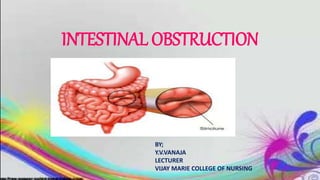
INTESTINAL OBSTRUCTION
Introduction
• Bowel obstruction, also known as intestinal obstruction, is a
mechanical or functional obstruction of the intestines which prevents
the normal movement of the products of digestion. Either the small
bowel or large bowel may be affected.
When a blockage occurs, food and drink cannot pass through the body.
Obstructions are serious and need to be treated immediately. They may
even require surgery.
Definition
Intestinal obstruction exists when blockage prevents the normal flow of intestinal
contents through the intestinal tract.
“Brunner”
Intestinal obstruction occurs when the intestinal contents cannot pass through the
GI tract, and it requires prompt treatment. The obstruction may be partial or
complete.
“Lewis”
An intestinal obstruction is a potentially serious condition in which the intestines
are blocked. The blockage may be either partial or complete, occurring at one or
more locations. Both the small intestine and large intestine, called the colon, can
be affected
https://www.healthline.com/health/intestinal-obstructions
Types
Intestinal obstruction
Mechanical
Non mechanical
Pseudoobstruction
Vascular obstruction
Mechanical obstruction
• Mechanical obstruction may be caused by an occlusion of the lumen
of the intestinal tract.
• Most intestinal obstructions occurs in the small intestinal tract, most
often in the ileum
• Mechanical obstruction account for 90% of all intestinal obstructions
• Adhesions account for 50% - can develop after abdominal surgery
• Hernias for 15%
• Neoplasms for 15% of obstruction of the SI
• Carcinoma is the most common cause of large bowel obstruction
followed by volvulus and diverticular disease
Non Mechanical obstruction
• Non mechanical obstruction may result from a neuromuscular or
vascular disorder.
• Paralytic ileus is the most common form of the non mechanical
obstruction.
• Other causes of Paralytic ileus include inflammatory responses
Pseudoobstruction
• Pseudoobstruction is an apparent mechanical obstruction of the intestine
without demonstration of obstruction by radiologic methods
• Collagen vascular diseases, neurologic and endocrine disorders may cause
pseuoobstruction
Vascular Obstruction:
• Are rare and are due to an interference with the blood supply to a portion of the
intestine
CLASSIFICATION
 Dynamic/ Adynamic
 Small bowel obstruction [ high or low ]
 Large bowel obstruction
 Acute
 Chronic
 Acute on chronic
 Subacute
 Simple - (no vascular impairment)
 Strangulated
 Closed loop obstruction- ( both ends are obstructed e.g volvulus)
INTESTINAL OBSTRUCTION IS CLASSIFIED IN
TWO TYPES
 DYNAMIC : where peristalsis is working against a mechanical
obstruction.
 ADYNAMIC: it may occur in two forms
1. 1st where peristalsis may be absent(paralytic ileus,)occurring
secondarily to neuromuscular failure in the mesentery.
2. 2nd where peristalsis may be present in non- propulsive
form.(pseudo-obstruction)
• IN BOTH FORMS MECHANICAL ELEMENT IS ABSENT.
ON THE BASIS OF ONSET IT IS CLASSIFIED IN
TO
 ACUTE
 CHRONIC
 ACUTE ON CHRONIC
 SUBACUTE
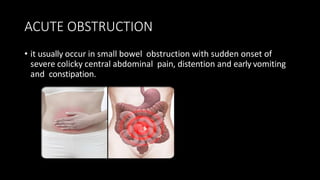
ACUTE OBSTRUCTION
• it usually occur in small bowel obstruction with sudden onset of
severe colicky central abdominal pain, distention and early vomiting
and constipation.
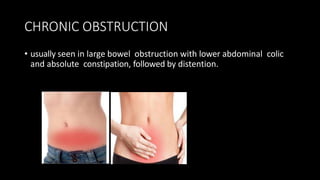
CHRONIC OBSTRUCTION
• usually seen in large bowel obstruction with lower abdominal colic
and absolute constipation, followed by distention.
ACUTE ON CHRONIC OBSTRUCTION :
 it starts in large bowel but gradually involves the small intestine.
 early symptoms are pain and constipation but when small intestine is
involved it is characterized by vomiting and general distention.
ON THE BASIS ,WHETHER THE OBSTRUCTION
IS
 simple mechanical
 Strangulated – obstruction with compromised blood flow
 closed loop – blockage in two different areas
Etiology
• Mechanical obstructions can result from;
• Mechanical obstructions are when something physically blocks the small
intestine. This can be due to:
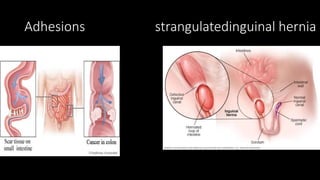
• Adhesions: fibrous tissue that develops after abdominal surgery.
• Benign or malignant tumor
• Complications of appendicitis
• Hernias
• Fecal impaction
• Strictures due to crohn’s disease or previous radiation therapy
Adhesions strangulatedinguinal hernia
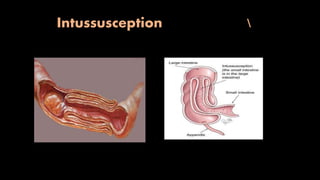
Intussusception
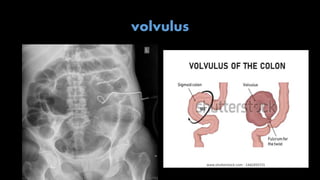
volvulus
• Intussuception
• Volvulus
• Fibrosis due to disorders such as endometriosis
• Vascular disorders
• In the people ages 65 years or older, diverticulitis, tumors, and fecal
impaction are the most common causes of obstruction
• Paralytic or Non mechanical obstructions result from :
• Handling of the intestines during the abdominal surgery
• Electrolyte disturbances especially hypokalemia
• Vascular insufficiency to the bowel – intestinal ischemia
Small bowel obstruction
• Small bowel obstruction is a partial or complete blockage of
the small intestine, which is a part of the digestive system.
Small bowel obstruction can be caused by many things,
including adhesions, hernia and inflammatory bowel
disorders.
Pathophysiology
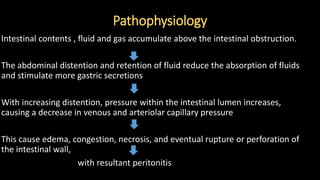
Intestinal contents , fluid and gas accumulate above the intestinal obstruction.
The abdominal distention and retention of fluid reduce the absorption of fluids
and stimulate more gastric secretions
With increasing distention, pressure within the intestinal lumen increases,
causing a decrease in venous and arteriolar capillary pressure
This cause edema, congestion, necrosis, and eventual rupture or perforation of
the intestinal wall,
with resultant peritonitis
Clinical Manifestations;
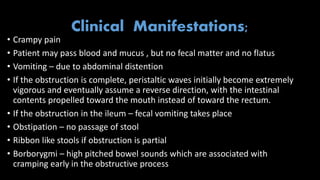
• Crampy pain
• Patient may pass blood and mucus , but no fecal matter and no flatus
• Vomiting – due to abdominal distention
• If the obstruction is complete, peristaltic waves initially become extremely
vigorous and eventually assume a reverse direction, with the intestinal
contents propelled toward the mouth instead of toward the rectum.
• If the obstruction in the ileum – fecal vomiting takes place
• Obstipation – no passage of stool
• Ribbon like stools if obstruction is partial
• Borborygmi – high pitched bowel sounds which are associated with
cramping early in the obstructive process
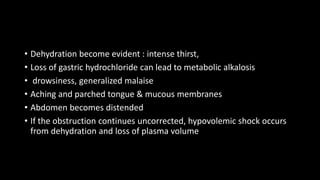
• Dehydration become evident : intense thirst,
• Loss of gastric hydrochloride can lead to metabolic alkalosis
• drowsiness, generalized malaise
• Aching and parched tongue & mucous membranes
• Abdomen becomes distended
• If the obstruction continues uncorrected, hypovolemic shock occurs
from dehydration and loss of plasma volume
Diagnostic Findings
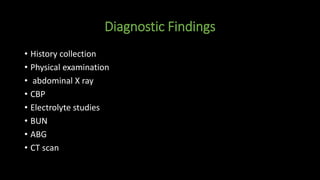
• History collection
• Physical examination
• abdominal X ray
• CBP
• Electrolyte studies
• BUN
• ABG
• CT scan
Medical management
• Semi fowler’s position helps to alleviate the pressure of abdominal
distention on chest
• IV infusion that contain normal saline and potassium should be given to
maintain fluid and electrolyte balance
• TPN may be necessary to correct nutritional deficiencies
• Decompression of the bowel through a NG tube or small bowel tube
• When the bowel is completely obstructed the possibility of strangulation
warrants surgical intervention.
• Repairing the hernia or dividing the adhesion to which the intestine is
attached
• In some instances, the portion of affected bowel may be removed and an
anastomosis performed.
Large Bowel Obstruction
Large bowel (intestinal) obstruction occurs when there is a blockage in
the colon or rectum that prevents food or gas from passing through.
This leads to swelling of the intestine.
Pathophysiology
• Large bowel obstruction results in an accumulation of intestinal contents, fluid,
and gas proximal to the obstruction
• Obstruction in the large bowel can lead to severe distention and perforation
unless some gas and some fluid can flow back through the ileal valve.
• If the blood supply is cut off, however intestinal strangulation and necrosis occur
In the large intestine, dehydration occurs slowly than in the small intestine
Clinical Manifestations
• if the obstruction in the sigmoid colon constipation
• Abdominal distention
• Loops of large bowel become visibly outlined through the abdominal
wall
• Crampy lower abdominal pain
• Fecal vomiting
• Symptoms of shock
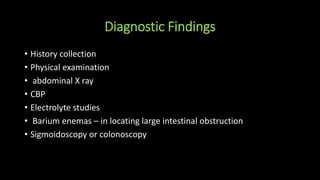
Diagnostic Findings
• History collection
• Physical examination
• abdominal X ray
• CBP
• Electrolyte studies
• Barium enemas – in locating large intestinal obstruction
• Sigmoidoscopy or colonoscopy
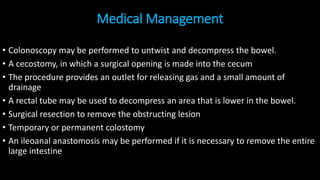
Medical Management
• Colonoscopy may be performed to untwist and decompress the bowel.
• A cecostomy, in which a surgical opening is made into the cecum
• The procedure provides an outlet for releasing gas and a small amount of
drainage
• A rectal tube may be used to decompress an area that is lower in the bowel.
• Surgical resection to remove the obstructing lesion
• Temporary or permanent colostomy
• An ileoanal anastomosis may be performed if it is necessary to remove the entire
large intestine

Intestinal obstruction

  • 1.
    BY; Y.V.VANAJA LECTURER VIJAY MARIE COLLEGEOF NURSING INTESTINAL OBSTRUCTION
  • 2.
    Introduction • Bowel obstruction,also known as intestinal obstruction, is a mechanical or functional obstruction of the intestines which prevents the normal movement of the products of digestion. Either the small bowel or large bowel may be affected. When a blockage occurs, food and drink cannot pass through the body. Obstructions are serious and need to be treated immediately. They may even require surgery.
  • 3.
    Definition Intestinal obstruction existswhen blockage prevents the normal flow of intestinal contents through the intestinal tract. “Brunner” Intestinal obstruction occurs when the intestinal contents cannot pass through the GI tract, and it requires prompt treatment. The obstruction may be partial or complete. “Lewis” An intestinal obstruction is a potentially serious condition in which the intestines are blocked. The blockage may be either partial or complete, occurring at one or more locations. Both the small intestine and large intestine, called the colon, can be affected https://www.healthline.com/health/intestinal-obstructions
  • 4.
  • 5.
    Mechanical obstruction • Mechanicalobstruction may be caused by an occlusion of the lumen of the intestinal tract. • Most intestinal obstructions occurs in the small intestinal tract, most often in the ileum • Mechanical obstruction account for 90% of all intestinal obstructions • Adhesions account for 50% - can develop after abdominal surgery • Hernias for 15% • Neoplasms for 15% of obstruction of the SI • Carcinoma is the most common cause of large bowel obstruction followed by volvulus and diverticular disease
  • 6.
    Non Mechanical obstruction •Non mechanical obstruction may result from a neuromuscular or vascular disorder. • Paralytic ileus is the most common form of the non mechanical obstruction. • Other causes of Paralytic ileus include inflammatory responses
  • 7.
    Pseudoobstruction • Pseudoobstruction isan apparent mechanical obstruction of the intestine without demonstration of obstruction by radiologic methods • Collagen vascular diseases, neurologic and endocrine disorders may cause pseuoobstruction Vascular Obstruction: • Are rare and are due to an interference with the blood supply to a portion of the intestine
  • 8.
    CLASSIFICATION  Dynamic/ Adynamic Small bowel obstruction [ high or low ]  Large bowel obstruction  Acute  Chronic  Acute on chronic  Subacute  Simple - (no vascular impairment)  Strangulated  Closed loop obstruction- ( both ends are obstructed e.g volvulus)
  • 9.
    INTESTINAL OBSTRUCTION ISCLASSIFIED IN TWO TYPES  DYNAMIC : where peristalsis is working against a mechanical obstruction.  ADYNAMIC: it may occur in two forms 1. 1st where peristalsis may be absent(paralytic ileus,)occurring secondarily to neuromuscular failure in the mesentery. 2. 2nd where peristalsis may be present in non- propulsive form.(pseudo-obstruction) • IN BOTH FORMS MECHANICAL ELEMENT IS ABSENT.
  • 10.
    ON THE BASISOF ONSET IT IS CLASSIFIED IN TO  ACUTE  CHRONIC  ACUTE ON CHRONIC  SUBACUTE
  • 11.
    ACUTE OBSTRUCTION • itusually occur in small bowel obstruction with sudden onset of severe colicky central abdominal pain, distention and early vomiting and constipation.
  • 12.
    CHRONIC OBSTRUCTION • usuallyseen in large bowel obstruction with lower abdominal colic and absolute constipation, followed by distention.
  • 13.
    ACUTE ON CHRONICOBSTRUCTION :  it starts in large bowel but gradually involves the small intestine.  early symptoms are pain and constipation but when small intestine is involved it is characterized by vomiting and general distention.
  • 14.
    ON THE BASIS,WHETHER THE OBSTRUCTION IS  simple mechanical  Strangulated – obstruction with compromised blood flow  closed loop – blockage in two different areas
  • 15.
    Etiology • Mechanical obstructionscan result from; • Mechanical obstructions are when something physically blocks the small intestine. This can be due to: • Adhesions: fibrous tissue that develops after abdominal surgery. • Benign or malignant tumor • Complications of appendicitis • Hernias • Fecal impaction • Strictures due to crohn’s disease or previous radiation therapy
  • 16.
  • 17.
  • 18.
  • 19.
    • Intussuception • Volvulus •Fibrosis due to disorders such as endometriosis • Vascular disorders • In the people ages 65 years or older, diverticulitis, tumors, and fecal impaction are the most common causes of obstruction
  • 20.
    • Paralytic orNon mechanical obstructions result from : • Handling of the intestines during the abdominal surgery • Electrolyte disturbances especially hypokalemia • Vascular insufficiency to the bowel – intestinal ischemia
  • 21.
    Small bowel obstruction •Small bowel obstruction is a partial or complete blockage of the small intestine, which is a part of the digestive system. Small bowel obstruction can be caused by many things, including adhesions, hernia and inflammatory bowel disorders.
  • 22.
    Pathophysiology Intestinal contents ,fluid and gas accumulate above the intestinal obstruction. The abdominal distention and retention of fluid reduce the absorption of fluids and stimulate more gastric secretions With increasing distention, pressure within the intestinal lumen increases, causing a decrease in venous and arteriolar capillary pressure This cause edema, congestion, necrosis, and eventual rupture or perforation of the intestinal wall, with resultant peritonitis
  • 23.
    Clinical Manifestations; • Crampypain • Patient may pass blood and mucus , but no fecal matter and no flatus • Vomiting – due to abdominal distention • If the obstruction is complete, peristaltic waves initially become extremely vigorous and eventually assume a reverse direction, with the intestinal contents propelled toward the mouth instead of toward the rectum. • If the obstruction in the ileum – fecal vomiting takes place • Obstipation – no passage of stool • Ribbon like stools if obstruction is partial • Borborygmi – high pitched bowel sounds which are associated with cramping early in the obstructive process
  • 24.
    • Dehydration becomeevident : intense thirst, • Loss of gastric hydrochloride can lead to metabolic alkalosis • drowsiness, generalized malaise • Aching and parched tongue & mucous membranes • Abdomen becomes distended • If the obstruction continues uncorrected, hypovolemic shock occurs from dehydration and loss of plasma volume
  • 25.
    Diagnostic Findings • Historycollection • Physical examination • abdominal X ray • CBP • Electrolyte studies • BUN • ABG • CT scan
  • 26.
    Medical management • Semifowler’s position helps to alleviate the pressure of abdominal distention on chest • IV infusion that contain normal saline and potassium should be given to maintain fluid and electrolyte balance • TPN may be necessary to correct nutritional deficiencies • Decompression of the bowel through a NG tube or small bowel tube • When the bowel is completely obstructed the possibility of strangulation warrants surgical intervention. • Repairing the hernia or dividing the adhesion to which the intestine is attached • In some instances, the portion of affected bowel may be removed and an anastomosis performed.
  • 27.
    Large Bowel Obstruction Largebowel (intestinal) obstruction occurs when there is a blockage in the colon or rectum that prevents food or gas from passing through. This leads to swelling of the intestine.
  • 28.
    Pathophysiology • Large bowelobstruction results in an accumulation of intestinal contents, fluid, and gas proximal to the obstruction • Obstruction in the large bowel can lead to severe distention and perforation unless some gas and some fluid can flow back through the ileal valve. • If the blood supply is cut off, however intestinal strangulation and necrosis occur In the large intestine, dehydration occurs slowly than in the small intestine
  • 29.
    Clinical Manifestations • ifthe obstruction in the sigmoid colon constipation • Abdominal distention • Loops of large bowel become visibly outlined through the abdominal wall • Crampy lower abdominal pain • Fecal vomiting • Symptoms of shock
  • 30.
    Diagnostic Findings • Historycollection • Physical examination • abdominal X ray • CBP • Electrolyte studies • Barium enemas – in locating large intestinal obstruction • Sigmoidoscopy or colonoscopy
  • 31.
    Medical Management • Colonoscopymay be performed to untwist and decompress the bowel. • A cecostomy, in which a surgical opening is made into the cecum • The procedure provides an outlet for releasing gas and a small amount of drainage • A rectal tube may be used to decompress an area that is lower in the bowel. • Surgical resection to remove the obstructing lesion • Temporary or permanent colostomy • An ileoanal anastomosis may be performed if it is necessary to remove the entire large intestine

Editor's Notes

  • #2 BY; Y.V.VANAJA LECTURER VIJAY MARIE COLLEGE OF NURSING