HEMORRHOIDS
ANATOMY AND CLASSIFICATION
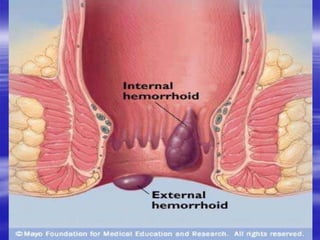
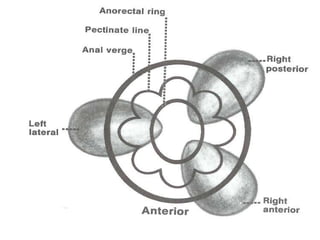
 right anterior, right posterior and left lateral
positions
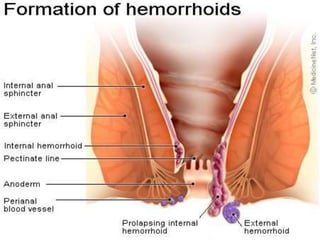
 those originating above the dentate line
which are termed internal
 those originating below the dentate line
which are termed external.
PATHOPHYSIOLOGY
 represent engorgement or enlargement of
the normal fibrovascular cushions lining the
anal canal.
 chronic straining secondary to constipation
or occasionally diarrhea
 fibrovascular cushions lose their attachment
to the underlying rectal wall.
PATHOPHYSIOLOGY
 prolapse of internal hemorrhoidal tissue
through the anal canal.
 the overlying mucosa becomes more friable
and the vasculature increases.
 With overlying thinning of the mucosa and
vascular engorgement, subsequent rectal
bleeding occurs.
ANATOMY AND CLASSIFICATION
 classified by history and not by physical
examination.
 Grade I - bleeding without prolapse.
 Grade II - prolapse with spontaneous reduction.
 Grade III - prolapse with manual reduction.
 Grade IV - incarcerated, irreducible prolapse.
SYMPTOMS
 bright red blood per rectum or a prolapsing
anal mass.
 with, or following, bowel movements, is
almost universally bright red, and very
commonly drips into the toilet water.
 Blood may also be seen while wiping after
defecation.
SYMPTOMS
 prolapse usually occurs in association with a
bowel movement,
 may also prolapse during walking or heavy lifting
as a result of increased intra-abdominal pressure.
 extreme pain, bleeding and occasionally signs of
systemic illness in case of strangulation.
PHYSICAL EXAMINATION
 Patients should be examined in the left lateral
decubitus position
 any rashes, condylomata, or eczematous lesions.
 external sphincter function
 Any abscesses, fissures or fistulae
PHYSICAL EXAMINATION
 lubricated finger should be gently inserted into the
anal canal while asking the patient to bear down
 the resting tone of the anal canal should be
ascertained as well as the voluntary contraction of
the puborectalis and external anal sphincter.
 masses should be noted as well as any areas of
tenderness.
PHYSICAL EXAMINATION
 internal hemorrhoids are generally not palpable on digital
examination.
 anoscopy is performed.
 The side viewing anoscope should be inserted with the
open portion in the right anterior then right posterior and
finally the left lateral position
 Hemorrhoidal bundles will appear as bulging mucosa and
anoderm within the open portion of the anoscope.
EVALUATION OF RECTAL
BLEEDING
 rule out rectal cancer.
 young individual with bleeding associated with
hemorrhoidal disease and no other systemic
symptoms, and no family history, perhaps
anoscopy and rigid sigmoidoscopy
 older individual, with either a family history of
colorectal cancer, or change in bowel habits, a
complete colonoscopy should be performed to rule
out proximal neoplasia.
TREATMENT
 varies from simple reassurance to operative
hemorrhoidectomy.
 Treatments are classified into three
categories:
1) Dietary and lifestyle modification.
2) Non operative/office procedures.
3) Operative hemorrhoidectomy.
DIETARY AND LIFESTYLE
MODIFICATIONS
 the main goal of this treatment is to minimize
straining at stool.
 achieved by increasing fluid and fiber in the diet,
recommending exercise, and perhaps adding fiber
agents to the diet such as psyllium.
 if necessary, stool softeners may be added.
 "you don't defecate in the library so you shouldn't
read in the bathroom".
Office Treatments
RUBBER BAND LIGATION
 Grade I or Grade II hemorrhoids and, in some
circumstances, Grade III hemorrhoids.
 Complications include bleeding, pain, thrombosis
and life threatening perineal sepsis.
 successful in two thirds to three quarters of all
individuals with first and second degree
hemorrhoids.
Office Treatments
RUBBER BAND LIGATION
 Bayer, Myslovaty, and Picovsky followed 2,934
patients banded over a 12 year period.
 Seventy-nine percent required no further therapy,
while eighteen percent required repeat banding
due to recurrence.
 Hemorrhoidectomy was necessary in 2.1% related
to persistent symptoms .
Office Treatments
INFRARED COAGULATION
 generates infrared radiation which
coagulates tissue protein and evaporates
water from cells.
 is most beneficial in Grade I and small
Grade II hemorrhoids.
Office Treatments
BICAP ELECTROCOAGULATION
 It works, in theory, similar to
photocoagulation or to rubber banding.
 the probe must be left in place for ten
minutes.
 poor patient tolerance minimized the effect
of this procedure.
Office Treatments
SCLEROTHERAPY
 injection of an irritating material into the
submucosa in order to decrease vascularity
and increase fibrosis.
 Injecting agents have traditionally been
phenol in oil, sodium morrhuate, or quinine
urea.
Office Treatments
 Manual anal dilatation was first described by
Lord .
 Cryotherapy was used in the past with the
belief that freezing the apex of the anal
canal could result in decreased vascularity
and fibrosis of the anal cushions.
Surgical Treatment of Hemorrhoids
HEMORRHOIDECTOMY
 The triangular shaped hemorrhoid is excised
down to the underlying sphincter muscle.
 Wound can be closed or left open
 stapled hemorrhoidectomy has been
developed as an alternative to standard
hemorrhoidectomy

Heamorrohoid lecture 1.ppt

  • 1.
  • 4.
    ANATOMY AND CLASSIFICATION right anterior, right posterior and left lateral positions  those originating above the dentate line which are termed internal  those originating below the dentate line which are termed external.
  • 7.
    PATHOPHYSIOLOGY  represent engorgementor enlargement of the normal fibrovascular cushions lining the anal canal.  chronic straining secondary to constipation or occasionally diarrhea  fibrovascular cushions lose their attachment to the underlying rectal wall.
  • 8.
    PATHOPHYSIOLOGY  prolapse ofinternal hemorrhoidal tissue through the anal canal.  the overlying mucosa becomes more friable and the vasculature increases.  With overlying thinning of the mucosa and vascular engorgement, subsequent rectal bleeding occurs.
  • 9.
    ANATOMY AND CLASSIFICATION classified by history and not by physical examination.  Grade I - bleeding without prolapse.  Grade II - prolapse with spontaneous reduction.  Grade III - prolapse with manual reduction.  Grade IV - incarcerated, irreducible prolapse.
  • 10.
    SYMPTOMS  bright redblood per rectum or a prolapsing anal mass.  with, or following, bowel movements, is almost universally bright red, and very commonly drips into the toilet water.  Blood may also be seen while wiping after defecation.
  • 11.
    SYMPTOMS  prolapse usuallyoccurs in association with a bowel movement,  may also prolapse during walking or heavy lifting as a result of increased intra-abdominal pressure.  extreme pain, bleeding and occasionally signs of systemic illness in case of strangulation.
  • 12.
    PHYSICAL EXAMINATION  Patientsshould be examined in the left lateral decubitus position  any rashes, condylomata, or eczematous lesions.  external sphincter function  Any abscesses, fissures or fistulae
  • 13.
    PHYSICAL EXAMINATION  lubricatedfinger should be gently inserted into the anal canal while asking the patient to bear down  the resting tone of the anal canal should be ascertained as well as the voluntary contraction of the puborectalis and external anal sphincter.  masses should be noted as well as any areas of tenderness.
  • 14.
    PHYSICAL EXAMINATION  internalhemorrhoids are generally not palpable on digital examination.  anoscopy is performed.  The side viewing anoscope should be inserted with the open portion in the right anterior then right posterior and finally the left lateral position  Hemorrhoidal bundles will appear as bulging mucosa and anoderm within the open portion of the anoscope.
  • 15.
    EVALUATION OF RECTAL BLEEDING rule out rectal cancer.  young individual with bleeding associated with hemorrhoidal disease and no other systemic symptoms, and no family history, perhaps anoscopy and rigid sigmoidoscopy  older individual, with either a family history of colorectal cancer, or change in bowel habits, a complete colonoscopy should be performed to rule out proximal neoplasia.
  • 16.
    TREATMENT  varies fromsimple reassurance to operative hemorrhoidectomy.  Treatments are classified into three categories: 1) Dietary and lifestyle modification. 2) Non operative/office procedures. 3) Operative hemorrhoidectomy.
  • 17.
    DIETARY AND LIFESTYLE MODIFICATIONS the main goal of this treatment is to minimize straining at stool.  achieved by increasing fluid and fiber in the diet, recommending exercise, and perhaps adding fiber agents to the diet such as psyllium.  if necessary, stool softeners may be added.  "you don't defecate in the library so you shouldn't read in the bathroom".
  • 18.
    Office Treatments RUBBER BANDLIGATION  Grade I or Grade II hemorrhoids and, in some circumstances, Grade III hemorrhoids.  Complications include bleeding, pain, thrombosis and life threatening perineal sepsis.  successful in two thirds to three quarters of all individuals with first and second degree hemorrhoids.
  • 19.
    Office Treatments RUBBER BANDLIGATION  Bayer, Myslovaty, and Picovsky followed 2,934 patients banded over a 12 year period.  Seventy-nine percent required no further therapy, while eighteen percent required repeat banding due to recurrence.  Hemorrhoidectomy was necessary in 2.1% related to persistent symptoms .
  • 20.
    Office Treatments INFRARED COAGULATION generates infrared radiation which coagulates tissue protein and evaporates water from cells.  is most beneficial in Grade I and small Grade II hemorrhoids.
  • 21.
    Office Treatments BICAP ELECTROCOAGULATION It works, in theory, similar to photocoagulation or to rubber banding.  the probe must be left in place for ten minutes.  poor patient tolerance minimized the effect of this procedure.
  • 22.
    Office Treatments SCLEROTHERAPY  injectionof an irritating material into the submucosa in order to decrease vascularity and increase fibrosis.  Injecting agents have traditionally been phenol in oil, sodium morrhuate, or quinine urea.
  • 23.
    Office Treatments  Manualanal dilatation was first described by Lord .  Cryotherapy was used in the past with the belief that freezing the apex of the anal canal could result in decreased vascularity and fibrosis of the anal cushions.
  • 24.
    Surgical Treatment ofHemorrhoids HEMORRHOIDECTOMY  The triangular shaped hemorrhoid is excised down to the underlying sphincter muscle.  Wound can be closed or left open  stapled hemorrhoidectomy has been developed as an alternative to standard hemorrhoidectomy