ZONAL P.G CME , HYDERABAD
PROF. SREEJOY PATNAIK
FAIS, FIAGES, FAMS.
HON.PROF. IMAAMS
LIFE MEMBER OSSI, IFSO,ELSA, IHPBA, IFSO
BARIATRIC AND METABOLIC SURGEON
SHANTI OMNI MULTI SUPER SPECIALITY
HOSPITAL
CUTTACK, ODISHA
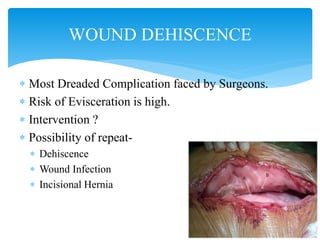
WOUND DEHISCENCE
 Most Dreaded Complication faced by Surgeons.
 Risk of Evisceration is high.
 Intervention ?
 Possibility of repeat-
 Dehiscence
 Wound Infection
 Incisional Hernia
Wound Dehiscence
 It is a rupture of the wound along the surgical
incision.
 Complication of Surgery
 The split - Surface Layers
-Deep Layers (whole wound)
 Abdominal wound dehiscence
 Wound failure
 Wound disruption
 Evisceration and Eventration.
SYNONYMS

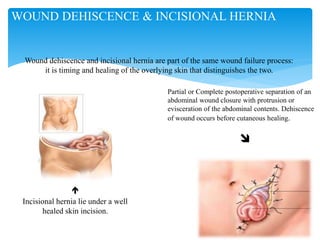
Incisional hernia lie under a well
healed skin incision.
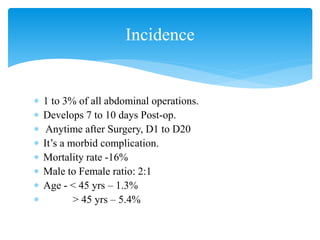
Partial or Complete postoperative separation of an
abdominal wound closure with protrusion or
evisceration of the abdominal contents. Dehiscence
of wound occurs before cutaneous healing.

WOUND DEHISCENCE & INCISIONAL HERNIA
Wound dehiscence and incisional hernia are part of the same wound failure process:
it is timing and healing of the overlying skin that distinguishes the two.
Partial postoperative separation 
Complete  postoperative separation
Incidence
 1 to 3% of all abdominal operations.
 Develops 7 to 10 days Post-op.
 Anytime after Surgery, D1 to D20
 It’s a morbid complication.
 Mortality rate -16%
 Male to Female ratio: 2:1
 Age - < 45 yrs – 1.3%
 > 45 yrs – 5.4%
Factors for wound breakdown
A . Local-
- Haematoma
- Seroma
B. Regional-
- Bowel Edema
- Abdominal distention
- Intra abdominal infections
- Haemorrhage
- Trauma
- Pre-op Int.obstruction
C. Systemic-
-Advanced age
- Malnutrition
- Pulmonary & Cardiac diseases
- Renal Failure
-Obesity
- DM
-RT & CT
- Jaundice
- Alcoholism
- Hypoproteinaemia
-
Factors for wound breakdown
D. Surgical -
- Emergency Procedure
-Imperfect techniques of
wound closure.
-Excessive tension
- Imperfect incision
- Prolonged OT time
- Trauma to wound post.op
- Poor knotting and suturing.
Factors for wound breakdown
E. Intra abdominal-
-Vomiting,
sneezing,
coughing
- Repeated urinary
retention
- Prolonged
Paralytic Ileus
Bleeding
Swelling
Redness
Pain
Unexplained fever
Unexplained tachycardia
Symptoms
 Unusual wound pain
 Broken sutures
 The wound opening
spontaneously
 Pus and /or frothy drainage
 Paralytic ileus
The patient may present as one or more of the following:
recent surgical wound not appearing to be healing properly
 Dehiscence usually declares itself 7-
14 days post.op and may occur
without warning.
 May manifest following straining or
removal of sutures.
 Patient often notes a “ ripping
sensation” or a feeling that “
something has given way”.
 Impending dehiscence is often
preceded by the appearance of
salmon pink serous discharge from
the wound. ( 85% of cases.}
Clinical Manifestations
Signs
 Failure of suture to remain anchored in the fascia.
 Suture breakage
 Knot failure
 Excessive stitch interval which allows protrusion of
viscera.
 Sutures and knots are intact, but the suture has pulled
through the fascia.
 (Result of fascial necrosis from sutures being placed too
close to the edge or under too much tension)
Causes of wound separation
 Midline incision is the most common.
 The rate of dehiscence is higher in midline than in
transverse incisions.
 Midline incision -”non-anatomic” cuts across the
aponeurotic fibres,
 Transverse incision which cuts paralell to the fibres.
 Contraction of the abdominal wall causes laterally directed
tension on the closure.
Operative Factors
Incision type?
 Data suggest that mass closure is equivalent to or better
than layered closure in preventing dehiscence.
 Mass closure is currently favoured because of its safety,
efficacy, and speed
Operative Factors
Mass versus Layered Closure?
 Several RCT’s - no statistically significant difference in the
incidence of wound disruption between the two techniques.
 Continuous suture is a reasonable closure technique because
of its safety, efficacy, and speed.
 Interrupted suture – Emergency procedure.
Operative Factors
Interrupted versus Continuous Sutures?
 Numerous studies have shown no difference in the
overall incidence of wound complications between
both sutures.
 Non-absorbable monofilament is ideal with high risk
factors for delayed healing.
Operative Factors
Absorbable vs. non-absorbable sutures?

 The stitch interval and the tissue bite size?
 Should be 1 cm. average with a range between 1-2 cm.
 Suture Length-to-Wound Length Ratio?
 Should be 4:1 or greater for continuous mass closure.
 A ratio < 4:1 is associated with an increased risk of WD and the
development of IH.
Operative Factors
 Suturing the peritoneum is not vital to prevent wound
dehiscence.
 RCT‘s show no difference in the wound disruption rate
with one-layered closure (peritoneum not sutured) than
two-layered closure.
 Normally peritoneal defects heal by simultaneous
regeneration.
Operative Factors
Peritoneal Closure or not?
Examination
 Assess Incision: Examine the entire wound.
 Look for leakage of fluid when palpated.
 Look for signs of infection.
 Wound or surrounding area look for signs of -
purulent discharge,
crepitus,
cellulitis with fluctuance,
inspect the inside of wound.
 Vital Signs: Look for fever
INSPECTION
Investigations:
LAB TESTS:
Wound and tissues c/s
Blood tests to determine if there is an
infection
IMAGING STUDIES:
X-ray: to evaluate the extent of
wound separation.
USG : to evaluate for pus and
pockets of fluid.
CT Scan : to evaluate for pus and
pockets of fluid.
 Focus should be based on-
 Nutritional support
 Circulatory support
 Therapy to be designed to –
 Eliminate necrotic tissue
 Control Bio burden
 Maintain optimal environment for granulation tissue formation
& epithelial migration.
 Broad spectrum Antibiotic therapy
 Frequent changes in wound dressing to prevent infection
 Wound exposure to air to accelerate healing and prevent
infection, and allow growth of new tissue from below.
Treatment
Non-operative treatment
Treatment
 Depends on
 Extent of Fascial Separation.
 Presence of Evisceration.
 Intra-abdomen Pathology (Int. leak, Peritonitis)
 Small Dehiscence
 Conservative Management
 Saline moistened gauze packs
 Abdominal Binders
 Large Dehiscence with Evisceration
 Saline moistened towel packing
 IV fluids resuscitation
 Preparation for closure OT
 Adequate Relaxation of the Patient
Pre-operative broad spectrum antibiotics
Re-suture with a mass closure with the placement of deep
retention sutures.
Deep bites of tissue, using plenty of suture material, and avoid
excessive tension on the wound.
 Close the skin fairly loosely
Superficial wound drain.
Gross wound sepsis - leave the skin open and pack
TREATMENT
Operative Treatment:
Steps of Management in OT
 Thorough exploration of abdominal cavity.
 Rule out presence of septic focus or anastomotic leak.
 Manage Infection.
 Assess the condition of fascia.
Strong & intact - Primary Closure
Infected & necrotic - Debridement
 Closure :
Retention Sutures
Prosthetic material-
Absorbable mesh or Permanent (Polyglactin or PTFE- Poly
Tetra Fluro Ethylene)
 Synthetic Materials: Silicone Sheets sutured to fascial edges
 VAC (Vaccum Assisted Closure) Therapy
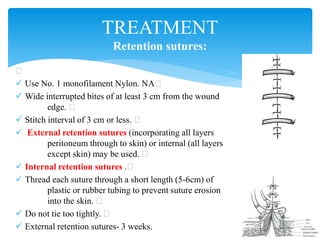
 Use No. 1 monofilament Nylon. NA
 Wide interrupted bites of at least 3 cm from the wound
edge.
 Stitch interval of 3 cm or less.
 External retention sutures (incorporating all layers
peritoneum through to skin) or internal (all layers
except skin) may be used.
 Internal retention sutures .
 Thread each suture through a short length (5-6cm) of
plastic or rubber tubing to prevent suture erosion
into the skin.
 Do not tie too tightly.
 External retention sutures- 3 weeks.
TREATMENT
Retention sutures:
 In a small number of patients it is impossible to close
the abdominal wall primarily
 Conditions which may predispose include:
 1. Major abdominal trauma.
 2. Gross abdominal sepsis.
 3. Retroperitoneal haematoma e.g. post ruptured
AAA.
 4. Loss of abdominal wall tissue e.g. Necrotizing
fasciitis.
 Attempted closure abdominal compartment
syndrome
TREATMENT
The Uncloseable Abdomen:
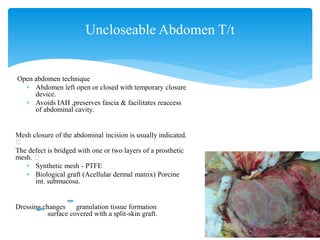
Open abdomen technique
 Abdomen left open or closed with temporary closure
device.
 Avoids IAH ,preserves fascia & facilitates reaccess
of abdominal cavity.
Mesh closure of the abdominal incision is usually indicated.
The defect is bridged with one or two layers of a prosthetic
mesh.
 Synthetic mesh - PTFE
 Biological graft (Acellular dermal matrix) Porcine
int. submucosa.
Dressing changes granulation tissue formation
surface covered with a split-skin graft.
Uncloseable Abdomen T/t
VAC Therapy
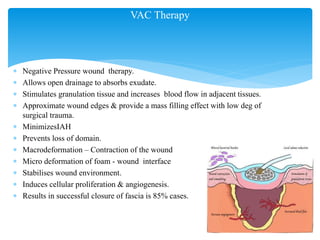
 Negative Pressure wound therapy.
 Allows open drainage to absorbs exudate.
 Stimulates granulation tissue and increases blood flow in adjacent tissues.
 Approximate wound edges & provide a mass filling effect with low deg of
surgical trauma.
 MinimizesIAH
 Prevents loss of domain.
 Macrodeformation – Contraction of the wound
 Micro deformation of foam - wound interface
 Stabilises wound environment.
 Induces cellular proliferation & angiogenesis.
 Results in successful closure of fascia is 85% cases.
Procedure of VAC
 Foam based sponges are used
 (Pore size – 400-600 Am) placed inside
the wound.
 Suction unit placed on the Sponge.
 Area sealed with adhesive .
 Suction tube then connected to Vaccum
pump & Sub-atmosphere pressure is
applied- 50mmHg to 125 mmHg.
 Foam dressing Changed every 3-5days.
Guidelines for Wound Closure
A .SL TO WL RATIO:
 SL : WL has a strong co-relation with development of Incisional Hernia.
 The total length of the suture should be approximately four times the
length of the incision.
 Rate of IH is lower if SL:WL = 4:1
 Lower or higher ratio > 4 is associated with 3 fold increase in IH.
 Small tissue bites with reasonable limits of stitch intervals ↓ incidence of
IH.
Sutures placed at short intervals & at good distance from wound edges
 WD
B. STITCH LENGTH TENSION
 Ratio of SL & no. of stitches – important
 Optimal stitch length - < 5cm
 Rate of infection is  if stitch length is too long.
 Excessive tension on suture  rate of wound Infection.
 Button hole hernias- common, suture cuts through the aponeurotic
tissue.
TAKE HOME MESSAGE
(RECOMMENDATIONS)
 Lap wounds should be closed by continuous technique in one-layer.
 Self locking knots should be used for the anchor knots.
 Suture material- Monofilament ( NA) suture or- Polydioxanone/ PDS-(A) but
contributes wound strength for 6wks
 Aponeurotic tissue closure should be atleast 10 mm from wound edges.( vertical
midline)
 Length of each stitch should be < 5cm
 Do not incorporate Peritoneum, muscle & sub. Cut fat in the suture.
 Excessive tension on suture line to be avoided.
 All wounds should be closed with a SL:WL ratio of 4:1 or optimal ratio in
between 4 and 5.
 Adequate care to be taken – long lap. Wounds
 Prolonged operative time –easy closure methods by tired surgeon should be
avoided.

WOUND DEHISCENCE

  • 1.
    ZONAL P.G CME, HYDERABAD PROF. SREEJOY PATNAIK FAIS, FIAGES, FAMS. HON.PROF. IMAAMS LIFE MEMBER OSSI, IFSO,ELSA, IHPBA, IFSO BARIATRIC AND METABOLIC SURGEON SHANTI OMNI MULTI SUPER SPECIALITY HOSPITAL CUTTACK, ODISHA
  • 2.
    WOUND DEHISCENCE  MostDreaded Complication faced by Surgeons.  Risk of Evisceration is high.  Intervention ?  Possibility of repeat-  Dehiscence  Wound Infection  Incisional Hernia
  • 3.
    Wound Dehiscence  Itis a rupture of the wound along the surgical incision.  Complication of Surgery  The split - Surface Layers -Deep Layers (whole wound)
  • 4.
     Abdominal wounddehiscence  Wound failure  Wound disruption  Evisceration and Eventration. SYNONYMS
  • 5.
     Incisional hernia lieunder a well healed skin incision. Partial or Complete postoperative separation of an abdominal wound closure with protrusion or evisceration of the abdominal contents. Dehiscence of wound occurs before cutaneous healing.  WOUND DEHISCENCE & INCISIONAL HERNIA Wound dehiscence and incisional hernia are part of the same wound failure process: it is timing and healing of the overlying skin that distinguishes the two.
  • 6.
    Partial postoperative separation Complete  postoperative separation
  • 7.
    Incidence  1 to3% of all abdominal operations.  Develops 7 to 10 days Post-op.  Anytime after Surgery, D1 to D20  It’s a morbid complication.  Mortality rate -16%  Male to Female ratio: 2:1  Age - < 45 yrs – 1.3%  > 45 yrs – 5.4%
  • 8.
    Factors for woundbreakdown A . Local- - Haematoma - Seroma B. Regional- - Bowel Edema - Abdominal distention - Intra abdominal infections - Haemorrhage - Trauma - Pre-op Int.obstruction
  • 9.
    C. Systemic- -Advanced age -Malnutrition - Pulmonary & Cardiac diseases - Renal Failure -Obesity - DM -RT & CT - Jaundice - Alcoholism - Hypoproteinaemia - Factors for wound breakdown
  • 10.
    D. Surgical - -Emergency Procedure -Imperfect techniques of wound closure. -Excessive tension - Imperfect incision - Prolonged OT time - Trauma to wound post.op - Poor knotting and suturing. Factors for wound breakdown E. Intra abdominal- -Vomiting, sneezing, coughing - Repeated urinary retention - Prolonged Paralytic Ileus
  • 11.
    Bleeding Swelling Redness Pain Unexplained fever Unexplained tachycardia Symptoms Unusual wound pain  Broken sutures  The wound opening spontaneously  Pus and /or frothy drainage  Paralytic ileus The patient may present as one or more of the following: recent surgical wound not appearing to be healing properly
  • 12.
     Dehiscence usuallydeclares itself 7- 14 days post.op and may occur without warning.  May manifest following straining or removal of sutures.  Patient often notes a “ ripping sensation” or a feeling that “ something has given way”.  Impending dehiscence is often preceded by the appearance of salmon pink serous discharge from the wound. ( 85% of cases.} Clinical Manifestations Signs
  • 13.
     Failure ofsuture to remain anchored in the fascia.  Suture breakage  Knot failure  Excessive stitch interval which allows protrusion of viscera.  Sutures and knots are intact, but the suture has pulled through the fascia.  (Result of fascial necrosis from sutures being placed too close to the edge or under too much tension) Causes of wound separation
  • 14.
     Midline incisionis the most common.  The rate of dehiscence is higher in midline than in transverse incisions.  Midline incision -”non-anatomic” cuts across the aponeurotic fibres,  Transverse incision which cuts paralell to the fibres.  Contraction of the abdominal wall causes laterally directed tension on the closure. Operative Factors Incision type?
  • 15.
     Data suggestthat mass closure is equivalent to or better than layered closure in preventing dehiscence.  Mass closure is currently favoured because of its safety, efficacy, and speed Operative Factors Mass versus Layered Closure?
  • 16.
     Several RCT’s- no statistically significant difference in the incidence of wound disruption between the two techniques.  Continuous suture is a reasonable closure technique because of its safety, efficacy, and speed.  Interrupted suture – Emergency procedure. Operative Factors Interrupted versus Continuous Sutures?
  • 17.
     Numerous studieshave shown no difference in the overall incidence of wound complications between both sutures.  Non-absorbable monofilament is ideal with high risk factors for delayed healing. Operative Factors Absorbable vs. non-absorbable sutures?
  • 18.
      The stitchinterval and the tissue bite size?  Should be 1 cm. average with a range between 1-2 cm.  Suture Length-to-Wound Length Ratio?  Should be 4:1 or greater for continuous mass closure.  A ratio < 4:1 is associated with an increased risk of WD and the development of IH. Operative Factors
  • 19.
     Suturing theperitoneum is not vital to prevent wound dehiscence.  RCT‘s show no difference in the wound disruption rate with one-layered closure (peritoneum not sutured) than two-layered closure.  Normally peritoneal defects heal by simultaneous regeneration. Operative Factors Peritoneal Closure or not?
  • 20.
    Examination  Assess Incision:Examine the entire wound.  Look for leakage of fluid when palpated.  Look for signs of infection.  Wound or surrounding area look for signs of - purulent discharge, crepitus, cellulitis with fluctuance, inspect the inside of wound.  Vital Signs: Look for fever INSPECTION
  • 21.
    Investigations: LAB TESTS: Wound andtissues c/s Blood tests to determine if there is an infection IMAGING STUDIES: X-ray: to evaluate the extent of wound separation. USG : to evaluate for pus and pockets of fluid. CT Scan : to evaluate for pus and pockets of fluid.
  • 22.
     Focus shouldbe based on-  Nutritional support  Circulatory support  Therapy to be designed to –  Eliminate necrotic tissue  Control Bio burden  Maintain optimal environment for granulation tissue formation & epithelial migration.  Broad spectrum Antibiotic therapy  Frequent changes in wound dressing to prevent infection  Wound exposure to air to accelerate healing and prevent infection, and allow growth of new tissue from below. Treatment Non-operative treatment
  • 23.
    Treatment  Depends on Extent of Fascial Separation.  Presence of Evisceration.  Intra-abdomen Pathology (Int. leak, Peritonitis)  Small Dehiscence  Conservative Management  Saline moistened gauze packs  Abdominal Binders  Large Dehiscence with Evisceration  Saline moistened towel packing  IV fluids resuscitation  Preparation for closure OT  Adequate Relaxation of the Patient
  • 24.
    Pre-operative broad spectrumantibiotics Re-suture with a mass closure with the placement of deep retention sutures. Deep bites of tissue, using plenty of suture material, and avoid excessive tension on the wound.  Close the skin fairly loosely Superficial wound drain. Gross wound sepsis - leave the skin open and pack TREATMENT Operative Treatment:
  • 25.
    Steps of Managementin OT  Thorough exploration of abdominal cavity.  Rule out presence of septic focus or anastomotic leak.  Manage Infection.  Assess the condition of fascia. Strong & intact - Primary Closure Infected & necrotic - Debridement  Closure : Retention Sutures Prosthetic material- Absorbable mesh or Permanent (Polyglactin or PTFE- Poly Tetra Fluro Ethylene)  Synthetic Materials: Silicone Sheets sutured to fascial edges  VAC (Vaccum Assisted Closure) Therapy
  • 26.
     Use No.1 monofilament Nylon. NA  Wide interrupted bites of at least 3 cm from the wound edge.  Stitch interval of 3 cm or less.  External retention sutures (incorporating all layers peritoneum through to skin) or internal (all layers except skin) may be used.  Internal retention sutures .  Thread each suture through a short length (5-6cm) of plastic or rubber tubing to prevent suture erosion into the skin.  Do not tie too tightly.  External retention sutures- 3 weeks. TREATMENT Retention sutures:
  • 27.
     In asmall number of patients it is impossible to close the abdominal wall primarily  Conditions which may predispose include:  1. Major abdominal trauma.  2. Gross abdominal sepsis.  3. Retroperitoneal haematoma e.g. post ruptured AAA.  4. Loss of abdominal wall tissue e.g. Necrotizing fasciitis.  Attempted closure abdominal compartment syndrome TREATMENT The Uncloseable Abdomen:
  • 28.
    Open abdomen technique Abdomen left open or closed with temporary closure device.  Avoids IAH ,preserves fascia & facilitates reaccess of abdominal cavity. Mesh closure of the abdominal incision is usually indicated. The defect is bridged with one or two layers of a prosthetic mesh.  Synthetic mesh - PTFE  Biological graft (Acellular dermal matrix) Porcine int. submucosa. Dressing changes granulation tissue formation surface covered with a split-skin graft. Uncloseable Abdomen T/t
  • 29.
    VAC Therapy  NegativePressure wound therapy.  Allows open drainage to absorbs exudate.  Stimulates granulation tissue and increases blood flow in adjacent tissues.  Approximate wound edges & provide a mass filling effect with low deg of surgical trauma.  MinimizesIAH  Prevents loss of domain.  Macrodeformation – Contraction of the wound  Micro deformation of foam - wound interface  Stabilises wound environment.  Induces cellular proliferation & angiogenesis.  Results in successful closure of fascia is 85% cases.
  • 30.
    Procedure of VAC Foam based sponges are used  (Pore size – 400-600 Am) placed inside the wound.  Suction unit placed on the Sponge.  Area sealed with adhesive .  Suction tube then connected to Vaccum pump & Sub-atmosphere pressure is applied- 50mmHg to 125 mmHg.  Foam dressing Changed every 3-5days.
  • 31.
    Guidelines for WoundClosure A .SL TO WL RATIO:  SL : WL has a strong co-relation with development of Incisional Hernia.  The total length of the suture should be approximately four times the length of the incision.  Rate of IH is lower if SL:WL = 4:1  Lower or higher ratio > 4 is associated with 3 fold increase in IH.  Small tissue bites with reasonable limits of stitch intervals ↓ incidence of IH. Sutures placed at short intervals & at good distance from wound edges  WD
  • 32.
    B. STITCH LENGTHTENSION  Ratio of SL & no. of stitches – important  Optimal stitch length - < 5cm  Rate of infection is  if stitch length is too long.  Excessive tension on suture  rate of wound Infection.  Button hole hernias- common, suture cuts through the aponeurotic tissue.
  • 33.
    TAKE HOME MESSAGE (RECOMMENDATIONS) Lap wounds should be closed by continuous technique in one-layer.  Self locking knots should be used for the anchor knots.  Suture material- Monofilament ( NA) suture or- Polydioxanone/ PDS-(A) but contributes wound strength for 6wks  Aponeurotic tissue closure should be atleast 10 mm from wound edges.( vertical midline)  Length of each stitch should be < 5cm  Do not incorporate Peritoneum, muscle & sub. Cut fat in the suture.  Excessive tension on suture line to be avoided.  All wounds should be closed with a SL:WL ratio of 4:1 or optimal ratio in between 4 and 5.  Adequate care to be taken – long lap. Wounds  Prolonged operative time –easy closure methods by tired surgeon should be avoided.