BLEEDING PER RECTUM
Clinical group 2
34th batch
Faculty of medicine-University of Ruhuna
By-PRJ,MASJ,KM,KK,SWK,SK.
1
• What is bleeding PR ?
• History taking from a patient with bleeding PR
• Common DDs for bleeding PR
• Physical examination of a patient with
bleeding PR
• Investigations (lab/endoscopic/radiological)
• Treatment options
2
Rectal bleeding
A symptom of a problem in the GI tract.
It means any blood passed rectally;
consequently, the blood may come from any
area or structure in the GI tract that allows
blood to leak into the GI lumen.
3
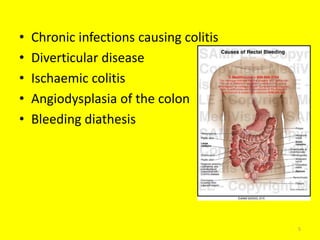
Causes of rectal bleeding
• Hemorrhoids
• Anal fissures
• Carcinoma ( colorectal, anal )
• Colorectal polyps
• Inflammatory bowel disease ( chron’s disease,
ulcerative colitis)
• Rectal prolapse
4
• Chronic infections causing colitis
• Diverticular disease
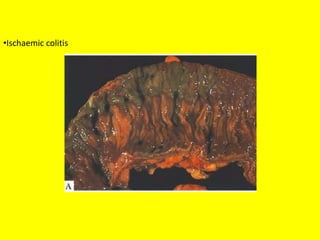
• Ischaemic colitis
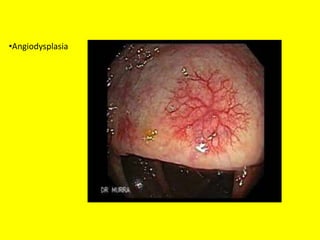
• Angiodysplasia of the colon
• Bleeding diathesis
5
causes of rectal bleeding according to
the history
• Pattern of bleeding
-Fresh blood- distal lesion (anal canal or rectum)
-Altered blood- proximal lesion
• Amount of blood passed
• Duration & progression
• Associated symptoms- pain, lump,
alteration in bowel habits, etc.
6
Important points in the history
• Hemorrhoids- bleeding after defecation
- fresh blood drops on stools
- spurting of blood
- lump coming out of anus
- perianal discomfort
• Anal fissure- fresh blood streaked on stools
- pain( sharp, severe, start with defecation & last
for hours)
• Inflammatory bowel disease- blood & mucus diarrhea
- painless unless co-exist fissure
- systemic symptoms; low grade fever
7
• Colorectal carcinoma-
- fresh blood after defecation- rectal carcinoma
-altered blood mixed with stools – carcinoma in sigmoid
colon or descending colon
- painless
- tenesmus & sense of incomplete ivacuation (rectal CA)
- altered bowel habits (early morning blood & mucus
diarrhea, constipation or altering constipation &
diarrhea.
- features of complications ( intestinal obstruction, local
spread, distant metastasis)
• Diverticular disease- large volume of blood
- painless
8
perianal conditions causing rectal
bleeding.
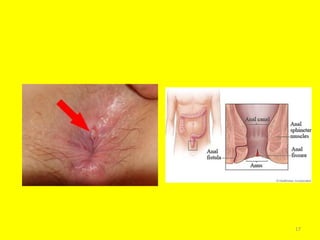
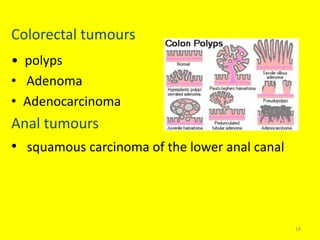
Haemorrhoids
Anal fistula
Anal fissure
9
HAEMORRHOIDS
• These are enlarged vascular cushions in the
lower rectum and anal canal.
• The classical position of haemorrhoids
corresponds to the 3 o’clock, 7 o’clock
and 11 o’clock positions with the patient in
the lithotomy position.
10
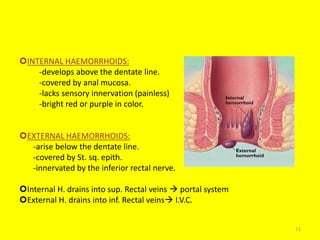
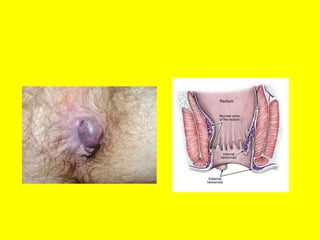
INTERNAL HAEMORRHOIDS:
-develops above the dentate line.
-covered by anal mucosa.
-lacks sensory innervation (painless)
-bright red or purple in color.
EXTERNAL HAEMORRHOIDS:
-arise below the dentate line.
-covered by St. sq. epith.
-innervated by the inferior rectal nerve.
Internal H. drains into sup. Rectal veins  portal system
External H. drains into inf. Rectal veins I.V.C.
11
Clinical features of haemorroids
• Bleeding, is the principal and earliest symptom.
• The nature of the bleeding is characteristically separate
from the motion and is seen either on the paper on
wiping or as a fresh splash in the pan.
• rarely, the bleeding may be sufficient to cause
anaemia.
• pain may result from congestion of pile masses below a
hypertonic sphincter.
• mucous discharge
• prolapse
12
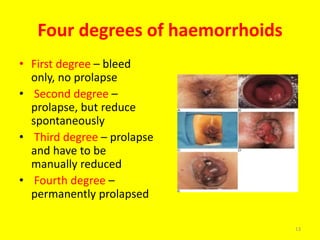
Four degrees of haemorrhoids
• First degree – bleed
only, no prolapse
• Second degree –
prolapse, but reduce
spontaneously
• Third degree – prolapse
and have to be
manually reduced
• Fourth degree –
permanently prolapsed
13
Complications of haemorrhoids
• Strangulation and thrombosis.
• Ulceration
• Gangrene
• Portal pyaemia
• Fibrosis
14
Treatment of haemorrhoids
• Symptomatic – advice about defaecatory
habits, stool softeners and bulking agents
• Injection of sclerosant
• Banding
• Transanal haemorrhoidal
dearterialisation/haemorrhoidopexy
• Haemorrhoidectomy
15
Indications
• third- and fourth-degree
haemorrhoids;
• second-degree
haemorrhoids that have not
been cured by
non-operative treatments;
• fibrosed haemorrhoids;
• interoexternal
haemorrhoids when the
external haemorrhoid
is well defined.
Complications of
haemorrhoidectomy
Early
• Pain
• Acute retention of urine
• Reactionary haemorrhage
Late
• Secondary haemorrhage
• Anal stricture
• Anal fissure
• Incontinence
16
17
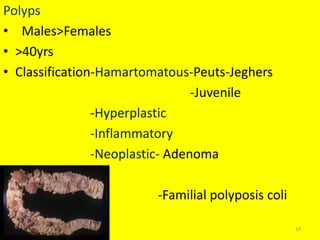
Colorectal tumours
• polyps
• Adenoma
• Adenocarcinoma
Anal tumours
• squamous carcinoma of the lower anal canal
18
Polyps
• Males>Females
• >40yrs
• Classification-Hamartomatous-Peuts-Jeghers
-Juvenile
-Hyperplastic
-Inflammatory
-Neoplastic- Adenoma
-Familial polyposis coli
19
C/F -:
• Asymtomatic (most)
• Passsage of blood & mucus PR
• Prolaps
• Rarely obstruction/Intussusception
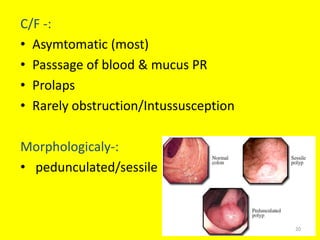
Morphologicaly-:
• pedunculated/sessile
20
Peuts-Jeghers polyps
Common in small IN , but can occur in large IN
Associated with mucocutaneous pigmentation in
lips and gums
Multiple
Juvenile polyps
Cause bleeding or obstruction
Pain if prolaps during defication
Hyperplastic polyps
Comprise 90% of all polyps
Multiple
Inflammatory polyps
Pseudopolyps
Usually associated with colitis 21
Adenomatous polyps
• Histological types-Tubular
-Villous (*)
-Tubulovillous
• Solitary/Multiple
• Presentations-diarrhoea
-mucous discharge
-hypokalaemia
-bleeding
• Risk of malignancy is increased with the increased size
of adenoma(>1cm) , with the sessile nature,villous
architecture & dysplasia
22
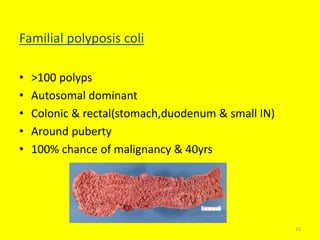
Familial polyposis coli
• >100 polyps
• Autosomal dominant
• Colonic & rectal(stomach,duodenum & small IN)
• Around puberty
• 100% chance of malignancy & 40yrs
23
Colorectal carcinoma
• Has genetic predisposition
• 5yr survival-30%-40%
• Etiology-dietary animal fat
-Smoking
-Alcohol
-cholecystectomy
-low fiber diet
• M:F-3:1
• Common age-45-65yrs
24
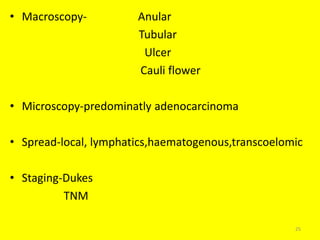
• Macroscopy- Anular
Tubular
Ulcer
Cauli flower
• Microscopy-predominatly adenocarcinoma
• Spread-local, lymphatics,haematogenous,transcoelomic
• Staging-Dukes
TNM
25
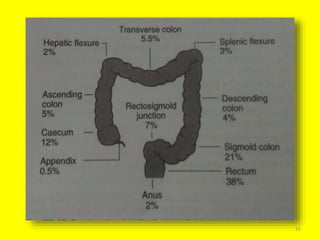
26
Clinical features:
20%-emergency(intestinal obstrction,peritonitis)
Symptoms depends on the region of the lesion
• Left colon
• Right colon
• Metastasis
• Rectal cancer
27
CARCINOMA OF THE RECTUM
• 75% occur in the lower part of the rectal ampulla
papilliferous or a simple ulcer with everted edges.
• 25% in the upper part of the rectum annular in shape.
• 90% or rectal cancers can be felt with a finger during PR.
MACROSCOPIC APPEARANCE:
It may be as follows:
• papilliferous
• ulcerating commonest
• stenosing at rectosigmoid
• colloid
28
MICROSCOPIC APPEARANCE:
• *90% are adenocarcinoma
• *9% are colloid – adenocarcinoma with
mucous production-
• *1% highly anaplastic carcinoma simplex
• Rectal ca is common in middle and old age
(50-70 yrs) but can occur in young adults.
• It is equally common in both sexes.
29
• Rectal bleeding
•Change in bowel habit
•High annular cancers at the rectosigmoid
junction may cause partial obstruction 
presenting as alternating constipation and
diarrhoea.
•Tenesmus
•Pain is an uncommon symptom.
Symptoms
30
SIGNS ON EXAMINATION
On Rectal Examination:
the lower edge of a malignant ulcer can be felt
blood and mucous on the gloved finger.
If the tumour is in the upper part of the rectum, only the lower
edge is felt.
On general examination:
The liver
Other sites for metastasis are: supraclavicular lymph glands,
the lungs and the skin.
The inguinal LN are involved only if the tumour is below the
Hiltons line to involve the skin.
If the pt. has palpable inguinal LN, the tumour is most likely to be
sq. cc. of the anal skin.
31
Anal tumours
• Rare
• Most common-epidermoid tumours(sq cc)
• A malignant tumour protruding through the anal
canal is more likely to be an adenocarcinoma of
the rectum invading the anal skin.
32
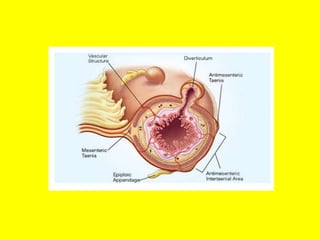
DIVERTICULAR DISEASE
•Diverticulae are outpouchings of mucosa through the bowel wall
associated with increased intraluminal pressure.
•May occur anywhere in the colon.
•But commonly occur in the sigmoid and descending colon.
•May be asymptomatic.
May present with
•Rectal bleeding: acute, massive and fresh blood ; often required blood
transfusion.
•chronic left sided abdominal pain + changes in bowel habits
•acute abdominal symptoms
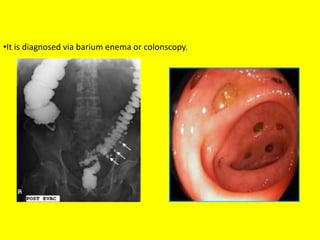
•It is diagnosed via barium enema or colonscopy.
Inflammatory Bowel Disease
Chronic inflammatory disease occur
anywhere in the alimentary tract
from mouth to anus.
Chronic inflammatory disease that
involves the whole or part of the
colon.
Transmural disease. Confined to the mucosa.
Common sites;
terminal ileum
colon
rectum
Nearly always involves the rectum,
extending to involve distal or total
colon.
Ulcerative colitisCrohn’s disease
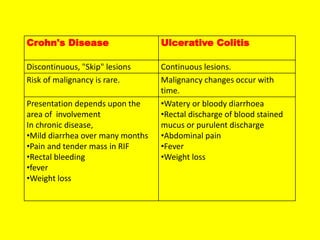
Crohn's Disease Ulcerative Colitis
Discontinuous, "Skip" lesions Continuous lesions.
Risk of malignancy is rare. Malignancy changes occur with
time.
Presentation depends upon the
area of involvement
In chronic disease,
•Mild diarrhea over many months
•Pain and tender mass in RIF
•Rectal bleeding
•fever
•Weight loss
•Watery or bloody diarrhoea
•Rectal discharge of blood stained
mucus or purulent discharge
•Abdominal pain
•Fever
•Weight loss
•Ischaemic colitis
•Angiodysplasia
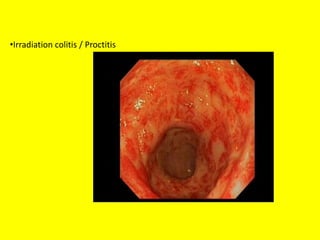
•Irradiation colitis / Proctitis
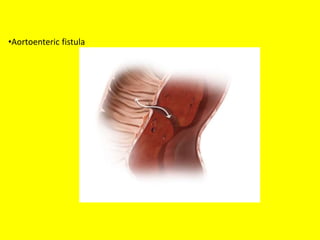
•Aortoenteric fistula
•Rectal prolapse
•Intussusception
•Mesenteric infarction
•Massive upper GI bleeding
•Trauma
•Bleeding diathesis
Physical examination and lab
investigations
General examination
lPallor
lIcterus
lPeripheral stigmata of inflammatory bowel disease
l skin - erythema nodosum, pyoderma gangrenosum
l Eye - sleritis, uveitis
lLymphadenopathy - left supraclavicular node
Abdominal examination
• Hepatomegally
• Palpable masses
• Ascitis
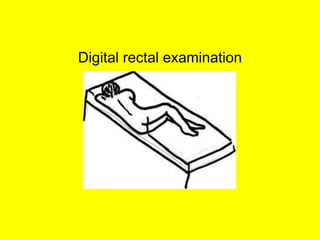
Digital rectal examination
lInspection – anal fissures, skin tags, prolapse, opening of fistula
lPalpate – masses (size, ulceration, pararectal lymphnodes) , mucosa
, prostate gland,
lAnal sphincter tone
lLook at finger for blood, stool, mucous
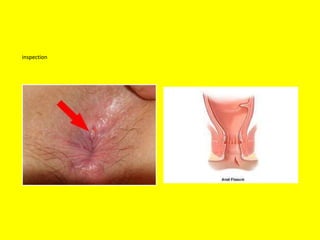
inspection
Rectal carcinoma
on Rectal Examination:
It feels hard and bulges into the lumen of the
rectum, the edges are everted and the base is
irregular and friable.
Upon withdrawal of the finger, you will have blood
and mucous on the gloved finger.
If the tumour is in the upper part of the rectum,
only the lower edge is felt.
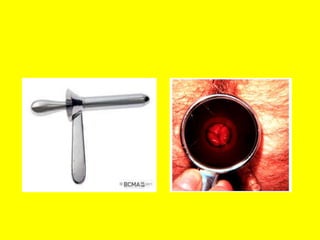
Proctoscopy
lFor diagnosis and treatment of haemorrhoids
lExtact locaton of the tumor in relation to the sphincter
mechanism
sigmoidoscopy:
2 types – rigid sigmoidoscopy
flexible sigmoidoscopy
essential to exclude rectal pathology as
carcinoma or polyps.
should be taken tissue biopsies for histology
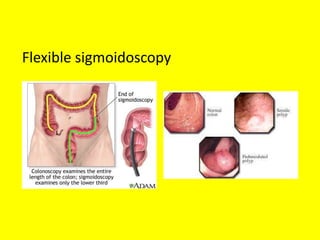
Flexible sigmoidoscopy
Barium Enema
Double-contrast barium enema examinations can be
justified only for elective evaluation of previous unexplained
LGIB.
Do not use barium enema examination in the acute
hemorrhage phase, because it makes subsequent
diagnostic evaluations, including angiography and
colonoscopy, impossible.
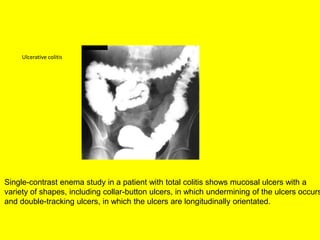
Single-contrast enema study in a patient with total colitis shows mucosal ulcers with a
variety of shapes, including collar-button ulcers, in which undermining of the ulcers occurs
and double-tracking ulcers, in which the ulcers are longitudinally orientated.
Ulcerative colitis
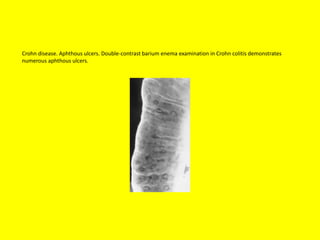
Crohn disease. Aphthous ulcers. Double-contrast barium enema examination in Crohn colitis demonstrates
numerous aphthous ulcers.
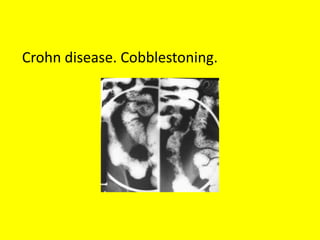
Crohn disease. Cobblestoning.
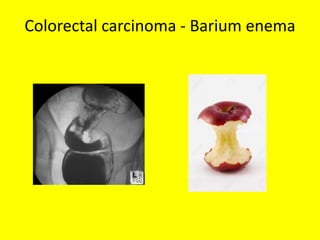
Colorectal carcinoma - Barium enema
Lab investigations
•FBC
•ESR
•U&E
•LFT(liver metastases)
•Carcinoembryonic antigen (CEA) test
•Cancer anrigen - CA 19-9 assay
•Clotting screen
•Fecal occult blood testing
•Histology
Management of the diverticular disease
•Uncomplicated symptomatic diverticular disease
High fiber diet
Antispasmodic eg- Colofac
Bulking agent eg - Fybogel
•Acute diverticulitis
Bed rest
Fluid only or nil orally
Analgesic
Antibiotics – cefuroxime and metronidazole
•Perforation with generalized fecal peritonitis
Laparotomy
Peritoneal lavage
Resect perforated area
Antibiotics as for acute diverticulitis
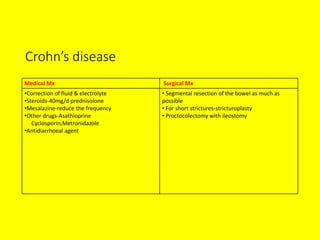
Crohn’s disease
Medical Mx Surgical Mx
•Correction of fluid & electrolyte
•Steroids-40mg/d prednisolone
•Mesalazine-reduce the frequency
•Other drugs-Asathioprine
Cyclosporin,Metronidazole
•Antidiarrhoeal agent
• Segmental resection of the bowel as much as
possible
• For short strictures-stricturoplasty
• Proctocolectomy with ileostomy
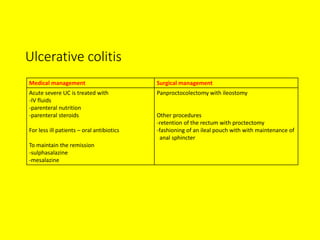
Ulcerative colitis
Medical management Surgical management
Acute severe UC is treated with
-IV fluids
-parenteral nutrition
-parenteral steroids
For less ill patients – oral antibiotics
To maintain the remission
-sulphasalazine
-mesalazine
Panproctocolectomy with ileostomy
Other procedures
-retention of the rectum with proctectomy
-fashioning of an ileal pouch with with maintenance of
anal sphincter
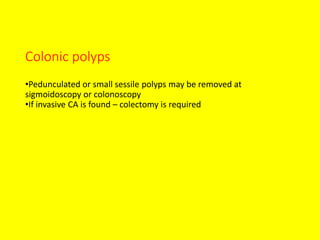
Colonic polyps
•Pedunculated or small sessile polyps may be removed at
sigmoidoscopy or colonoscopy
•If invasive CA is found – colectomy is required
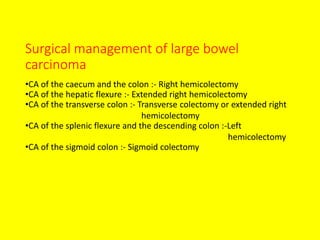
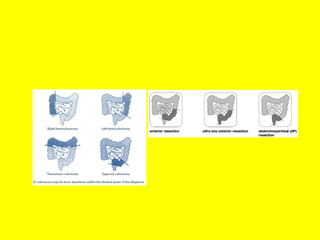
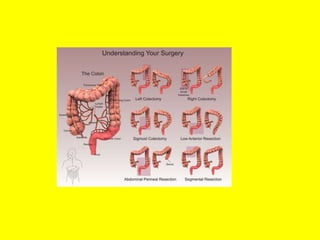
Surgical management of large bowel
carcinoma
•CA of the caecum and the colon :- Right hemicolectomy
•CA of the hepatic flexure :- Extended right hemicolectomy
•CA of the transverse colon :- Transverse colectomy or extended right
hemicolectomy
•CA of the splenic flexure and the descending colon :-Left
hemicolectomy
•CA of the sigmoid colon :- Sigmoid colectomy
CA of the rectum
Sphincter saving surgery – Anterior resection
Tumour should be more than 1-2cm above the anal sphincter
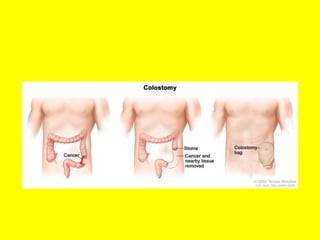
Sphincter loosing surgery – Abdomino perineal resection with
permanent colostomy.This is combined
with
a total mesorectal excision (TME)
THANK YOU…!!!
71

Rectal bleeding

  • 1.
    BLEEDING PER RECTUM Clinicalgroup 2 34th batch Faculty of medicine-University of Ruhuna By-PRJ,MASJ,KM,KK,SWK,SK. 1
  • 2.
    • What isbleeding PR ? • History taking from a patient with bleeding PR • Common DDs for bleeding PR • Physical examination of a patient with bleeding PR • Investigations (lab/endoscopic/radiological) • Treatment options 2
  • 3.
    Rectal bleeding A symptomof a problem in the GI tract. It means any blood passed rectally; consequently, the blood may come from any area or structure in the GI tract that allows blood to leak into the GI lumen. 3
  • 4.
    Causes of rectalbleeding • Hemorrhoids • Anal fissures • Carcinoma ( colorectal, anal ) • Colorectal polyps • Inflammatory bowel disease ( chron’s disease, ulcerative colitis) • Rectal prolapse 4
  • 5.
    • Chronic infectionscausing colitis • Diverticular disease • Ischaemic colitis • Angiodysplasia of the colon • Bleeding diathesis 5
  • 6.
    causes of rectalbleeding according to the history • Pattern of bleeding -Fresh blood- distal lesion (anal canal or rectum) -Altered blood- proximal lesion • Amount of blood passed • Duration & progression • Associated symptoms- pain, lump, alteration in bowel habits, etc. 6
  • 7.
    Important points inthe history • Hemorrhoids- bleeding after defecation - fresh blood drops on stools - spurting of blood - lump coming out of anus - perianal discomfort • Anal fissure- fresh blood streaked on stools - pain( sharp, severe, start with defecation & last for hours) • Inflammatory bowel disease- blood & mucus diarrhea - painless unless co-exist fissure - systemic symptoms; low grade fever 7
  • 8.
    • Colorectal carcinoma- -fresh blood after defecation- rectal carcinoma -altered blood mixed with stools – carcinoma in sigmoid colon or descending colon - painless - tenesmus & sense of incomplete ivacuation (rectal CA) - altered bowel habits (early morning blood & mucus diarrhea, constipation or altering constipation & diarrhea. - features of complications ( intestinal obstruction, local spread, distant metastasis) • Diverticular disease- large volume of blood - painless 8
  • 9.
    perianal conditions causingrectal bleeding. Haemorrhoids Anal fistula Anal fissure 9
  • 10.
    HAEMORRHOIDS • These areenlarged vascular cushions in the lower rectum and anal canal. • The classical position of haemorrhoids corresponds to the 3 o’clock, 7 o’clock and 11 o’clock positions with the patient in the lithotomy position. 10
  • 11.
    INTERNAL HAEMORRHOIDS: -develops abovethe dentate line. -covered by anal mucosa. -lacks sensory innervation (painless) -bright red or purple in color. EXTERNAL HAEMORRHOIDS: -arise below the dentate line. -covered by St. sq. epith. -innervated by the inferior rectal nerve. Internal H. drains into sup. Rectal veins  portal system External H. drains into inf. Rectal veins I.V.C. 11
  • 12.
    Clinical features ofhaemorroids • Bleeding, is the principal and earliest symptom. • The nature of the bleeding is characteristically separate from the motion and is seen either on the paper on wiping or as a fresh splash in the pan. • rarely, the bleeding may be sufficient to cause anaemia. • pain may result from congestion of pile masses below a hypertonic sphincter. • mucous discharge • prolapse 12
  • 13.
    Four degrees ofhaemorrhoids • First degree – bleed only, no prolapse • Second degree – prolapse, but reduce spontaneously • Third degree – prolapse and have to be manually reduced • Fourth degree – permanently prolapsed 13
  • 14.
    Complications of haemorrhoids •Strangulation and thrombosis. • Ulceration • Gangrene • Portal pyaemia • Fibrosis 14
  • 15.
    Treatment of haemorrhoids •Symptomatic – advice about defaecatory habits, stool softeners and bulking agents • Injection of sclerosant • Banding • Transanal haemorrhoidal dearterialisation/haemorrhoidopexy • Haemorrhoidectomy 15
  • 16.
    Indications • third- andfourth-degree haemorrhoids; • second-degree haemorrhoids that have not been cured by non-operative treatments; • fibrosed haemorrhoids; • interoexternal haemorrhoids when the external haemorrhoid is well defined. Complications of haemorrhoidectomy Early • Pain • Acute retention of urine • Reactionary haemorrhage Late • Secondary haemorrhage • Anal stricture • Anal fissure • Incontinence 16
  • 17.
  • 18.
    Colorectal tumours • polyps •Adenoma • Adenocarcinoma Anal tumours • squamous carcinoma of the lower anal canal 18
  • 19.
    Polyps • Males>Females • >40yrs •Classification-Hamartomatous-Peuts-Jeghers -Juvenile -Hyperplastic -Inflammatory -Neoplastic- Adenoma -Familial polyposis coli 19
  • 20.
    C/F -: • Asymtomatic(most) • Passsage of blood & mucus PR • Prolaps • Rarely obstruction/Intussusception Morphologicaly-: • pedunculated/sessile 20
  • 21.
    Peuts-Jeghers polyps Common insmall IN , but can occur in large IN Associated with mucocutaneous pigmentation in lips and gums Multiple Juvenile polyps Cause bleeding or obstruction Pain if prolaps during defication Hyperplastic polyps Comprise 90% of all polyps Multiple Inflammatory polyps Pseudopolyps Usually associated with colitis 21
  • 22.
    Adenomatous polyps • Histologicaltypes-Tubular -Villous (*) -Tubulovillous • Solitary/Multiple • Presentations-diarrhoea -mucous discharge -hypokalaemia -bleeding • Risk of malignancy is increased with the increased size of adenoma(>1cm) , with the sessile nature,villous architecture & dysplasia 22
  • 23.
    Familial polyposis coli •>100 polyps • Autosomal dominant • Colonic & rectal(stomach,duodenum & small IN) • Around puberty • 100% chance of malignancy & 40yrs 23
  • 24.
    Colorectal carcinoma • Hasgenetic predisposition • 5yr survival-30%-40% • Etiology-dietary animal fat -Smoking -Alcohol -cholecystectomy -low fiber diet • M:F-3:1 • Common age-45-65yrs 24
  • 25.
    • Macroscopy- Anular Tubular Ulcer Cauliflower • Microscopy-predominatly adenocarcinoma • Spread-local, lymphatics,haematogenous,transcoelomic • Staging-Dukes TNM 25
  • 26.
  • 27.
    Clinical features: 20%-emergency(intestinal obstrction,peritonitis) Symptomsdepends on the region of the lesion • Left colon • Right colon • Metastasis • Rectal cancer 27
  • 28.
    CARCINOMA OF THERECTUM • 75% occur in the lower part of the rectal ampulla papilliferous or a simple ulcer with everted edges. • 25% in the upper part of the rectum annular in shape. • 90% or rectal cancers can be felt with a finger during PR. MACROSCOPIC APPEARANCE: It may be as follows: • papilliferous • ulcerating commonest • stenosing at rectosigmoid • colloid 28
  • 29.
    MICROSCOPIC APPEARANCE: • *90%are adenocarcinoma • *9% are colloid – adenocarcinoma with mucous production- • *1% highly anaplastic carcinoma simplex • Rectal ca is common in middle and old age (50-70 yrs) but can occur in young adults. • It is equally common in both sexes. 29
  • 30.
    • Rectal bleeding •Changein bowel habit •High annular cancers at the rectosigmoid junction may cause partial obstruction  presenting as alternating constipation and diarrhoea. •Tenesmus •Pain is an uncommon symptom. Symptoms 30
  • 31.
    SIGNS ON EXAMINATION OnRectal Examination: the lower edge of a malignant ulcer can be felt blood and mucous on the gloved finger. If the tumour is in the upper part of the rectum, only the lower edge is felt. On general examination: The liver Other sites for metastasis are: supraclavicular lymph glands, the lungs and the skin. The inguinal LN are involved only if the tumour is below the Hiltons line to involve the skin. If the pt. has palpable inguinal LN, the tumour is most likely to be sq. cc. of the anal skin. 31
  • 32.
    Anal tumours • Rare •Most common-epidermoid tumours(sq cc) • A malignant tumour protruding through the anal canal is more likely to be an adenocarcinoma of the rectum invading the anal skin. 32
  • 33.
    DIVERTICULAR DISEASE •Diverticulae areoutpouchings of mucosa through the bowel wall associated with increased intraluminal pressure. •May occur anywhere in the colon. •But commonly occur in the sigmoid and descending colon. •May be asymptomatic. May present with •Rectal bleeding: acute, massive and fresh blood ; often required blood transfusion. •chronic left sided abdominal pain + changes in bowel habits •acute abdominal symptoms
  • 35.
    •It is diagnosedvia barium enema or colonscopy.
  • 36.
    Inflammatory Bowel Disease Chronicinflammatory disease occur anywhere in the alimentary tract from mouth to anus. Chronic inflammatory disease that involves the whole or part of the colon. Transmural disease. Confined to the mucosa. Common sites; terminal ileum colon rectum Nearly always involves the rectum, extending to involve distal or total colon. Ulcerative colitisCrohn’s disease
  • 37.
    Crohn's Disease UlcerativeColitis Discontinuous, "Skip" lesions Continuous lesions. Risk of malignancy is rare. Malignancy changes occur with time. Presentation depends upon the area of involvement In chronic disease, •Mild diarrhea over many months •Pain and tender mass in RIF •Rectal bleeding •fever •Weight loss •Watery or bloody diarrhoea •Rectal discharge of blood stained mucus or purulent discharge •Abdominal pain •Fever •Weight loss
  • 38.
  • 39.
  • 40.
  • 41.
  • 42.
    •Rectal prolapse •Intussusception •Mesenteric infarction •Massiveupper GI bleeding •Trauma •Bleeding diathesis
  • 43.
    Physical examination andlab investigations
  • 44.
    General examination lPallor lIcterus lPeripheral stigmataof inflammatory bowel disease l skin - erythema nodosum, pyoderma gangrenosum l Eye - sleritis, uveitis lLymphadenopathy - left supraclavicular node
  • 45.
  • 46.
  • 47.
    lInspection – analfissures, skin tags, prolapse, opening of fistula lPalpate – masses (size, ulceration, pararectal lymphnodes) , mucosa , prostate gland, lAnal sphincter tone lLook at finger for blood, stool, mucous
  • 49.
  • 50.
    Rectal carcinoma on RectalExamination: It feels hard and bulges into the lumen of the rectum, the edges are everted and the base is irregular and friable. Upon withdrawal of the finger, you will have blood and mucous on the gloved finger. If the tumour is in the upper part of the rectum, only the lower edge is felt.
  • 51.
    Proctoscopy lFor diagnosis andtreatment of haemorrhoids lExtact locaton of the tumor in relation to the sphincter mechanism
  • 53.
    sigmoidoscopy: 2 types –rigid sigmoidoscopy flexible sigmoidoscopy essential to exclude rectal pathology as carcinoma or polyps. should be taken tissue biopsies for histology
  • 54.
  • 55.
    Barium Enema Double-contrast bariumenema examinations can be justified only for elective evaluation of previous unexplained LGIB. Do not use barium enema examination in the acute hemorrhage phase, because it makes subsequent diagnostic evaluations, including angiography and colonoscopy, impossible.
  • 56.
    Single-contrast enema studyin a patient with total colitis shows mucosal ulcers with a variety of shapes, including collar-button ulcers, in which undermining of the ulcers occurs and double-tracking ulcers, in which the ulcers are longitudinally orientated. Ulcerative colitis
  • 57.
    Crohn disease. Aphthousulcers. Double-contrast barium enema examination in Crohn colitis demonstrates numerous aphthous ulcers.
  • 58.
  • 59.
  • 60.
    Lab investigations •FBC •ESR •U&E •LFT(liver metastases) •Carcinoembryonicantigen (CEA) test •Cancer anrigen - CA 19-9 assay •Clotting screen •Fecal occult blood testing •Histology
  • 61.
    Management of thediverticular disease •Uncomplicated symptomatic diverticular disease High fiber diet Antispasmodic eg- Colofac Bulking agent eg - Fybogel •Acute diverticulitis Bed rest Fluid only or nil orally Analgesic Antibiotics – cefuroxime and metronidazole
  • 62.
    •Perforation with generalizedfecal peritonitis Laparotomy Peritoneal lavage Resect perforated area Antibiotics as for acute diverticulitis
  • 63.
    Crohn’s disease Medical MxSurgical Mx •Correction of fluid & electrolyte •Steroids-40mg/d prednisolone •Mesalazine-reduce the frequency •Other drugs-Asathioprine Cyclosporin,Metronidazole •Antidiarrhoeal agent • Segmental resection of the bowel as much as possible • For short strictures-stricturoplasty • Proctocolectomy with ileostomy
  • 64.
    Ulcerative colitis Medical managementSurgical management Acute severe UC is treated with -IV fluids -parenteral nutrition -parenteral steroids For less ill patients – oral antibiotics To maintain the remission -sulphasalazine -mesalazine Panproctocolectomy with ileostomy Other procedures -retention of the rectum with proctectomy -fashioning of an ileal pouch with with maintenance of anal sphincter
  • 65.
    Colonic polyps •Pedunculated orsmall sessile polyps may be removed at sigmoidoscopy or colonoscopy •If invasive CA is found – colectomy is required
  • 66.
    Surgical management oflarge bowel carcinoma •CA of the caecum and the colon :- Right hemicolectomy •CA of the hepatic flexure :- Extended right hemicolectomy •CA of the transverse colon :- Transverse colectomy or extended right hemicolectomy •CA of the splenic flexure and the descending colon :-Left hemicolectomy •CA of the sigmoid colon :- Sigmoid colectomy
  • 67.
    CA of therectum Sphincter saving surgery – Anterior resection Tumour should be more than 1-2cm above the anal sphincter Sphincter loosing surgery – Abdomino perineal resection with permanent colostomy.This is combined with a total mesorectal excision (TME)
  • 71.

Editor's Notes