PERNICIOUS
ANEMIA
Presented by : Dr. Shubhi Saxena
Under Guidance of : Dr. Narayani Joshi
INTRODUCTION
 First described as a recognisable clinical entity by
Addison in 1855.
 It is a chronic disorder of middle and old age, and the
basic pathological lesion is gastric atrophy which results
in Vitamin B12 deficiency.
 With adequate treatment the prognosis is excellent.
PATHOGENESIS
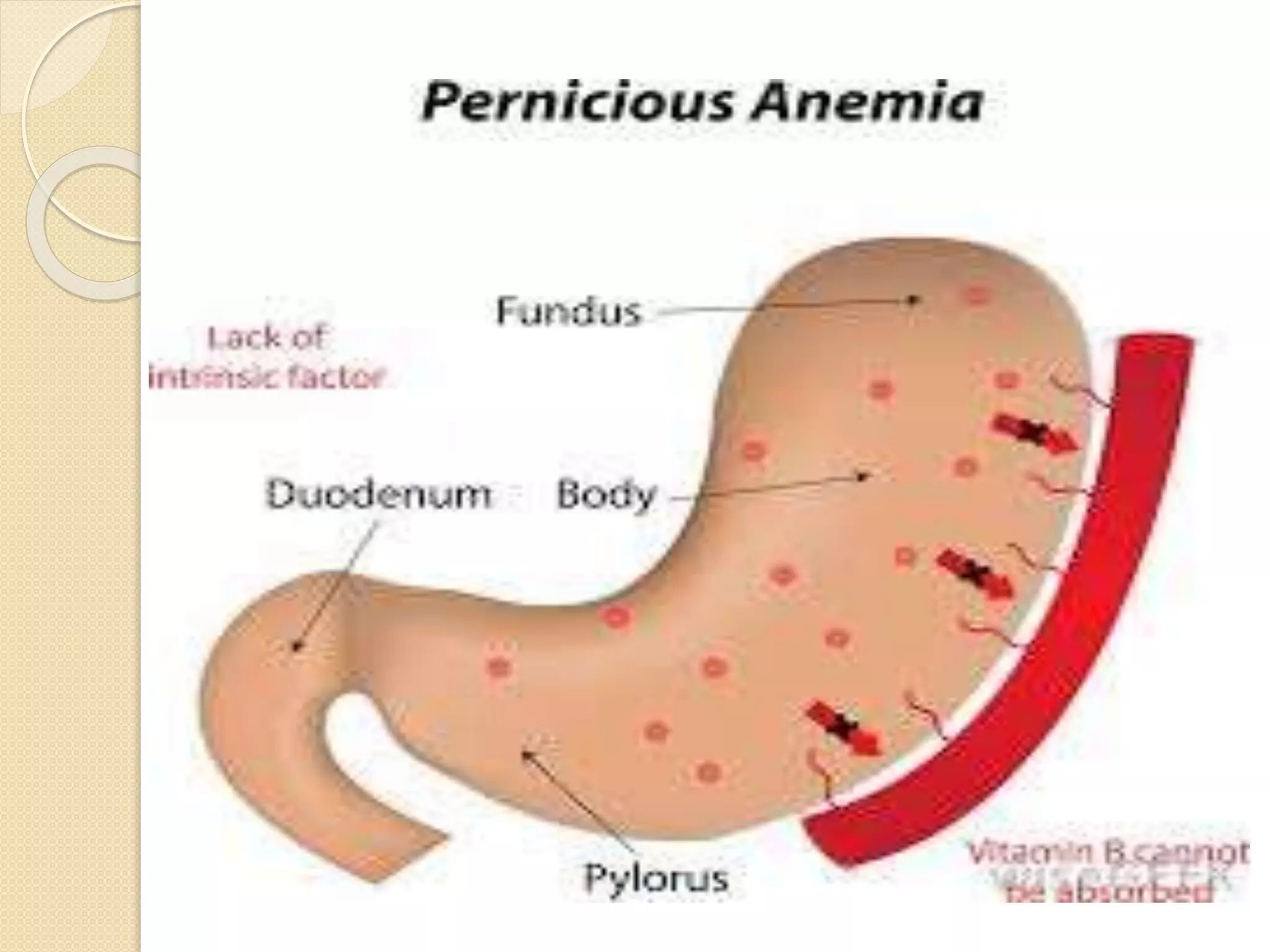
 Failure of secretion of Intrinsic factor (IF) by the stomach due
to permanent atrophy of the gastric mucosa membrane.
 In the absence of IF, the Vit B12 of food is not absorbed,
resulting in Vit B12 deficiency.
 The Diffuse mucosal atrophy, which is referred to as chronic
atrophic gastritis, is most marked in body of stomach.
 The atrophic mucosa is heavily infiltrated by lymphocytes and
plasma cells.
 Histological examination reveals an almost complete
absence of chief and parietal cells, frequently with a
change to an intestinal type of epithelium.
 The atrophy results in –
Loss of intrinsic factor
Decrease HCL secretion
Decrease pepsin
Decrease gastric secretion
Normal Gastric atrophy
PA
• The current evidence suggests that the pathogenesis of
pernicious anaemia is uncertain and it is the end result of
complex interaction between genetic and auto immune
factors.
• AUTOIMMUNE FACTORS -
◦ The discovery that gastric parietal cell auto-antibodies were
frequently present in the seum and gastric juice, and it is presumed
that these auto-antibodies were responsible for the atrophy of gastric
mucosa.
• There are 2 Antibodies against the antegenic components of
gastric parietal cells in serum and gastric juice :-
PARIETAL CELL ANTIBODIES :
o 90% PA patients have serum IgG antibodies to surface
membrane and cytoplasmic antigens of gastric parietal cells.
o 35% in sera of patient relatives.
o 30-60% in patients of chronic atrophic gastritis without PA.
o Normal people, particularly females 70 years above.
 INTRINSIC FACTOR ANTIBODIES :
oBlocking antibodies (Type I anti-IF antibody) -
 React with Vit B12–combining site of IF and inhibit B12
binding.
 Found in 50-70% patients.
oBinding antibodies (Type II anti-IF antibody) -
• Attach to site distant from Vit B12-combinig site and prevent
linkage of IF-Vit B12 complex to ileal receptor.
• Less frequently occurs and are usually present when titre of
blocking antibodies is high.
CLINICAL FEATURES
 Anaemia
 Glossitis (Red beefy tongue)
 Nervous system manifestations :
◦ Axonal degeneration
◦ Peripheral neuropathy due to peripheral nerve lesion
◦ Demyelination of posterior and lateral columns of spinal cord
◦ Paraesthesia of feet (Bilateral, symmetrical, spreads gradually up the
legs to the thighs)
◦ Clumpsy fine movements of fingers
◦ Retrobulbar neuritis
◦ Mild mental disturbances
Red beefy tongue
 GI Manisfestations :
◦ Diarrohea
◦ Anorexia
◦ Dyspepsia
◦ Slight to moderate hepatomegaly
 Congestive cardiac failure
 Petechiae or small ecchymoses of skin
 Mild pyrexia
 Amenorrhea and infertility
BLOOD PICTURE
 CBC –
◦ Hb 3 g/dl or even less
◦ MCV increased from 110-140 fl
◦ MCH increased from 33-38 pg
◦ MCHC normal
◦ Leucopenia from 3000-4000/ul
◦ Thrombocytopenia from 100000-150000/ul
 PBF –
◦ RBC: show presence of macrocytic red cells along
with anisopoikilocytosis in form of Macro-ovalocytes,
microcytes and occassional fragmented cells. Some
cells show basophilic stippling. A small number of
Nrbc and Howell jolly bodies are often seen. In
severe anaemia, Nrbc may be typical megaloblasts.
◦ WBC: show moderate leucopenia. Hypersegmented
neutrophils are always present and few myelocytes
may appear.
 Bone marrow aspiration:
◦ Generally not necessary, but essential in doubtful
cases.
◦ It should be performed before the administration
of Vit B12, as this rapidly changes erthyropoiesis
from megaloblastic to normoblastic.
 BIOCHEMICAL FINDINGS –
◦ S.bilirubin is from 14-17 umol/l
◦ S.haptoglobin reduced
◦ S.ferritin and S.iron increased but fall within 48hrs
of T/t
◦ Plasma LDH increased
◦ Serum folate is usually normal
◦ Red cell folate is almost always reduced
◦ Coombs is positive in 10% patients due to
complement coating of red cells.
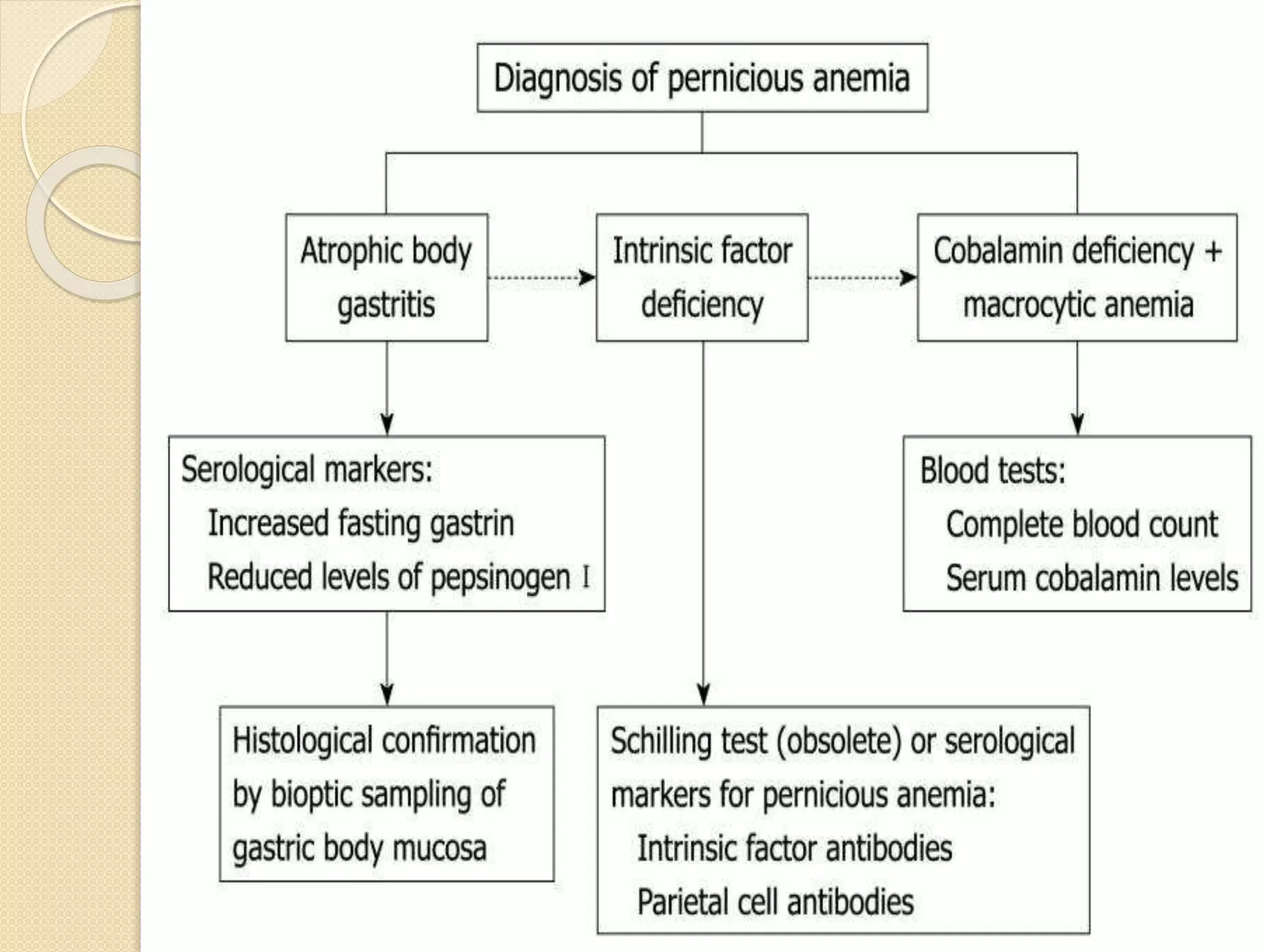
DIAGNOSIS
 Clinical picture
 Macrocytic blood picture
 Megaloblastic bone marrow
 Low serum Vit B12
 Positive serum IF antibody test
 Radioactive Vit B12 assay test
 Response to therapeutic trial of B12
TREATMENT
 Administration of Vit B12 :
◦ INITIAL DOSAGE : 1000 ug hydroxycobalamin
daily for 1 week
◦ MAINTENANCE DOSAGE : 1000 ug once every 3
months.
 Symptomatic and supportive therapy.
 Follow-up and early detection of gastric carcinoma and
carcinoids.
Pernicious  Anemia

Pernicious Anemia

  • 1.
    PERNICIOUS ANEMIA Presented by :Dr. Shubhi Saxena Under Guidance of : Dr. Narayani Joshi
  • 2.
    INTRODUCTION  First describedas a recognisable clinical entity by Addison in 1855.  It is a chronic disorder of middle and old age, and the basic pathological lesion is gastric atrophy which results in Vitamin B12 deficiency.  With adequate treatment the prognosis is excellent.
  • 3.
    PATHOGENESIS  Failure ofsecretion of Intrinsic factor (IF) by the stomach due to permanent atrophy of the gastric mucosa membrane.  In the absence of IF, the Vit B12 of food is not absorbed, resulting in Vit B12 deficiency.  The Diffuse mucosal atrophy, which is referred to as chronic atrophic gastritis, is most marked in body of stomach.  The atrophic mucosa is heavily infiltrated by lymphocytes and plasma cells.
  • 5.
     Histological examinationreveals an almost complete absence of chief and parietal cells, frequently with a change to an intestinal type of epithelium.  The atrophy results in – Loss of intrinsic factor Decrease HCL secretion Decrease pepsin Decrease gastric secretion
  • 6.
  • 7.
    • The currentevidence suggests that the pathogenesis of pernicious anaemia is uncertain and it is the end result of complex interaction between genetic and auto immune factors. • AUTOIMMUNE FACTORS - ◦ The discovery that gastric parietal cell auto-antibodies were frequently present in the seum and gastric juice, and it is presumed that these auto-antibodies were responsible for the atrophy of gastric mucosa.
  • 8.
    • There are2 Antibodies against the antegenic components of gastric parietal cells in serum and gastric juice :- PARIETAL CELL ANTIBODIES : o 90% PA patients have serum IgG antibodies to surface membrane and cytoplasmic antigens of gastric parietal cells. o 35% in sera of patient relatives. o 30-60% in patients of chronic atrophic gastritis without PA. o Normal people, particularly females 70 years above.
  • 9.
     INTRINSIC FACTORANTIBODIES : oBlocking antibodies (Type I anti-IF antibody) -  React with Vit B12–combining site of IF and inhibit B12 binding.  Found in 50-70% patients. oBinding antibodies (Type II anti-IF antibody) - • Attach to site distant from Vit B12-combinig site and prevent linkage of IF-Vit B12 complex to ileal receptor. • Less frequently occurs and are usually present when titre of blocking antibodies is high.
  • 10.
    CLINICAL FEATURES  Anaemia Glossitis (Red beefy tongue)  Nervous system manifestations : ◦ Axonal degeneration ◦ Peripheral neuropathy due to peripheral nerve lesion ◦ Demyelination of posterior and lateral columns of spinal cord ◦ Paraesthesia of feet (Bilateral, symmetrical, spreads gradually up the legs to the thighs) ◦ Clumpsy fine movements of fingers ◦ Retrobulbar neuritis ◦ Mild mental disturbances
  • 11.
  • 12.
     GI Manisfestations: ◦ Diarrohea ◦ Anorexia ◦ Dyspepsia ◦ Slight to moderate hepatomegaly  Congestive cardiac failure  Petechiae or small ecchymoses of skin  Mild pyrexia  Amenorrhea and infertility
  • 13.
    BLOOD PICTURE  CBC– ◦ Hb 3 g/dl or even less ◦ MCV increased from 110-140 fl ◦ MCH increased from 33-38 pg ◦ MCHC normal ◦ Leucopenia from 3000-4000/ul ◦ Thrombocytopenia from 100000-150000/ul
  • 14.
     PBF – ◦RBC: show presence of macrocytic red cells along with anisopoikilocytosis in form of Macro-ovalocytes, microcytes and occassional fragmented cells. Some cells show basophilic stippling. A small number of Nrbc and Howell jolly bodies are often seen. In severe anaemia, Nrbc may be typical megaloblasts. ◦ WBC: show moderate leucopenia. Hypersegmented neutrophils are always present and few myelocytes may appear.
  • 16.
     Bone marrowaspiration: ◦ Generally not necessary, but essential in doubtful cases. ◦ It should be performed before the administration of Vit B12, as this rapidly changes erthyropoiesis from megaloblastic to normoblastic.
  • 17.
     BIOCHEMICAL FINDINGS– ◦ S.bilirubin is from 14-17 umol/l ◦ S.haptoglobin reduced ◦ S.ferritin and S.iron increased but fall within 48hrs of T/t ◦ Plasma LDH increased ◦ Serum folate is usually normal ◦ Red cell folate is almost always reduced ◦ Coombs is positive in 10% patients due to complement coating of red cells.
  • 18.
    DIAGNOSIS  Clinical picture Macrocytic blood picture  Megaloblastic bone marrow  Low serum Vit B12  Positive serum IF antibody test  Radioactive Vit B12 assay test  Response to therapeutic trial of B12
  • 20.
    TREATMENT  Administration ofVit B12 : ◦ INITIAL DOSAGE : 1000 ug hydroxycobalamin daily for 1 week ◦ MAINTENANCE DOSAGE : 1000 ug once every 3 months.  Symptomatic and supportive therapy.  Follow-up and early detection of gastric carcinoma and carcinoids.