Approach to a Bleeding
Disorder
By: Hailemariam Bekele
Hayelom Michael
Outline
2
Introduction
History taking
Physical finding
Investigation
References
Introduction
Bleeding, technically known as
hemorrhaging, is the loss of blood escaping
from the circulatory system.
Bleeding can occur internally, where blood
leaks from blood vessels inside the body, or
externally, either through a natural opening
such as the mouth, nose,
ear, urethra, vagina or anus, or through a
break in the skin.
3
4
Bleeding arises due to either traumatic
injury, underlying medical condition, or a
combination.
'Medical bleeding' denotes hemorrhage as a
result of an underlying medical condition
Blood can escape from blood vessels as a
result of 3 basic patterns of injury:
Intravascular changes - changes of the blood
within vessels (e.g. ↓ clotting factors)
5
Intramural changes - changes arising within
the walls of blood vessels (e.g. aneurysms)
Extravascular changes - changes arising
outside blood vessels (e.g. infection)
Certain medical conditions can also make
patients susceptible to bleeding.
These are conditions that affect the normal
"hemostatic" functions of the body.
Hemostasis involves several components.
The main components of the hemostatic
system include platelets and
the coagulation system.
Bleeding disorders
Inherited disorders
Acquired disorders
Inherited disorders: Coagulation Factor Deficiencies
Platelete disorders
Acquired disorders: Liver disease , Vitamin- k
deficiency,
Anticoagulants,Platelet
abnormalities
6
7
History taking
8
For most hemorrhagic conditions,
history plays an important role in
diagnosing the cause.
For a hemorrhagic condition the history
should determine the site or sites of
bleeding, the severity and duration of
hemorrhage, and the age at symptom
onset.
9
Was the bleeding spontaneous or after
trauma? Does bruising occur
spontaneously?
One should determine if symptoms
correlate with the degree of injury or
trauma. Are there lumps with bruises for
which there is minimal trauma?
Was there a previous personal or family
history of similar problems?
recent transfusion?
Cont’d…
10
If there has been joint pain, swelling or
limitation of movement
If there has been bleeding from umbilical
stump
If there has been previous surgery or
significant dental procedures, was there any
increased bleeding?
Delayed or slow healing of superficial injuries
may suggest a hereditary bleeding disorder.
In postpubertal females, it is important to take
a careful menstrual history.
Medications such as aspirin, other non-
11
Note:
Once the child is beyond the neonatal period,
thrombotic symptoms are relatively rare until
adulthood.
In the neonate, physiologic deficiencies of
procoagulants and anticoagulants cause the
hemostatic mechanism to be dysregulated
Even in the absence of a family history, the
presence of thrombosis in the child or teenager
should trigger an evaluation of the individual for
a hereditary or acquired predisposition to
12
Non-steroidal anti-inflammatory drugs
such as ibuprofen, mefenamic acid, etc.
and aspirin inhibit platelet function
whereas anticonvulsants,
antihistaminics, antituberculous drugs
especially rifampicin are known to cause
thrombocytopenia.
The overall health of the patient also is a
clue to the cause of bleeding. Congenital
bleeding disorders and ITP usually
occur in children who are otherwise well.
Physical Examination
13
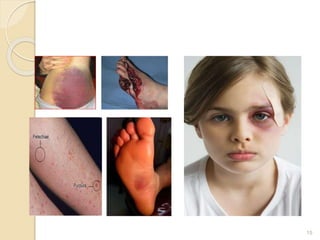
Physical examination offers further clues to
the diagnosis
Is it bleeding? e.g. fixed drug eruption,
erythema nodosum, viral exanthem and
mosquito bites The examination should
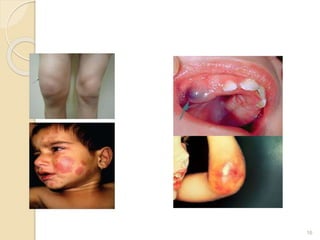
determine the presence of petechiae,
ecchymoses, hematomas, hemarthroses, or
mucous membrane bleeding.
7/19/2014
approach to pediatrics bleeding
disorders 14
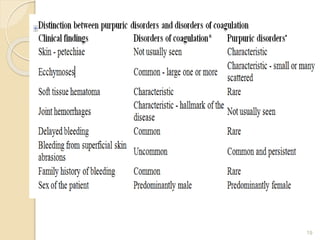
Patients with defects in platelet/blood
vessel wall interaction usually have
mucous membrane bleeding; petechiae
on the skin and mucous membranes;
and small, ecchymotic lesions of the
skin sometimes associated with
hematomas.
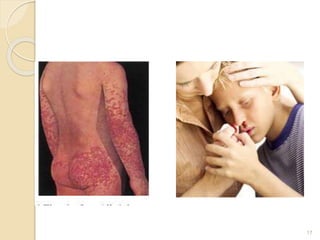
Individuals with a clotting factor
deficiency such as factor VIII or factor IX
deficiency have symptoms of deep
bleeding into muscles and joints with
15
16
17
18
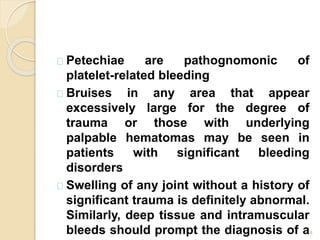
Petechiae are pathognomonic of
platelet-related bleeding
Bruises in any area that appear
excessively large for the degree of
trauma or those with underlying
palpable hematomas may be seen in
patients with significant bleeding
disorders
Swelling of any joint without a history of
significant trauma is definitely abnormal.
Similarly, deep tissue and intramuscular
bleeds should prompt the diagnosis of a
19
20
If it is bleeding, then is it localized or
generalized? A single site involved, it is
more likely to be a localized bleeding
rather than a generalized bleeding
disorder
If generalized, is it platelet type or
coagulation type of bleeding? Is it
congenital/hereditary or acquired
disorder? Symptoms of a longer
duration are indicative of a congenital
disorder such as von Willebrand Disease
(vWD) or coagulation-factor deficiencies
7/19/2014
approach to pediatrics bleeding
disorders 21
Look for hepatosplenomegaly
Do a rectal exam for evidence of GI bleeding
Look for physical signs and symptoms of
diseases related to capillary fragility: Petechiae
secondary to coughing, sneezing, Valsalva
maneuver, blood pressure measurement.
Note: The possibility of physical abuse must be
considered in the evaluation of any child with
unusual patterns of bruising or bleeding.
Laboratory Evaluation
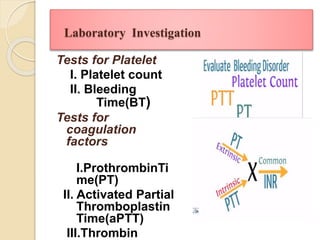
Laboratory Investigation
Tests for Platelet
I. Platelet count
II. Bleeding
Time(BT)
Tests for
coagulation
factors
I.ProthrombinTi
me(PT)
II. Activated Partial
Thromboplastin
Time(aPTT)
III.Thrombin
Platelet count must be done in a suspected
bleeding disorder.
Bleeding Time (BT)
Significance
Assess Primary Hemostatic defect(vessel
wall or platelet).
Dependent on adequate functioning of plt.
& Bl.Vs.
Range
4-8 min
Platelet count & Bleeding
Time
Causes of prolonged BT
I. Thrombocytopenia.
II. VWD.
III. Platelet function disorder
IV. Disorder of blood vesseles.
Interpretation
Significance
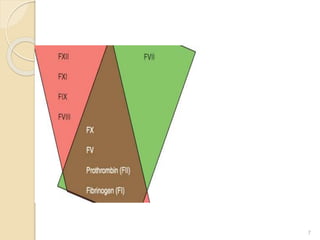
 Reflects overall activity of the Extrinsic
Pathway.
 Most sensitive to changes in Factor V,VII,X.
 Lesser to Factor I & II.
Principle
Platelet poor plasma+Tissue
Thromboplastin+Calcium
In Presence of F VII Extrinsic pathway is
activated & clot
formed
Prothrombin Time(PT)
Causes of prolonged PT
1. Deficiency of Factor VII,X,V,II,I
2. Vit K deficiency
3. Liver disease
4. Oral anticoagulants
Interpretatio
n
Significance
 Reflects efficiency of Intrinsic Pathway.
 Sensitive to changes in Factor VIII,IX,XI,XII.
 Also sensitive to heparin & circulating
anticoagulants.
The test measures the clotting time of plasma
after the activation of contact
So it indicates the overall efficiency of the
Intrinsic pathway
Normal range
26 to 40 seconds.
Activated Partial Thromboplastin
Time
(aPTT)
Causes of prolonged aPTT
1. Deficiency of Factor VIII(Hemophilia A).
2. Deficiency of Factor IX(Hemophilia B).
3. Heparin therapy.
4. Circulating anticoagulants.
5. Liver disease.
Interpretation
Significance
Asses the final step of coagulation i.e.
conversion of fibrinogen to fibrin in presence
of thrombin.
Bypasses Extrinsic & Intrinsic pathway.
Principle
Thrombin is added to plasma and the clotting
time is
measured.
TT is affected by the concentration and reaction
of fibrinogen and by the presence of inhibitory
substances.
Normal range
A patient’s TT should be within 2 s of the control
Thrombin
Time(TT)
Causes of prolonged TT
1. Disorders of fibrinogen-
Afibrinogenaemia.
Hypofibrinogenaemia.
Dysfibrinogenaemia.
2. Liver disease.
3. heparin therapy.
.
Interpretati
on
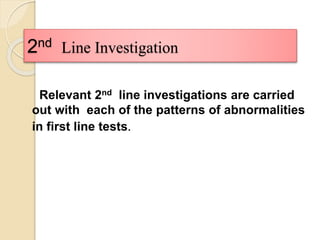
Relevant 2nd line investigations are carried
out with each of the patterns of abnormalities
in first line tests.
2nd Line Investigation
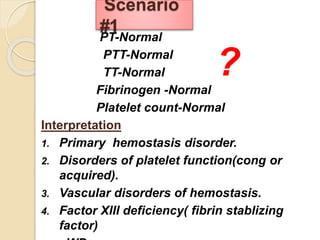
PT-Normal
PTT-Normal
TT-Normal
Fibrinogen -Normal
Platelet count-Normal
Interpretation
1. Primary hemostasis disorder.
2. Disorders of platelet function(cong or
acquired).
3. Vascular disorders of hemostasis.
4. Factor XIII deficiency( fibrin stablizing
factor)
Scenario
#1
?
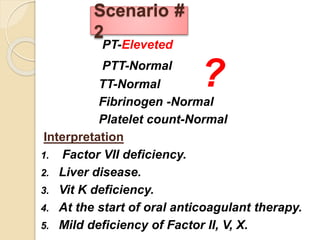
PT-Eleveted
PTT-Normal
TT-Normal
Fibrinogen -Normal
Platelet count-Normal
Interpretation
1. Factor VII deficiency.
2. Liver disease.
3. Vit K deficiency.
4. At the start of oral anticoagulant therapy.
5. Mild deficiency of Factor II, V, X.
Scenario #
2
?
2nd line investigations
1. Mixing test.
2. Factor VII assay.
3. Liver function test.
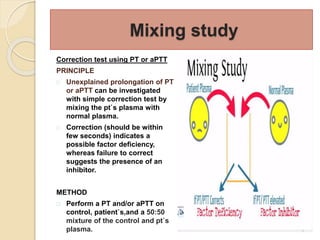
Mixing study
Correction test using PT or aPTT
PRINCIPLE
Unexplained prolongation of PT
or aPTT can be investigated
with simple correction test by
mixing the pt`s plasma with
normal plasma.
Correction (should be within
few seconds) indicates a
possible factor deficiency,
whereas failure to correct
suggests the presence of an
inhibitor.
METHOD
Perform a PT and/or aPTT on
control, patient`s,and a 50:50
mixture of the control and pt`s
plasma.
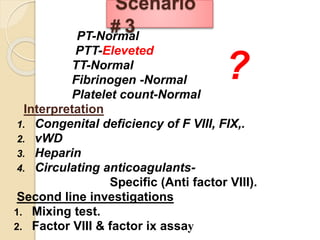
PT-Normal
PTT-Eleveted
TT-Normal
Fibrinogen -Normal
Platelet count-Normal
Interpretation
1. Congenital deficiency of F VIII, FIX,.
2. vWD
3. Heparin
4. Circulating anticoagulants-
Specific (Anti factor VIII).
Second line investigations
1. Mixing test.
2. Factor VIII & factor ix assay
Scenario
# 3
?
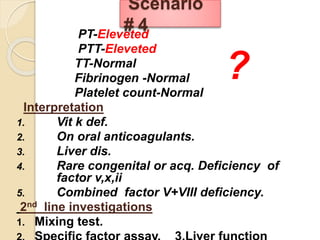
PT-Eleveted
PTT-Eleveted
TT-Normal
Fibrinogen -Normal
Platelet count-Normal
Interpretation
1. Vit k def.
2. On oral anticoagulants.
3. Liver dis.
4. Rare congenital or acq. Deficiency of
factor v,x,ii
5. Combined factor V+VIII deficiency.
2nd line investigations
1. Mixing test.
Scenario
# 4
?
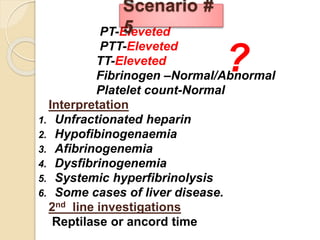
PT-Eleveted
PTT-Eleveted
TT-Eleveted
Fibrinogen –Normal/Abnormal
Platelet count-Normal
Interpretation
1. Unfractionated heparin
2. Hypofibinogenaemia
3. Afibrinogenemia
4. Dysfibrinogenemia
5. Systemic hyperfibrinolysis
6. Some cases of liver disease.
2nd line investigations
Reptilase or ancord time
Scenario #
5
?
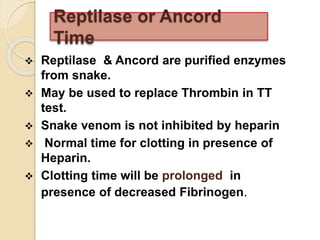
 Reptilase & Ancord are purified enzymes
from snake.
 May be used to replace Thrombin in TT
test.
 Snake venom is not inhibited by heparin
 Normal time for clotting in presence of
Heparin.
 Clotting time will be prolonged in
presence of decreased Fibrinogen.
Reptilase or Ancord
Time
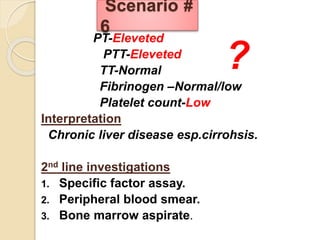
PT-Eleveted
PTT-Eleveted
TT-Normal
Fibrinogen –Normal/low
Platelet count-Low
Interpretation
Chronic liver disease esp.cirrohsis.
2nd line investigations
1. Specific factor assay.
2. Peripheral blood smear.
3. Bone marrow aspirate.
Scenario #
6
?
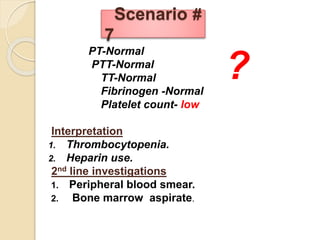
PT-Normal
PTT-Normal
TT-Normal
Fibrinogen -Normal
Platelet count- low
Interpretation
1. Thrombocytopenia.
2. Heparin use.
2nd line investigations
1. Peripheral blood smear.
2. Bone marrow aspirate.
Scenario #
7
?
References
43
1. American Academy of pediatrics
(http://pedsinreview.aappublications.org/cgi/
content/full/29/4/121)
2. Nelson Textbook of Pediatrics, 18th ed.
3. Current Pediatric Diagnosis & Treatment ,
18th edition
4. Pediatrics on call journal, may 2005 vol.2
issue 5
5. Up to date
44

Approach to bleeding disorder

  • 1.
    Approach to aBleeding Disorder By: Hailemariam Bekele Hayelom Michael
  • 2.
  • 3.
    Introduction Bleeding, technically knownas hemorrhaging, is the loss of blood escaping from the circulatory system. Bleeding can occur internally, where blood leaks from blood vessels inside the body, or externally, either through a natural opening such as the mouth, nose, ear, urethra, vagina or anus, or through a break in the skin. 3
  • 4.
    4 Bleeding arises dueto either traumatic injury, underlying medical condition, or a combination. 'Medical bleeding' denotes hemorrhage as a result of an underlying medical condition Blood can escape from blood vessels as a result of 3 basic patterns of injury: Intravascular changes - changes of the blood within vessels (e.g. ↓ clotting factors)
  • 5.
    5 Intramural changes -changes arising within the walls of blood vessels (e.g. aneurysms) Extravascular changes - changes arising outside blood vessels (e.g. infection) Certain medical conditions can also make patients susceptible to bleeding. These are conditions that affect the normal "hemostatic" functions of the body. Hemostasis involves several components. The main components of the hemostatic system include platelets and the coagulation system.
  • 6.
    Bleeding disorders Inherited disorders Acquireddisorders Inherited disorders: Coagulation Factor Deficiencies Platelete disorders Acquired disorders: Liver disease , Vitamin- k deficiency, Anticoagulants,Platelet abnormalities 6
  • 7.
  • 8.
    History taking 8 For mosthemorrhagic conditions, history plays an important role in diagnosing the cause. For a hemorrhagic condition the history should determine the site or sites of bleeding, the severity and duration of hemorrhage, and the age at symptom onset.
  • 9.
    9 Was the bleedingspontaneous or after trauma? Does bruising occur spontaneously? One should determine if symptoms correlate with the degree of injury or trauma. Are there lumps with bruises for which there is minimal trauma? Was there a previous personal or family history of similar problems? recent transfusion?
  • 10.
    Cont’d… 10 If there hasbeen joint pain, swelling or limitation of movement If there has been bleeding from umbilical stump If there has been previous surgery or significant dental procedures, was there any increased bleeding? Delayed or slow healing of superficial injuries may suggest a hereditary bleeding disorder. In postpubertal females, it is important to take a careful menstrual history. Medications such as aspirin, other non-
  • 11.
    11 Note: Once the childis beyond the neonatal period, thrombotic symptoms are relatively rare until adulthood. In the neonate, physiologic deficiencies of procoagulants and anticoagulants cause the hemostatic mechanism to be dysregulated Even in the absence of a family history, the presence of thrombosis in the child or teenager should trigger an evaluation of the individual for a hereditary or acquired predisposition to
  • 12.
    12 Non-steroidal anti-inflammatory drugs suchas ibuprofen, mefenamic acid, etc. and aspirin inhibit platelet function whereas anticonvulsants, antihistaminics, antituberculous drugs especially rifampicin are known to cause thrombocytopenia. The overall health of the patient also is a clue to the cause of bleeding. Congenital bleeding disorders and ITP usually occur in children who are otherwise well.
  • 13.
    Physical Examination 13 Physical examinationoffers further clues to the diagnosis Is it bleeding? e.g. fixed drug eruption, erythema nodosum, viral exanthem and mosquito bites The examination should determine the presence of petechiae, ecchymoses, hematomas, hemarthroses, or mucous membrane bleeding.
  • 14.
    7/19/2014 approach to pediatricsbleeding disorders 14 Patients with defects in platelet/blood vessel wall interaction usually have mucous membrane bleeding; petechiae on the skin and mucous membranes; and small, ecchymotic lesions of the skin sometimes associated with hematomas. Individuals with a clotting factor deficiency such as factor VIII or factor IX deficiency have symptoms of deep bleeding into muscles and joints with
  • 15.
  • 16.
  • 17.
  • 18.
    18 Petechiae are pathognomonicof platelet-related bleeding Bruises in any area that appear excessively large for the degree of trauma or those with underlying palpable hematomas may be seen in patients with significant bleeding disorders Swelling of any joint without a history of significant trauma is definitely abnormal. Similarly, deep tissue and intramuscular bleeds should prompt the diagnosis of a
  • 19.
  • 20.
    20 If it isbleeding, then is it localized or generalized? A single site involved, it is more likely to be a localized bleeding rather than a generalized bleeding disorder If generalized, is it platelet type or coagulation type of bleeding? Is it congenital/hereditary or acquired disorder? Symptoms of a longer duration are indicative of a congenital disorder such as von Willebrand Disease (vWD) or coagulation-factor deficiencies
  • 21.
    7/19/2014 approach to pediatricsbleeding disorders 21 Look for hepatosplenomegaly Do a rectal exam for evidence of GI bleeding Look for physical signs and symptoms of diseases related to capillary fragility: Petechiae secondary to coughing, sneezing, Valsalva maneuver, blood pressure measurement. Note: The possibility of physical abuse must be considered in the evaluation of any child with unusual patterns of bruising or bleeding.
  • 22.
  • 23.
    Laboratory Investigation Tests forPlatelet I. Platelet count II. Bleeding Time(BT) Tests for coagulation factors I.ProthrombinTi me(PT) II. Activated Partial Thromboplastin Time(aPTT) III.Thrombin
  • 24.
    Platelet count mustbe done in a suspected bleeding disorder. Bleeding Time (BT) Significance Assess Primary Hemostatic defect(vessel wall or platelet). Dependent on adequate functioning of plt. & Bl.Vs. Range 4-8 min Platelet count & Bleeding Time
  • 25.
    Causes of prolongedBT I. Thrombocytopenia. II. VWD. III. Platelet function disorder IV. Disorder of blood vesseles. Interpretation
  • 26.
    Significance  Reflects overallactivity of the Extrinsic Pathway.  Most sensitive to changes in Factor V,VII,X.  Lesser to Factor I & II. Principle Platelet poor plasma+Tissue Thromboplastin+Calcium In Presence of F VII Extrinsic pathway is activated & clot formed Prothrombin Time(PT)
  • 27.
    Causes of prolongedPT 1. Deficiency of Factor VII,X,V,II,I 2. Vit K deficiency 3. Liver disease 4. Oral anticoagulants Interpretatio n
  • 28.
    Significance  Reflects efficiencyof Intrinsic Pathway.  Sensitive to changes in Factor VIII,IX,XI,XII.  Also sensitive to heparin & circulating anticoagulants. The test measures the clotting time of plasma after the activation of contact So it indicates the overall efficiency of the Intrinsic pathway Normal range 26 to 40 seconds. Activated Partial Thromboplastin Time (aPTT)
  • 29.
    Causes of prolongedaPTT 1. Deficiency of Factor VIII(Hemophilia A). 2. Deficiency of Factor IX(Hemophilia B). 3. Heparin therapy. 4. Circulating anticoagulants. 5. Liver disease. Interpretation
  • 30.
    Significance Asses the finalstep of coagulation i.e. conversion of fibrinogen to fibrin in presence of thrombin. Bypasses Extrinsic & Intrinsic pathway. Principle Thrombin is added to plasma and the clotting time is measured. TT is affected by the concentration and reaction of fibrinogen and by the presence of inhibitory substances. Normal range A patient’s TT should be within 2 s of the control Thrombin Time(TT)
  • 31.
    Causes of prolongedTT 1. Disorders of fibrinogen- Afibrinogenaemia. Hypofibrinogenaemia. Dysfibrinogenaemia. 2. Liver disease. 3. heparin therapy. . Interpretati on
  • 32.
    Relevant 2nd lineinvestigations are carried out with each of the patterns of abnormalities in first line tests. 2nd Line Investigation
  • 33.
    PT-Normal PTT-Normal TT-Normal Fibrinogen -Normal Platelet count-Normal Interpretation 1.Primary hemostasis disorder. 2. Disorders of platelet function(cong or acquired). 3. Vascular disorders of hemostasis. 4. Factor XIII deficiency( fibrin stablizing factor) Scenario #1 ?
  • 34.
    PT-Eleveted PTT-Normal TT-Normal Fibrinogen -Normal Platelet count-Normal Interpretation 1.Factor VII deficiency. 2. Liver disease. 3. Vit K deficiency. 4. At the start of oral anticoagulant therapy. 5. Mild deficiency of Factor II, V, X. Scenario # 2 ?
  • 35.
    2nd line investigations 1.Mixing test. 2. Factor VII assay. 3. Liver function test.
  • 36.
    Mixing study Correction testusing PT or aPTT PRINCIPLE Unexplained prolongation of PT or aPTT can be investigated with simple correction test by mixing the pt`s plasma with normal plasma. Correction (should be within few seconds) indicates a possible factor deficiency, whereas failure to correct suggests the presence of an inhibitor. METHOD Perform a PT and/or aPTT on control, patient`s,and a 50:50 mixture of the control and pt`s plasma.
  • 37.
    PT-Normal PTT-Eleveted TT-Normal Fibrinogen -Normal Platelet count-Normal Interpretation 1.Congenital deficiency of F VIII, FIX,. 2. vWD 3. Heparin 4. Circulating anticoagulants- Specific (Anti factor VIII). Second line investigations 1. Mixing test. 2. Factor VIII & factor ix assay Scenario # 3 ?
  • 38.
    PT-Eleveted PTT-Eleveted TT-Normal Fibrinogen -Normal Platelet count-Normal Interpretation 1.Vit k def. 2. On oral anticoagulants. 3. Liver dis. 4. Rare congenital or acq. Deficiency of factor v,x,ii 5. Combined factor V+VIII deficiency. 2nd line investigations 1. Mixing test. Scenario # 4 ?
  • 39.
    PT-Eleveted PTT-Eleveted TT-Eleveted Fibrinogen –Normal/Abnormal Platelet count-Normal Interpretation 1.Unfractionated heparin 2. Hypofibinogenaemia 3. Afibrinogenemia 4. Dysfibrinogenemia 5. Systemic hyperfibrinolysis 6. Some cases of liver disease. 2nd line investigations Reptilase or ancord time Scenario # 5 ?
  • 40.
     Reptilase &Ancord are purified enzymes from snake.  May be used to replace Thrombin in TT test.  Snake venom is not inhibited by heparin  Normal time for clotting in presence of Heparin.  Clotting time will be prolonged in presence of decreased Fibrinogen. Reptilase or Ancord Time
  • 41.
    PT-Eleveted PTT-Eleveted TT-Normal Fibrinogen –Normal/low Platelet count-Low Interpretation Chronicliver disease esp.cirrohsis. 2nd line investigations 1. Specific factor assay. 2. Peripheral blood smear. 3. Bone marrow aspirate. Scenario # 6 ?
  • 42.
    PT-Normal PTT-Normal TT-Normal Fibrinogen -Normal Platelet count-low Interpretation 1. Thrombocytopenia. 2. Heparin use. 2nd line investigations 1. Peripheral blood smear. 2. Bone marrow aspirate. Scenario # 7 ?
  • 43.
    References 43 1. American Academyof pediatrics (http://pedsinreview.aappublications.org/cgi/ content/full/29/4/121) 2. Nelson Textbook of Pediatrics, 18th ed. 3. Current Pediatric Diagnosis & Treatment , 18th edition 4. Pediatrics on call journal, may 2005 vol.2 issue 5 5. Up to date
  • 44.

Editor's Notes