SANJEEV KUMAR
B.Sc MLT PART-III
ANAEMIA
 Definition by WHO
“A condition in which the number of RBCs or their oxygen carrying
capacity is insufficient to meet the physiological needs, which vary by
age, sex, altitude, smoking and pregnancy status”
 Any of three concentration measurements are used to establish
the presence of anaemia:
 Hemoglobin(Hb) level(g/dl)
 Hematocrit(%)
 RBC number(1012/l)
IRON DEFICIENCY ANAEMIA
 Iron deficiency anaemia is a type of anaemia in which the supply of iron to
bone marrow is inadequate and total body iron is deficient to support
optimal erythropoiesis in the developing red cell mass.
 IDA is characterized by a defective development of red cells resulting in the
production of small pale erythrocytes.
 Iron is a component of various heme proteins, including cytochromes,
myoglobin, catalase and peroxidase.
 Important in oxidation-reduction reactions
 Microcytic hypochromic red cells
 MCV<80fl
 MCH<25pg
 Body iron stores depleted
 Level of circulating iron is reduced
PREVALENCE OF IDA IN INDIA
 Children in India varies from 35-45% in various studies
 Higher in females
 More in case of pregnancy with a prevalence rate of 45-60%
 Prevalent in both in rural and urban population
 Severity is high in lower socio-economic group
 High risk groups of children, pregnant women and elderly
adolescents
DAILY IRON REQUIREMENTS
 Infants up to 4 months : 0.5 mg
 Infants 5-12 months and children : 1 mg
 Menstruating women : 3 mg
 Pregnancy : 3-4 mg
 Adult men and postmenopausal women : 1 mg
 The loss is about 1 mg / day.
 To balance the daily iron loss of 1 mg , about 10% of the daily iron
intake is absorbed.
CAUSE OF IDA
 Four groups
 Inadequate iron intake
 Defective absorption
 Excessive loss of iron (5mg of iron is lost for loss of 10ml blood)
 Increased requirement
 In infants and children(6-18 months), iron deficiency results from
poor dietary intake
 In adults iron deficiency is usually secondary to chronic blood
loss.
 In women of reproductive age group iron deficiency is usually
result of menstrual disorders and pregnancy.
 Inadequate dietary intake of iron
 Defective absorption of iron
 Subtotal gastrectomy
 In partial gastrectomy-loss of gastric acidity result in impaired Fe absorption
 In total gastrectomy food rapidly passes through duodenum and absorption of iron is impaired
 Helicobacter pylori gastritis
 Excessive loss of iron
 Gastrointestinal bleeding
 Peptic ulcer,
 Gastritis,
 Hookworm infection,
 Various neoplasms especially carcinoma of colon, marathon runners;
 Urinary tract bleeding
 Haematuria
 Haemoglobinuria
 Respiratory tract bleeding
 Bleeding disorders
 Increased requirements for iron—Pregnancy, infancy, adolescents
CLINICAL FEATURES
 Fatigue, restless legs, palpitations, breathlessness.
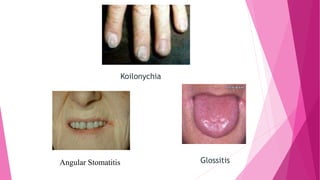
 Koilonychia/plantynychia: finger nail become thin, flattened, brittle &
finally spoon shaped.
 Angular stomatitis, glossitis: papillae of tongue making the surface
smooth.
 Atrophic gastritis – Inflammation of the lining of the stomach
 Achlorhydria – lack of hydrochloric acid secretion in the stomach
 Dysphagia – difficulty in swallowing because of esophageal web,
known as Plummer-Vinson syndrome
 Most common characteristics symptoms is PICA i.e. an abnormal and
intense desire to eat strange substances such as clay, paint, cardboard,
coal, etc.
Koilonychia
GlossitisAngular Stomatitis
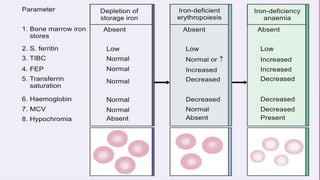
STAGES IN THE DEVELOPMENT OF IDA
 Depletion of iron stores
 Serum ferritin conc. decrease
 Absence of stainable iron in BM
 Decrease in transport iron with reduced availability of iron for
erythropoiesis
 Circulating iron level falls
 Serum iron & transferrin saturation decrease
 TIBC increase
 Free erythrocyte protoporphyrin(FEP) increases
 Normocytic normochromic anaemia
 Microcytic anaemia
 Microcytic hypochromic anaemia
Lab. Diagnosis of Iron Deficiency Anaemia
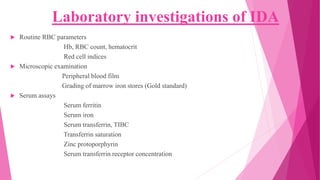
Laboratory investigations of IDA
 Routine RBC parameters
Hb, RBC count, hematocrit
Red cell indices
 Microscopic examination
Peripheral blood film
Grading of marrow iron stores (Gold standard)
 Serum assays
Serum ferritin
Serum iron
Serum transferrin, TIBC
Transferrin saturation
Zinc protoporphyrin
Serum transferrin receptor concentration
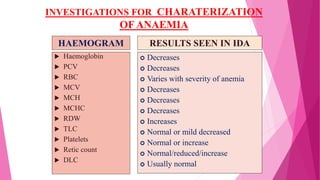
INVESTIGATIONS FOR CHARATERIZATION
OF ANAEMIA
 Haemoglobin
 PCV
 RBC
 MCV
 MCH
 MCHC
 RDW
 TLC
 Platelets
 Retic count
 DLC
 Decreases
 Decreases
 Varies with severity of anemia
 Decreases
 Decreases
 Decreases
 Increases
 Normal or mild decreased
 Normal or increase
 Normal/reduced/increase
 Usually normal
HAEMOGRAM RESULTS SEEN IN IDA
BLOOD FILM:
 Anisocytosis and poikilocytosis seen
 Red cells are microcytic and
hypochromic
 In addition to poorly haemoglobinized
red cells, elliptocytes(pencil cells),target
cells, tear drop cells and cell fragments
are present
BONE MARROW FEATURES
 Hypercellular
 Erythroid hyperplasia
 Erythropoiesis is micronormoblastic
 Normoblast are smaller
 Late micronormoblasts demonstrate persistent basophilia
 Cytoplasmic border indicate incomplete hemoglobinization.
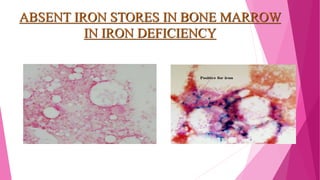
 Absence of stainable iron in the bone marrow on Perl’s Prussian blue
reaction is a specific and a reliable test for diagnosis of iron deficiency
anaemia.
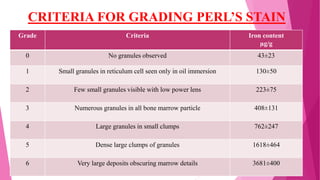
 BMA smear shows completely devoid of iron and iron grade is 0 (NIL).
 The serum iron gives a measure of the iron supply to the tissues
at the time of sampling.
 Chromogenic Method
 Principle
 When serum iron is treated with Mixed Acid Reagent, the protein
bound iron is detached by the action of conc. HCl & reduced to ferrous
state by thioglycolic acid & proteins are precipitated by the action of
TCA. This ferrous iron is then treated with chromogen solution & it
forms a colored complex which is then measured at 562 nm.
Estimation of Serum Iron
 REQUIREMENTS -
 Apparatus
1)Iron free test tube 4)Test tube rack
2)Vortex mixture 5)Pipettes
3)Centrifuge 6)Spectrophotometer
 Reagents
 Mixed acid reagent
Conc. HCl (detach iron from transferrin) – 90ml
Trichloro acetic acid(protein precipitant) – 100ml
Thioglycolic acid(reduce Fe3+ to Fe2+ ) – 30ml
Dissolve in iron free distilled water and make volume to 1000ml
 Chromogen solution
Ferrozine : 25mg
Sod. Acetate(1.5mol/l) : 20.4g
Make volume up to 100ml with iron free distilled water
 Stock standard (100µg/ml)
 Pure iron wire : 100mg
 HCl(7mol/l) : 4ml
 Distilled water up to 1000ml
 Working solution (2µg/ml)
 Stock solution : 2ml
 Distilled water : 100ml
 PREPARATION OF GLASSWARES
 Wash all glassware in a detergent solution.
 Remove glassware by washing thoroughly in dist. water.
 Soak in 2 mol/l HCL for 24hr.
 Finally wash in iron free D/W.
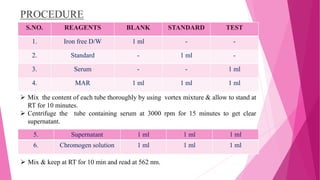
PROCEDURE
 Mix the content of each tube thoroughly by using vortex mixture & allow to stand at
RT for 10 minutes.
 Centrifuge the tube containing serum at 3000 rpm for 15 minutes to get clear
supernatant.
5. Supernatant 1 ml 1 ml 1 ml
6. Chromogen solution 1 ml 1 ml 1 ml
S.NO. REAGENTS BLANK STANDARD TEST
1. Iron free D/W 1 ml - -
2. Standard - 1 ml -
3. Serum - - 1 ml
4. MAR 1 ml 1 ml 1 ml
 Mix & keep at RT for 10 min and read at 562 nm.
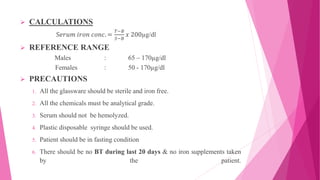
 CALCULATIONS
S𝑒𝑟𝑢𝑚 𝑖𝑟𝑜𝑛 𝑐𝑜𝑛𝑐. =
𝑇−𝐵
𝑆−𝐵
𝑥 200µg/dl
 REFERENCE RANGE
Males : 65 – 170µg/dl
Females : 50 - 170µg/dl
 PRECAUTIONS
1. All the glassware should be sterile and iron free.
2. All the chemicals must be analytical grade.
3. Serum should not be hemolyzed.
4. Plastic disposable syringe should be used.
5. Patient should be in fasting condition
6. There should be no BT during last 20 days & no iron supplements taken
by the patient.
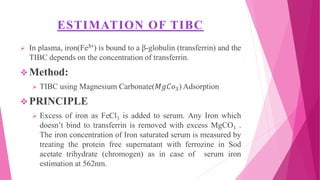
ESTIMATION OF TIBC
 In plasma, iron(Fe3+) is bound to a β-globulin (transferrin) and the
TIBC depends on the concentration of transferrin.
 Method:
 TIBC using Magnesium Carbonate(𝑀𝑔𝐶𝑜3) Adsorption
 PRINCIPLE
 Excess of iron as FeCl3 is added to serum. Any Iron which
doesn’t bind to transferrin is removed with excess MgCO3 .
The iron concentration of Iron saturated serum is measured by
treating the protein free supernatant with ferrozine in Sod
acetate trihydrate (chromogen) as in case of serum iron
estimation at 562nm.
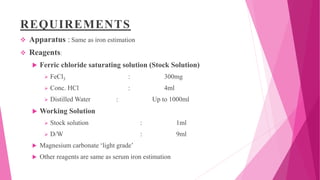
REQUIREMENTS
 Apparatus : Same as iron estimation
 Reagents:
 Ferric chloride saturating solution (Stock Solution)
 FeCl3 : 300mg
 Conc. HCl : 4ml
 Distilled Water : Up to 1000ml
 Working Solution
 Stock solution : 1ml
 D/W : 9ml
 Magnesium carbonate ‘light grade’
 Other reagents are same as serum iron estimation
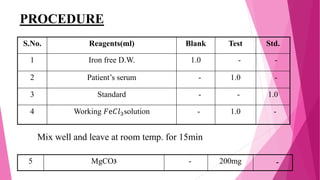
S.No. Reagents(ml) Blank Test Std.
1 Iron free D.W. 1.0 - -
2 Patient’s serum - 1.0 -
3 Standard - - 1.0
4 Working 𝐹ⅇ𝐶𝑙3solution - 1.0 -
Mix well and leave at room temp. for 15min
PROCEDURE
5 MgCO3 - 200mg -
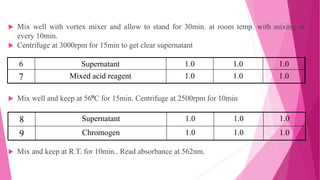
 Mix well with vortex mixer and allow to stand for 30min. at room temp. with mixing at
every 10min.
 Centrifuge at 3000rpm for 15min to get clear supernatant
 Mix well and keep at 560C for 15min. Centrifuge at 2500rpm for 10min
 Mix and keep at R.T. for 10min.. Read absorbance at 562nm.
6 Supernatant 1.0 1.0 1.0
7 Mixed acid reagent 1.0 1.0 1.0
8 Supernatant 1.0 1.0 1.0
9 Chromogen 1.0 1.0 1.0
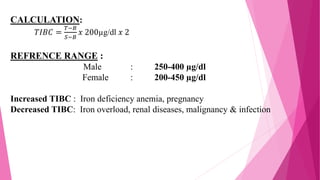
CALCULATION:
𝑇𝐼𝐵𝐶 =
𝑇−𝐵
𝑆−𝐵
𝑥 200µg/dl 𝑥 2
REFRENCE RANGE :
Male : 250-400 µg/dl
Female : 200-450 µg/dl
Increased TIBC : Iron deficiency anemia, pregnancy
Decreased TIBC: Iron overload, renal diseases, malignancy & infection
SERUM TRANSFERRIN
 Though TIBC is an indirect measure of transferrin we can also measure
transferrin directly. There are many immunological methods for
measuring transferrin concentration directly such as:
 Mancini radial immunodiffusion method
 Electro immunassay (the Laurell rocket technique)
 Immunonephelometric technique
 Immunoturbidimetric technique
 Normal range: 2.0 – 3.0g/l
In IDA, transferrin >3.0g/l
 Normally 1mg of transferrin binds 1.4µg of iron
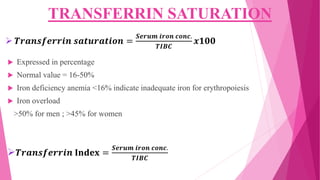
TRANSFERRIN SATURATION
 Expressed in percentage
 Normal value = 16-50%
 Iron deficiency anemia <16% indicate inadequate iron for erythropoiesis
 Iron overload
>50% for men ; >45% for women
 𝑻𝒓𝒂𝒏𝒔𝒇𝒆𝒓𝒓𝒊𝒏 𝒔𝒂𝒕𝒖𝒓𝒂𝒕𝒊𝒐𝒏 =
𝑺𝒆𝒓𝒖𝒎 𝒊𝒓𝒐𝒏 𝒄𝒐𝒏𝒄.
𝑻𝑰𝑩𝑪
𝒙𝟏𝟎𝟎
 𝑻𝒓𝒂𝒏𝒔𝒇𝒆𝒓𝒓𝒊𝒏 𝐈𝐧𝐝𝐞𝐱 =
𝑺𝒆𝒓𝒖𝒎 𝒊𝒓𝒐𝒏 𝒄𝒐𝒏𝒄.
𝑻𝑰𝑩𝑪
SERUM FERRITIN
 Ferritin is found intracellular and in blood stream.
 Reliable parameter to determine the iron stores in the body.
 Its determination is an important parameter for the diagnosis and therapy control of
the iron deficiency .
 Ferritin measurement is recommended for risk group like blood donors, pregnant
woman, hemodialysis patient and infants.
 Serum ferritin reflects body iron stores and its measurement has been widely used as
a test for iron deficiency and iron overload
 Serum Ferritin can be measured by radio immunoassay or ELISA ( enzyme linked
immunosorbent assay)
 Most sensitive and specific test for diagnosis of iron deficiency anaemia. Serum
ferritin decreases even before the appearance of anaemia
 1 μg/L serum ferritin ≈10 mg storage iron
 Serum ferritin < 12 μg/L is highly specific for diagnosis of iron deficiency anaemia
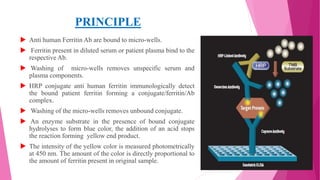
PRINCIPLE
 Anti human Ferritin Ab are bound to micro-wells.
 Ferritin present in diluted serum or patient plasma bind to the
respective Ab.
 Washing of micro-wells removes unspecific serum and
plasma components.
 HRP conjugate anti human ferritin immunologically detect
the bound patient ferritin forming a conjugate/ferritin/Ab
complex.
 Washing of the micro-wells removes unbound conjugate.
 An enzyme substrate in the presence of bound conjugate
hydrolyses to form blue color, the addition of an acid stops
the reaction forming yellow end product.
 The intensity of the yellow color is measured photometrically
at 450 nm. The amount of the color is directly proportional to
the amount of ferritin present in original sample.
MATERIAL REQUIRED
1) Microplate : coated with highly purified specific Anti human
ferritin Ab(rabbit, polyclonal)
2) Six calibrators: conc. 0, 15,50,150,500 and 1500 ng/ml
3) Controls: positive and negative control
4) Sample buffer: for dilution of sample
5) Enzyme conjugate solution: containing polyclonal rabbit anti
human ferritin, labeled with horse radish peroxidase.
6) TMB substrate solution : (Tetra methyl benzidine)
7) Stop solution : 1 mol HCl
8) Wash solution: phosphate buffer
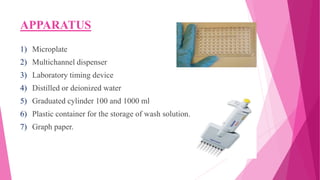
APPARATUS
1) Microplate
2) Multichannel dispenser
3) Laboratory timing device
4) Distilled or deionized water
5) Graduated cylinder 100 and 1000 ml
6) Plastic container for the storage of wash solution.
7) Graph paper.
PROCEDURE
1) Prepare a sufficient no of micro plate wells to accommodate control and patient
samples.
2) Pipette 25 µl of calibrator, controls and patient samples in duplicate into the wells.
3) Add 100µl sample buffer to each wells.
4) Incubate for 30 min at 25⁰-28⁰ C.
5) Discard the content of micro-wells and wash 3 times with 300 µl of wash solution or
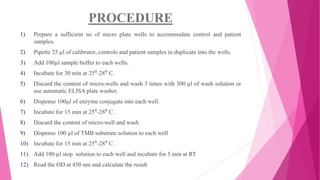
use automatic ELISA plate washer.
6) Dispense 100µl of enzyme conjugate into each well.
7) Incubate for 15 min at 25⁰-28⁰ C.
8) Discard the content of micro-well and wash
9) Dispense 100 µl of TMB substrate solution to each well
10) Incubate for 15 min at 25⁰-28⁰ C .
11) Add 100 µl stop solution to each well and incubate for 5 min at RT
12) Read the OD at 450 nm and calculate the result
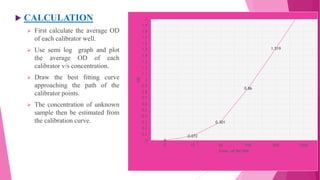
 CALCULATION
 First calculate the average OD
of each calibrator well.
 Use semi log graph and plot
the average OD of each
calibrator v/s concentration.
 Draw the best fitting curve
approaching the path of the
calibrator points.
 The concentration of unknown
sample then be estimated from
the calibration curve.
0
0.072
0.301
0.86
1.519
0
0.1
0.2
0.3
0.4
0.5
0.6
0.7
0.8
0.9
1
1.1
1.2
1.3
1.4
1.5
1.6
1.7
1.8
1.9
2
0 15 50 150 500 1500
OD
Conc. of ferritin
 PRECAUTIONS
1) Store the kit at 2-8ºC.
2) Once started , the test must be performed without interruption.
3) Avoid carry over contamination.
4) Wash micro-wells thoroughly and remove the last droplets.
 NORMAL RANGE
 15-300 µg /l in normal adult
 varying with age and sex.
 Interpretation of result
 Use of serum ferritin is for the assessment of iron stores.
 In adults (puberty to middle life)-
Conc. are higher in men than in women.
Conc. < 15 µg/l – absence of storage iron.
 In children
Conc. are lower in children than in adults.
Conc. < 12 µg/l – absence of storage iron.
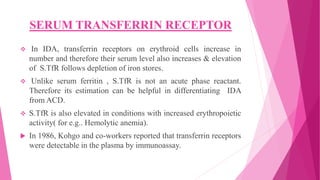
SERUM TRANSFERRIN RECEPTOR
 In IDA, transferrin receptors on erythroid cells increase in
number and therefore their serum level also increases & elevation
of S.TfR follows depletion of iron stores.
 Unlike serum ferritin , S.TfR is not an acute phase reactant.
Therefore its estimation can be helpful in differentiating IDA
from ACD.
 S.TfR is also elevated in conditions with increased erythropoietic
activity( for e.g.. Hemolytic anemia).
 In 1986, Kohgo and co-workers reported that transferrin receptors
were detectable in the plasma by immunoassay.
FERRITIN STORES: BONE MARROW
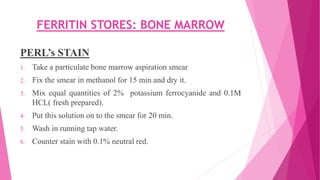
PERL’s STAIN
1. Take a particulate bone marrow aspiration smear
2. Fix the smear in methanol for 15 min and dry it.
3. Mix equal quantities of 2% potassium ferrocyanide and 0.1M
HCL( fresh prepared).
4. Put this solution on to the smear for 20 min.
5. Wash in running tap water.
6. Counter stain with 0.1% neutral red.
CRITERIA FOR GRADING PERL’S STAIN
Grade Criteria Iron content
µg/g
0 No granules observed 43±23
1 Small granules in reticulum cell seen only in oil immersion 130±50
2 Few small granules visible with low power lens 223±75
3 Numerous granules in all bone marrow particle 408±131
4 Large granules in small clumps 762±247
5 Dense large clumps of granules 1618±464
6 Very large deposits obscuring marrow details 3681±400
ABSENT IRON STORES IN BONE MARROW
IN IRON DEFICIENCY
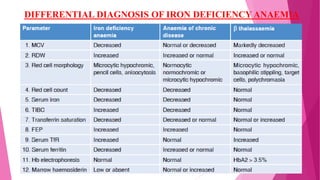
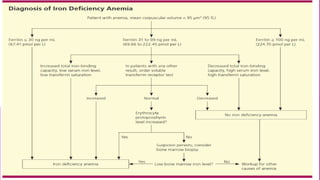
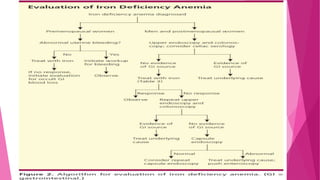
DIFFERENTIAL DIAGNOSIS OF IRON DEFICIENCY ANAEMIA
THANK YOU

Iron Deficiency Anaemia

  • 1.
  • 2.
    ANAEMIA  Definition byWHO “A condition in which the number of RBCs or their oxygen carrying capacity is insufficient to meet the physiological needs, which vary by age, sex, altitude, smoking and pregnancy status”  Any of three concentration measurements are used to establish the presence of anaemia:  Hemoglobin(Hb) level(g/dl)  Hematocrit(%)  RBC number(1012/l)
  • 3.
    IRON DEFICIENCY ANAEMIA Iron deficiency anaemia is a type of anaemia in which the supply of iron to bone marrow is inadequate and total body iron is deficient to support optimal erythropoiesis in the developing red cell mass.  IDA is characterized by a defective development of red cells resulting in the production of small pale erythrocytes.  Iron is a component of various heme proteins, including cytochromes, myoglobin, catalase and peroxidase.  Important in oxidation-reduction reactions  Microcytic hypochromic red cells  MCV<80fl  MCH<25pg  Body iron stores depleted  Level of circulating iron is reduced
  • 4.
    PREVALENCE OF IDAIN INDIA  Children in India varies from 35-45% in various studies  Higher in females  More in case of pregnancy with a prevalence rate of 45-60%  Prevalent in both in rural and urban population  Severity is high in lower socio-economic group  High risk groups of children, pregnant women and elderly adolescents
  • 5.
    DAILY IRON REQUIREMENTS Infants up to 4 months : 0.5 mg  Infants 5-12 months and children : 1 mg  Menstruating women : 3 mg  Pregnancy : 3-4 mg  Adult men and postmenopausal women : 1 mg  The loss is about 1 mg / day.  To balance the daily iron loss of 1 mg , about 10% of the daily iron intake is absorbed.
  • 6.
    CAUSE OF IDA Four groups  Inadequate iron intake  Defective absorption  Excessive loss of iron (5mg of iron is lost for loss of 10ml blood)  Increased requirement  In infants and children(6-18 months), iron deficiency results from poor dietary intake  In adults iron deficiency is usually secondary to chronic blood loss.  In women of reproductive age group iron deficiency is usually result of menstrual disorders and pregnancy.
  • 7.
     Inadequate dietaryintake of iron  Defective absorption of iron  Subtotal gastrectomy  In partial gastrectomy-loss of gastric acidity result in impaired Fe absorption  In total gastrectomy food rapidly passes through duodenum and absorption of iron is impaired  Helicobacter pylori gastritis  Excessive loss of iron  Gastrointestinal bleeding  Peptic ulcer,  Gastritis,  Hookworm infection,  Various neoplasms especially carcinoma of colon, marathon runners;  Urinary tract bleeding  Haematuria  Haemoglobinuria  Respiratory tract bleeding  Bleeding disorders  Increased requirements for iron—Pregnancy, infancy, adolescents
  • 8.
    CLINICAL FEATURES  Fatigue,restless legs, palpitations, breathlessness.  Koilonychia/plantynychia: finger nail become thin, flattened, brittle & finally spoon shaped.  Angular stomatitis, glossitis: papillae of tongue making the surface smooth.  Atrophic gastritis – Inflammation of the lining of the stomach  Achlorhydria – lack of hydrochloric acid secretion in the stomach  Dysphagia – difficulty in swallowing because of esophageal web, known as Plummer-Vinson syndrome  Most common characteristics symptoms is PICA i.e. an abnormal and intense desire to eat strange substances such as clay, paint, cardboard, coal, etc.
  • 9.
  • 10.
    STAGES IN THEDEVELOPMENT OF IDA  Depletion of iron stores  Serum ferritin conc. decrease  Absence of stainable iron in BM  Decrease in transport iron with reduced availability of iron for erythropoiesis  Circulating iron level falls  Serum iron & transferrin saturation decrease  TIBC increase  Free erythrocyte protoporphyrin(FEP) increases  Normocytic normochromic anaemia  Microcytic anaemia  Microcytic hypochromic anaemia
  • 12.
    Lab. Diagnosis ofIron Deficiency Anaemia
  • 13.
    Laboratory investigations ofIDA  Routine RBC parameters Hb, RBC count, hematocrit Red cell indices  Microscopic examination Peripheral blood film Grading of marrow iron stores (Gold standard)  Serum assays Serum ferritin Serum iron Serum transferrin, TIBC Transferrin saturation Zinc protoporphyrin Serum transferrin receptor concentration
  • 14.
    INVESTIGATIONS FOR CHARATERIZATION OFANAEMIA  Haemoglobin  PCV  RBC  MCV  MCH  MCHC  RDW  TLC  Platelets  Retic count  DLC  Decreases  Decreases  Varies with severity of anemia  Decreases  Decreases  Decreases  Increases  Normal or mild decreased  Normal or increase  Normal/reduced/increase  Usually normal HAEMOGRAM RESULTS SEEN IN IDA
  • 15.
    BLOOD FILM:  Anisocytosisand poikilocytosis seen  Red cells are microcytic and hypochromic  In addition to poorly haemoglobinized red cells, elliptocytes(pencil cells),target cells, tear drop cells and cell fragments are present
  • 16.
    BONE MARROW FEATURES Hypercellular  Erythroid hyperplasia  Erythropoiesis is micronormoblastic  Normoblast are smaller  Late micronormoblasts demonstrate persistent basophilia  Cytoplasmic border indicate incomplete hemoglobinization.  Absence of stainable iron in the bone marrow on Perl’s Prussian blue reaction is a specific and a reliable test for diagnosis of iron deficiency anaemia.  BMA smear shows completely devoid of iron and iron grade is 0 (NIL).
  • 17.
     The serumiron gives a measure of the iron supply to the tissues at the time of sampling.  Chromogenic Method  Principle  When serum iron is treated with Mixed Acid Reagent, the protein bound iron is detached by the action of conc. HCl & reduced to ferrous state by thioglycolic acid & proteins are precipitated by the action of TCA. This ferrous iron is then treated with chromogen solution & it forms a colored complex which is then measured at 562 nm. Estimation of Serum Iron
  • 18.
     REQUIREMENTS - Apparatus 1)Iron free test tube 4)Test tube rack 2)Vortex mixture 5)Pipettes 3)Centrifuge 6)Spectrophotometer  Reagents  Mixed acid reagent Conc. HCl (detach iron from transferrin) – 90ml Trichloro acetic acid(protein precipitant) – 100ml Thioglycolic acid(reduce Fe3+ to Fe2+ ) – 30ml Dissolve in iron free distilled water and make volume to 1000ml  Chromogen solution Ferrozine : 25mg Sod. Acetate(1.5mol/l) : 20.4g Make volume up to 100ml with iron free distilled water
  • 19.
     Stock standard(100µg/ml)  Pure iron wire : 100mg  HCl(7mol/l) : 4ml  Distilled water up to 1000ml  Working solution (2µg/ml)  Stock solution : 2ml  Distilled water : 100ml  PREPARATION OF GLASSWARES  Wash all glassware in a detergent solution.  Remove glassware by washing thoroughly in dist. water.  Soak in 2 mol/l HCL for 24hr.  Finally wash in iron free D/W.
  • 20.
    PROCEDURE  Mix thecontent of each tube thoroughly by using vortex mixture & allow to stand at RT for 10 minutes.  Centrifuge the tube containing serum at 3000 rpm for 15 minutes to get clear supernatant. 5. Supernatant 1 ml 1 ml 1 ml 6. Chromogen solution 1 ml 1 ml 1 ml S.NO. REAGENTS BLANK STANDARD TEST 1. Iron free D/W 1 ml - - 2. Standard - 1 ml - 3. Serum - - 1 ml 4. MAR 1 ml 1 ml 1 ml  Mix & keep at RT for 10 min and read at 562 nm.
  • 21.
     CALCULATIONS S𝑒𝑟𝑢𝑚 𝑖𝑟𝑜𝑛𝑐𝑜𝑛𝑐. = 𝑇−𝐵 𝑆−𝐵 𝑥 200µg/dl  REFERENCE RANGE Males : 65 – 170µg/dl Females : 50 - 170µg/dl  PRECAUTIONS 1. All the glassware should be sterile and iron free. 2. All the chemicals must be analytical grade. 3. Serum should not be hemolyzed. 4. Plastic disposable syringe should be used. 5. Patient should be in fasting condition 6. There should be no BT during last 20 days & no iron supplements taken by the patient.
  • 22.
    ESTIMATION OF TIBC In plasma, iron(Fe3+) is bound to a β-globulin (transferrin) and the TIBC depends on the concentration of transferrin.  Method:  TIBC using Magnesium Carbonate(𝑀𝑔𝐶𝑜3) Adsorption  PRINCIPLE  Excess of iron as FeCl3 is added to serum. Any Iron which doesn’t bind to transferrin is removed with excess MgCO3 . The iron concentration of Iron saturated serum is measured by treating the protein free supernatant with ferrozine in Sod acetate trihydrate (chromogen) as in case of serum iron estimation at 562nm.
  • 23.
    REQUIREMENTS  Apparatus :Same as iron estimation  Reagents:  Ferric chloride saturating solution (Stock Solution)  FeCl3 : 300mg  Conc. HCl : 4ml  Distilled Water : Up to 1000ml  Working Solution  Stock solution : 1ml  D/W : 9ml  Magnesium carbonate ‘light grade’  Other reagents are same as serum iron estimation
  • 24.
    S.No. Reagents(ml) BlankTest Std. 1 Iron free D.W. 1.0 - - 2 Patient’s serum - 1.0 - 3 Standard - - 1.0 4 Working 𝐹ⅇ𝐶𝑙3solution - 1.0 - Mix well and leave at room temp. for 15min PROCEDURE 5 MgCO3 - 200mg -
  • 25.
     Mix wellwith vortex mixer and allow to stand for 30min. at room temp. with mixing at every 10min.  Centrifuge at 3000rpm for 15min to get clear supernatant  Mix well and keep at 560C for 15min. Centrifuge at 2500rpm for 10min  Mix and keep at R.T. for 10min.. Read absorbance at 562nm. 6 Supernatant 1.0 1.0 1.0 7 Mixed acid reagent 1.0 1.0 1.0 8 Supernatant 1.0 1.0 1.0 9 Chromogen 1.0 1.0 1.0
  • 26.
    CALCULATION: 𝑇𝐼𝐵𝐶 = 𝑇−𝐵 𝑆−𝐵 𝑥 200µg/dl𝑥 2 REFRENCE RANGE : Male : 250-400 µg/dl Female : 200-450 µg/dl Increased TIBC : Iron deficiency anemia, pregnancy Decreased TIBC: Iron overload, renal diseases, malignancy & infection
  • 27.
    SERUM TRANSFERRIN  ThoughTIBC is an indirect measure of transferrin we can also measure transferrin directly. There are many immunological methods for measuring transferrin concentration directly such as:  Mancini radial immunodiffusion method  Electro immunassay (the Laurell rocket technique)  Immunonephelometric technique  Immunoturbidimetric technique  Normal range: 2.0 – 3.0g/l In IDA, transferrin >3.0g/l  Normally 1mg of transferrin binds 1.4µg of iron
  • 28.
    TRANSFERRIN SATURATION  Expressedin percentage  Normal value = 16-50%  Iron deficiency anemia <16% indicate inadequate iron for erythropoiesis  Iron overload >50% for men ; >45% for women  𝑻𝒓𝒂𝒏𝒔𝒇𝒆𝒓𝒓𝒊𝒏 𝒔𝒂𝒕𝒖𝒓𝒂𝒕𝒊𝒐𝒏 = 𝑺𝒆𝒓𝒖𝒎 𝒊𝒓𝒐𝒏 𝒄𝒐𝒏𝒄. 𝑻𝑰𝑩𝑪 𝒙𝟏𝟎𝟎  𝑻𝒓𝒂𝒏𝒔𝒇𝒆𝒓𝒓𝒊𝒏 𝐈𝐧𝐝𝐞𝐱 = 𝑺𝒆𝒓𝒖𝒎 𝒊𝒓𝒐𝒏 𝒄𝒐𝒏𝒄. 𝑻𝑰𝑩𝑪
  • 29.
    SERUM FERRITIN  Ferritinis found intracellular and in blood stream.  Reliable parameter to determine the iron stores in the body.  Its determination is an important parameter for the diagnosis and therapy control of the iron deficiency .  Ferritin measurement is recommended for risk group like blood donors, pregnant woman, hemodialysis patient and infants.  Serum ferritin reflects body iron stores and its measurement has been widely used as a test for iron deficiency and iron overload  Serum Ferritin can be measured by radio immunoassay or ELISA ( enzyme linked immunosorbent assay)  Most sensitive and specific test for diagnosis of iron deficiency anaemia. Serum ferritin decreases even before the appearance of anaemia  1 μg/L serum ferritin ≈10 mg storage iron  Serum ferritin < 12 μg/L is highly specific for diagnosis of iron deficiency anaemia
  • 30.
    PRINCIPLE  Anti humanFerritin Ab are bound to micro-wells.  Ferritin present in diluted serum or patient plasma bind to the respective Ab.  Washing of micro-wells removes unspecific serum and plasma components.  HRP conjugate anti human ferritin immunologically detect the bound patient ferritin forming a conjugate/ferritin/Ab complex.  Washing of the micro-wells removes unbound conjugate.  An enzyme substrate in the presence of bound conjugate hydrolyses to form blue color, the addition of an acid stops the reaction forming yellow end product.  The intensity of the yellow color is measured photometrically at 450 nm. The amount of the color is directly proportional to the amount of ferritin present in original sample.
  • 31.
    MATERIAL REQUIRED 1) Microplate: coated with highly purified specific Anti human ferritin Ab(rabbit, polyclonal) 2) Six calibrators: conc. 0, 15,50,150,500 and 1500 ng/ml 3) Controls: positive and negative control 4) Sample buffer: for dilution of sample 5) Enzyme conjugate solution: containing polyclonal rabbit anti human ferritin, labeled with horse radish peroxidase. 6) TMB substrate solution : (Tetra methyl benzidine) 7) Stop solution : 1 mol HCl 8) Wash solution: phosphate buffer
  • 32.
    APPARATUS 1) Microplate 2) Multichanneldispenser 3) Laboratory timing device 4) Distilled or deionized water 5) Graduated cylinder 100 and 1000 ml 6) Plastic container for the storage of wash solution. 7) Graph paper.
  • 33.
    PROCEDURE 1) Prepare asufficient no of micro plate wells to accommodate control and patient samples. 2) Pipette 25 µl of calibrator, controls and patient samples in duplicate into the wells. 3) Add 100µl sample buffer to each wells. 4) Incubate for 30 min at 25⁰-28⁰ C. 5) Discard the content of micro-wells and wash 3 times with 300 µl of wash solution or use automatic ELISA plate washer. 6) Dispense 100µl of enzyme conjugate into each well. 7) Incubate for 15 min at 25⁰-28⁰ C. 8) Discard the content of micro-well and wash 9) Dispense 100 µl of TMB substrate solution to each well 10) Incubate for 15 min at 25⁰-28⁰ C . 11) Add 100 µl stop solution to each well and incubate for 5 min at RT 12) Read the OD at 450 nm and calculate the result
  • 34.
     CALCULATION  Firstcalculate the average OD of each calibrator well.  Use semi log graph and plot the average OD of each calibrator v/s concentration.  Draw the best fitting curve approaching the path of the calibrator points.  The concentration of unknown sample then be estimated from the calibration curve. 0 0.072 0.301 0.86 1.519 0 0.1 0.2 0.3 0.4 0.5 0.6 0.7 0.8 0.9 1 1.1 1.2 1.3 1.4 1.5 1.6 1.7 1.8 1.9 2 0 15 50 150 500 1500 OD Conc. of ferritin
  • 35.
     PRECAUTIONS 1) Storethe kit at 2-8ºC. 2) Once started , the test must be performed without interruption. 3) Avoid carry over contamination. 4) Wash micro-wells thoroughly and remove the last droplets.  NORMAL RANGE  15-300 µg /l in normal adult  varying with age and sex.  Interpretation of result  Use of serum ferritin is for the assessment of iron stores.  In adults (puberty to middle life)- Conc. are higher in men than in women. Conc. < 15 µg/l – absence of storage iron.  In children Conc. are lower in children than in adults. Conc. < 12 µg/l – absence of storage iron.
  • 36.
    SERUM TRANSFERRIN RECEPTOR In IDA, transferrin receptors on erythroid cells increase in number and therefore their serum level also increases & elevation of S.TfR follows depletion of iron stores.  Unlike serum ferritin , S.TfR is not an acute phase reactant. Therefore its estimation can be helpful in differentiating IDA from ACD.  S.TfR is also elevated in conditions with increased erythropoietic activity( for e.g.. Hemolytic anemia).  In 1986, Kohgo and co-workers reported that transferrin receptors were detectable in the plasma by immunoassay.
  • 37.
    FERRITIN STORES: BONEMARROW PERL’s STAIN 1. Take a particulate bone marrow aspiration smear 2. Fix the smear in methanol for 15 min and dry it. 3. Mix equal quantities of 2% potassium ferrocyanide and 0.1M HCL( fresh prepared). 4. Put this solution on to the smear for 20 min. 5. Wash in running tap water. 6. Counter stain with 0.1% neutral red.
  • 38.
    CRITERIA FOR GRADINGPERL’S STAIN Grade Criteria Iron content µg/g 0 No granules observed 43±23 1 Small granules in reticulum cell seen only in oil immersion 130±50 2 Few small granules visible with low power lens 223±75 3 Numerous granules in all bone marrow particle 408±131 4 Large granules in small clumps 762±247 5 Dense large clumps of granules 1618±464 6 Very large deposits obscuring marrow details 3681±400
  • 39.
    ABSENT IRON STORESIN BONE MARROW IN IRON DEFICIENCY
  • 40.
    DIFFERENTIAL DIAGNOSIS OFIRON DEFICIENCY ANAEMIA
  • 43.

Editor's Notes

  • #16 Hb decrease but RBC normal….possible,,,, red cell indices also decrease……
  • #17 Severe ansiopoikilocytosis…
  • #21 Acid is iron detaching…. Thioglycolic acid is reducing reagent from ferric to ferrous… TCA cause protein ppt… Preparation of chromogen….