IRON DEFICIENCY
ANEMIA CASE STUDY
PATIENT INTRODUCTION
 Ms. T is a 38 year old white woman who presents to her
Nurse Practitioner complaining of 6 month history of
intermenstrual bleeding and menorrhagia accompanied with
extreme fatigue and weakness. Her month periods now
included 8-10 days of bleeding and cramping.
 Medical history: G2 P2, uses NSAIDS regularly for left knee
pain from previous sport injury as teen.
 Family history: non contributory
PHYSICAL EXAM AND LAB
RESULTS
 Height – 5’5 inches
 BP 130/80
 Pulse 98 regular
 Chest clear
 Lifelabs Medical Laboratories (2017)
Patients results Normal values
female
Hb 91 115 - 155
Hct .29 0.35 - 0.45
RBC 3.3 3.5 - 5
MCV 71 82 - 98
MCH 19 27.5 - 33.5
MCHC 27 300 -370
WBC 7.9 4 -10
Ferritin 9.7 24 – 444
Iron 8 11 - 33
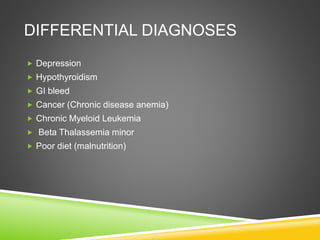
DIFFERENTIAL DIAGNOSES
 Depression
 Hypothyroidism
 GI bleed
 Cancer (Chronic disease anemia)
 Chronic Myeloid Leukemia
 Beta Thalassemia minor
 Poor diet (malnutrition)
HEMOGRAM OF IRON DEFICIENCY
ANEMIA AND DDX FROM OTHER
ANEMIAS
IDA ACD VBD
Ferritin
︎⇩ ⇧ normal
Iron
⇩ ⇩ normal
MCV/ MCH
⇩ Usually
normal to
decreased
⇧
 Iron deficiency anemia (IDA)
 Anemia of Chronic Disease (ACD)
 Vit B12 deficiency (VBD)
(Schrier & Camaschella, 2017)
PATHOPHYSIOLOGY OF THE
DISEASE
Iron is a crucial element for hemoglobin production, its
necessity is especially high in kids and pregnant women due
high demand. Iron deficiency is the most common cause for
anemia in general population, anemia becomes evident when
Iron stores in a form of Ferritin are depleted. Since the biggest
source of Iron for building new Hb recycled from old RBC, even
a small amount of chronic bleeding can lead to anemia.
(Schrier, 2017)
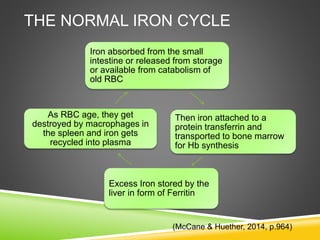
THE NORMAL IRON CYCLE
Iron absorbed from the small
intestine or released from storage
or available from catabolism of
old RBC
Then iron attached to a
protein transferrin and
transported to bone marrow
for Hb synthesis
Excess Iron stored by the
liver in form of Ferritin
As RBC age, they get
destroyed by macrophages in
the spleen and iron gets
recycled into plasma
(McCane & Huether, 2014, p.964)
TREATMENT GOALS
 Investigate the cause of anemia and loss of Iron stores
 Patient education regarding her new diagnoses, treatment options
and prognoses.
 Correct anemia and Iron stores with supplements
 Watch for treatment compliance
 Diet counseling
PATIENT SPECIFIC TREATMENT
 Diet counseling
 Investigate the cause of prolonged intermenstrual bleeding, stop the use of
NSAIDS if possible and rule out GI bleed .
 Educate the patient how to use Iron supplements and about its side
effects.
 Advise patient to keep Iron supplements away from children (overdose is
toxic)
 Start supplementing with Iron supplements in conjunction with vitamin C.
INITIATING THERAPY
 Can start from 180 mg elemental Iron a day and
regulate the dose based on patients tolerance and
severity of anemia. It is recommended to start with a
lower dose to ease up on side effects and slowly go
up.
 Order CBC and Ferritin, and see the patient again in 2-
4 weeks
 Continue treatment for 3-6 month. Supplementing
beyond 6 month is not recommended
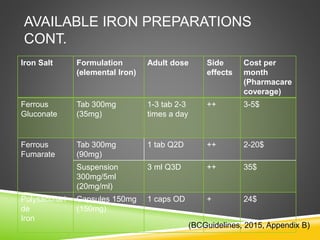
AVAILABLE IRON PREPARATIONS
There is no preference to a specific agent, however sustained
release products may not be as effective as regular product.
Iron salt Formulation
(elemental iron)
Adult dose Side
effects
Cost per
month
Ferrous sulfate Tab 300mg (60mg) 1tab Q3D +++ 2-3$
Sustained release Tab
160mg(50mg)
1-4 tab OD + 25$
Suspension 75mg/ml
(15mg/ml)
4ml Q3D ++ 100$
Syrup 30mg/ml
(6mg/ml)
10ml Q3D ++ 3-5$
(BCGuidelines, 2015, Appendix B)
AVAILABLE IRON PREPARATIONS
CONT.
Iron Salt Formulation
(elemental Iron)
Adult dose Side
effects
Cost per
month
(Pharmacare
coverage)
Ferrous
Gluconate
Tab 300mg
(35mg)
1-3 tab 2-3
times a day
++ 3-5$
Ferrous
Fumarate
Tab 300mg
(90mg)
1 tab Q2D ++ 2-20$
Suspension
300mg/5ml
(20mg/ml)
3 ml Q3D ++ 35$
Polysacchari
de
Iron
Capsules 150mg
(150mg)
1 caps OD + 24$
(BCGuidelines, 2015, Appendix B)
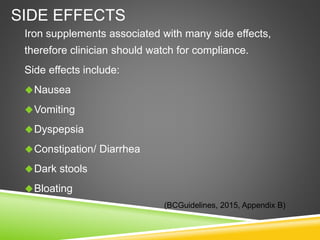
SIDE EFFECTS
Iron supplements associated with many side effects,
therefore clinician should watch for compliance.
Side effects include:
Nausea
Vomiting
Dyspepsia
Constipation/ Diarrhea
Dark stools
Bloating
(BCGuidelines, 2015, Appendix B)
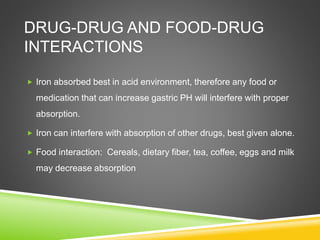
DRUG-DRUG AND FOOD-DRUG
INTERACTIONS
 Iron absorbed best in acid environment, therefore any food or
medication that can increase gastric PH will interfere with proper
absorption.
 Iron can interfere with absorption of other drugs, best given alone.
 Food interaction: Cereals, dietary fiber, tea, coffee, eggs and milk
may decrease absorption
PATIENT SPECIFIC RISK FACTORS
Ms T. is at risk for anemia for several factors:
 Female of child baring age
 Was pregnant twice
 Long intermenstrual bleeding
 Long term use of NSAIDS
EPIDEMIOLOGY
Overall Iron deficiency is the most common reason for anemia, it
affects over 12 percent of the population, and more prevailing in third
world countries due to poor diet (Schrier, 2017).
Who is at risk?
 Infants
 Children
 Women
 Elderly
 People with certain conditions
EPIDEMIOLOGY CONT.
Causes for
iron
deficiency
Poor
absorption
Inadequate
intake and
high
demand
Blood
loss
o Chronic bleeding
o Heavy period
o Frequent blood
donor
o Celiac disease
o Gastric surgery
o Gastric ulcer
o Gastric
parasites
o Poor diet
o Vegetarian diet
o Pregnancy/lactati
on
o Growth sprout
(Schrier,2017)
REFERENCE
 Benz, E., 2017. Clinical Manifestations and Diagnosis of the Thalassemias.
UptoDate. Retrieved from https://www.uptodate.com/contents/clinical-
manifestations-and-diagnosis-of-the-
thalassemias?source=search_result&search=beta%20thalassemia%20minor&sel
ectedTitle=1~14
 British Columbia Guidelines, 2015. Iron Deficiency – Investigation and
Management. Retrieved from
http://www2.gov.bc.ca/gov/content/health/practitioner-professional-resources/bc-
guidelines/iron-deficiency
 Dietitians of Canada, 2016. Food sources of Iron. Retrieved from
http://www.dietitians.ca/Your-Health/Nutrition-A-Z/Minerals/Food-Sources-of-
Iron.aspx
 Ross, D., 2017. Diagnosis of and Screening for Hypothyroidism in Non Pregnant
Adults. Uptodate. Retrieved from https://www.uptodate.com/contents/diagnosis-
of-and-screening-for-hypothyroidism-in-nonpregnant-
adults?source=search_result&search=hypothyroidism&selectedTitle=1~150
 LifeLabs, 2017. Reference Range. Retrieved from
http://www.lifelabs.com/healthcare-providers/Pages/Reference-Ranges.aspx
 McCance, K., & Huether, S.,2014, p.964. The Hematologic System.
Pathophysiology: the Biologic Basis for Disease in Adults and Children.
REFERENCE CONT.
 Schrier, S., 2017. Causes and Diagnosis of Iron Deficiency and Iron
Deficiency Anemia in Adults. UptoDate. Retrieved from
https://www.uptodate.com/contents/causes-and-diagnosis-of-iron-
deficiency-and-iron-deficiency-anemia-in-
adults?source=search_result&search=iron%20deficiency%20anemia
&selectedTitle=1~150
 Schrier, S., Camaschella, C., 2017. Anemia of Chronic
Disease/Inflammation. UptoDate. Retrieved from
https://www.uptodate.com/contents/anemia-of-chronic-disease-
inflammation?source=search_result&search=anemia%20of%20chroni
c&selectedTitle=1~150
 Van Etten, R., 2017. Clinical Manifestations and Diagnosis of Chronic
Myeloid Leukemia. UptoDate. Retrieved from
https://www.uptodate.com/contents/clinical-manifestations-and-
diagnosis-of-chronic-myeloid-
leukemia?source=search_result&search=chronic%20myeloid%20leuk
emia&selectedTitle=1~150

Iron deficiency anemia

  • 1.
  • 2.
    PATIENT INTRODUCTION  Ms.T is a 38 year old white woman who presents to her Nurse Practitioner complaining of 6 month history of intermenstrual bleeding and menorrhagia accompanied with extreme fatigue and weakness. Her month periods now included 8-10 days of bleeding and cramping.  Medical history: G2 P2, uses NSAIDS regularly for left knee pain from previous sport injury as teen.  Family history: non contributory
  • 3.
    PHYSICAL EXAM ANDLAB RESULTS  Height – 5’5 inches  BP 130/80  Pulse 98 regular  Chest clear  Lifelabs Medical Laboratories (2017) Patients results Normal values female Hb 91 115 - 155 Hct .29 0.35 - 0.45 RBC 3.3 3.5 - 5 MCV 71 82 - 98 MCH 19 27.5 - 33.5 MCHC 27 300 -370 WBC 7.9 4 -10 Ferritin 9.7 24 – 444 Iron 8 11 - 33
  • 4.
    DIFFERENTIAL DIAGNOSES  Depression Hypothyroidism  GI bleed  Cancer (Chronic disease anemia)  Chronic Myeloid Leukemia  Beta Thalassemia minor  Poor diet (malnutrition)
  • 5.
    HEMOGRAM OF IRONDEFICIENCY ANEMIA AND DDX FROM OTHER ANEMIAS IDA ACD VBD Ferritin ︎⇩ ⇧ normal Iron ⇩ ⇩ normal MCV/ MCH ⇩ Usually normal to decreased ⇧  Iron deficiency anemia (IDA)  Anemia of Chronic Disease (ACD)  Vit B12 deficiency (VBD) (Schrier & Camaschella, 2017)
  • 6.
    PATHOPHYSIOLOGY OF THE DISEASE Ironis a crucial element for hemoglobin production, its necessity is especially high in kids and pregnant women due high demand. Iron deficiency is the most common cause for anemia in general population, anemia becomes evident when Iron stores in a form of Ferritin are depleted. Since the biggest source of Iron for building new Hb recycled from old RBC, even a small amount of chronic bleeding can lead to anemia. (Schrier, 2017)
  • 7.
    THE NORMAL IRONCYCLE Iron absorbed from the small intestine or released from storage or available from catabolism of old RBC Then iron attached to a protein transferrin and transported to bone marrow for Hb synthesis Excess Iron stored by the liver in form of Ferritin As RBC age, they get destroyed by macrophages in the spleen and iron gets recycled into plasma (McCane & Huether, 2014, p.964)
  • 8.
    TREATMENT GOALS  Investigatethe cause of anemia and loss of Iron stores  Patient education regarding her new diagnoses, treatment options and prognoses.  Correct anemia and Iron stores with supplements  Watch for treatment compliance  Diet counseling
  • 9.
    PATIENT SPECIFIC TREATMENT Diet counseling  Investigate the cause of prolonged intermenstrual bleeding, stop the use of NSAIDS if possible and rule out GI bleed .  Educate the patient how to use Iron supplements and about its side effects.  Advise patient to keep Iron supplements away from children (overdose is toxic)  Start supplementing with Iron supplements in conjunction with vitamin C.
  • 10.
    INITIATING THERAPY  Canstart from 180 mg elemental Iron a day and regulate the dose based on patients tolerance and severity of anemia. It is recommended to start with a lower dose to ease up on side effects and slowly go up.  Order CBC and Ferritin, and see the patient again in 2- 4 weeks  Continue treatment for 3-6 month. Supplementing beyond 6 month is not recommended
  • 11.
    AVAILABLE IRON PREPARATIONS Thereis no preference to a specific agent, however sustained release products may not be as effective as regular product. Iron salt Formulation (elemental iron) Adult dose Side effects Cost per month Ferrous sulfate Tab 300mg (60mg) 1tab Q3D +++ 2-3$ Sustained release Tab 160mg(50mg) 1-4 tab OD + 25$ Suspension 75mg/ml (15mg/ml) 4ml Q3D ++ 100$ Syrup 30mg/ml (6mg/ml) 10ml Q3D ++ 3-5$ (BCGuidelines, 2015, Appendix B)
  • 12.
    AVAILABLE IRON PREPARATIONS CONT. IronSalt Formulation (elemental Iron) Adult dose Side effects Cost per month (Pharmacare coverage) Ferrous Gluconate Tab 300mg (35mg) 1-3 tab 2-3 times a day ++ 3-5$ Ferrous Fumarate Tab 300mg (90mg) 1 tab Q2D ++ 2-20$ Suspension 300mg/5ml (20mg/ml) 3 ml Q3D ++ 35$ Polysacchari de Iron Capsules 150mg (150mg) 1 caps OD + 24$ (BCGuidelines, 2015, Appendix B)
  • 13.
    SIDE EFFECTS Iron supplementsassociated with many side effects, therefore clinician should watch for compliance. Side effects include: Nausea Vomiting Dyspepsia Constipation/ Diarrhea Dark stools Bloating (BCGuidelines, 2015, Appendix B)
  • 14.
    DRUG-DRUG AND FOOD-DRUG INTERACTIONS Iron absorbed best in acid environment, therefore any food or medication that can increase gastric PH will interfere with proper absorption.  Iron can interfere with absorption of other drugs, best given alone.  Food interaction: Cereals, dietary fiber, tea, coffee, eggs and milk may decrease absorption
  • 15.
    PATIENT SPECIFIC RISKFACTORS Ms T. is at risk for anemia for several factors:  Female of child baring age  Was pregnant twice  Long intermenstrual bleeding  Long term use of NSAIDS
  • 16.
    EPIDEMIOLOGY Overall Iron deficiencyis the most common reason for anemia, it affects over 12 percent of the population, and more prevailing in third world countries due to poor diet (Schrier, 2017). Who is at risk?  Infants  Children  Women  Elderly  People with certain conditions
  • 17.
    EPIDEMIOLOGY CONT. Causes for iron deficiency Poor absorption Inadequate intakeand high demand Blood loss o Chronic bleeding o Heavy period o Frequent blood donor o Celiac disease o Gastric surgery o Gastric ulcer o Gastric parasites o Poor diet o Vegetarian diet o Pregnancy/lactati on o Growth sprout (Schrier,2017)
  • 18.
    REFERENCE  Benz, E.,2017. Clinical Manifestations and Diagnosis of the Thalassemias. UptoDate. Retrieved from https://www.uptodate.com/contents/clinical- manifestations-and-diagnosis-of-the- thalassemias?source=search_result&search=beta%20thalassemia%20minor&sel ectedTitle=1~14  British Columbia Guidelines, 2015. Iron Deficiency – Investigation and Management. Retrieved from http://www2.gov.bc.ca/gov/content/health/practitioner-professional-resources/bc- guidelines/iron-deficiency  Dietitians of Canada, 2016. Food sources of Iron. Retrieved from http://www.dietitians.ca/Your-Health/Nutrition-A-Z/Minerals/Food-Sources-of- Iron.aspx  Ross, D., 2017. Diagnosis of and Screening for Hypothyroidism in Non Pregnant Adults. Uptodate. Retrieved from https://www.uptodate.com/contents/diagnosis- of-and-screening-for-hypothyroidism-in-nonpregnant- adults?source=search_result&search=hypothyroidism&selectedTitle=1~150  LifeLabs, 2017. Reference Range. Retrieved from http://www.lifelabs.com/healthcare-providers/Pages/Reference-Ranges.aspx  McCance, K., & Huether, S.,2014, p.964. The Hematologic System. Pathophysiology: the Biologic Basis for Disease in Adults and Children.
  • 19.
    REFERENCE CONT.  Schrier,S., 2017. Causes and Diagnosis of Iron Deficiency and Iron Deficiency Anemia in Adults. UptoDate. Retrieved from https://www.uptodate.com/contents/causes-and-diagnosis-of-iron- deficiency-and-iron-deficiency-anemia-in- adults?source=search_result&search=iron%20deficiency%20anemia &selectedTitle=1~150  Schrier, S., Camaschella, C., 2017. Anemia of Chronic Disease/Inflammation. UptoDate. Retrieved from https://www.uptodate.com/contents/anemia-of-chronic-disease- inflammation?source=search_result&search=anemia%20of%20chroni c&selectedTitle=1~150  Van Etten, R., 2017. Clinical Manifestations and Diagnosis of Chronic Myeloid Leukemia. UptoDate. Retrieved from https://www.uptodate.com/contents/clinical-manifestations-and- diagnosis-of-chronic-myeloid- leukemia?source=search_result&search=chronic%20myeloid%20leuk emia&selectedTitle=1~150

Editor's Notes

  • #3 Main points of this history is: Ms T. being a white woman, long term heavy menstrual bleeding and long term NSAIDS use.
  • #4 From her physical exam we can see that she is tachycardic, lab results indicate that she is anemic with microcytic and hypochromic RBC. We can also see that her Ferritin and Iron are low meaning her Iron storages are depleted (British Columbia Guidelines, 2015).
  • #5 Depression - Ms. T’s symptoms of extreme fatigue, weakness can raise a question about her mental status, while we can not exclude this diagnoses, by looking at her lab results those symptoms initially can be result of her anemia. Hypothyroidism – also can present with fatigue and weakness, however in this case I would expect Ms. T’s to be bradycardic with macrocytic RBC (Ross,2017) . GI bleed – due to her long-term NSAIDS use, I would be suspicious of Iron deficiency anemia second to GI bleed, to investigate we can order “Hemoccult stool test”. Cancer or chronic disease anemia – usually presents with normochromic and normocytic anemia (Schrier & Camaschella, 2017) Chronic Leukemia – some of the sympoms of Leukemia can be fatigue and weakness due to low RBC and anemia, however in this case Ms. T’s WBC count is normal (Van Etten, 2017) Beta Thalassemia minor– is a genetic condition that affects people with Mediterranean origin (Italian, Greek), microcytic and hypochromic RBC are typical to people with this condition, however they don’t have clinical picture of anemia and their Ferritin is normal, RBW test will be beneficial for diagnosis (Benz,2017).
  • #7 Often Iron deficiency can exist without any symptoms until anemia develops, however patient can complain on other non-specific symptoms, for example, hair loss, fatigue and cold intolerance (BCGuidlines, 2016).
  • #8 Only 10% of Iron is absorbed from food. The uptake mechanism of Iron in the body regulated by hepatic peptide hepcidin. High level of hepcidin signals the body to decrease Iron absorption from the gut, inflammation can stimulate production of hepcidin and interfere with normal Iron cycle (McCane & Huether, 2014).
  • #9 due to effects of Iron on the stomach
  • #10 Foods containing Iron include: Non heme iron – Oatmeal, lentils, edamame, spinach. Heme Iron - red meat, liver. See the reference source for complete list. (Dietitians of Canada, 2016) Iron is best absorbed on empty stomach, however it is poorly tolerated this way, one of the strategies to help with adherence to treatment is to give daily dose in small portions and advise the patient to take it with meals. Best taken with citric fruits or orange juice, and dark green veg. Patient should not take Iron in combination with multi-vitamins. (BCGuidlines, 2015)
  • #12 Cont. next slide
  • #14 Liquid preparations can cause teeth staining, advise patient to use straw.
  • #15 For example “ Antacids, anything containing aluminum, magnesium, calcium, zinc, proton pump receptor antagonist” (BcGuidelines, 2015, appendix B). Iron should be given two hour before or after with meds like “bisphosphonates, tetracycline abx, quinolone abx, levodopa, methyldopa, levothyroxine and penicillamine.” (BCGuidelines, 2015, appendix B).
  • #16 Every subsequent pregnancy increases the risk of IDA.
  • #17 Cont next slide
  • #20 Thank you.