


By
Sachin R P
Harshith A
Channabasaveshwara Institute of Technology, gubbi
 Introduction to Heat pump
Parts of a Heat pump
Working of Heat pump
Thermodynamics Process
 Terms associated with Heat pump
Application of Heat pump
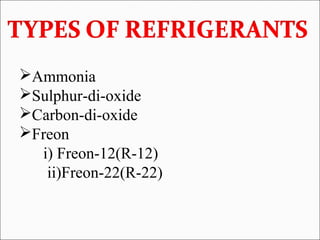
Types of Refrigerant
Why CO2 ?
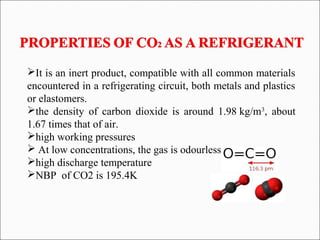
 Properties of CO2 as a Refrigerant
 Advantages of heat pumps with CO2 refrigerant
Conclusion
OVERVIEW
A heat pump is a device that transfers heat energy
from a heat source to a heat sink against a temperature
gradient.
 Heat pumps are designed to move thermal
energy opposite the direction of spontaneous heat flow.
A heat pump uses some amount of external high-grade
energy to accomplish the desired transfer of thermal
energy from heat source to heat sink.
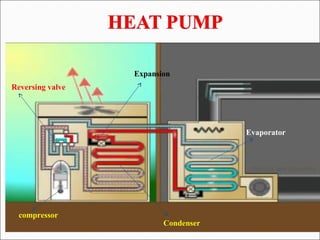
Reversing valve 
Evaporator
compressor 
Condenser
Expansion
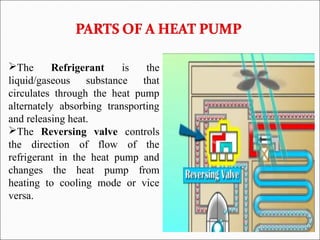
The Refrigerant is the
liquid/gaseous substance that
circulates through the heat pump
alternately absorbing transporting
and releasing heat.
The Reversing  valve  controls
the direction of flow of the
refrigerant in the heat pump and
changes the heat pump from
heating to cooling mode or vice
versa.
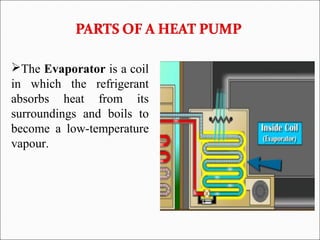
The Evaporator is a coil
in which the refrigerant
absorbs heat from its
surroundings and boils to
become a low-temperature
vapour.
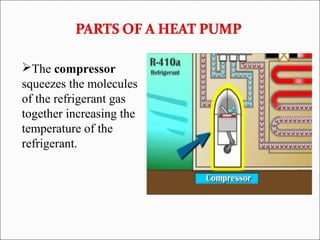
The compressor 
squeezes the molecules
of the refrigerant gas
together increasing the
temperature of the
refrigerant.
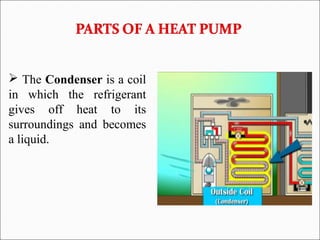
 The Condenser is a coil
in which the refrigerant
gives off heat to its
surroundings and becomes
a liquid.
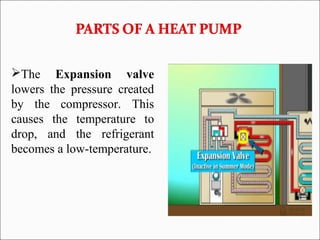
The Expansion valve
lowers the pressure created
by the compressor. This
causes the temperature to
drop, and the refrigerant
becomes a low-temperature.
Heat pumps mainly consists of
operation
a)Heating cycle
b)Cooling cycle
c)Defrost cycle
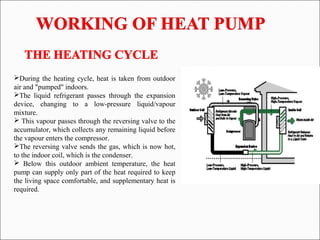
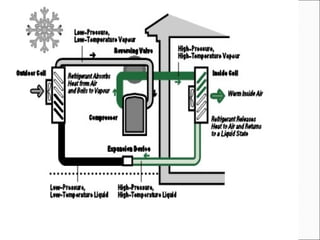
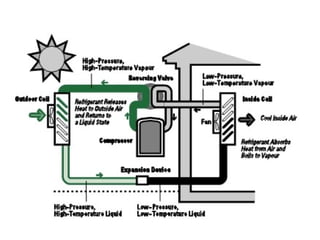
During the heating cycle, heat is taken from outdoor
air and "pumped" indoors.
The liquid refrigerant passes through the expansion
device, changing to a low-pressure liquid/vapour
mixture.
 This vapour passes through the reversing valve to the
accumulator, which collects any remaining liquid before
the vapour enters the compressor.
The reversing valve sends the gas, which is now hot,
to the indoor coil, which is the condenser.
 Below this outdoor ambient temperature, the heat
pump can supply only part of the heat required to keep
the living space comfortable, and supplementary heat is
required.
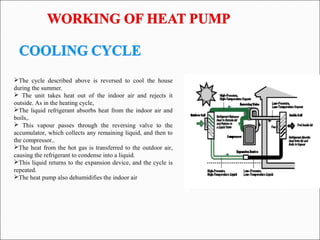
The cycle described above is reversed to cool the house
during the summer.
 The unit takes heat out of the indoor air and rejects it
outside. As in the heating cycle,
The liquid refrigerant absorbs heat from the indoor air and
boils,.
 This vapour passes through the reversing valve to the
accumulator, which collects any remaining liquid, and then to
the compressor..
The heat from the hot gas is transferred to the outdoor air,
causing the refrigerant to condense into a liquid.
This liquid returns to the expansion device, and the cycle is
repeated.
The heat pump also dehumidifies the indoor air
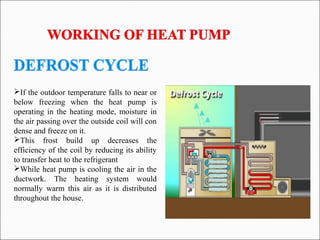
If the outdoor temperature falls to near or
below freezing when the heat pump is
operating in the heating mode, moisture in
the air passing over the outside coil will con
dense and freeze on it.
This frost build up decreases the
efficiency of the coil by reducing its ability
to transfer heat to the refrigerant
While heat pump is cooling the air in the
ductwork. The heating system would
normally warm this air as it is distributed
throughout the house.
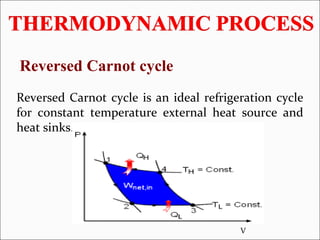
Reversed Carnot cycle
Reversed Carnot cycle is an ideal refrigeration cycle
for constant temperature external heat source and
heat sinks.
V
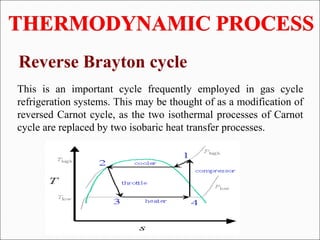
Reverse Brayton cycle
This is an important cycle frequently employed in gas cycle
refrigeration systems. This may be thought of as a modification of
reversed Carnot cycle, as the two isothermal processes of Carnot
cycle are replaced by two isobaric heat transfer processes.
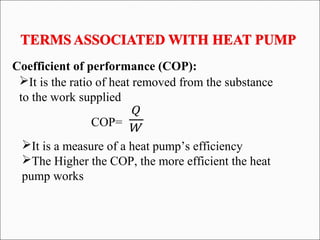
Coefficient of performance (COP):
It is the ratio of heat removed from the substance
to the work supplied
�
�COP=
It is a measure of a heat pump’s efficiency
The Higher the COP, the more efficient the heat
pump works
Btu/h (British thermal unit per hour) : is a
measure of the output of a heating or cooling
system, in one hour
Ton: is a measure of heat pump capacity
equivalent to 3.5 kW or 12000 Btu/h
Balance point : is the temperature at which the
amount of heating provided by the heat pump
equals the amount of heat lost from the house
HEATING OF INTERIOR ENVIRONMENTS
Heat pumps may be used also solely for heating the
internal environment.
Space heating
Sanitary water heating
Process heating
Dehumidification
Heat recovery
COOLING OF INTERIOR ENVIRONMENTS
Heat pumps are mainly used for cooling the internal
environment as an alternative source over
conventional system
Air-conditions
Cold storage
Industrial use
Ammonia
Sulphur-di-oxide
Carbon-di-oxide
Freon
i) Freon-12(R-12)
ii)Freon-22(R-22)
 Carbon dioxide is very abundant in the environment.
 It is a natural refrigerant known and used in the
past.
 Carbon dioxide has an ozone depletion potential (ODP)
of zero .
It has a low replacement cost.
 In addition to its basic environmental properties, carbon
dioxide is non- toxic. It carries an A1 safety classification
(the same as most fluorocarbon refrigerants), indicating
that it has low toxicity and is non-flammable
It is an inert product, compatible with all common materials
encountered in a refrigerating circuit, both metals and plastics
or elastomers.
the density of carbon dioxide is around 1.98 kg/m3
, about
1.67 times that of air.
high working pressures
 At low concentrations, the gas is odourless
high discharge temperature
NBP of CO2 is 195.4K
No Fumes, odours and smoke
Energy efficient
The other challenge is that CO2 refrigerant
cycles operate at far higher pressure than
standard vapour-compression-cycle equipment
A new generation of CO2 based heat pumps
could avoid the high global warming potential
much higher temperatures
The natural fluid Carbon Dioxide displays some excellent properties in the use as a
refrigerant in compression-type refrigerating or heat pump systems: it offers unequalled
local and ecological safety, widespread availability at low cost, with no need for
recycling and containment.
Because of its low critical temperature (around 31 °C), CO2 does not compare
favourably against traditional refrigerants, as far as energy efficiency is
concerned, when simple theoretical cycle analyses are carried out.
But this situation can be mitigated, and in some cases completely reversed, by proper
design of the system aimed at fully exploiting the unique characteristics of CO2 and/or
the exclusive features of transcritical cycles, which bring about important factors that
improve the practical performance of CO2 systems.
A widespread research activity is underway world-wide for the application of CO2 in
many areas with promising results, including mobile and residential air conditioning,
heat pumps, and water chillers, commercial and marine applications).
WORKING OF HEAT PUMPS WITH (CO2) REFRIGERANT

WORKING OF HEAT PUMPS WITH (CO2) REFRIGERANT

  • 1.
    By Sachin R P HarshithA Channabasaveshwara Institute of Technology, gubbi
  • 2.
     Introduction toHeat pump Parts of a Heat pump Working of Heat pump Thermodynamics Process  Terms associated with Heat pump Application of Heat pump Types of Refrigerant Why CO2 ?  Properties of CO2 as a Refrigerant  Advantages of heat pumps with CO2 refrigerant Conclusion OVERVIEW
  • 3.
    A heat pump is adevice that transfers heat energy from a heat source to a heat sink against a temperature gradient.  Heat pumps are designed to move thermal energy opposite the direction of spontaneous heat flow. A heat pump uses some amount of external high-grade energy to accomplish the desired transfer of thermal energy from heat source to heat sink.
  • 4.
  • 5.
    The Refrigerant isthe liquid/gaseous substance that circulates through the heat pump alternately absorbing transporting and releasing heat. The Reversing  valve  controls the direction of flow of the refrigerant in the heat pump and changes the heat pump from heating to cooling mode or vice versa.
  • 6.
    The Evaporator is acoil in which the refrigerant absorbs heat from its surroundings and boils to become a low-temperature vapour.
  • 7.
    The compressor  squeezes themolecules of the refrigerant gas together increasing the temperature of the refrigerant.
  • 8.
     The Condenseris a coil in which the refrigerant gives off heat to its surroundings and becomes a liquid.
  • 9.
    The Expansion valve lowersthe pressure created by the compressor. This causes the temperature to drop, and the refrigerant becomes a low-temperature.
  • 10.
    Heat pumps mainlyconsists of operation a)Heating cycle b)Cooling cycle c)Defrost cycle
  • 11.
    During the heatingcycle, heat is taken from outdoor air and "pumped" indoors. The liquid refrigerant passes through the expansion device, changing to a low-pressure liquid/vapour mixture.  This vapour passes through the reversing valve to the accumulator, which collects any remaining liquid before the vapour enters the compressor. The reversing valve sends the gas, which is now hot, to the indoor coil, which is the condenser.  Below this outdoor ambient temperature, the heat pump can supply only part of the heat required to keep the living space comfortable, and supplementary heat is required.
  • 13.
    The cycle describedabove is reversed to cool the house during the summer.  The unit takes heat out of the indoor air and rejects it outside. As in the heating cycle, The liquid refrigerant absorbs heat from the indoor air and boils,.  This vapour passes through the reversing valve to the accumulator, which collects any remaining liquid, and then to the compressor.. The heat from the hot gas is transferred to the outdoor air, causing the refrigerant to condense into a liquid. This liquid returns to the expansion device, and the cycle is repeated. The heat pump also dehumidifies the indoor air
  • 15.
    If the outdoortemperature falls to near or below freezing when the heat pump is operating in the heating mode, moisture in the air passing over the outside coil will con dense and freeze on it. This frost build up decreases the efficiency of the coil by reducing its ability to transfer heat to the refrigerant While heat pump is cooling the air in the ductwork. The heating system would normally warm this air as it is distributed throughout the house.
  • 16.
    Reversed Carnot cycle ReversedCarnot cycle is an ideal refrigeration cycle for constant temperature external heat source and heat sinks. V
  • 17.
    Reverse Brayton cycle Thisis an important cycle frequently employed in gas cycle refrigeration systems. This may be thought of as a modification of reversed Carnot cycle, as the two isothermal processes of Carnot cycle are replaced by two isobaric heat transfer processes.
  • 18.
    Coefficient of performance(COP): It is the ratio of heat removed from the substance to the work supplied � �COP= It is a measure of a heat pump’s efficiency The Higher the COP, the more efficient the heat pump works
  • 19.
    Btu/h (British thermalunit per hour) : is a measure of the output of a heating or cooling system, in one hour Ton: is a measure of heat pump capacity equivalent to 3.5 kW or 12000 Btu/h Balance point : is the temperature at which the amount of heating provided by the heat pump equals the amount of heat lost from the house
  • 20.
    HEATING OF INTERIORENVIRONMENTS Heat pumps may be used also solely for heating the internal environment. Space heating Sanitary water heating Process heating Dehumidification Heat recovery
  • 21.
    COOLING OF INTERIORENVIRONMENTS Heat pumps are mainly used for cooling the internal environment as an alternative source over conventional system Air-conditions Cold storage Industrial use
  • 22.
  • 23.
     Carbon dioxideis very abundant in the environment.  It is a natural refrigerant known and used in the past.  Carbon dioxide has an ozone depletion potential (ODP) of zero . It has a low replacement cost.  In addition to its basic environmental properties, carbon dioxide is non- toxic. It carries an A1 safety classification (the same as most fluorocarbon refrigerants), indicating that it has low toxicity and is non-flammable
  • 24.
    It is aninert product, compatible with all common materials encountered in a refrigerating circuit, both metals and plastics or elastomers. the density of carbon dioxide is around 1.98 kg/m3 , about 1.67 times that of air. high working pressures  At low concentrations, the gas is odourless high discharge temperature NBP of CO2 is 195.4K
  • 25.
    No Fumes, odoursand smoke Energy efficient The other challenge is that CO2 refrigerant cycles operate at far higher pressure than standard vapour-compression-cycle equipment A new generation of CO2 based heat pumps could avoid the high global warming potential much higher temperatures
  • 26.
    The natural fluidCarbon Dioxide displays some excellent properties in the use as a refrigerant in compression-type refrigerating or heat pump systems: it offers unequalled local and ecological safety, widespread availability at low cost, with no need for recycling and containment. Because of its low critical temperature (around 31 °C), CO2 does not compare favourably against traditional refrigerants, as far as energy efficiency is concerned, when simple theoretical cycle analyses are carried out. But this situation can be mitigated, and in some cases completely reversed, by proper design of the system aimed at fully exploiting the unique characteristics of CO2 and/or the exclusive features of transcritical cycles, which bring about important factors that improve the practical performance of CO2 systems. A widespread research activity is underway world-wide for the application of CO2 in many areas with promising results, including mobile and residential air conditioning, heat pumps, and water chillers, commercial and marine applications).