 INTRODUCTION
 PRINCIPLE & WORKING
 TYPES OF PCM
 PCM INCORPORATION
 BUILDING APPLICATION
 BIO PCM
 GLASS-X
 MERITS & DEMERITS
 SELECTION CRITERIA
 CASE STUDY
 CONCLUSION
25/08/2014 2DEPT. OF CIVIL ENGINEERING, TKMCE
• Modern architecture is attractive, flexible and light weight
• Phase Changing Materials - Interior finishing alternatives
• Stores much larger amount of thermal energy per unit
mass than conventional building materials
• Requires less amount of energy for production
• It can charge and discharge energy in the form of latent
heat
25/08/2014 3DEPT. OF CIVIL ENGINEERING, TKMCE
25/08/2014 4DEPT. OF CIVIL ENGINEERING, TKMCE
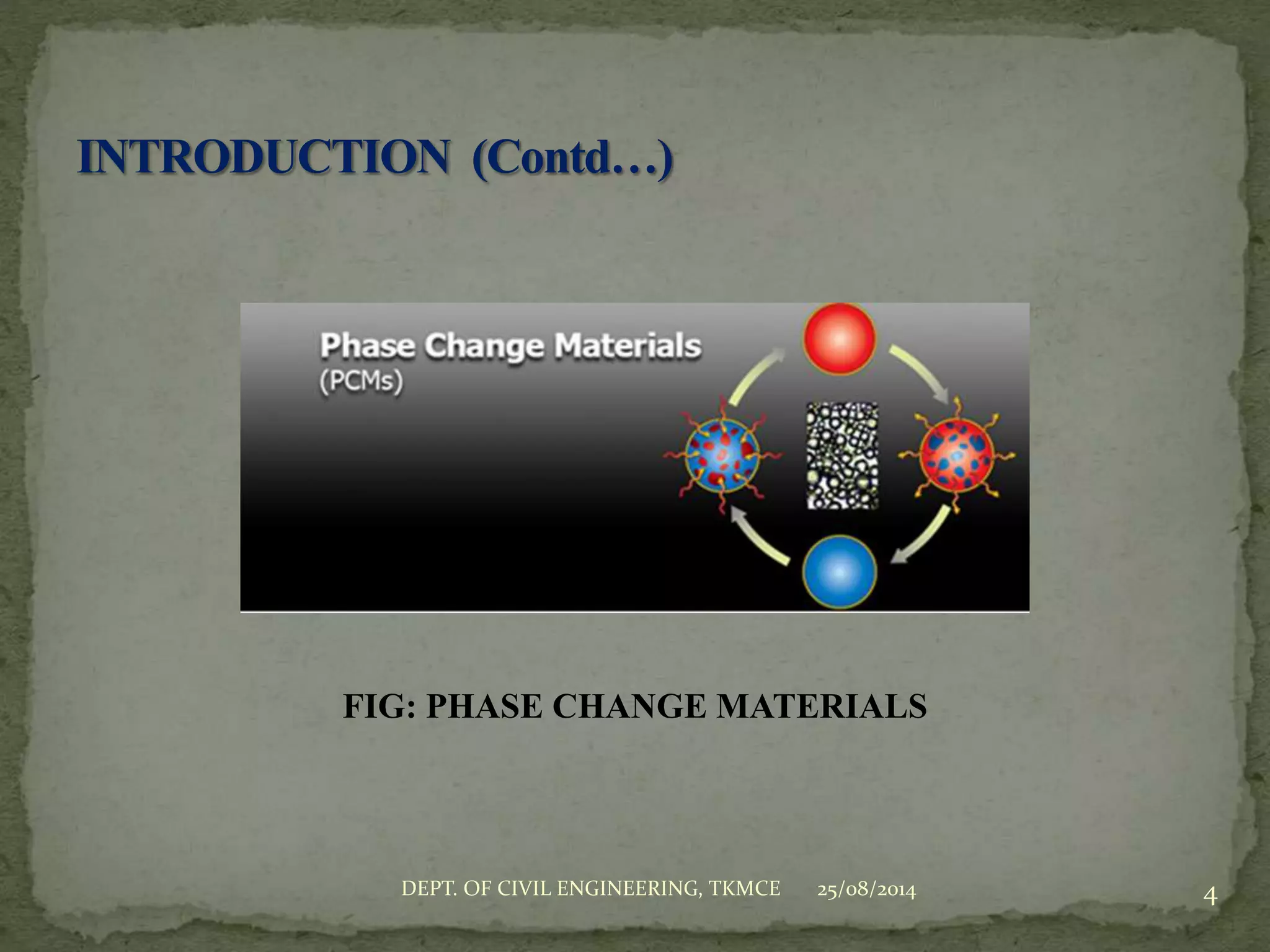
FIG: PHASE CHANGE MATERIALS
• When heat is applied to any substance, it is transferred in
two ways
Sensible heat
Latent heat
• PCMs works on the principle of latent heat
• Latent heat enables PCMs to control room temperature
25/08/2014 5DEPT. OF CIVIL ENGINEERING, TKMCE
• PCMs used in construction change from solid to liquid at
23ºC - 26ºC
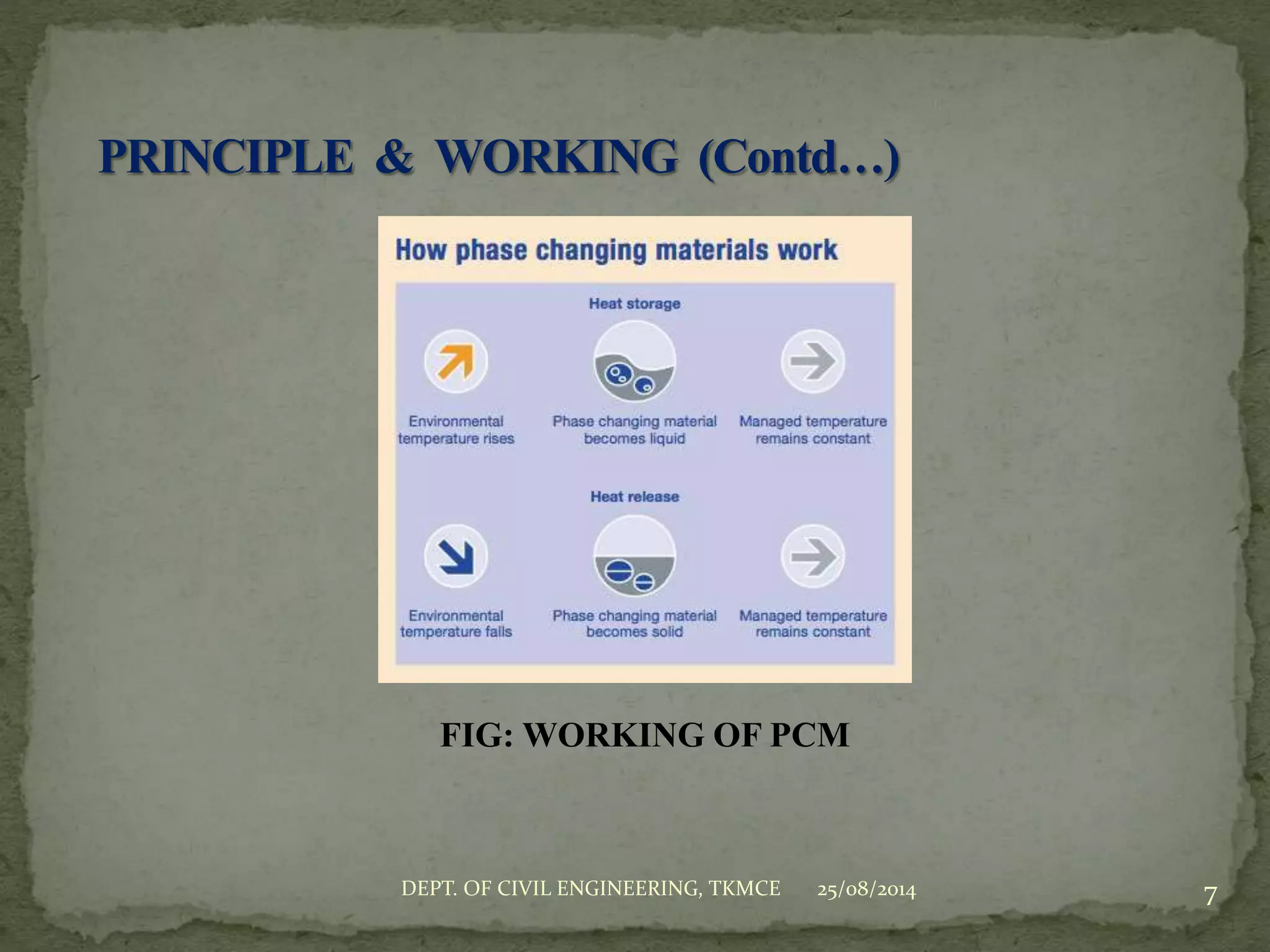
• They melt, absorb heat from room and room temperature
is kept constant until the change of state is complete
• PCM then returned to solid state by night time ventilation /
mechanical means
• When returned to solid state it emits the heat
• The phase change cycle repeats
25/08/2014 6DEPT. OF CIVIL ENGINEERING, TKMCE
25/08/2014 7DEPT. OF CIVIL ENGINEERING, TKMCE
FIG: WORKING OF PCM
• There are many types of PCM but not all are suitable for
use in buildings
• The two main types of PCM used in construction are
inorganic salt hydrates and organic paraffin or fatty acids
• Both materials have a set of advantages and disadvantages
that must be taken into consideration
25/08/2014 8DEPT. OF CIVIL ENGINEERING, TKMCE
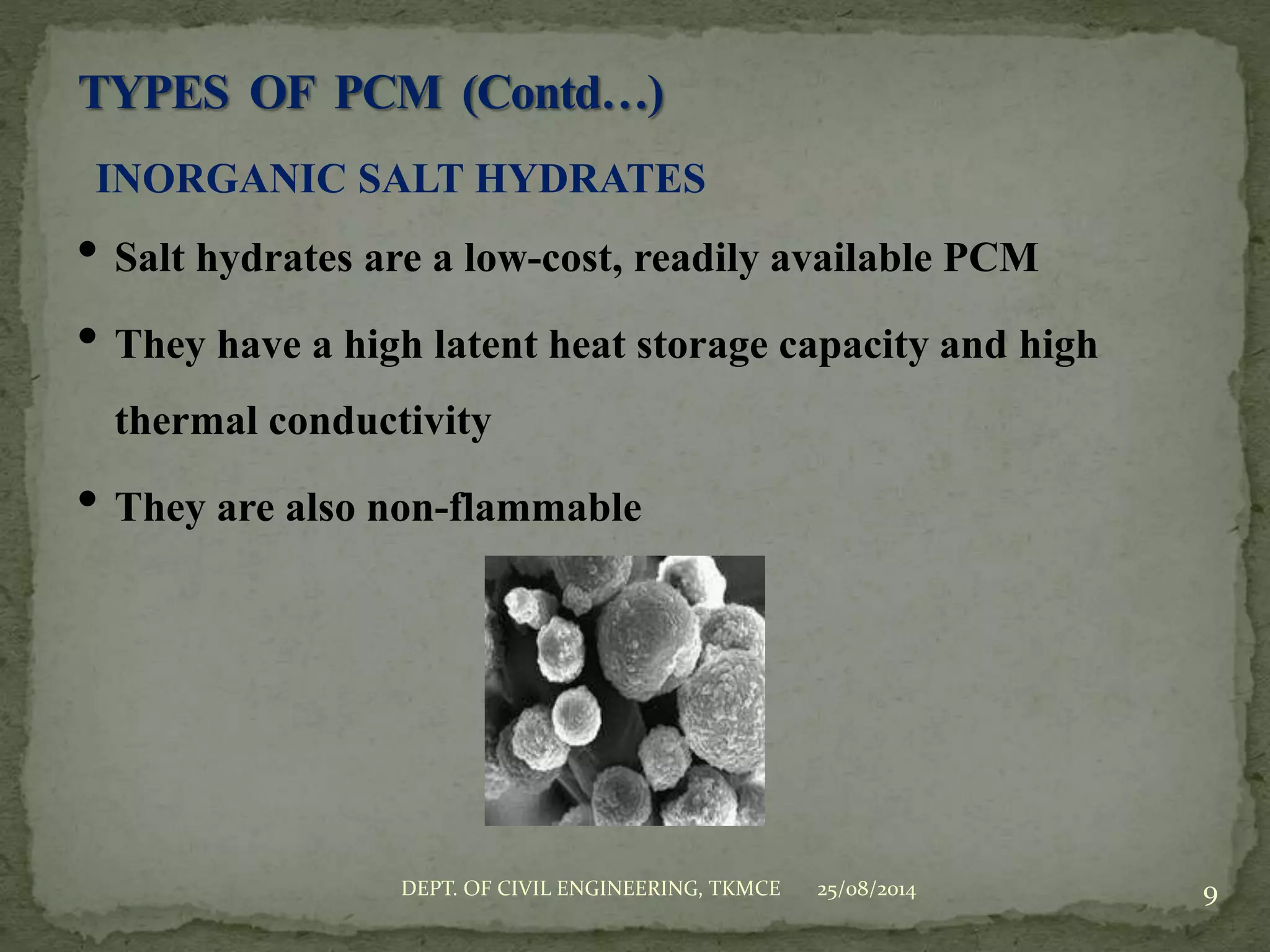
INORGANIC SALT HYDRATES
• Salt hydrates are a low-cost, readily available PCM
• They have a high latent heat storage capacity and high
thermal conductivity
• They are also non-flammable
25/08/2014 9DEPT. OF CIVIL ENGINEERING, TKMCE
• Paraffin’s and fatty acids do not expand as they melt, and
freeze without much super cooling
• They are chemically stable, compatible with conventional
construction materials and recyclable
• Paraffin’s are hydrophobic, which means they are water-
repellant
• As a result, their phase-change points are reliable
25/08/2014 10DEPT. OF CIVIL ENGINEERING, TKMCE
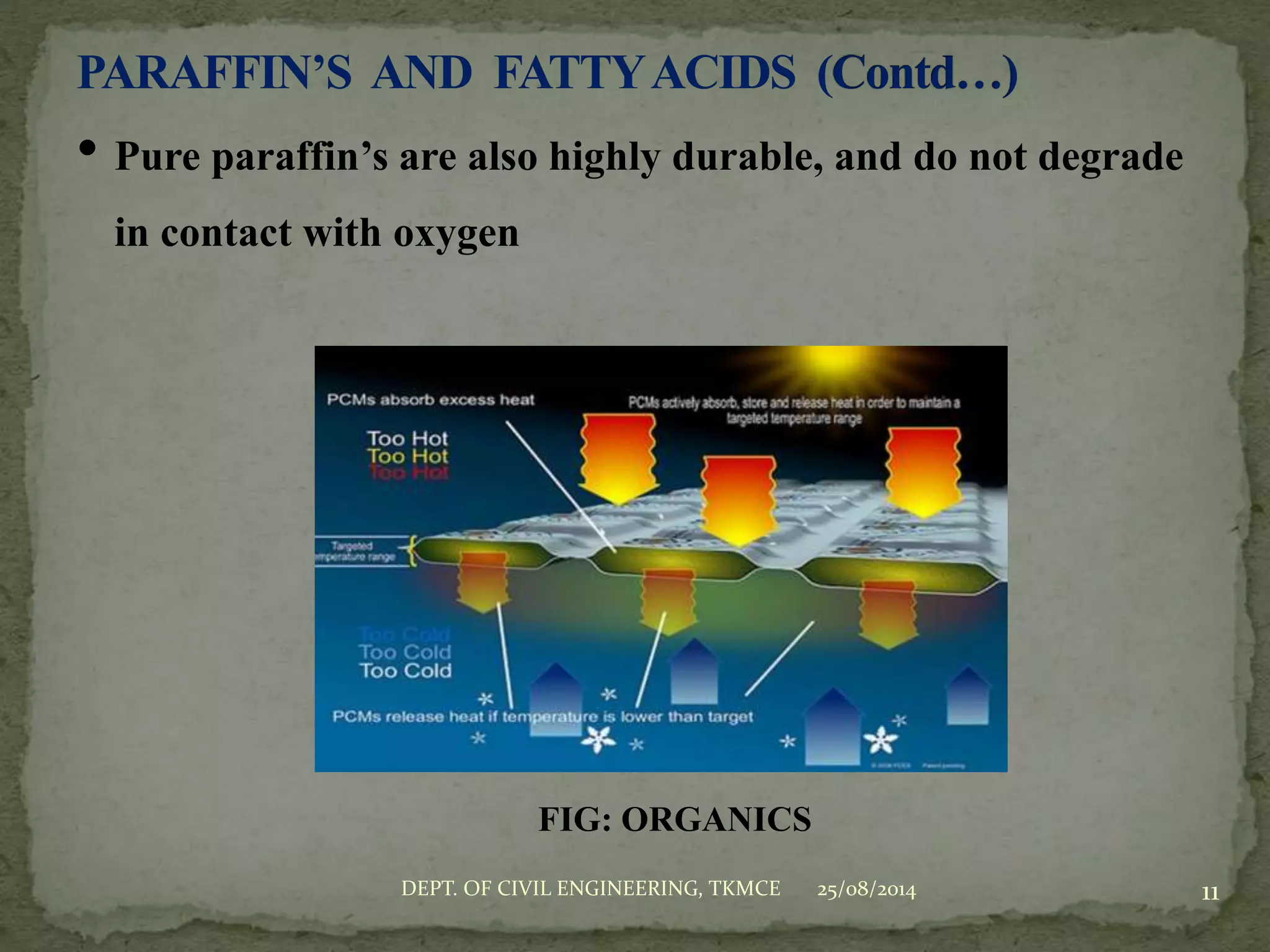
• Pure paraffin’s are also highly durable, and do not degrade
in contact with oxygen
25/08/2014 11DEPT. OF CIVIL ENGINEERING, TKMCE
FIG: ORGANICS
• Impregnated into building materials in 2 ways :
Either directly or as pellets
Microencapsulation
• Microencapsulation most preferred always.
• Night cooling considered as the main difficulty
25/08/2014 12DEPT. OF CIVIL ENGINEERING, TKMCE
25/08/2014DEPT. OF CIVIL ENGINEERING, TKMCE 13
FIG : DIRECT USAGE
25/08/2014DEPT. OF CIVIL ENGINEERING, TKMCE 14
• Individual particles of solid/ liquid material are coated with a
continuous film of polymeric material
• Produce capsules called microcapsules
• Microcapsules – small sphere with uniform wall round it
• Micrometer to millimeter range
•Appearance of beads, powder
• Polymer sphere shaped
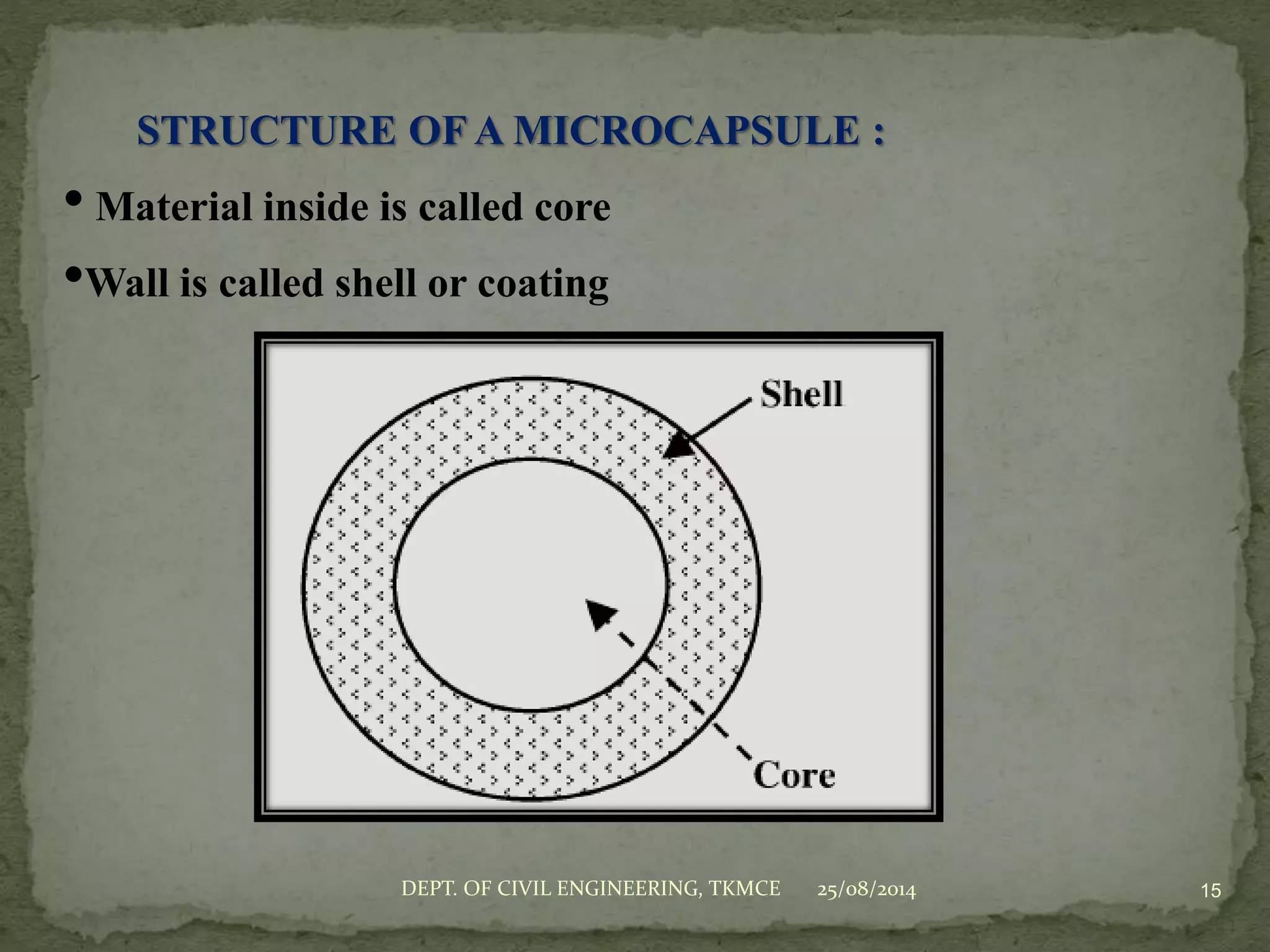
STRUCTURE OF A MICROCAPSULE :
• Material inside is called core
•Wall is called shell or coating
25/08/2014DEPT. OF CIVIL ENGINEERING, TKMCE 15
MORPHOLOGY :
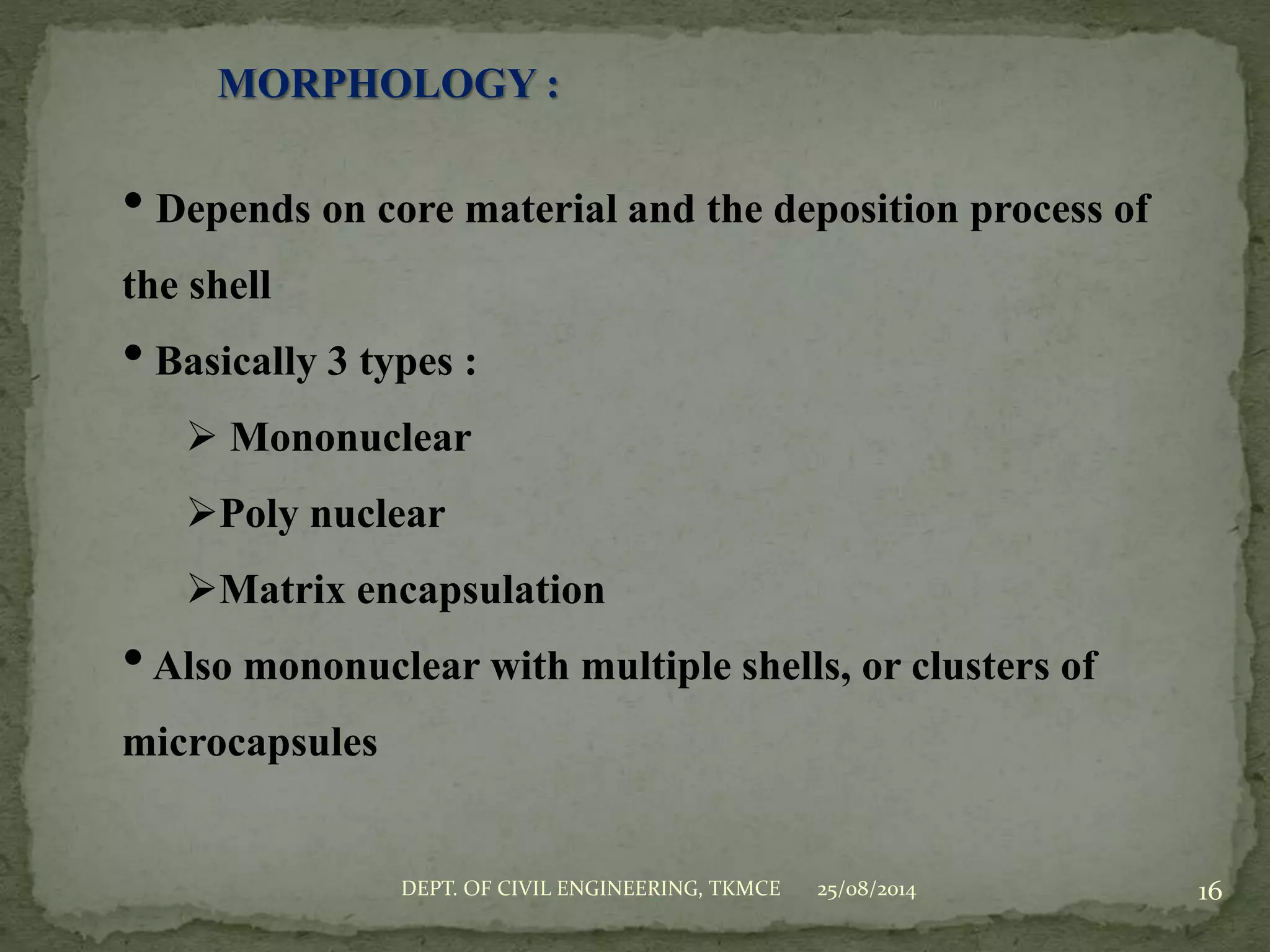
• Depends on core material and the deposition process of
the shell
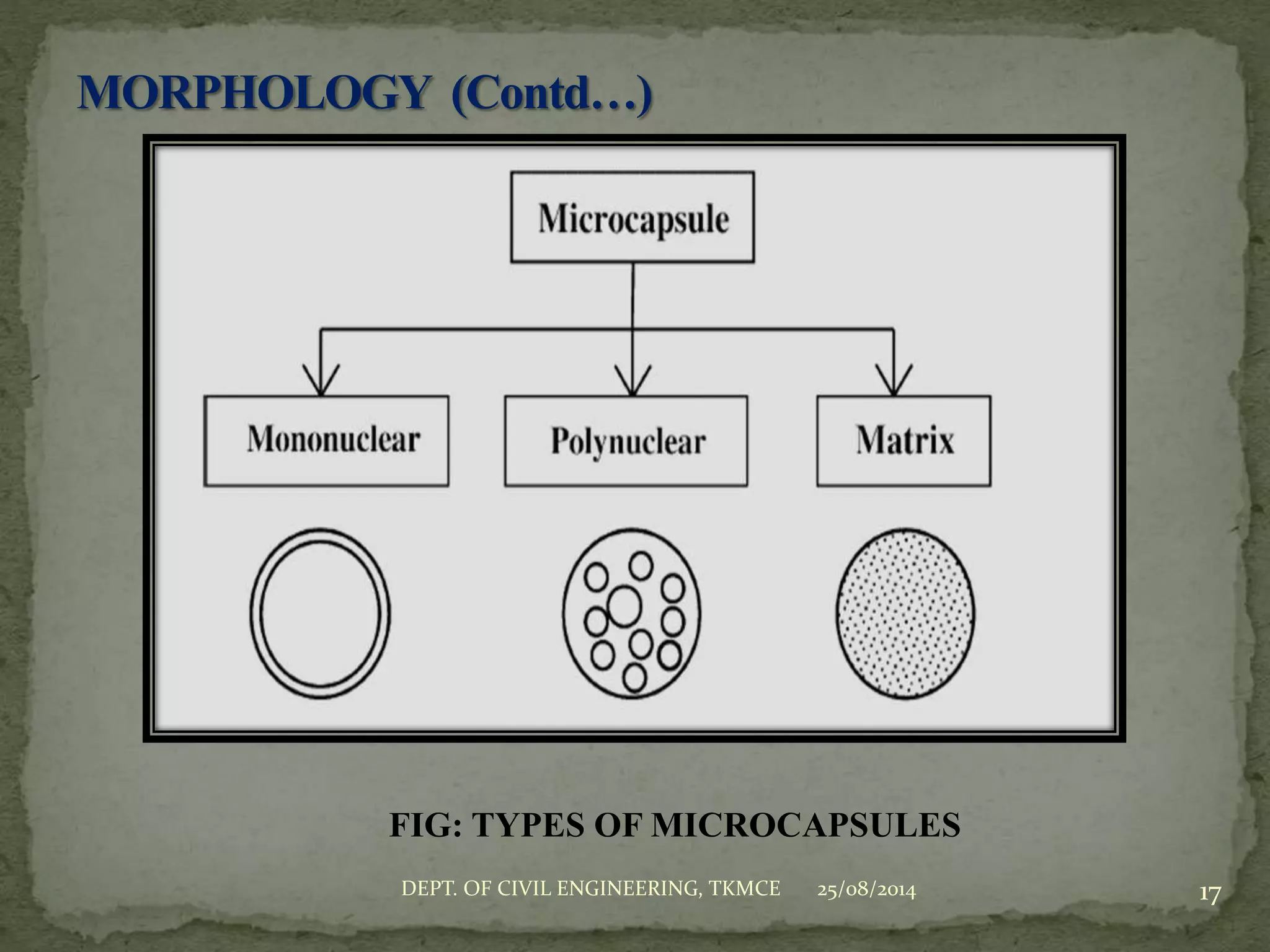
• Basically 3 types :
 Mononuclear
Poly nuclear
Matrix encapsulation
•Also mononuclear with multiple shells, or clusters of
microcapsules
25/08/2014DEPT. OF CIVIL ENGINEERING, TKMCE 16
25/08/2014DEPT. OF CIVIL ENGINEERING, TKMCE 17
FIG: TYPES OF MICROCAPSULES
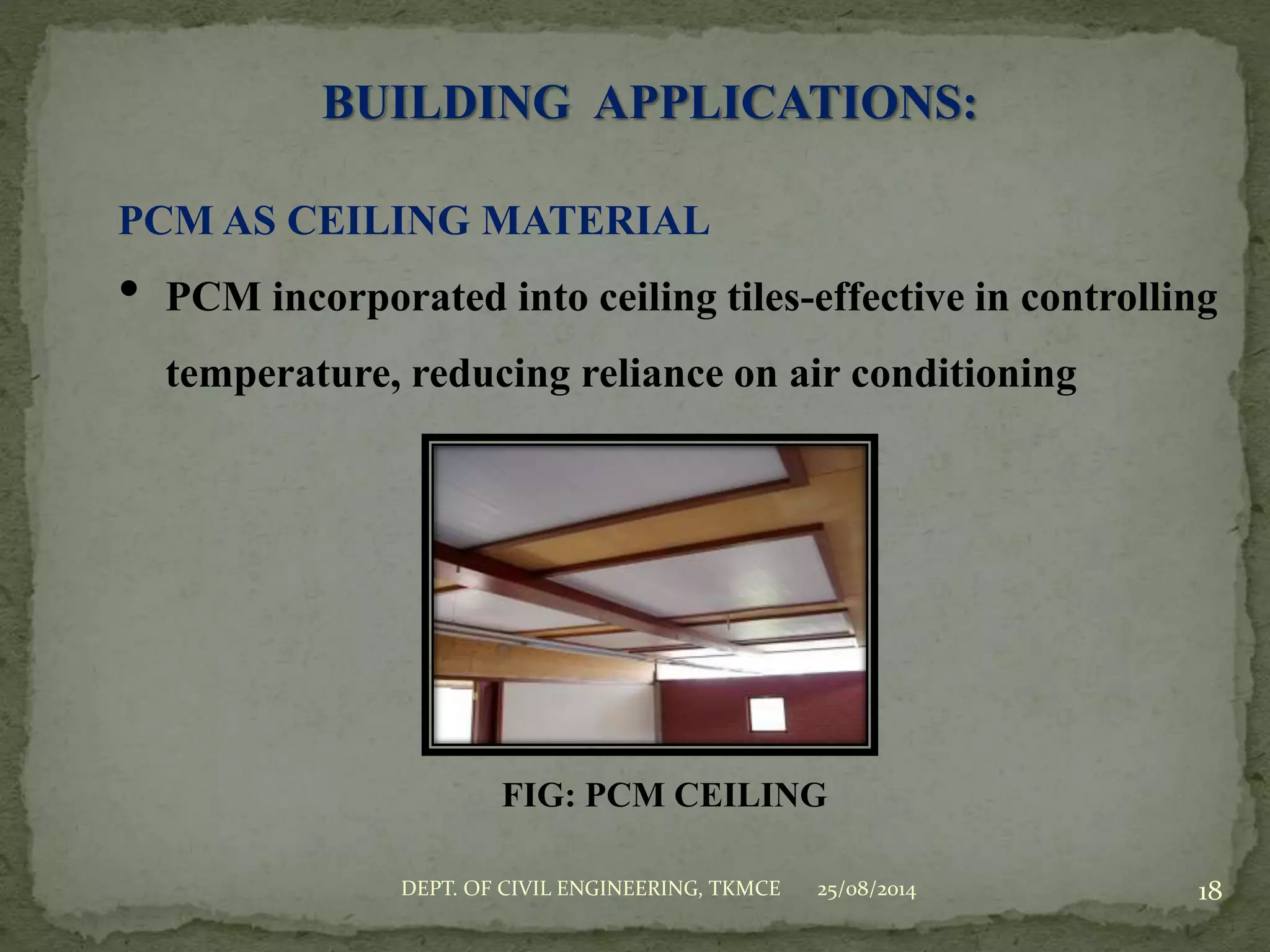
PCM AS CEILING MATERIAL
• PCM incorporated into ceiling tiles-effective in controlling
temperature, reducing reliance on air conditioning
BUILDING APPLICATIONS:
25/08/2014DEPT. OF CIVIL ENGINEERING, TKMCE 18
FIG: PCM CEILING
25/08/2014DEPT. OF CIVIL ENGINEERING, TKMCE 19
• Microscopic polymer capsules containing a wax storage
medium, embedded in gypsum and then encased in the
metal tile
FIG: FIXING A PCM CEILING
25/08/2014DEPT. OF CIVIL ENGINEERING, TKMCE 20
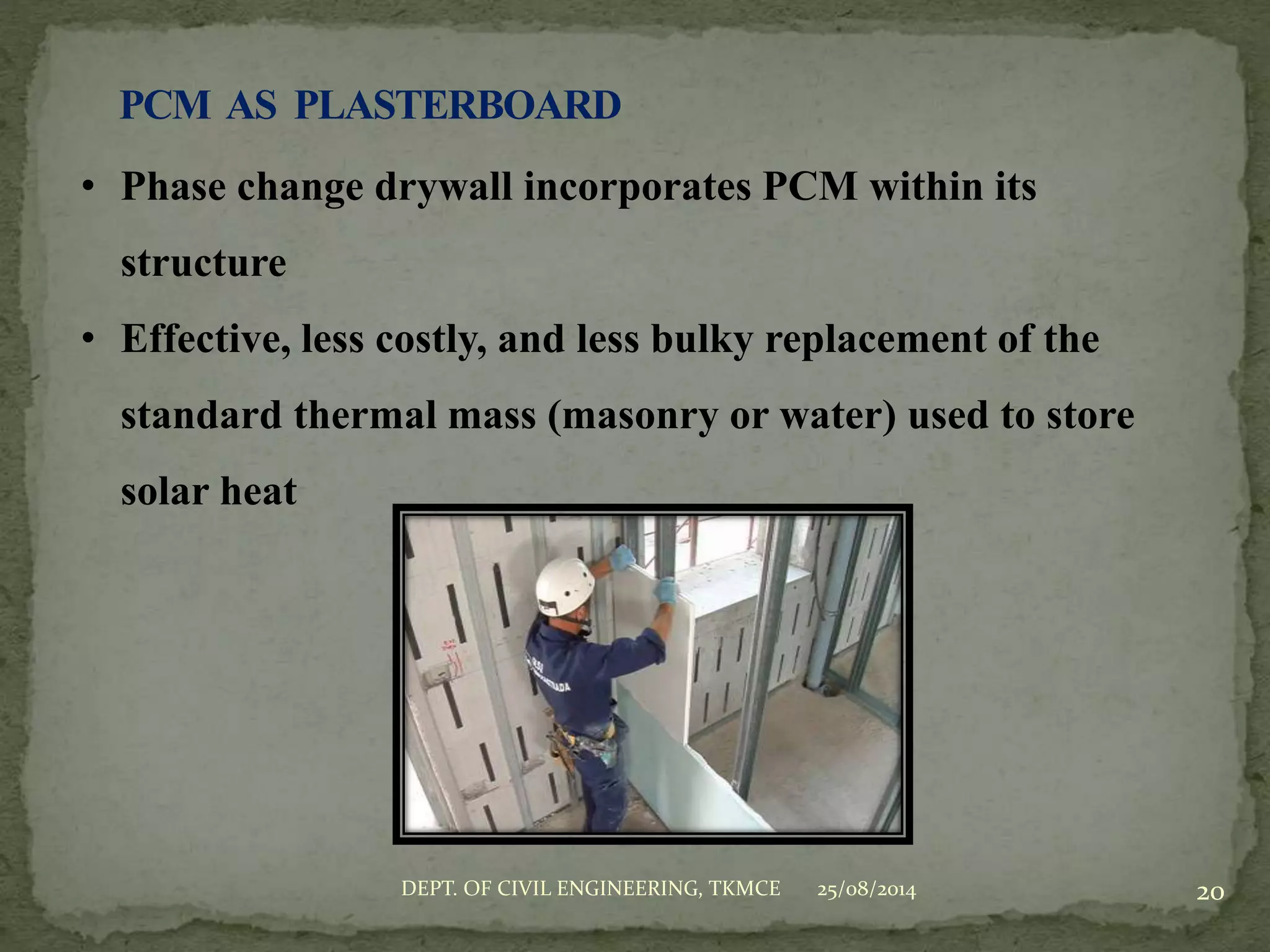
• Phase change drywall incorporates PCM within its
structure
• Effective, less costly, and less bulky replacement of the
standard thermal mass (masonry or water) used to store
solar heat
BIO PCM:
• A rolled mat that contains PCM
• Integrated into new construction or retrofitted into existing
• Mat is installed between insulation and drywall layers and
located in walls and ceiling
25/08/2014 21DEPT. OF CIVIL ENGINEERING, TKMCE
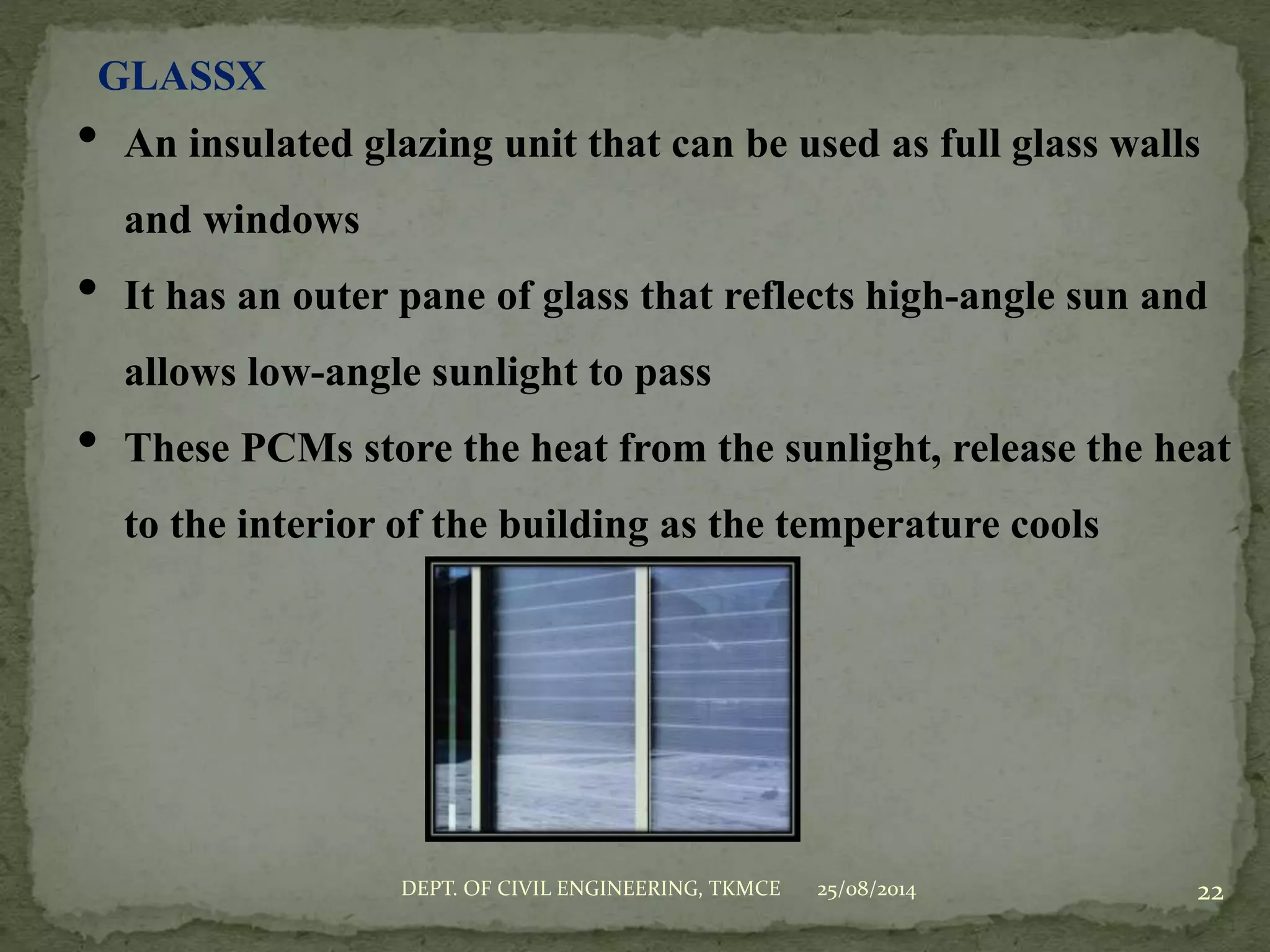
GLASSX
• An insulated glazing unit that can be used as full glass walls
and windows
• It has an outer pane of glass that reflects high-angle sun and
allows low-angle sunlight to pass
• These PCMs store the heat from the sunlight, release the heat
to the interior of the building as the temperature cools
25/08/2014DEPT. OF CIVIL ENGINEERING, TKMCE 22
25/08/2014DEPT. OF CIVIL ENGINEERING, TKMCE 23
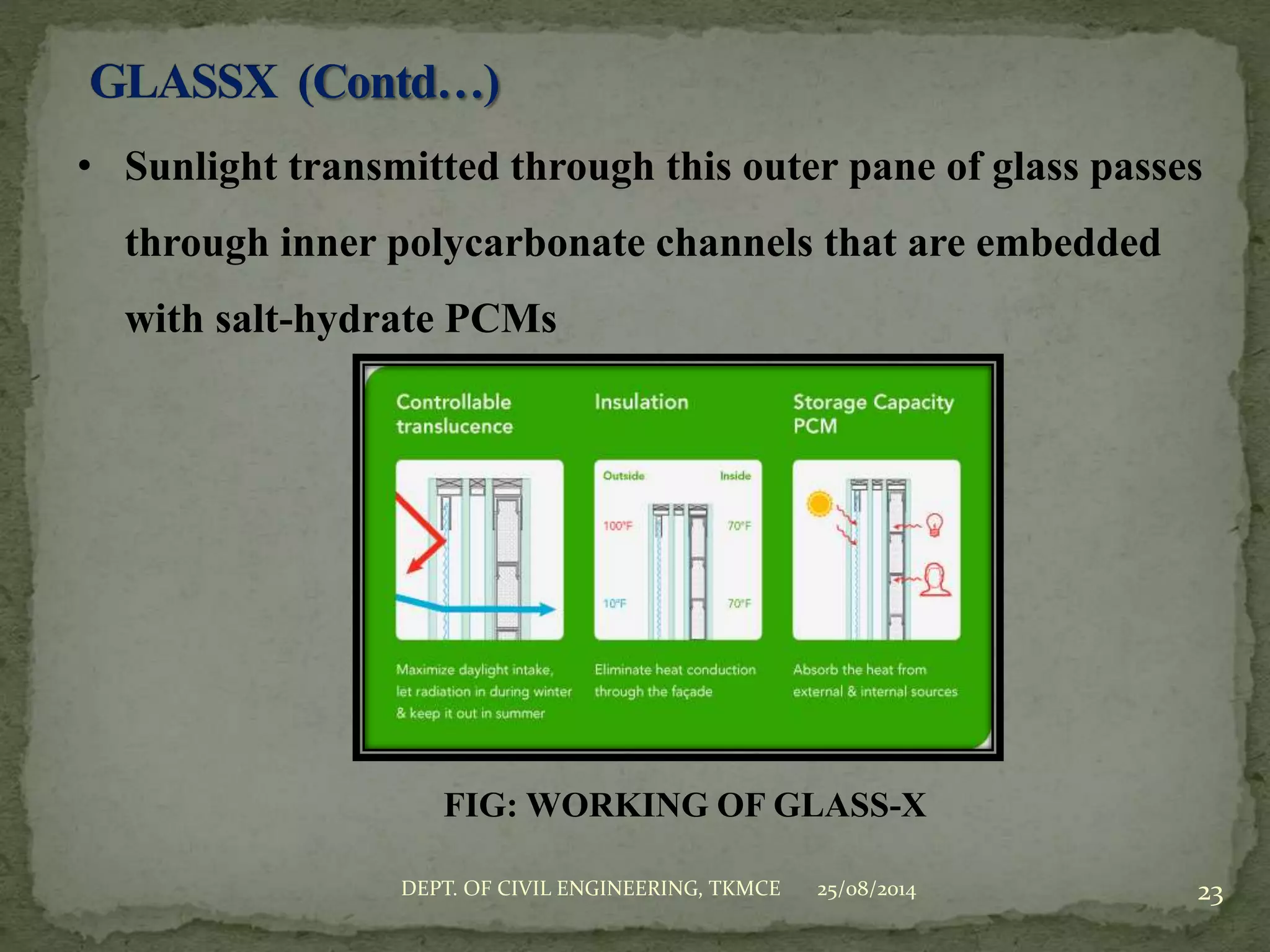
• Sunlight transmitted through this outer pane of glass passes
through inner polycarbonate channels that are embedded
with salt-hydrate PCMs
FIG: WORKING OF GLASS-X
• A melting temperature range in construction is 23°C or
26°C
• A high latent heat of fusion per unit volume minimizes the
area of PCM tiles that are needed
• High thermal conductivity
• Minimal changes in volume
• Congruent melting
25/08/2014 24DEPT. OF CIVIL ENGINEERING, TKMCE
SELECTION CRITERIA ( Contd…)
25/08/2014 25DEPT. OF CIVIL ENGINEERING, TKMCE
• A completely reversible freezing/melting cycle
• Durability over a large number of cycles
• Non-corrosiveness to construction materials
• Non-flammability
 MERITS
 Freeze without much supercooling
 Ability to melt congruently
 Self nucleating properties
 Compatibility with conventional material of
construction
 No segregation
 Recyclable
25/08/2014 26DEPT. OF CIVIL ENGINEERING, TKMCE
 DEMERITS
- Low thermal conductivity in solid state
- Flammable
- Corrosive
- Volumetric latent heat storage capacity is low
- Phase segregation
25/08/2014 27DEPT. OF CIVIL ENGINEERING, TKMCE
25/08/2014 28DEPT. OF CIVIL ENGINEERING, TKMCE
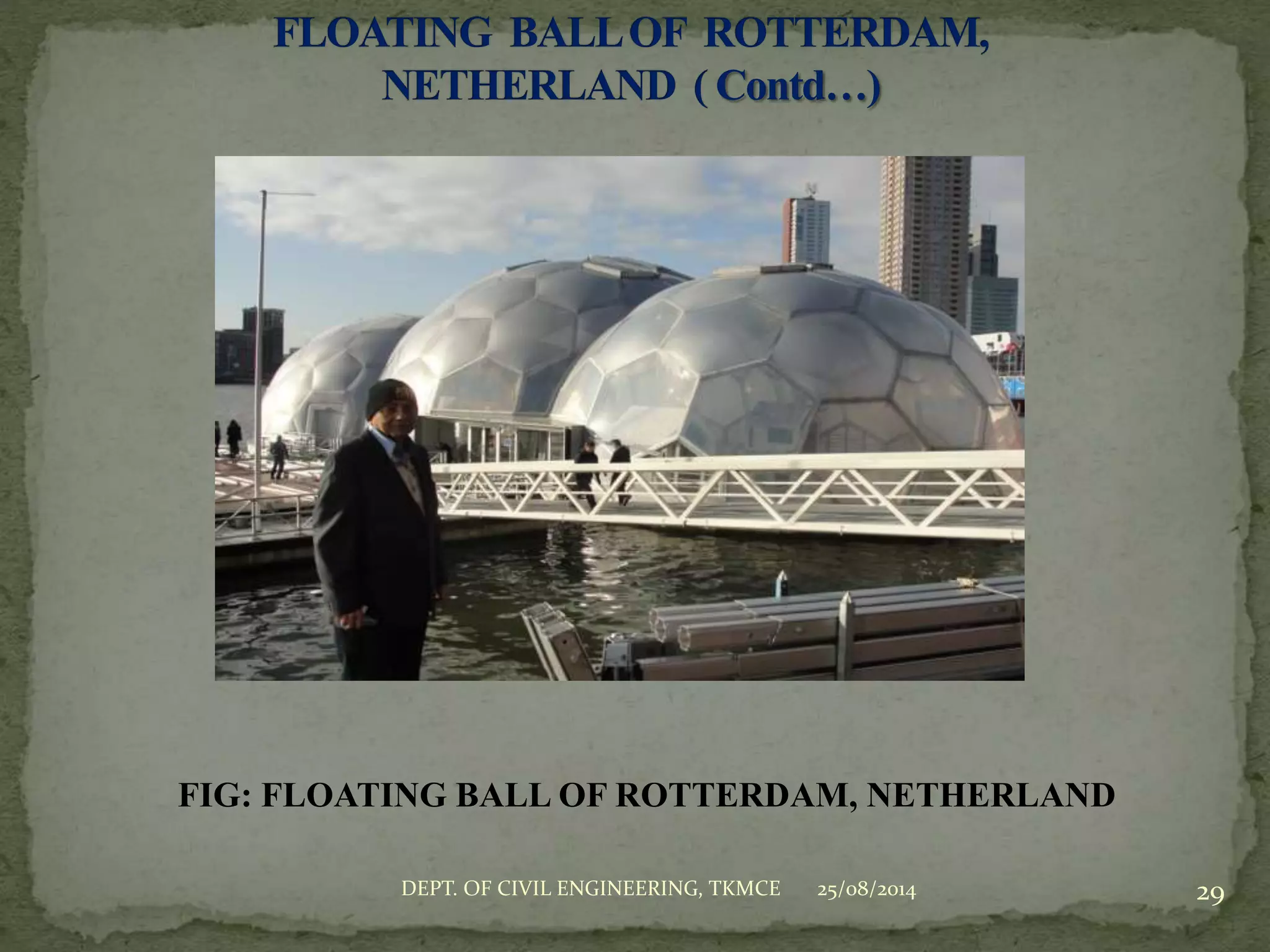
• Three semi transparent domes of 18.5, 20, 24m
diameter
• Building has been built in one of the city harbor of
Rotterdam
• Climate is managed in different way in different room
• Exhibition hall temperature is kept about 15 ˚C
• Conference hall temp is maintained about 21˚C
• Temperature is varied with the help of PCM
25/08/2014 29DEPT. OF CIVIL ENGINEERING, TKMCE
FIG: FLOATING BALL OF ROTTERDAM, NETHERLAND
CONCLUSION
• Improves thermal comfort levels and obviate or reduce the
need for air-conditioning
• Reduction in peak temperatures is possible
• Used in Residential buildings too
• Significant advantages for both commercial and residential
buildings
• Night ventilation- an integral part
• Likely to become a valuable tool for improving thermal
comfort in domestic buildings
25/08/2014DEPT. OF CIVIL ENGINEERING, TKMCE 30
REFFERENCES
 Zubillaga (2007), “Use of microencapsulated PCM in concrete walls for energy
savings. Energy and Buildings”, Vol. 39 pp.113-119.
 I.O. Salyer, A.K. Sircar, R.P. Chartoff, D.E. Miller(1995), “Advanced phase-
change materials for passive solar storage applications”, Proceedings of the
20th Intersociety Energy Conversion Engineering Conference, Warren dale,
Pennsylvania, USA: 699-709.
25/08/2014DEPT. OF CIVIL ENGINEERING, TKMCE 31
THANK YOU
25/08/2014DEPT. OF CIVIL ENGINEERING, TKMCE 32

PHASE CHANGING MATERIAL AS BUILDING MATERIALS

  • 2.
     INTRODUCTION  PRINCIPLE& WORKING  TYPES OF PCM  PCM INCORPORATION  BUILDING APPLICATION  BIO PCM  GLASS-X  MERITS & DEMERITS  SELECTION CRITERIA  CASE STUDY  CONCLUSION 25/08/2014 2DEPT. OF CIVIL ENGINEERING, TKMCE
  • 3.
    • Modern architectureis attractive, flexible and light weight • Phase Changing Materials - Interior finishing alternatives • Stores much larger amount of thermal energy per unit mass than conventional building materials • Requires less amount of energy for production • It can charge and discharge energy in the form of latent heat 25/08/2014 3DEPT. OF CIVIL ENGINEERING, TKMCE
  • 4.
    25/08/2014 4DEPT. OFCIVIL ENGINEERING, TKMCE FIG: PHASE CHANGE MATERIALS
  • 5.
    • When heatis applied to any substance, it is transferred in two ways Sensible heat Latent heat • PCMs works on the principle of latent heat • Latent heat enables PCMs to control room temperature 25/08/2014 5DEPT. OF CIVIL ENGINEERING, TKMCE
  • 6.
    • PCMs usedin construction change from solid to liquid at 23ºC - 26ºC • They melt, absorb heat from room and room temperature is kept constant until the change of state is complete • PCM then returned to solid state by night time ventilation / mechanical means • When returned to solid state it emits the heat • The phase change cycle repeats 25/08/2014 6DEPT. OF CIVIL ENGINEERING, TKMCE
  • 7.
    25/08/2014 7DEPT. OFCIVIL ENGINEERING, TKMCE FIG: WORKING OF PCM
  • 8.
    • There aremany types of PCM but not all are suitable for use in buildings • The two main types of PCM used in construction are inorganic salt hydrates and organic paraffin or fatty acids • Both materials have a set of advantages and disadvantages that must be taken into consideration 25/08/2014 8DEPT. OF CIVIL ENGINEERING, TKMCE
  • 9.
    INORGANIC SALT HYDRATES •Salt hydrates are a low-cost, readily available PCM • They have a high latent heat storage capacity and high thermal conductivity • They are also non-flammable 25/08/2014 9DEPT. OF CIVIL ENGINEERING, TKMCE
  • 10.
    • Paraffin’s andfatty acids do not expand as they melt, and freeze without much super cooling • They are chemically stable, compatible with conventional construction materials and recyclable • Paraffin’s are hydrophobic, which means they are water- repellant • As a result, their phase-change points are reliable 25/08/2014 10DEPT. OF CIVIL ENGINEERING, TKMCE
  • 11.
    • Pure paraffin’sare also highly durable, and do not degrade in contact with oxygen 25/08/2014 11DEPT. OF CIVIL ENGINEERING, TKMCE FIG: ORGANICS
  • 12.
    • Impregnated intobuilding materials in 2 ways : Either directly or as pellets Microencapsulation • Microencapsulation most preferred always. • Night cooling considered as the main difficulty 25/08/2014 12DEPT. OF CIVIL ENGINEERING, TKMCE
  • 13.
    25/08/2014DEPT. OF CIVILENGINEERING, TKMCE 13 FIG : DIRECT USAGE
  • 14.
    25/08/2014DEPT. OF CIVILENGINEERING, TKMCE 14 • Individual particles of solid/ liquid material are coated with a continuous film of polymeric material • Produce capsules called microcapsules • Microcapsules – small sphere with uniform wall round it • Micrometer to millimeter range •Appearance of beads, powder • Polymer sphere shaped
  • 15.
    STRUCTURE OF AMICROCAPSULE : • Material inside is called core •Wall is called shell or coating 25/08/2014DEPT. OF CIVIL ENGINEERING, TKMCE 15
  • 16.
    MORPHOLOGY : • Dependson core material and the deposition process of the shell • Basically 3 types :  Mononuclear Poly nuclear Matrix encapsulation •Also mononuclear with multiple shells, or clusters of microcapsules 25/08/2014DEPT. OF CIVIL ENGINEERING, TKMCE 16
  • 17.
    25/08/2014DEPT. OF CIVILENGINEERING, TKMCE 17 FIG: TYPES OF MICROCAPSULES
  • 18.
    PCM AS CEILINGMATERIAL • PCM incorporated into ceiling tiles-effective in controlling temperature, reducing reliance on air conditioning BUILDING APPLICATIONS: 25/08/2014DEPT. OF CIVIL ENGINEERING, TKMCE 18 FIG: PCM CEILING
  • 19.
    25/08/2014DEPT. OF CIVILENGINEERING, TKMCE 19 • Microscopic polymer capsules containing a wax storage medium, embedded in gypsum and then encased in the metal tile FIG: FIXING A PCM CEILING
  • 20.
    25/08/2014DEPT. OF CIVILENGINEERING, TKMCE 20 • Phase change drywall incorporates PCM within its structure • Effective, less costly, and less bulky replacement of the standard thermal mass (masonry or water) used to store solar heat
  • 21.
    BIO PCM: • Arolled mat that contains PCM • Integrated into new construction or retrofitted into existing • Mat is installed between insulation and drywall layers and located in walls and ceiling 25/08/2014 21DEPT. OF CIVIL ENGINEERING, TKMCE
  • 22.
    GLASSX • An insulatedglazing unit that can be used as full glass walls and windows • It has an outer pane of glass that reflects high-angle sun and allows low-angle sunlight to pass • These PCMs store the heat from the sunlight, release the heat to the interior of the building as the temperature cools 25/08/2014DEPT. OF CIVIL ENGINEERING, TKMCE 22
  • 23.
    25/08/2014DEPT. OF CIVILENGINEERING, TKMCE 23 • Sunlight transmitted through this outer pane of glass passes through inner polycarbonate channels that are embedded with salt-hydrate PCMs FIG: WORKING OF GLASS-X
  • 24.
    • A meltingtemperature range in construction is 23°C or 26°C • A high latent heat of fusion per unit volume minimizes the area of PCM tiles that are needed • High thermal conductivity • Minimal changes in volume • Congruent melting 25/08/2014 24DEPT. OF CIVIL ENGINEERING, TKMCE
  • 25.
    SELECTION CRITERIA (Contd…) 25/08/2014 25DEPT. OF CIVIL ENGINEERING, TKMCE • A completely reversible freezing/melting cycle • Durability over a large number of cycles • Non-corrosiveness to construction materials • Non-flammability
  • 26.
     MERITS  Freezewithout much supercooling  Ability to melt congruently  Self nucleating properties  Compatibility with conventional material of construction  No segregation  Recyclable 25/08/2014 26DEPT. OF CIVIL ENGINEERING, TKMCE
  • 27.
     DEMERITS - Lowthermal conductivity in solid state - Flammable - Corrosive - Volumetric latent heat storage capacity is low - Phase segregation 25/08/2014 27DEPT. OF CIVIL ENGINEERING, TKMCE
  • 28.
    25/08/2014 28DEPT. OFCIVIL ENGINEERING, TKMCE • Three semi transparent domes of 18.5, 20, 24m diameter • Building has been built in one of the city harbor of Rotterdam • Climate is managed in different way in different room • Exhibition hall temperature is kept about 15 ˚C • Conference hall temp is maintained about 21˚C • Temperature is varied with the help of PCM
  • 29.
    25/08/2014 29DEPT. OFCIVIL ENGINEERING, TKMCE FIG: FLOATING BALL OF ROTTERDAM, NETHERLAND
  • 30.
    CONCLUSION • Improves thermalcomfort levels and obviate or reduce the need for air-conditioning • Reduction in peak temperatures is possible • Used in Residential buildings too • Significant advantages for both commercial and residential buildings • Night ventilation- an integral part • Likely to become a valuable tool for improving thermal comfort in domestic buildings 25/08/2014DEPT. OF CIVIL ENGINEERING, TKMCE 30
  • 31.
    REFFERENCES  Zubillaga (2007),“Use of microencapsulated PCM in concrete walls for energy savings. Energy and Buildings”, Vol. 39 pp.113-119.  I.O. Salyer, A.K. Sircar, R.P. Chartoff, D.E. Miller(1995), “Advanced phase- change materials for passive solar storage applications”, Proceedings of the 20th Intersociety Energy Conversion Engineering Conference, Warren dale, Pennsylvania, USA: 699-709. 25/08/2014DEPT. OF CIVIL ENGINEERING, TKMCE 31
  • 32.
    THANK YOU 25/08/2014DEPT. OFCIVIL ENGINEERING, TKMCE 32