REFRIGERATION CYCLE
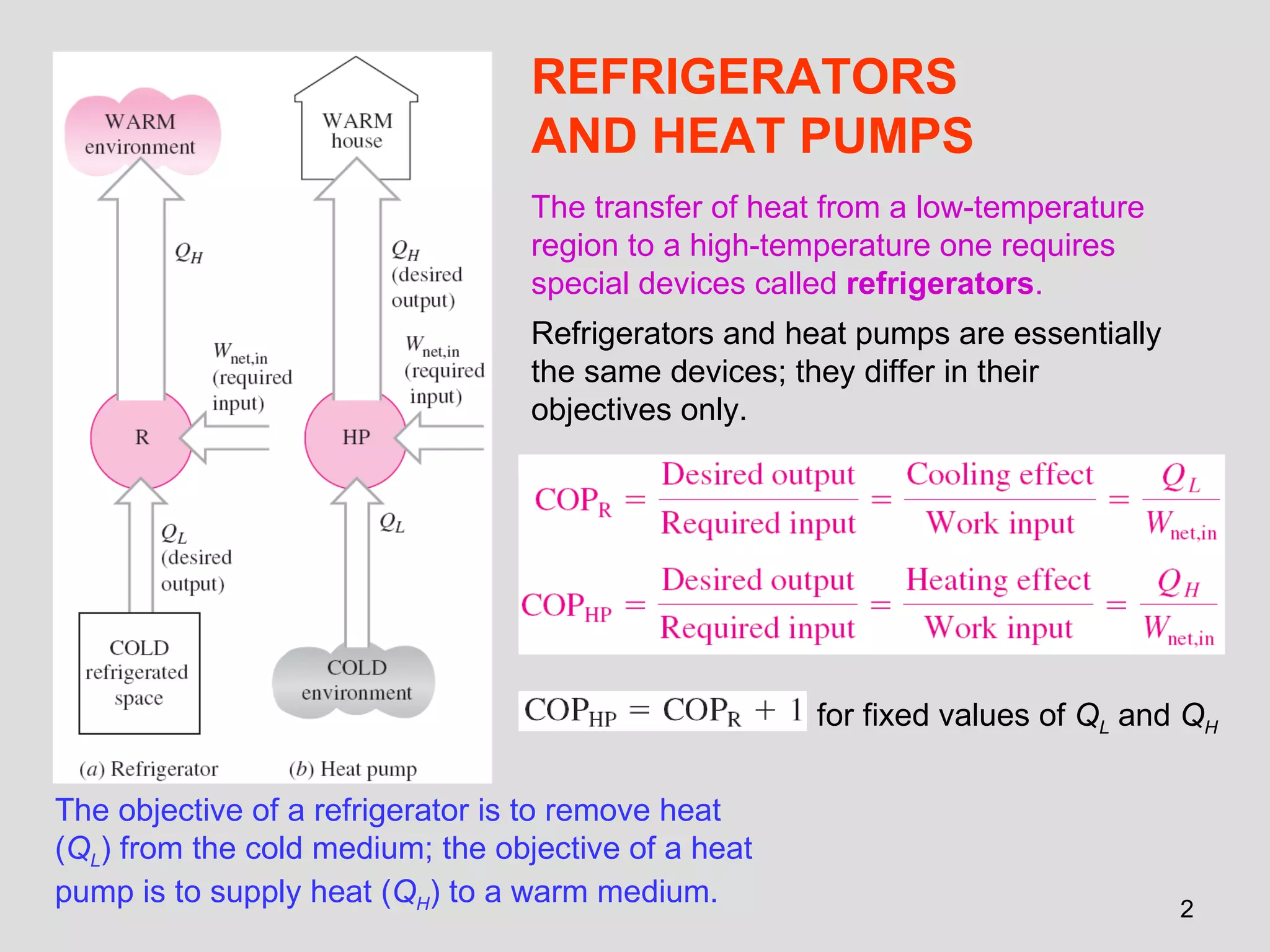
REFRIGERATORS AND HEAT PUMPS The objective of a refrigerator is to remove heat ( Q L ) from the cold medium; the objective of a heat pump is to supply heat ( Q H ) to a warm medium. The transfer of heat from a low-temperature region to a high-temperature one requires special devices called  refrigerators . Refrigerators and heat pumps are essentially the same devices; they differ in their objectives only. for fixed values of  Q L  and  Q H
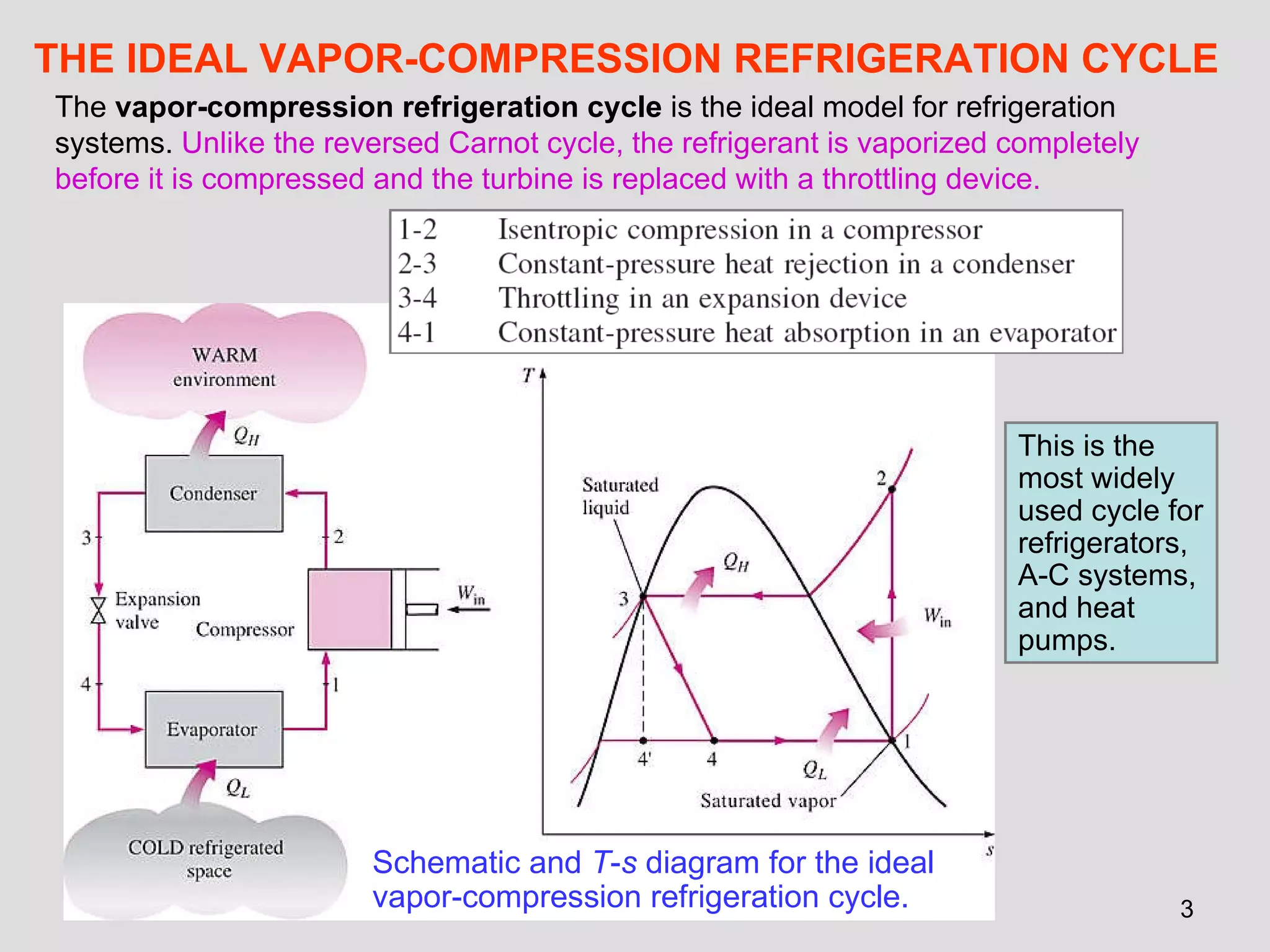
THE IDEAL VAPOR-COMPRESSION REFRIGERATION CYCLE The  vapor-compression refrigeration cycle  is the ideal model for refrigeration systems.  Unlike the reversed Carnot cycle, the refrigerant is vaporized completely before it is compressed and the turbine is replaced with a throttling device.  Schematic and  T - s  diagram for the ideal vapor-compression refrigeration cycle. This is the most widely used cycle for refrigerators, A-C systems, and heat pumps.
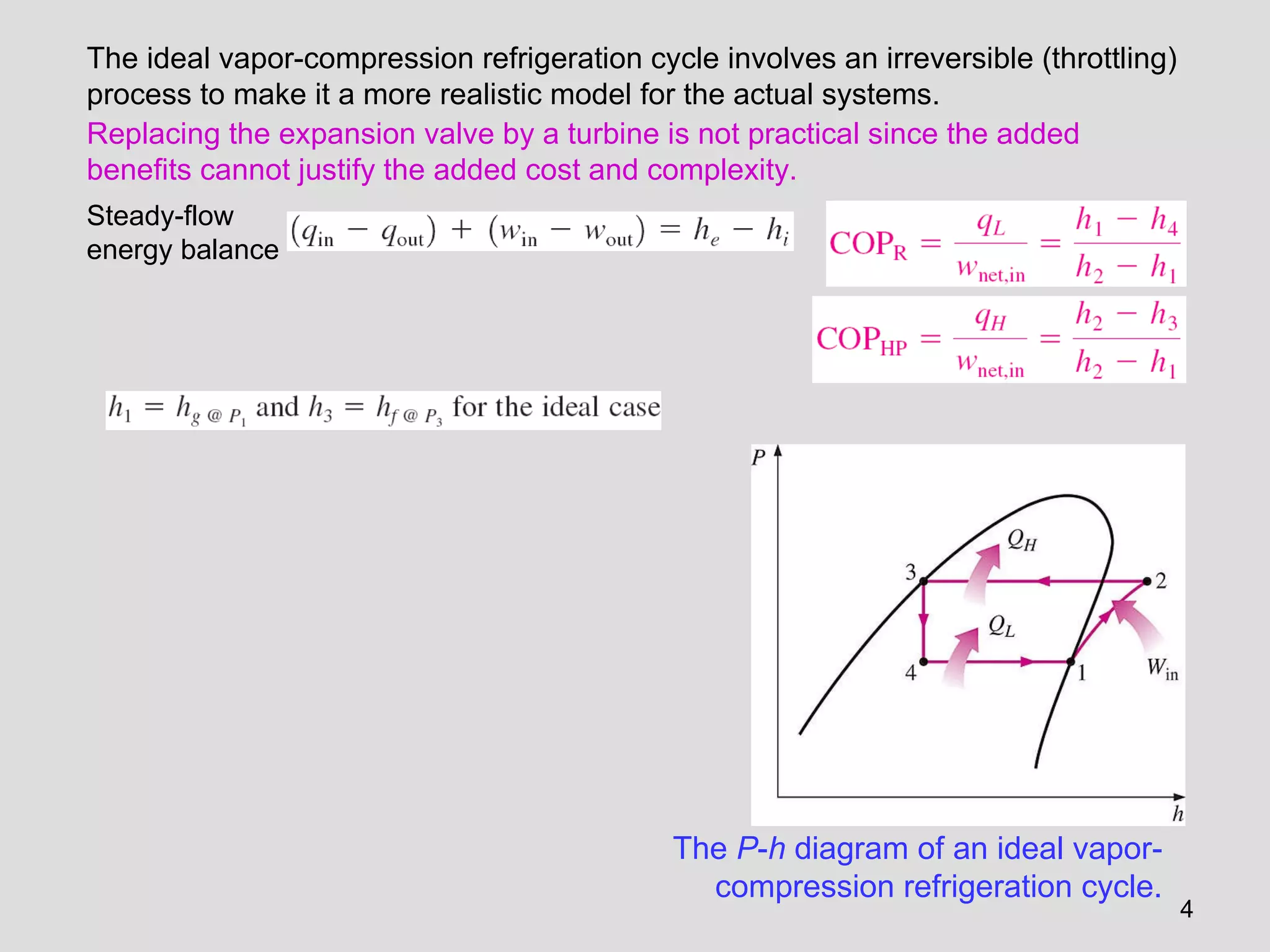
The  P - h  diagram of an ideal vapor-compression refrigeration cycle. The ideal vapor-compression refrigeration cycle involves an irreversible (throttling) process to make it a more realistic model for the actual systems.  Replacing the expansion valve by a turbine is not practical since the added benefits cannot justify the added cost and complexity. Steady-flow energy balance
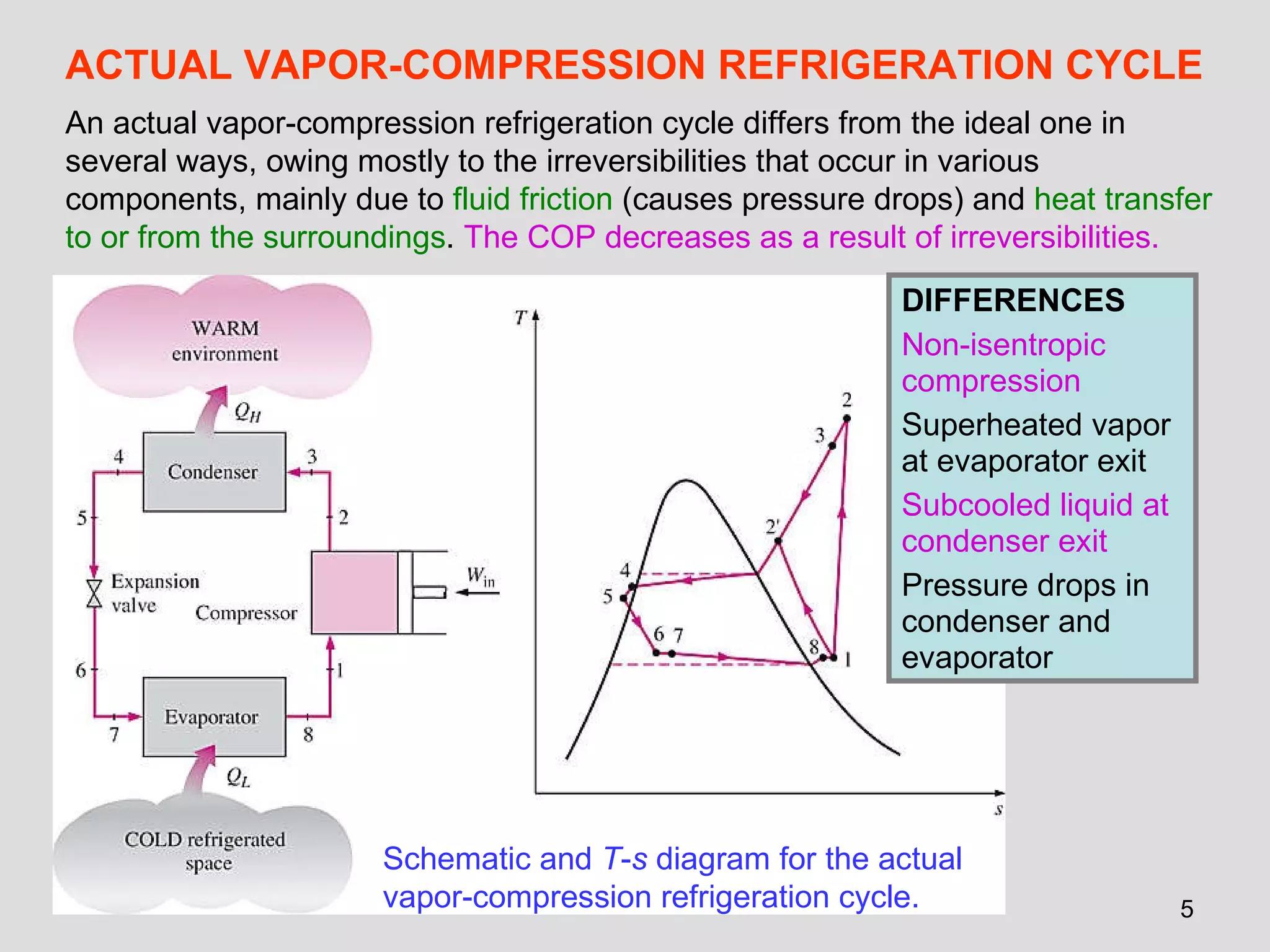
ACTUAL VAPOR-COMPRESSION REFRIGERATION CYCLE Schematic and  T - s  diagram for the actual vapor-compression refrigeration cycle. An actual vapor-compression refrigeration cycle differs from the ideal one in several ways, owing mostly to the irreversibilities that occur in various components, mainly due to  fluid friction  (causes pressure drops) and  heat transfer to or from the surroundings .  The COP decreases as a result of irreversibilities. DIFFERENCES Non-isentropic compression Superheated vapor at evaporator exit Subcooled liquid at condenser exit Pressure drops in condenser and evaporator
SELECTING THE RIGHT REFRIGERANT Several refrigerants may be used in refrigeration systems such as chlorofluorocarbons (CFCs), ammonia, hydrocarbons (propane, ethane, ethylene, etc.), carbon dioxide, air (in the air-conditioning of aircraft), and even water (in applications above the freezing point).  R-11, R-12, R-22, R-134a, and R-502 account for over 90 percent of the market. The industrial and heavy-commercial sectors use  ammonia  (it is toxic). R-11 is used in large-capacity water chillers serving A-C systems in buildings.   R-134a (replaced R-12, which damages ozone layer) is used in domestic refrigerators and freezers, as well as automotive air conditioners.  R-22 is used in window air conditioners, heat pumps, air conditioners of commercial buildings, and large industrial refrigeration systems, and offers strong competition to ammonia.   R-502 (a blend of R-115 and R-22) is the dominant refrigerant used in commercial refrigeration systems such as those in supermarkets. CFCs allow more ultraviolet radiation into the earth’s atmosphere by destroying the protective ozone layer and thus contributing to the greenhouse effect that causes global warming. Fully halogenated CFCs (such as R-11, R-12, and R-115) do the most damage to the ozone layer. Refrigerants that are friendly to the ozone layer have been developed. Two important parameters that need to be considered in the selection of a refrigerant are the temperatures of the two media (the refrigerated space and the environment) with which the refrigerant exchanges heat.
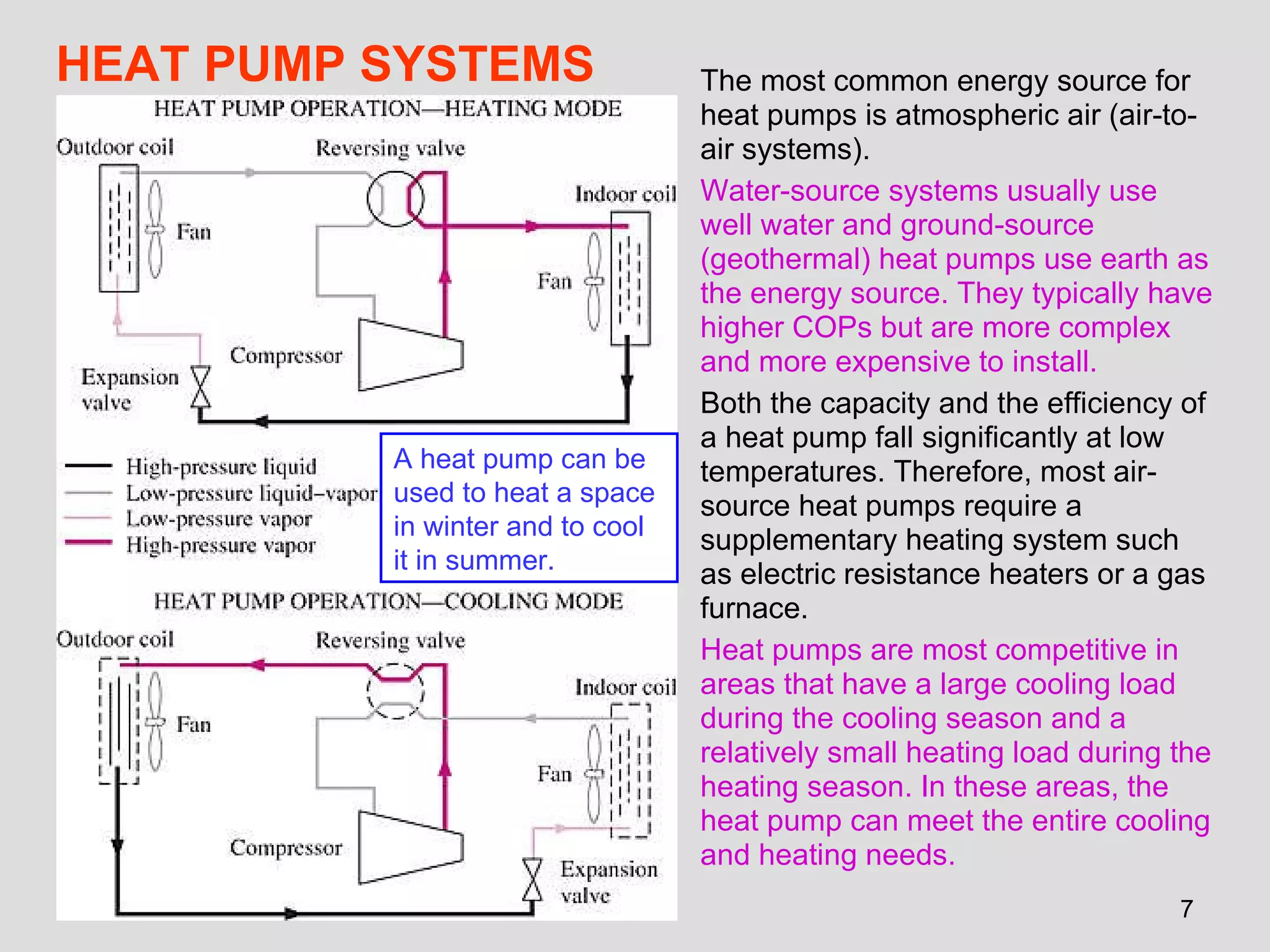
HEAT PUMP SYSTEMS A heat pump can be used to heat a space in winter and to cool it in summer. The most common energy source for heat pumps is atmospheric air (air-to- air systems).  Water-source systems usually use well water and ground-source (geothermal) heat pumps use earth as the energy source. They typically have higher COPs but are more complex and more expensive to install. Both the capacity and the efficiency of a heat pump fall significantly at low temperatures. Therefore, most air-source heat pumps require a supplementary heating system such as electric resistance heaters or a gas furnace. Heat pumps are most competitive in areas that have a large cooling load during the cooling season and a relatively small heating load during the heating season. In these areas, the heat pump can meet the entire cooling and heating needs.

Refrigeration cycle

  • 1.
  • 2.
    REFRIGERATORS AND HEATPUMPS The objective of a refrigerator is to remove heat ( Q L ) from the cold medium; the objective of a heat pump is to supply heat ( Q H ) to a warm medium. The transfer of heat from a low-temperature region to a high-temperature one requires special devices called refrigerators . Refrigerators and heat pumps are essentially the same devices; they differ in their objectives only. for fixed values of Q L and Q H
  • 3.
    THE IDEAL VAPOR-COMPRESSIONREFRIGERATION CYCLE The vapor-compression refrigeration cycle is the ideal model for refrigeration systems. Unlike the reversed Carnot cycle, the refrigerant is vaporized completely before it is compressed and the turbine is replaced with a throttling device. Schematic and T - s diagram for the ideal vapor-compression refrigeration cycle. This is the most widely used cycle for refrigerators, A-C systems, and heat pumps.
  • 4.
    The P- h diagram of an ideal vapor-compression refrigeration cycle. The ideal vapor-compression refrigeration cycle involves an irreversible (throttling) process to make it a more realistic model for the actual systems. Replacing the expansion valve by a turbine is not practical since the added benefits cannot justify the added cost and complexity. Steady-flow energy balance
  • 5.
    ACTUAL VAPOR-COMPRESSION REFRIGERATIONCYCLE Schematic and T - s diagram for the actual vapor-compression refrigeration cycle. An actual vapor-compression refrigeration cycle differs from the ideal one in several ways, owing mostly to the irreversibilities that occur in various components, mainly due to fluid friction (causes pressure drops) and heat transfer to or from the surroundings . The COP decreases as a result of irreversibilities. DIFFERENCES Non-isentropic compression Superheated vapor at evaporator exit Subcooled liquid at condenser exit Pressure drops in condenser and evaporator
  • 6.
    SELECTING THE RIGHTREFRIGERANT Several refrigerants may be used in refrigeration systems such as chlorofluorocarbons (CFCs), ammonia, hydrocarbons (propane, ethane, ethylene, etc.), carbon dioxide, air (in the air-conditioning of aircraft), and even water (in applications above the freezing point). R-11, R-12, R-22, R-134a, and R-502 account for over 90 percent of the market. The industrial and heavy-commercial sectors use ammonia (it is toxic). R-11 is used in large-capacity water chillers serving A-C systems in buildings. R-134a (replaced R-12, which damages ozone layer) is used in domestic refrigerators and freezers, as well as automotive air conditioners. R-22 is used in window air conditioners, heat pumps, air conditioners of commercial buildings, and large industrial refrigeration systems, and offers strong competition to ammonia. R-502 (a blend of R-115 and R-22) is the dominant refrigerant used in commercial refrigeration systems such as those in supermarkets. CFCs allow more ultraviolet radiation into the earth’s atmosphere by destroying the protective ozone layer and thus contributing to the greenhouse effect that causes global warming. Fully halogenated CFCs (such as R-11, R-12, and R-115) do the most damage to the ozone layer. Refrigerants that are friendly to the ozone layer have been developed. Two important parameters that need to be considered in the selection of a refrigerant are the temperatures of the two media (the refrigerated space and the environment) with which the refrigerant exchanges heat.
  • 7.
    HEAT PUMP SYSTEMSA heat pump can be used to heat a space in winter and to cool it in summer. The most common energy source for heat pumps is atmospheric air (air-to- air systems). Water-source systems usually use well water and ground-source (geothermal) heat pumps use earth as the energy source. They typically have higher COPs but are more complex and more expensive to install. Both the capacity and the efficiency of a heat pump fall significantly at low temperatures. Therefore, most air-source heat pumps require a supplementary heating system such as electric resistance heaters or a gas furnace. Heat pumps are most competitive in areas that have a large cooling load during the cooling season and a relatively small heating load during the heating season. In these areas, the heat pump can meet the entire cooling and heating needs.