Building Energy 2014

PV and Heat Pumps:
Net Zero Heating Solutions
Fortunat Mueller PE
Co Owner
ReVision Energy
March, 2014

Professional design, installation and service of renewable energy systems.
Heat Pumps and Net
Zero
• Intro

•Why Heat Pumps for Net Zero
•PV Basics
•Heat Pump Basics
•Mini Split details
•Design Processes
•Working Example
Who is ReVision Energy?
• Northern New England’s most experienced renewable energy
•

installer—more than 2,500 solar hot water & solar electric systems
in Maine & NH.
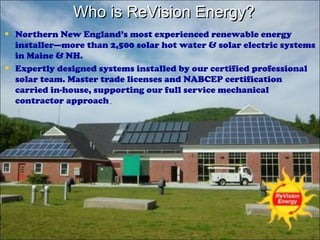
Expertly designed systems installed by our certified professional
solar team. Master trade licenses and NABCEP certification
carried in-house, supporting our full service mechanical
contractor approach.
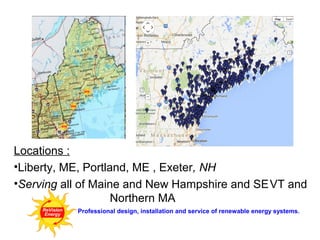
Locations :
•Liberty, ME, Portland, ME , Exeter, NH
•Serving all of Maine and New Hampshire and SEVT and
Northern MA
Professional design, installation and service of renewable energy systems.
Technical Competence
•
•
•
•
•
•
•
•

Master Electrician’s License
Master Plumber’s License
NABCEP Certification (Thermal & PV)
Maine State Solar Installer Certifications
EPA Refrigerant License
2,500+ Systems Installed to Date
Engineering in-house (P.E.)
Depth of Experience
Define Net Zero Building
A zero-energy building, also known as a zero net
energy (ZNE) building, net-zero energy
building (NZEB), or net zero building, is a
building with zero net energy consumption,
meaning the total amount of energy used by the
building on an annual basis is roughly equal to the
amount of renewable energy created on the site.
How do you get there?
• NG plus HUGE PV to offset all source
energy
• Biomass + PV (wood or pellets)
• Large Solar Thermal + PV
• Resistive Electric + PV
• Heat Pump + PV
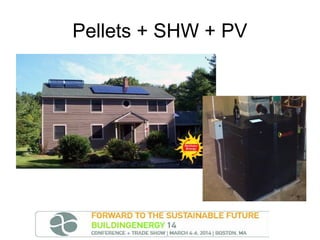
Pellets + SHW + PV
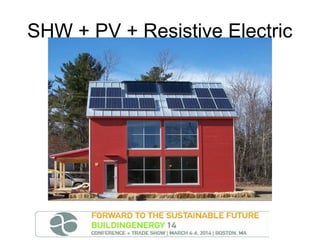
SHW + PV + Resistive Electric
Heat pump as Lever for PV
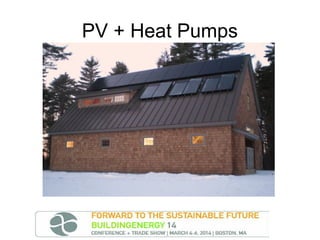
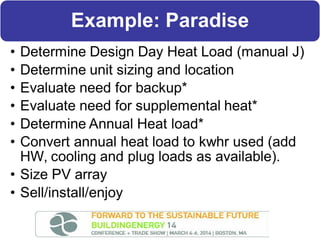
PV + Heat Pumps
Mini Splits are all the rage…
• Low(er) Cost?
– Gas by wire for those without access

•
•
•
•

No Combustion
Air conditioning as a benefit
Good fit for supplemental heat
Path to net zero with PV
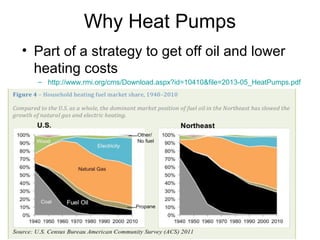
Why Heat Pumps
• Part of a strategy to get off oil and lower
heating costs
– http://www.rmi.org/cms/Download.aspx?id=10410&file=2013-05_HeatPumps.pdf
Heat Pumps and Net Zero

• Allow you to heat/cool efficiently with electricity which is easily
produced renewably on site
• By taking advantage of net metering, you can easily ‘store’ the
electricity generated in the summer to use for heat in the
winter.
Energy Security in Reach
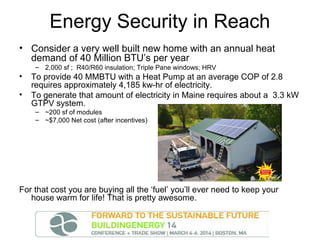
• Consider a very well built new home with an annual heat
demand of 40 Million BTU’s per year
– 2,000 sf ; R40/R60 insulation; Triple Pane windows; HRV

•
•

To provide 40 MMBTU with a Heat Pump at an average COP of 2.8
requires approximately 4,185 kw-hr of electricity.
To generate that amount of electricity in Maine requires about a 3.3 kW
GTPV system.
– ~200 sf of modules
– ~$7,000 Net cost (after incentives)

For that cost you are buying all the ‘fuel’ you’ll ever need to keep your
house warm for life! That is pretty awesome.
In one hour enough
solar energy strikes
the earth’s surface
to supply all energy
demand for one
year.

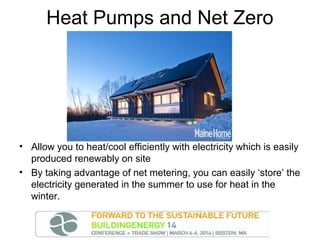
Net Zero home in
Lancaster NH.
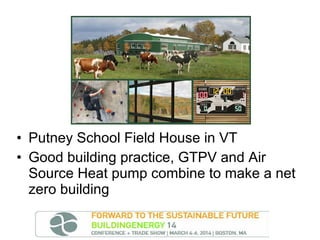
• Putney School Field House in VT
• Good building practice, GTPV and Air
Source Heat pump combine to make a net
zero building
Solar Electric Basics

Proctor Academy, Andover, NH
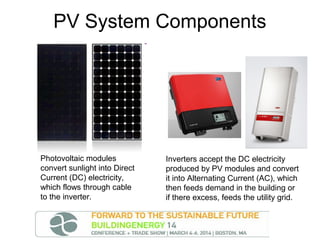
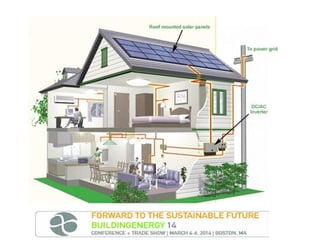
PV System Components

Photovoltaic modules
convert sunlight into Direct
Current (DC) electricity,
which flows through cable
to the inverter.

Inverters accept the DC electricity
produced by PV modules and convert
it into Alternating Current (AC), which
then feeds demand in the building or
if there excess, feeds the utility grid.
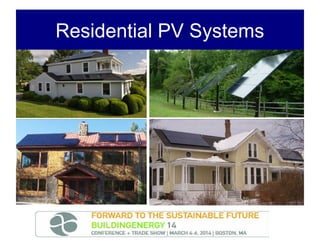
Residential PV Systems
Ground Mounting Options
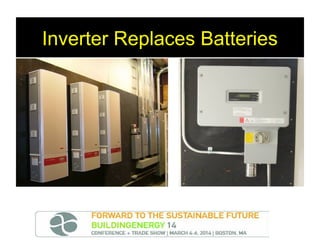
Inverter Replaces Batteries
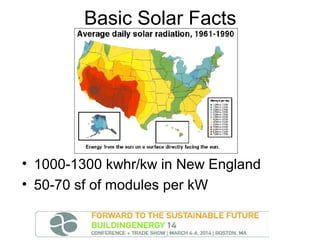
Basic Solar Facts

• 1000-1300 kwhr/kw in New England
• 50-70 sf of modules per kW
Heat Pumps Basics
•

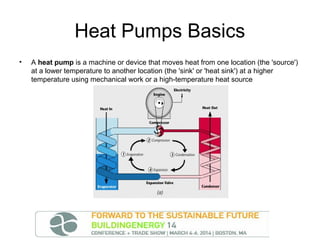
A heat pump is a machine or device that moves heat from one location (the 'source')
at a lower temperature to another location (the 'sink' or 'heat sink') at a higher
temperature using mechanical work or a high-temperature heat source
Thermodynamics 101
Temperature vs Heat
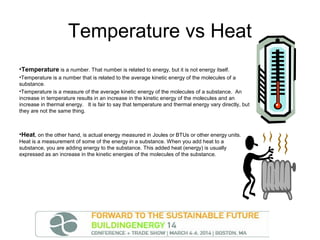
•Temperature is a number. That number is related to energy, but it is not energy itself.
•Temperature is a number that is related to the average kinetic energy of the molecules of a
substance.
•Temperature is a measure of the average kinetic energy of the molecules of a substance. An
increase in temperature results in an increase in the kinetic energy of the molecules and an
increase in thermal energy. It is fair to say that temperature and thermal energy vary directly, but
they are not the same thing.

•Heat, on the other hand, is actual energy measured in Joules or BTUs or other energy units.
Heat is a measurement of some of the energy in a substance. When you add heat to a
substance, you are adding energy to the substance. This added heat (energy) is usually
expressed as an increase in the kinetic energies of the molecules of the substance.
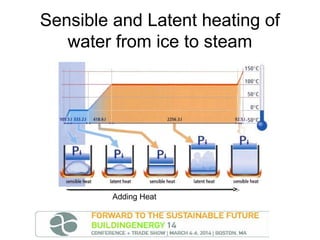
Sensible vs Latent Heat
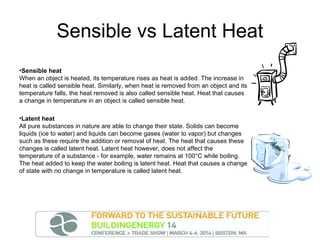
•Sensible heat
When an object is heated, its temperature rises as heat is added. The increase in
heat is called sensible heat. Similarly, when heat is removed from an object and its
temperature falls, the heat removed is also called sensible heat. Heat that causes
a change in temperature in an object is called sensible heat.
•Latent heat
All pure substances in nature are able to change their state. Solids can become
liquids (ice to water) and liquids can become gases (water to vapor) but changes
such as these require the addition or removal of heat. The heat that causes these
changes is called latent heat. Latent heat however, does not affect the
temperature of a substance - for example, water remains at 100°C while boiling.
The heat added to keep the water boiling is latent heat. Heat that causes a change
of state with no change in temperature is called latent heat.
Sensible and Latent heating of
water from ice to steam

Adding Heat
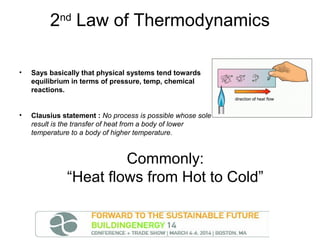
2nd Law of Thermodynamics
•

Says basically that physical systems tend towards
equilibrium in terms of pressure, temp, chemical
reactions.

•

Clausius statement : No process is possible whose sole
result is the transfer of heat from a body of lower
temperature to a body of higher temperature.

Commonly:
“Heat flows from Hot to Cold”
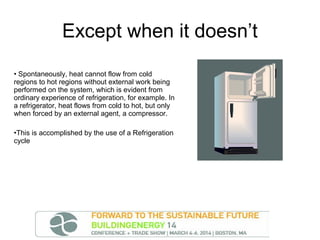
Except when it doesn’t
• Spontaneously, heat cannot flow from cold
regions to hot regions without external work being
performed on the system, which is evident from
ordinary experience of refrigeration, for example. In
a refrigerator, heat flows from cold to hot, but only
when forced by an external agent, a compressor.
•This is accomplished by the use of a Refrigeration
cycle
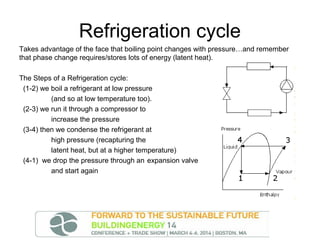
Refrigeration cycle
Takes advantage of the face that boiling point changes with pressure…and remember
that phase change requires/stores lots of energy (latent heat).
The Steps of a Refrigeration cycle:
(1-2) we boil a refrigerant at low pressure
(and so at low temperature too).
(2-3) we run it through a compressor to
increase the pressure
(3-4) then we condense the refrigerant at
high pressure (recapturing the
latent heat, but at a higher temperature)
(4-1) we drop the pressure through an expansion valve
and start again
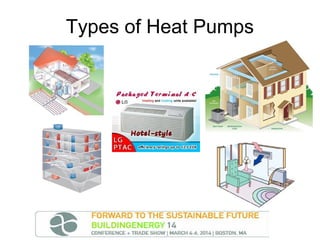
Types of Heat Pumps
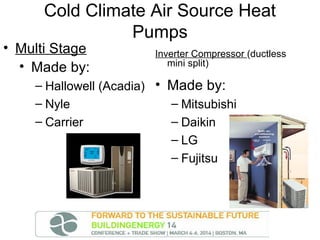
Cold Climate Air Source Heat
Pumps

• Multi Stage
• Made by:

Inverter Compressor (ductless
mini split)

– Hallowell (Acadia) • Made by:
– Nyle
– Mitsubishi
– Carrier
– Daikin
– LG
– Fujitsu
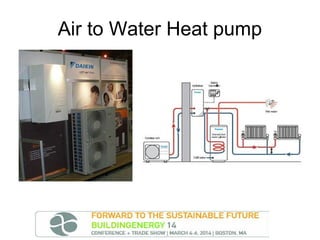
Air to Water Heat pump
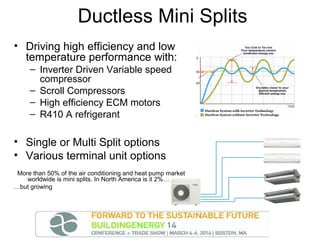
Ductless Mini Splits
• Driving high efficiency and low
temperature performance with:
– Inverter Driven Variable speed
compressor
– Scroll Compressors
– High efficiency ECM motors
– R410 A refrigerant

• Single or Multi Split options
• Various terminal unit options
More than 50% of the air conditioning and heat pump market
worldwide is mini splits. In North America is it 2%…
…but growing
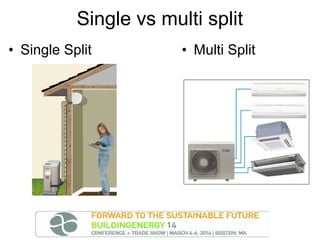
Single vs multi split
• Single Split

• Multi Split
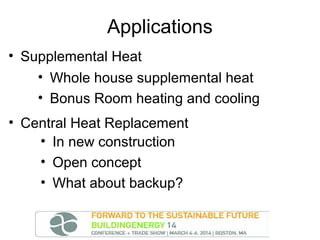
Applications
• Supplemental Heat
• Whole house supplemental heat
• Bonus Room heating and cooling
• Central Heat Replacement
• In new construction
• Open concept
• What about backup?
Heat Pump Performance: COP
•

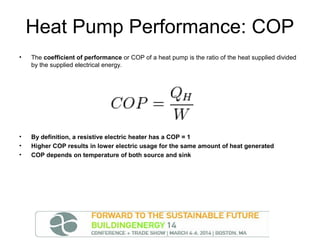
The coefficient of performance or COP of a heat pump is the ratio of the heat supplied divided
by the supplied electrical energy.

•
•
•

By definition, a resistive electric heater has a COP = 1
Higher COP results in lower electric usage for the same amount of heat generated
COP depends on temperature of both source and sink
Mini Split Performance
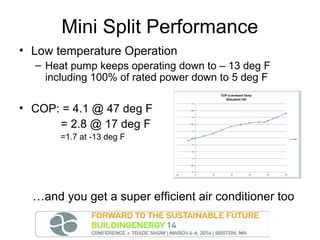
• Low temperature Operation
– Heat pump keeps operating down to – 13 deg F
including 100% of rated power down to 5 deg F

• COP: = 4.1 @ 47 deg F
= 2.8 @ 17 deg F
=1.7 at -13 deg F

…and you get a super efficient air conditioner too
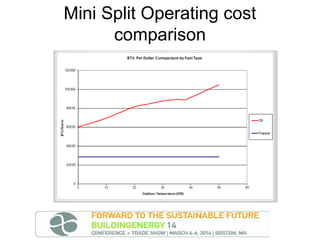
Mini Split Operating cost
comparison
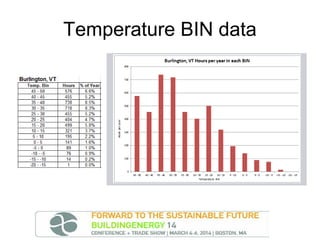
Temperature BIN data
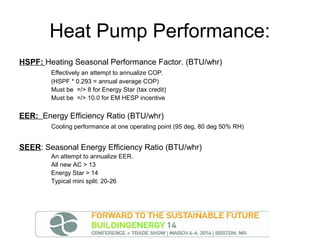
Heat Pump Performance:
HSPF: Heating Seasonal Performance Factor. (BTU/whr)
Effectively an attempt to annualize COP.
(HSPF * 0.293 = annual average COP)
Must be =/> 8 for Energy Star (tax credit)
Must be =/> 10.0 for EM HESP incentive

EER: Energy Efficiency Ratio (BTU/whr)
Cooling performance at one operating point (95 deg, 80 deg 50% RH)

SEER: Seasonal Energy Efficiency Ratio (BTU/whr)
An attempt to annualize EER.
All new AC > 13
Energy Star > 14
Typical mini split: 20-26
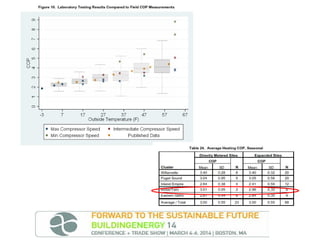
Ecotype reports
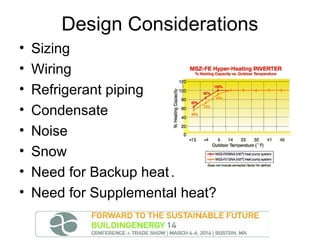
Design Considerations
•
•
•
•
•
•
•
•

Sizing
Wiring
Refrigerant piping
Condensate
Noise
Snow
Need for Backup heat?
Need for Supplemental heat?
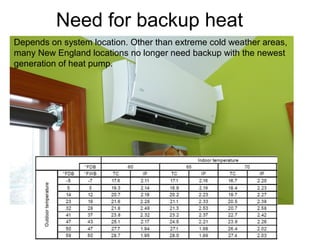
Need for backup heat
Depends on system location. Other than extreme cold weather areas,
many New England locations no longer need backup with the newest
generation of heat pump.
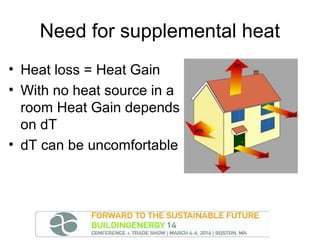
Need for supplemental heat
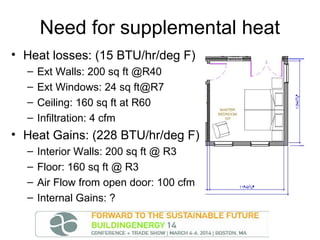
• Heat loss = Heat Gain
• With no heat source in a
room Heat Gain depends
on dT
• dT can be uncomfortable
Need for supplemental heat
• Heat losses: (15 BTU/hr/deg F)
–
–
–
–

Ext Walls: 200 sq ft @R40
Ext Windows: 24 sq ft@R7
Ceiling: 160 sq ft at R60
Infiltration: 4 cfm

• Heat Gains: (228 BTU/hr/deg F)
–
–
–
–

Interior Walls: 200 sq ft @ R3
Floor: 160 sq ft @ R3
Air Flow from open door: 100 cfm
Internal Gains: ?
Rule of Thumb, from Marc Rosenbaum:

“My guideline is that if people will tolerate 4°F lower than the heated space
(which in my mind means 72°F heated space, 68°F bedroom) and they
leave the doors mostly open, then a point-source heater is viable when the
heat loss is 1,000 BTU/hour and the room is occupied; 1,500 BTU/hr is
kind of my soft cut-off for considering it. Beyond that, I’ll provide some
electric resistance backup in those rooms.”
(www.greenbuildingadvisor.com)

Our rule:
“Better to have it and not need it, than to need it and not have it. Electric
resistance backup heat is cheap, and even cheaper to rough in for”
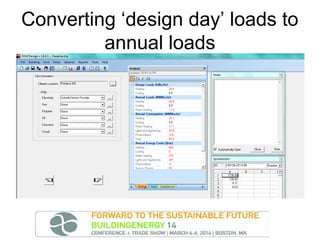
Converting ‘design day’ loads to
annual loads
Converting ‘design day’ loads to
annual loads
If not in your modeling software, you can estimate
it from ‘Design’ load:
Annual load (BTU) = ‘Design Load’* 24 * Cd * HDD /
(Design Load dT)
Where:
– ‘Design load’ (BTU/hr)
–‘Cd’ = building envelope factor (0.85)
– HDD = Heating Degree Days (deg F day) (7,770 for southern Maine)
– Design load dT = Temperature difference used in Manual J calcs (deg F)
Discussion/Questions
Contact us:

Fortunat Mueller
fortunat@revisionenergy.com
(207) 221-6342

Contact us:

Fortunat Mueller
fortunat@revisionenergy.com
(207) 221-6342

Professional design, installation and service of renewable energy systems.

Building Energy 2014: PV and Heat Pumps by Fortunat Mueller

  • 1.
    Building Energy 2014 PVand Heat Pumps: Net Zero Heating Solutions Fortunat Mueller PE Co Owner ReVision Energy March, 2014 Professional design, installation and service of renewable energy systems.
  • 2.
    Heat Pumps andNet Zero • Intro •Why Heat Pumps for Net Zero •PV Basics •Heat Pump Basics •Mini Split details •Design Processes •Working Example
  • 3.
    Who is ReVisionEnergy? • Northern New England’s most experienced renewable energy • installer—more than 2,500 solar hot water & solar electric systems in Maine & NH. Expertly designed systems installed by our certified professional solar team. Master trade licenses and NABCEP certification carried in-house, supporting our full service mechanical contractor approach.
  • 4.
    Locations : •Liberty, ME,Portland, ME , Exeter, NH •Serving all of Maine and New Hampshire and SEVT and Northern MA Professional design, installation and service of renewable energy systems.
  • 5.
    Technical Competence • • • • • • • • Master Electrician’sLicense Master Plumber’s License NABCEP Certification (Thermal & PV) Maine State Solar Installer Certifications EPA Refrigerant License 2,500+ Systems Installed to Date Engineering in-house (P.E.) Depth of Experience
  • 6.
    Define Net ZeroBuilding A zero-energy building, also known as a zero net energy (ZNE) building, net-zero energy building (NZEB), or net zero building, is a building with zero net energy consumption, meaning the total amount of energy used by the building on an annual basis is roughly equal to the amount of renewable energy created on the site.
  • 7.
    How do youget there? • NG plus HUGE PV to offset all source energy • Biomass + PV (wood or pellets) • Large Solar Thermal + PV • Resistive Electric + PV • Heat Pump + PV
  • 8.
  • 9.
    SHW + PV+ Resistive Electric
  • 10.
    Heat pump asLever for PV
  • 11.
    PV + HeatPumps
  • 12.
    Mini Splits areall the rage… • Low(er) Cost? – Gas by wire for those without access • • • • No Combustion Air conditioning as a benefit Good fit for supplemental heat Path to net zero with PV
  • 13.
    Why Heat Pumps •Part of a strategy to get off oil and lower heating costs – http://www.rmi.org/cms/Download.aspx?id=10410&file=2013-05_HeatPumps.pdf
  • 14.
    Heat Pumps andNet Zero • Allow you to heat/cool efficiently with electricity which is easily produced renewably on site • By taking advantage of net metering, you can easily ‘store’ the electricity generated in the summer to use for heat in the winter.
  • 15.
    Energy Security inReach • Consider a very well built new home with an annual heat demand of 40 Million BTU’s per year – 2,000 sf ; R40/R60 insulation; Triple Pane windows; HRV • • To provide 40 MMBTU with a Heat Pump at an average COP of 2.8 requires approximately 4,185 kw-hr of electricity. To generate that amount of electricity in Maine requires about a 3.3 kW GTPV system. – ~200 sf of modules – ~$7,000 Net cost (after incentives) For that cost you are buying all the ‘fuel’ you’ll ever need to keep your house warm for life! That is pretty awesome.
  • 16.
    In one hourenough solar energy strikes the earth’s surface to supply all energy demand for one year. Net Zero home in Lancaster NH.
  • 17.
    • Putney SchoolField House in VT • Good building practice, GTPV and Air Source Heat pump combine to make a net zero building
  • 18.
    Solar Electric Basics ProctorAcademy, Andover, NH
  • 19.
    PV System Components Photovoltaicmodules convert sunlight into Direct Current (DC) electricity, which flows through cable to the inverter. Inverters accept the DC electricity produced by PV modules and convert it into Alternating Current (AC), which then feeds demand in the building or if there excess, feeds the utility grid.
  • 21.
  • 22.
  • 23.
  • 24.
    Basic Solar Facts •1000-1300 kwhr/kw in New England • 50-70 sf of modules per kW
  • 25.
    Heat Pumps Basics • Aheat pump is a machine or device that moves heat from one location (the 'source') at a lower temperature to another location (the 'sink' or 'heat sink') at a higher temperature using mechanical work or a high-temperature heat source
  • 26.
  • 27.
    Temperature vs Heat •Temperatureis a number. That number is related to energy, but it is not energy itself. •Temperature is a number that is related to the average kinetic energy of the molecules of a substance. •Temperature is a measure of the average kinetic energy of the molecules of a substance. An increase in temperature results in an increase in the kinetic energy of the molecules and an increase in thermal energy. It is fair to say that temperature and thermal energy vary directly, but they are not the same thing. •Heat, on the other hand, is actual energy measured in Joules or BTUs or other energy units. Heat is a measurement of some of the energy in a substance. When you add heat to a substance, you are adding energy to the substance. This added heat (energy) is usually expressed as an increase in the kinetic energies of the molecules of the substance.
  • 28.
    Sensible vs LatentHeat •Sensible heat When an object is heated, its temperature rises as heat is added. The increase in heat is called sensible heat. Similarly, when heat is removed from an object and its temperature falls, the heat removed is also called sensible heat. Heat that causes a change in temperature in an object is called sensible heat. •Latent heat All pure substances in nature are able to change their state. Solids can become liquids (ice to water) and liquids can become gases (water to vapor) but changes such as these require the addition or removal of heat. The heat that causes these changes is called latent heat. Latent heat however, does not affect the temperature of a substance - for example, water remains at 100°C while boiling. The heat added to keep the water boiling is latent heat. Heat that causes a change of state with no change in temperature is called latent heat.
  • 29.
    Sensible and Latentheating of water from ice to steam Adding Heat
  • 30.
    2nd Law ofThermodynamics • Says basically that physical systems tend towards equilibrium in terms of pressure, temp, chemical reactions. • Clausius statement : No process is possible whose sole result is the transfer of heat from a body of lower temperature to a body of higher temperature. Commonly: “Heat flows from Hot to Cold”
  • 31.
    Except when itdoesn’t • Spontaneously, heat cannot flow from cold regions to hot regions without external work being performed on the system, which is evident from ordinary experience of refrigeration, for example. In a refrigerator, heat flows from cold to hot, but only when forced by an external agent, a compressor. •This is accomplished by the use of a Refrigeration cycle
  • 32.
    Refrigeration cycle Takes advantageof the face that boiling point changes with pressure…and remember that phase change requires/stores lots of energy (latent heat). The Steps of a Refrigeration cycle: (1-2) we boil a refrigerant at low pressure (and so at low temperature too). (2-3) we run it through a compressor to increase the pressure (3-4) then we condense the refrigerant at high pressure (recapturing the latent heat, but at a higher temperature) (4-1) we drop the pressure through an expansion valve and start again
  • 33.
  • 34.
    Cold Climate AirSource Heat Pumps • Multi Stage • Made by: Inverter Compressor (ductless mini split) – Hallowell (Acadia) • Made by: – Nyle – Mitsubishi – Carrier – Daikin – LG – Fujitsu
  • 35.
    Air to WaterHeat pump
  • 36.
    Ductless Mini Splits •Driving high efficiency and low temperature performance with: – Inverter Driven Variable speed compressor – Scroll Compressors – High efficiency ECM motors – R410 A refrigerant • Single or Multi Split options • Various terminal unit options More than 50% of the air conditioning and heat pump market worldwide is mini splits. In North America is it 2%… …but growing
  • 37.
    Single vs multisplit • Single Split • Multi Split
  • 38.
    Applications • Supplemental Heat •Whole house supplemental heat • Bonus Room heating and cooling • Central Heat Replacement • In new construction • Open concept • What about backup?
  • 39.
    Heat Pump Performance:COP • The coefficient of performance or COP of a heat pump is the ratio of the heat supplied divided by the supplied electrical energy. • • • By definition, a resistive electric heater has a COP = 1 Higher COP results in lower electric usage for the same amount of heat generated COP depends on temperature of both source and sink
  • 40.
    Mini Split Performance •Low temperature Operation – Heat pump keeps operating down to – 13 deg F including 100% of rated power down to 5 deg F • COP: = 4.1 @ 47 deg F = 2.8 @ 17 deg F =1.7 at -13 deg F …and you get a super efficient air conditioner too
  • 41.
    Mini Split Operatingcost comparison
  • 42.
  • 43.
    Heat Pump Performance: HSPF:Heating Seasonal Performance Factor. (BTU/whr) Effectively an attempt to annualize COP. (HSPF * 0.293 = annual average COP) Must be =/> 8 for Energy Star (tax credit) Must be =/> 10.0 for EM HESP incentive EER: Energy Efficiency Ratio (BTU/whr) Cooling performance at one operating point (95 deg, 80 deg 50% RH) SEER: Seasonal Energy Efficiency Ratio (BTU/whr) An attempt to annualize EER. All new AC > 13 Energy Star > 14 Typical mini split: 20-26
  • 44.
  • 46.
  • 49.
    Need for backupheat Depends on system location. Other than extreme cold weather areas, many New England locations no longer need backup with the newest generation of heat pump.
  • 50.
    Need for supplementalheat • Heat loss = Heat Gain • With no heat source in a room Heat Gain depends on dT • dT can be uncomfortable
  • 51.
    Need for supplementalheat • Heat losses: (15 BTU/hr/deg F) – – – – Ext Walls: 200 sq ft @R40 Ext Windows: 24 sq ft@R7 Ceiling: 160 sq ft at R60 Infiltration: 4 cfm • Heat Gains: (228 BTU/hr/deg F) – – – – Interior Walls: 200 sq ft @ R3 Floor: 160 sq ft @ R3 Air Flow from open door: 100 cfm Internal Gains: ?
  • 52.
    Rule of Thumb,from Marc Rosenbaum: “My guideline is that if people will tolerate 4°F lower than the heated space (which in my mind means 72°F heated space, 68°F bedroom) and they leave the doors mostly open, then a point-source heater is viable when the heat loss is 1,000 BTU/hour and the room is occupied; 1,500 BTU/hr is kind of my soft cut-off for considering it. Beyond that, I’ll provide some electric resistance backup in those rooms.” (www.greenbuildingadvisor.com) Our rule: “Better to have it and not need it, than to need it and not have it. Electric resistance backup heat is cheap, and even cheaper to rough in for”
  • 53.
    Converting ‘design day’loads to annual loads
  • 54.
    Converting ‘design day’loads to annual loads If not in your modeling software, you can estimate it from ‘Design’ load: Annual load (BTU) = ‘Design Load’* 24 * Cd * HDD / (Design Load dT) Where: – ‘Design load’ (BTU/hr) –‘Cd’ = building envelope factor (0.85) – HDD = Heating Degree Days (deg F day) (7,770 for southern Maine) – Design load dT = Temperature difference used in Manual J calcs (deg F)
  • 57.
    Discussion/Questions Contact us: Fortunat Mueller fortunat@revisionenergy.com (207)221-6342 Contact us: Fortunat Mueller fortunat@revisionenergy.com (207) 221-6342 Professional design, installation and service of renewable energy systems.

Editor's Notes

  • #5 Started in Liberty back in 200x then expanded to portland in 2006. Now working on Portsmouth and Holden
  • #10 Evacuated tubes vs flat plates
  • #15 Particularly acute problem for New England for whom oil heat represents a $14Billion dollar annual economic drain
  • #16 That is all exciting and everybody loves saving money but the reason I certainly wouldn’t be here talking about heat pumps if it were just a cheap way to heat a house. What makes us excited about mini splits is that it creates a viable path to carbon neutral or net zero homes, even for those folks not excited about burning wood. You can make electricity off the roof. You can’t make propane off the roof. Credit Keith, Kaplan Thompson, Alan Gibson. This is a carrier heat pump.
  • #17 Also possible as a partial solution in retrofit
  • #19 Works in Commercial too Existing ground source heat pump run at COP of 2.7 and their air source are averaging 2.9 A similar project is happening right here in Maine at the Coastal Maine Botanical Gardens (Scott simons and Fore solutions)
  • #27 Time Check: 1 hour gone. Refrigerator is really a type of Heat pump. If you took the door off your refrigerator and pushed it into the entry way of your house, it would be a really crappy heat pump. Notably most heat pumps are ‘reversible’ so the Evaporator becomes the Condensor and vice versa, turning a heating appliance into a cooling appliance and vice versa
  • #28 My favorite topic… But seriously I think it is worth talking about this briefly because though you could just say heat pumps are magic…it seems better to actually understand how they work.
  • #29 This is an important distinction. Temp is description of a state. Heat is Energy.
  • #30 This is important because the refrigeration cycle which heat pumps depend on take advantage of both of these types of heat energy.
  • #31 Latent heat amounts are generally large It take 1 BTU to heat 1 lb of water 1 degree, but it take 970 BTU to boil 1 lb of water without changing its temperature.
  • #32 German scientist Rudolf Clausius is credited with the first formulation of the second law, now known as the Clausius statement:[4] High pressure on one side of a door and low pressure on the other…tend to equilize.
  • #33 Note that Clausius doesn’t say :” No process is possible whose result is the transfer of heat from a body of lower temperature to a body of higher temperature” He says: No process is possible whose sole result is the transfer of heat from a body of lower temperature to a body of higher temperature If hot always went from hot to cold, then how would I keep my ice cream cold as the room heat would constantly be warming the freezer
  • #34 I promise this is the last thermo slide…it’s also the toughest one to follow so will definitely be on the test First of all understand the boiler point changes with pressure (i.e. water boils quicker at altitude) Then step through the process. 1-2-3-4
  • #35 Boiler/tower water source heat pump Ground source heat pump Packaged through the wall (hotel style) Split systems (conventional ducted and ductless)
  • #36 These are the two main types you’ll see. We hear a lot about the Nyle and Acadia because they come from Maine. They also got a lot of press (most recently some bad press). I’m going to focus primarily on the inverter ductless mini split because they are the ones driving the state of the art
  • #38 In one test at Mitsubishi, installing variable speed compressor s (and nothing else) in an existing system reduced energy consumption by up to 70% The other nice thing about ductless is that they are so much easier to install in renovations or well insulated spaces where duct leakeage is always an issue
  • #41 COP is really like efficiency. Unlike efficiency it can be >1. In fact it really should be otherwise what’s the point. Note that if you are talking about an honest COP it needs to include ALL the power used for the system (often pumps are ignored or defrost cycles are ignored) Air source heat pumps also use some of the refrigeration terms like HSPF and SEER and EER.
  • #42 Acadia was making news when they said they were in pure hp operation to 10 or 15 deg F (and then call on strip heat). Now we’re 20 degrees cooler… Cooling mode SEER 20.2 compared to a good window unit is about 10. (meaning half the elecrtrical cost for the same cooling) But which COP matters?
  • #43 Electric at 14 cents, Propane at 2.70 (which is probably too cheap) This is actually the CM, not the H2i. The flat propane curve is only correct to a first order
  • #44 Most of the heating hours occur between 20 and 50 degrees ambient temperature That is a bit deceptive because obviously the hours at low temp require more heat, but still. So how is the performance of these systems at these typical operating temperatures What about operating costs?
  • #45 Air source heat pumps also use some of the refrigeration terms like HSPF and SEER and EER. HSPF has inconsistent unints (BTU/whr
  • #55 Some software like REM design or PHPP gives this to you. Most HVAC sizing software does not.
  • #56 If I use the 24,000 BTU/hr load from the previous page I get 54 MM BTU/year with the simplified formula and the model says 49.8 MM BTU/year (pretty good rough estimate).
  • #57 45-60 minutes to go